TEL:+86 132 6656 7067




Pre-terminated and field-terminated fiber cabling are two common methods for installing optical infrastructure in data centers. Pre-terminated cabling is assembled and tested before it reaches the installation site, while field-terminated cabling is prepared, terminated, or spliced at the site.
The two approaches can use similar fiber types, connectors, patch panels, trunks, and distribution hardware. The major difference is where the cable termination process takes place and how much of the cabling system is completed before installation.
Pre-terminated systems are commonly used where rapid deployment, repeatable assembly, high-density connectivity, and controlled factory testing are important. Field termination can provide greater flexibility when cable routes are uncertain, lengths need to be adjusted on site, or the project requires customized termination during installation.
1. What Is Pre-Terminated Data Center Cabling?
Pre-terminated data center cabling consists of cable assemblies that are terminated, polished, tested, and usually labeled before shipment to the installation site.
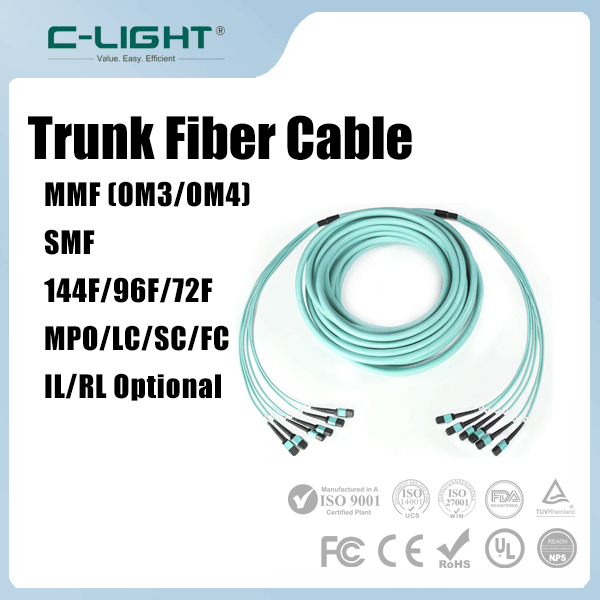
Typical products include MTP/MPO trunk cables, LC patch assemblies, harness cables, breakout assemblies, cassettes, and other modular fiber systems.
Because the connectors are already installed, the installation team generally focuses on routing the assemblies, securing the cables, connecting the modules, and verifying the completed links.
2. What Is Field-Terminated Data Center Cabling?
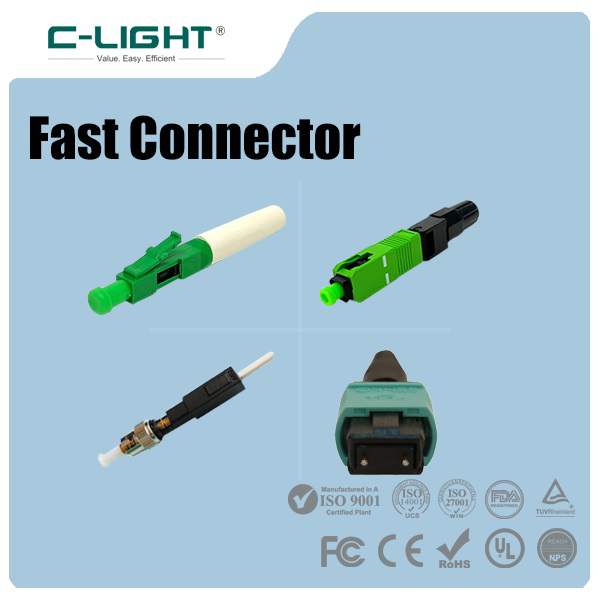
Field-terminated cabling is prepared and terminated at the data center site. Depending on the system, this can include field-installed connectors, fusion splicing, mechanical splicing, splice-on connectors, pigtails, or other termination methods.
The installer receives bulk fiber cable or partially prepared assemblies and completes the final termination according to the actual installed route.
This method provides greater flexibility when the final cable lengths or connection locations cannot be accurately determined before installation.
3. What Is the Main Difference Between Pre-Terminated and Field-Terminated Cabling?
| Feature | Pre-Terminated Cabling | Field-Terminated Cabling |
|---|---|---|
| Termination Location | Factory | Installation site |
| Installation Method | Plug-and-play assembly installation | Cutting, preparation, splicing, or connector installation on site |
| Deployment Speed | Generally faster | Generally slower |
| Length Flexibility | Requires accurate pre-engineering | High flexibility during installation |
| Factory Testing | Available before shipment | Final termination is tested after field installation |
| On-Site Labor | Lower | Higher |
| Specialized Equipment | Limited installation equipment required | May require fusion splicers and termination tools |
| Design Dependency | High during planning stage | More adaptable during installation |
4. How Is Pre-Terminated Fiber Cabling Installed?
A pre-terminated system is normally designed around a predetermined connection topology.
A typical installation sequence is:
System Design → Cable Measurement → Factory Assembly → Factory Testing → Shipment → Cable Routing → Connector Installation → Link Testing
The assemblies can then be routed through overhead trays, underfloor pathways, risers, cabinets, or other designated cable routes.
Because the optical connectors are already installed and tested, the installation process can reduce the amount of fiber preparation required at the project site.
5. How Is Field-Terminated Fiber Cabling Installed?
Field termination is completed after the cable has been routed through the actual data center environment.
A typical sequence is:
System Design → Bulk Cable Delivery → Cable Routing → Fiber Preparation → Splicing / Connector Installation → Testing → Labeling and Documentation
Depending on the termination method, the installer may need to strip cable jackets, expose individual fibers, organize fiber groups, perform fusion splicing, install connectors, protect splice points, and complete optical testing.
The final process depends on the cable construction and termination technology used in the project.
6. Which Method Provides Faster Deployment?
Pre-terminated cabling generally allows faster installation because much of the termination and testing work is completed before the cable reaches the data center.
This can be particularly useful for large projects where hundreds or thousands of fiber connections must be installed within a limited construction schedule.
Corning describes pre-terminated data center systems as plug-and-play solutions that can reduce on-site splicing and installation labor. Its case studies also document significant reductions in deployment time for large high-fiber-count installations.
Field termination usually requires additional preparation and testing at the site, so installation time can increase as the fiber count grows.
7. Which Method Provides More Length Flexibility?
Field termination provides greater flexibility when exact cable lengths are difficult to predict.
Because termination takes place after the cable has been installed, the installer can accommodate unexpected pathway changes, rack movement, building dimensions, or other site conditions.
Pre-terminated systems require accurate cable-length planning before manufacturing. A cable that is too short may require replacement, while an excessively long assembly can create additional slack-management requirements.
Accurate site surveys and route measurements are therefore particularly important for large pre-terminated projects.
8. How Does Factory Testing Differ from Field Testing?
Pre-terminated assemblies can be tested in a controlled manufacturing environment before shipment. Depending on the product and test program, this can include continuity verification, polarity verification, insertion-loss testing, and other optical performance checks.
Field-terminated systems require final testing after the cable has been installed and terminated. Field testing validates the completed channel and can identify problems introduced during installation.
| Testing Stage | Pre-Terminated | Field-Terminated |
|---|---|---|
| Factory Test | Completed before shipment | Normally not the final termination test |
| Installation Test | Used to verify the installed link | Required after field termination |
| Polarity Verification | Can be completed during assembly | Must be verified after installation |
| Connector Quality Control | Controlled manufacturing environment | Depends on field termination process |
9. How Do the Two Methods Affect Installation Labor?
Pre-terminated cabling can reduce the amount of specialized fiber termination work required at the project site. Installation teams can focus on cable routing, hardware mounting, connection, and verification.
Field termination requires trained personnel to perform fiber preparation, splicing, connector installation, inspection, and testing. The labor requirement becomes more significant as the number of fibers increases.
Corning notes that pre-terminated solutions can reduce dependence on specialized field-splicing labor, while field-installable solutions remain useful where splicing resources are available or pre-engineering is impractical.
10. How Do Pre-Terminated and Field-Terminated Cabling Compare in Optical Performance?
Optical performance depends on the complete cabling system and termination quality, not simply on whether the cable was terminated at the factory or in the field.
Factory termination provides a controlled environment for connector assembly, polishing, inspection, and testing. This can reduce variability in the termination process.
Field termination can also provide excellent optical performance when the installation team follows the required procedures and uses appropriate equipment. However, the final performance depends more directly on field workmanship and site conditions.
For high-speed networks with limited optical loss budgets, the actual insertion-loss and return-loss specifications of the installed channel should be measured and documented.
11. How Do They Differ in Connector Types?
Both approaches can support many of the connector technologies used in data center fiber infrastructure.
| Connector / Assembly | Pre-Terminated | Field-Terminated |
|---|---|---|
| MTP / MPO Trunk | Common | Possible with field-termination or splice methods |
| LC Patch Assembly | Common | Possible |
| MTP / MPO Harness | Common | Possible through suitable termination methods |
| Splice-On Connector | Possible as a factory assembly | Common field option |
| Pigtail + Splice | Possible as a preassembled solution | Common field installation method |
The selection should be based on the complete channel architecture, including fiber count, polarity, connector density, optical budget, and equipment interfaces.
12. Which Method Is Better for High-Density Cabling?
Pre-terminated systems are widely used for high-density data center cabling because multi-fiber trunks can be assembled, tested, and shipped as complete units.
High-fiber-count trunk assemblies can simplify backbone deployment by reducing the number of separate cable pulls and field terminations.
Corning's data center cabling guidance describes pre-terminated multi-fiber trunks as a way to increase fiber density in pathways and reduce deployment work, while very high-fiber-count field-terminated systems can require additional fiber preparation and termination steps.
Field termination remains useful when the required fiber count or route is difficult to predict in advance.
13. How Do They Compare in Polarity Management?
Polarity management is important for both systems, particularly in parallel optical networks using multi-fiber connectors.
With pre-terminated systems, polarity is normally defined during engineering and built into the cable assemblies, cassettes, harnesses, and connector configurations.
With field-terminated systems, polarity is established during installation and must be verified after termination.
For MTP/MPO systems, the polarity method, connector orientation, fiber position, and transmit/receive mapping should be documented before installation.
14. How Do They Compare in Project Cost?
Project cost depends on more than the initial cable price.
Pre-terminated systems can have higher component costs because cables are manufactured to a specified length and configuration. However, the reduced on-site labor, faster installation, factory testing, and lower field equipment requirements can influence the overall project cost.
Field-terminated systems can provide material flexibility and may reduce the risk of ordering incorrectly sized connectorized assemblies before construction. At the same time, labor, splicing equipment, termination tools, testing, and installation time add to project costs.
| Cost Factor | Pre-Terminated | Field-Terminated |
|---|---|---|
| Material Cost | Can be higher | Can be lower or more flexible |
| Field Labor | Generally lower | Generally higher |
| Termination Equipment | Limited site requirement | May require specialized tools |
| Installation Time | Generally shorter | Generally longer |
| Rework Risk | Length planning is important | More adaptable on site |
The appropriate comparison is therefore total installed cost rather than cable purchase price alone.
15. Which Method Is Easier to Modify?
Field-terminated cabling provides more flexibility when modifications are required during the initial construction process. Cable lengths can be adjusted and additional terminations can be completed as the physical layout becomes known.
Pre-terminated systems are highly modular once installed, but major physical changes may require new assemblies when the existing connectorized cable cannot accommodate the new route or length.
Modular pre-terminated architectures can still simplify moves, adds, and changes through patch panels, cassettes, and standardized patch cords.
16. Which Is More Suitable for Large Data Center Projects?
Large data center projects often benefit from pre-terminated solutions when the physical design has been accurately engineered before construction.
Large fiber trunks can be manufactured in advance, tested under controlled conditions, delivered to the site, and rapidly installed. This can be particularly useful when construction schedules are tight or the project requires very large numbers of optical connections.
Field termination can be appropriate for complex retrofit projects, unpredictable cable routes, phased installations, or locations where the required termination configuration cannot be finalized during the design stage.
17. How Do They Work with MTP Structured Cabling?
MTP structured cabling is commonly implemented using pre-terminated trunk cables, patch cords, harnesses, and cassettes.
A typical pre-terminated architecture is:
Switch → MTP Patch Cord → MTP Cassette → MTP Trunk → MTP Cassette → LC or MTP Patch Cord → Equipment
The multi-fiber assemblies can be factory configured for the required fiber count and polarity, reducing the amount of field termination required.
Field-terminated MTP systems are also possible, including architectures based on splice-on connectors or pigtail assemblies, but they require additional installation procedures and testing.
18. How Do They Work in AI Data Centers?
AI data centers can require very large numbers of high-speed optical connections between GPU servers, switches, storage systems, and network fabrics.
Pre-terminated high-density fiber systems can help organize large numbers of connections while reducing the amount of fiber preparation performed around the equipment racks.
At the same time, AI infrastructure can contain areas where equipment layouts or cable routes change during construction. Field-terminated solutions can provide flexibility in those areas.
A practical AI data center can therefore use pre-terminated high-density backbone cabling together with field-installable or direct-attached connections where the physical deployment requires greater flexibility.
19. How Should You Choose Between Pre-Terminated and Field-Terminated Cabling?
| Project Requirement | Suitable Approach |
|---|---|
| Fast data center deployment | Pre-terminated |
| Large number of repeated fiber links | Pre-terminated |
| High-density MTP trunk infrastructure | Pre-terminated |
| Accurate cable routes available before production | Pre-terminated |
| Uncertain cable lengths | Field-terminated |
| Retrofit or irregular installation | Field-terminated |
| Frequent site changes during construction | Field-terminated or hybrid |
| Limited field termination resources | Pre-terminated |
| Large planned deployment with standardized topology | Pre-terminated |
| Mixed installation conditions | Hybrid approach |
The final decision should consider cable route certainty, fiber count, installation schedule, labor availability, termination requirements, test procedures, project budget, rack density, and future network expansion.
20. Conclusion
Pre-terminated and field-terminated data center cabling provide different ways to build optical infrastructure.
Pre-terminated cabling moves much of the termination, assembly, and testing work into a controlled factory environment. It can reduce field labor, accelerate deployment, support high-density trunk systems, and provide consistent factory-tested assemblies. Accurate engineering and cable-length planning are important because the assemblies are manufactured before installation.
Field-terminated cabling moves the final termination process to the installation site. It provides greater flexibility when cable routes, lengths, or termination requirements are uncertain, making it useful for retrofit work, irregular layouts, and projects that need site-level customization.
Large data centers do not necessarily need to use only one method. A hybrid architecture can use pre-terminated MTP or other high-density trunks for backbone connectivity while using field termination in areas where route flexibility or customized connections are required.
21.Pre-Terminated vs Field-Terminated Data Center Cabling Q&A
Q1. What is pre-terminated data center cabling?
Q2. What is field-terminated data center cabling?
Q3. Which is faster to install?
Q4. Which provides more flexibility in cable length?
Q5. Is pre-terminated cabling more reliable?
Q6. Is field termination suitable for high-density data centers?
Q7. Is MTP cabling usually pre-terminated?
Q8. Can pre-terminated and field-terminated cabling be used together?
```
 >
>

 >
>
 >
>
 >
>
 >
>
 >
>
 >
>
 >
>