TEL:+86 132 6656 7067




1. Introduction to Passive WDM Technology
Wavelength Division Multiplexing (WDM) is a foundational technology in modern optical fiber communications, enabling multiple optical signals of different wavelengths to be transmitted simultaneously over a single optical fiber. This technique effectively multiplies the capacity of existing fiber infrastructure without requiring the costly and time-consuming deployment of new fiber cables. WDM systems can be broadly classified into two categories: active WDM and passive WDM.Passive WDM refers to WDM systems that consist exclusively of unpowered optical components — such as multiplexers, demultiplexers, filters, splitters, and optical add-drop multiplexers (OADMs) — and require no external electrical power, activeamplification, or dispersion compensation to operate.The system relies entirely on the optical budget of the transceivers used at the endpoints, meaning its transmission distance is fundamentally constrained by the transmit power and receiver sensitivity of the optical modules. In contrast, active WDM systems incorporate powered components such as EDFA optical amplifiers, dispersion compensation modules (DCM), and OTU wavelength converters, allowing for significantly longer transmission distances but at a higher capital and operational cost.
The core value proposition of passive WDM lies in its simplicity and cost-effectiveness. Since it contains no active components, passive WDM equipment has zero power consumption, requires virtually no maintenance, is immune to electronic failures, and offers a low total cost of ownership. It is transparent to any protocol and data rate, making it an exceptionally flexible solution for a wide range of optical networking scenarios. The global passive WDM market continues to expand rapidly, driven by surging bandwidth demands across telecommunications, data centers, and enterprise networks, with projected growth rates reflecting its central role in next-generation optical infrastructure.
2. Key Passive WDM Technologies: CWDM, DWDM, and FWDM
Passive WDM implementations are categorized primarily by channel spacing and wavelength density:
CWDM (Coarse Wavelength Division Multiplexing) utilizes wider channel spacing (typically 20 nm) and supports up to 18 channels in the 1270–1610 nm wavelength range. This relaxed spacing permits the use of uncooled lasers and lower-cost optical components, making CWDM the more economical choice for metro access networks, enterprise connectivity, and 5G fronthaul applications where moderate capacity and cost sensitivity are primary considerations.
DWDM (Dense Wavelength Division Multiplexing) employs much tighter channel spacing — typically 50 GHz or 100 GHz in the C-band — and can accommodate 40, 80, 96, or even more channels on a single fiber pair. This high channel density is essential for long-haul transport networks, high-capacity data center interconnects, and backbone applications where maximizing spectral efficiency is paramount. Passive DWDM systems (without amplifiers) are particularly well-suited for metropolitan area networks (MANs) and high-capacity, high-speed transmission lines where distances remain within the optical budget of DWDM transceivers.
FWDM (Filter Wavelength Division Multiplexer) is a specialized passive WDM component based on thin-film filter (TFF) technology. It is designed to multiplex or demultiplex specific wavelength combinations — most commonly the 1310/1490/1550 nm triplet used in FTTH PON systems — enabling simultaneous transmission of data, voice, and video services over a single fiber. With high channel isolation (>30 dB) and ultra-low insertion loss (<0.5 db="">
Additionally, OADM (Optical Add-Drop Multiplexer) modules allow selective extraction (drop) and insertion (add) of individual wavelength channels from a composite WDM signal while allowing the remaining wavelengths to pass through unaffected. This functionality is essential for building flexible ring-based and bus-based optical network topologies.
3. Primary Application Domains of Passive WDM
3.1 5G Fronthaul Networks
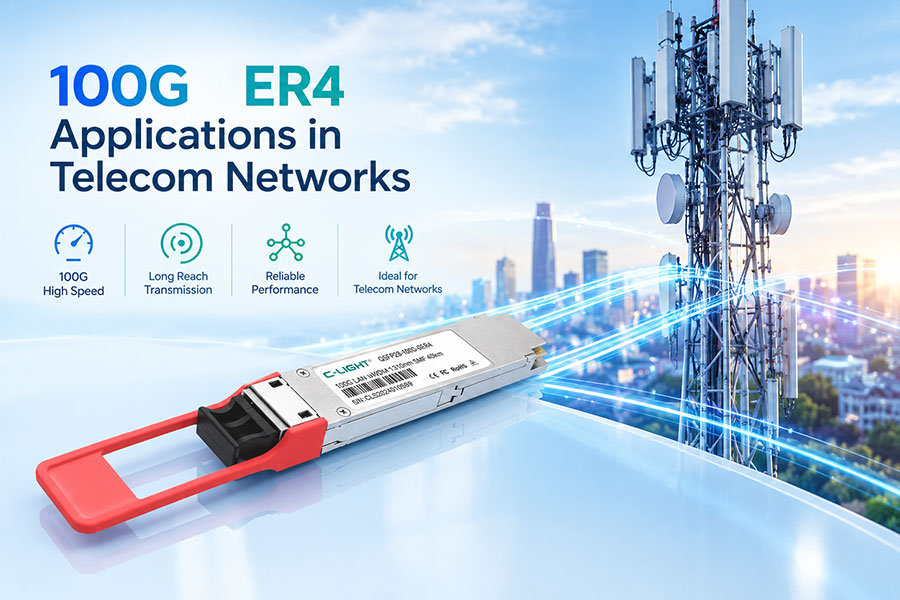
The most prominent and rapidly growing application for passive WDM today is 5G fronthaul — the fiber-based connection between Distributed Units (DUs) at the central office and Active Antenna Units (AAUs) at remote cell sites in a C-RAN (Centralized Radio Access Network) architecture.
With 5G deployments featuring massive MIMO antennas, significantly higher bandwidth requirements, and stringent low-latency demands, traditional point-to-point direct fiber connections quickly become impractical due to severe fiber resource scarcity and trenching constraints. Passive WDM addresses this challenge by allowing multiple AAUs (each assigned a unique wavelength) to share a single feeder fiber, dramatically reducing fiber consumption — from requiring as many as 12 or 24 dedicated fiber strands down to just 1 or 2 — while maintaining the high capacity and low latency required for 5G services.
The typical passive WDM 5G fronthaul configuration consists of a passive wavelength multiplexer at the AAU site, paired with colored optical modules (also known as "colored transceivers") at each AAU, and a corresponding multiplexer/demultiplexer at the DU side. This architecture supports two primary topological variants: dual-star topology for macro-cell 5G fronthaul deployments and bus topology for linear coverage scenarios such as highways, high-speed rail corridors, and tunnels.Common configurations include 6-to-1, 12-to-1, and 18-to-1 wavelength aggregation ratios using CWDM wavelengths.
Beyond pure passive WDM, semi-active WDM architectures represent a hybrid approach that combines a passive wavelength division multiplexer plus colored optical modules on the AAU side with active WDM equipment on the DU side, forming a unified and manageable fronthaul network with IP-based Web management and Netconf/Yang support for operator-level control. This hybrid model addresses the primary limitation of pure passive WDM — the lack of fault management and performance monitoring — while still preserving the cost and simplicity advantages of a passive remote plant.
3.2 FTTH and PON Access Networks
Passive WDM plays an integral role in Fiber-to-the-Home (FTTH) and Passive Optical Network (PON) architectures, where it enables the coexistence of multiple services over a shared optical distribution network (ODN). In typical GPON or EPON deployments, a single fiber carries bidirectional traffic using 1310 nm for upstream and 1490 nm for downstream data, while a 1550 nm wavelength may be overlaid for RF video broadcast (CATV) services — all multiplexed and demultiplexed using passive FWDM components.
Furthermore, WDM-PON (Wavelength Division Multiplexing Passive Optical Network) is emerging as a next-generation access technology capable of delivering dedicated, symmetric gigabit wavelengths to each subscriber. This architecture leverages athermal arrayed waveguide gratings (AAWGs) as passive wavelength routers in the field, providing a future-proof, protocol-agnostic platform for converged residential, business, and mobile backhaul services.
3.3 Data Center Interconnects (DCI)
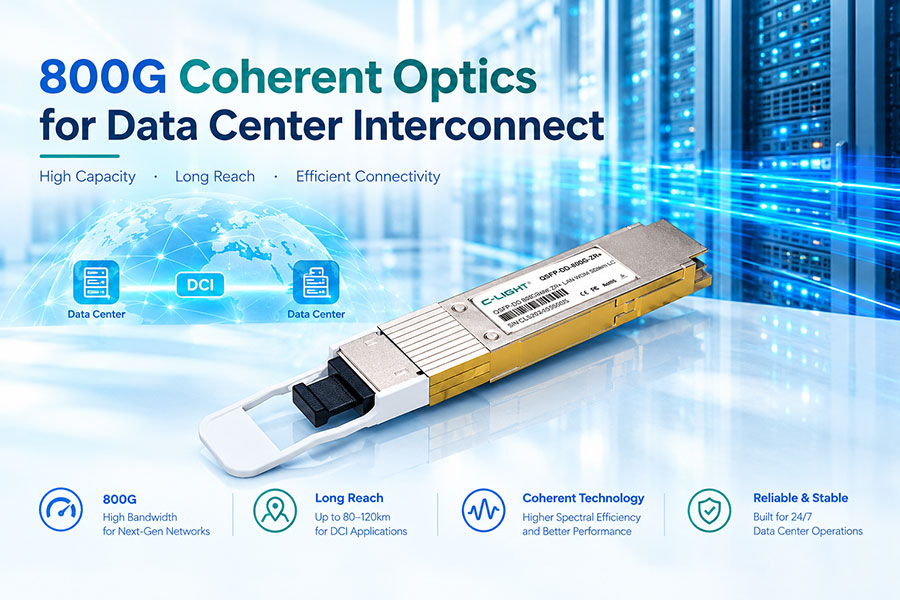
Within and between data centers, passive DWDM Mux/Demux modules are deployed to aggregate multiple high-speed channels — often 100G, 200G, or 400G — onto a single fiber pair for interconnection between facilities. Passive WDM is particularly attractive for DCI applications over metro distances (typically sub-80 km) where optical amplifiers are unnecessary and the simplicity of a passive solution reduces both equipment footprint and power consumption. The transparency of passive WDM to any protocol and data rate ensures compatibility with evolving data center networking standards without requiring forklift upgrades of the passive optical layer.
3.4 Metro and Regional Optical Networks
In metropolitan and regional network segments, passive CWDM and DWDM systems provide a scalable, cost-efficient method for aggregating traffic from multiple access nodes onto a shared transport infrastructure. Passive OADM modules are deployed along fiber rings to selectively add and drop wavelength channels at intermediate nodes, enabling flexible service provisioning without the expense and complexity of active ROADM platforms. This approach is widely adopted by cable MSOs, utilities, enterprises, and smaller service providers seeking to maximize the capacity of their existing fiber plant.
3.5 Industrial, Utility, and Specialized Applications
Passive WDM solutions extend well beyond traditional telecom and data center environments. They are deployed in oil and gas pipeline monitoring networks, electric power utility communications, mining operations, and transportation infrastructure (highways, railways, tunnels), where the combination of rugged, unpowered remote equipment and efficient fiber utilization is essential for reliable long-distance monitoring and control.
4. C-LIGHT Passive WDM Product Portfolio
C-LIGHT, a Shenzhen-based optical networking manufacturer with over 15 years of industry experience, offers a comprehensive portfolio of passive WDM products designed to address the full spectrum of applications discussed above. The company's passive WDM offerings span DWDM Mux/Demux modules, FWDM components, CWDM optical transceivers, and integrated 5G fronthaul solutions.
4.1 DWDM Mux/Demux Modules
C-LIGHT's DWDM MUX/DeMUX product line provides core capacity-expansion components for optical fiber networks, supporting the multiplexing of dozens to hundreds of optical signals with different wavelengths onto a single fiber.Available in channel configurations ranging from 4-channel to 64-channel variants, these modules support both dual-fiber and single-fiber operation with flexible C/L band coverage. Key technical features include support for flexible grid (Flex Grid) channel plans, high channel density (96+ wavelengths), and compatibility with 1U rack-mount, LGX, and ABS module packaging options. These modules are optimized for data center interconnects (DCI), 5G transport networks, and backbone infrastructure where ultra-high-speed terabit-level transmission is required.
The product range includes both MUX (multiplexer) and DeMUX (demultiplexer) variants, with part numbers such as CLDWMUX4CHD-XX through CLDWMUX64CHD-XX for dual-fiber configurations and corresponding single-fiber equivalents. All modules offer optional 1310 nm expansion ports for legacy service integration
4.2 FWDM (Filter WDM) Components
C-LIGHT's FWDM (Filter Wavelength Division Multiplexer) is a compact passive optical device based on thin-film filter (TFF) technology, engineered to multiplex and demultiplex specific wavelength combinations — most notably the 1310/1490/1550 nm wavelength triplet — over a single fiber. With channel isolation exceeding 30 dB and insertion loss below 0.5 dB, these components are ideally suited for FTTH PON systems, CATV overlay networks, and any application requiring low-crosstalk, high-stability multi-wavelength transmission. The product is available with flexible fiber diameter, length, and connector options (LC/SC/ST) to accommodate diverse deployment requirements
.
4.3 CWDM/DWDM Optical Transceivers
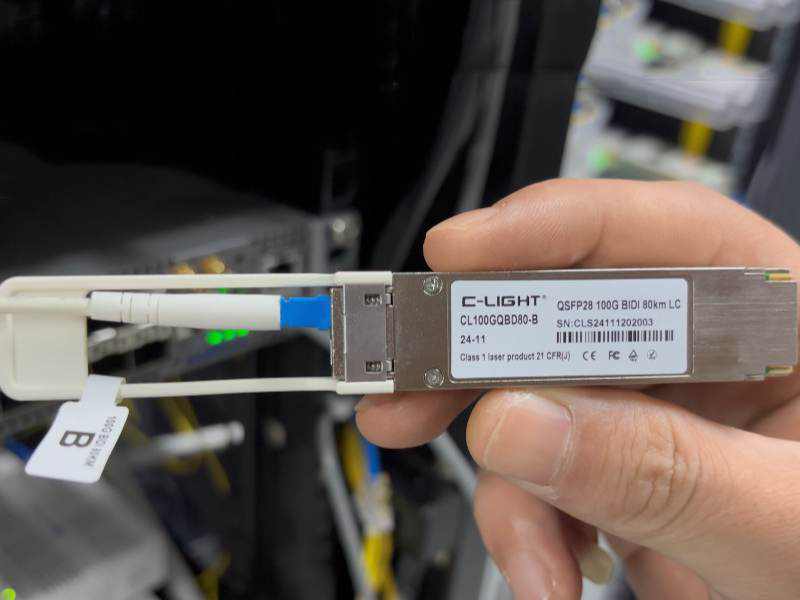
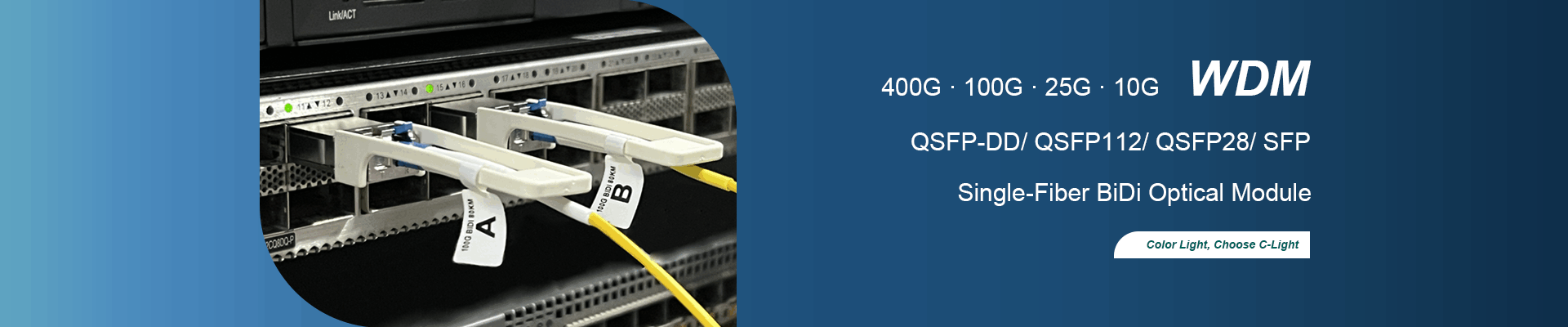
Complementing its passive component offerings, C-LIGHT provides an extensive portfolio of CWDM and DWDM optical transceiver modules spanning data rates from 1G to 400G. These modules are designed for seamless integration into passive WDM optical networks, supporting C-BAND 100G/50GHz DWDM wavelengths as well as standard CWDM wavelengths from 1270 nm to 1610 nm.Key product advantages include:
●Broad rate coverage: From 100Mbps up to 400Gbps, with 25G, 100G, and 400G variants in full production.
●Extended reach capabilities: The 25G DWDM SFP28 product line achieves up to 40 km transmission distance, exceeding the industry-standard 15 km benchmark.
●Protocol transparency: Supports multiple rate protocols including OTU, Ethernet, and Fibre Channel.
●Tunable and BiDi options: Single-fiber bidirectional (BiDi) products with tunable wavelengths and customized wavelength combinations are available.
●Global compatibility: After 15 years of interoperability verification with major switching equipment vendors worldwide, C-LIGHT modules offer strong compatibility assurance.
4.4 5G Fronthaul WDM Solutions
C-LIGHT's 5G Fronthaul WDM solution addresses the critical challenge of limited optical cable resources in 5G C-RAN deployments. The solution comprises a semi-active architecture where active WDM equipment at the DU side interoperates with a passive wavelength division multiplexer plus colored optical modules at the AAU side, forming a unified, manageable fronthaul network. Key specifications and features include:
CWDM 12-wave support: Operates across wavelengths including 1271/1291/1311/1331/1351/1371/1471/1491/1511/1531/1551/1571 nm.
Low insertion loss: ≤2.5 dB for 12-channel configurations.
High channel isolation: >25 dB adjacent channel isolation and >30 dB non-adjacent channel isolation.
Management capabilities: IP-based Web management and Netconf/Yang-based unified management for operator integration.
Standards compliance: Conforms to ITU-T G.694.2, Telcordia GR-1209-CORE, and GR-1221-CORE standards.
Protection options: Available in non-protected (C6, C12) and protected (OLP-C6, OLP-C12) configurations with latching optical switch protection.
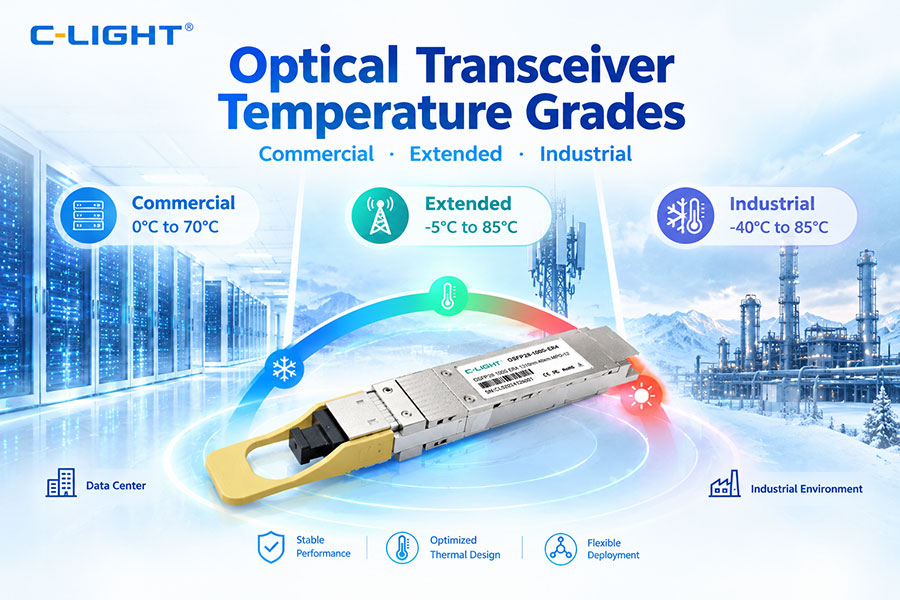
The remote passive WDM unit is available in 1U 3-slot chassis and pluggable card form factors, with an operating temperature range of -10 °C to +60 °C, suitable for outdoor cabinet and pole-mount deployments.
5. Conclusion and Future Outlook
Passive WDM technology continues to play an indispensable role in enabling cost-effective, power-efficient, and scalable optical network expansion across a diverse range of applications. From 5G fronthaul fiber relief to FTTH triple-play service delivery, from data center interconnects to industrial utility networks, passive WDM solutions deliver a compelling combination of simplicity, reliability, and low total cost of ownership.
C-LIGHT's comprehensive passive WDM portfolio — encompassing DWDM Mux/Demux modules, FWDM components, CWDM/DWDM transceivers, and integrated 5G fronthaul solutions — positions the company as a capable partner for operators and enterprises seeking to optimize their optical infrastructure. With continued industry trends toward higher data rates, more compact form factors, and greater wavelength density, passive WDM technology will remain a cornerstone of optical networking for the foreseeable future
 >
>

 >
>
 >
>
 >
>
 >
>
 >
>
 >
>
 >
>