TEL:+86 132 6656 7067




1. Introduction
As AI data centers move toward higher compute and network density, cooling has become a critical part of optical transceiver design. 800G and 1.6T modules can generate significant heat in a small physical space, creating new thermal challenges for switches and network systems. Liquid-cooled optical transceivers are being developed to work with advanced cooling architectures while maintaining high-speed optical performance.
2. Why Optical Modules Need Liquid Cooling
Optical transceivers contain lasers, drivers, receivers, DSPs, control circuits, and other components that generate heat. As bandwidth increases, thermal density also rises. In highly populated AI switches, the combined heat from many optical modules can become an important limitation for conventional airflow-based cooling.
3. 800G and 1.6T Thermal Challenges
The transition from 400G to 800G and 1.6T increases electrical lane speeds, optical integration, and processing requirements. Higher bandwidth does not automatically mean higher module power in every implementation, but it places greater pressure on power efficiency and thermal design.
4. What Is a Liquid-Cooled Optical Transceiver?
A liquid-cooled optical transceiver is a module designed to operate within a liquid-based thermal management system. Depending on the architecture, heat can be removed through a cold plate contacting the module, a liquid-cooled module housing, embedded microchannels, or direct immersion in a dielectric fluid.
5. Liquid Cooling vs Air Cooling
| Parameter | Air Cooling | Liquid Cooling |
|---|---|---|
| Cooling Medium | Air | Liquid coolant |
| Heat Transfer | Through airflow | Through liquid-based heat transfer |
| Thermal Density | More airflow dependent | Better suited to high thermal density |
| Fans | Important | Reduced dependence in suitable designs |
| Infrastructure | Fans and HVAC | Cold plates, pumps, manifolds, or tanks |
| Module Qualification | Conventional | Liquid compatibility may be required |
6. Liquid Cooling Is Not One Architecture
Liquid cooling can describe several different approaches. Direct-to-chip cooling, cold-plate cooling, module-integrated microchannels, and immersion cooling have different thermal paths, mechanical structures, maintenance requirements, and compatibility constraints.
7. Cold Plate Cooling
Cold plate cooling uses a thermally conductive plate connected to the liquid-cooling loop. The optical module transfers heat to the cold plate through a controlled mechanical interface. This approach can be designed around a pluggable switch architecture without requiring the entire module to be submerged.
8. Direct-to-Chip Cooling
Direct-to-chip cooling places the liquid-cooling interface close to high-power chips. In a network switch, this can include the switching ASIC and carefully designed optical cooling interfaces. It can reduce the thermal distance between the heat source and coolant.
9. Module-Integrated Cooling
Some liquid-cooled optical designs integrate cooling structures directly into the transceiver housing. Microchannels or dedicated thermal paths can move heat away from internal components more efficiently, but the design introduces additional mechanical and manufacturing requirements.
10. Immersion Cooling
Immersion cooling places equipment directly into a dielectric fluid. This differs from cold-plate cooling because the cooling medium surrounds the immersed equipment. Optical modules intended for immersion operation require specific material, connector, sealing, and reliability qualification.
11. Dielectric Fluids
Immersion systems require electrically non-conductive fluids. The fluid must also be compatible with the materials used in the optical module, including plastics, coatings, adhesives, seals, labels, PCB materials, and optical interfaces.
12. Optical Module Mechanical Design
Liquid-cooled optical modules require careful mechanical design because the thermal interface must coexist with the optical engine, electrical connector, cage, release mechanism, and host switch. The cooling structure should not compromise insertion, removal, or field service.
13. OSFP and Liquid Cooling
OSFP is an important form factor for 800G and 1.6T networking. Liquid-cooling systems can be designed around OSFP modules by providing a controlled thermal interface between the module and the host cooling structure.
14. OSFP-RHS for High-Density Systems
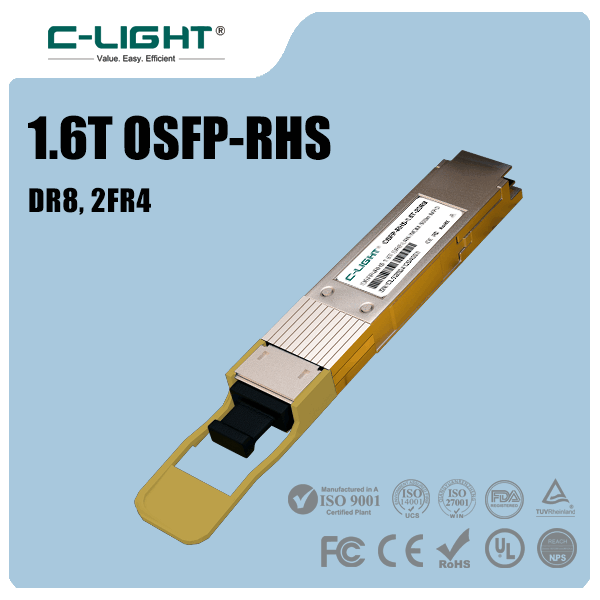
OSFP-RHS uses a reduced-height heat-sink structure intended for high-density system integration. C-LIGHT's 1.6T OSFP-RHS is designed for high thermal dissipation requirements and supports integration with cold plates or liquid-cooling systems.
15. 1.6T Optical Transceiver Cooling
1.6T optical modules place additional pressure on thermal management because of their high lane speeds and processing requirements. An optimized liquid-cooling interface can help remove heat while allowing the module to retain a compact high-density form factor.
16. Optical Engine Temperature
Temperature affects optical and electrical performance. Laser characteristics, receiver behavior, driver performance, and electronic processing can all change with temperature. Maintaining a stable operating temperature helps the module remain within its specified performance range.
17. Laser Thermal Management
Laser efficiency, optical output, wavelength behavior, and reliability are temperature-sensitive. The thermal path around the laser must therefore be considered when designing a liquid-cooled optical engine.
18. DSP Thermal Management
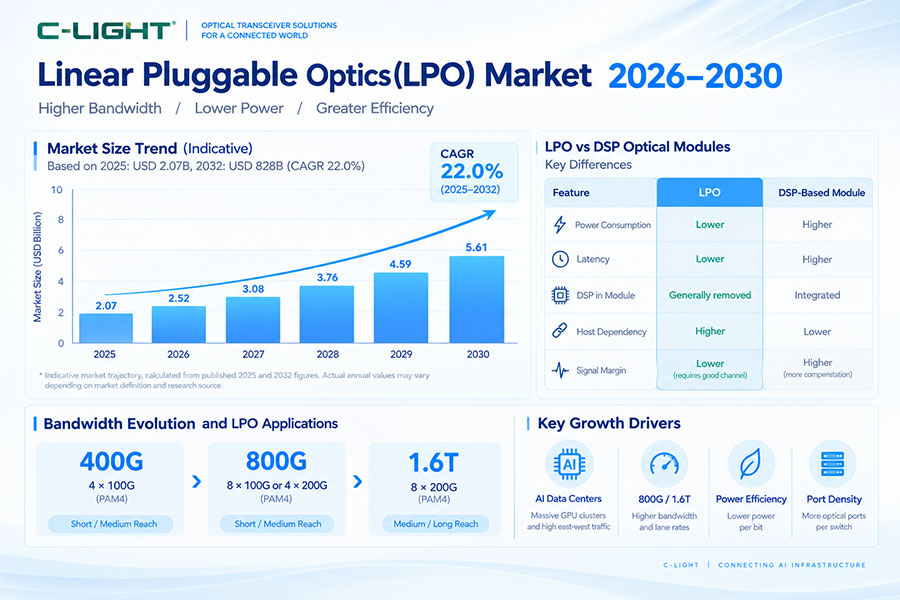
DSPs can be significant heat sources in retimed optical transceivers. As data rates increase, DSP efficiency and thermal transfer become important design factors. Lower-power architectures such as LPO can reduce some module-level processing load.
19. Driver and TIA Cooling
Optical drivers and transimpedance amplifiers also generate heat. Efficient thermal paths should consider all major heat sources rather than focusing on the DSP or laser alone.
20. Thermal Interface
A liquid-cooled optical module depends on an effective thermal interface between the heat-generating components and the cooling structure. Contact pressure, surface flatness, thermal materials, mechanical tolerances, and long-term stability all affect heat transfer.
21. Airflow Can Still Matter
Liquid cooling does not necessarily eliminate airflow throughout the entire system. Power supplies, control electronics, optical interfaces, and other components may still require air cooling. The final thermal architecture should therefore be evaluated at the system level.
22. Power Density
Thermal management becomes more difficult as more high-speed modules are installed in the same switch. For a densely populated platform, total optical-module power can become a substantial part of the system thermal load.
23. Port Density
Higher optical bandwidth per port allows greater network capacity within a limited switch footprint. However, higher port density concentrates heat in the same physical region. Liquid cooling provides an additional path for managing this thermal density.
24. AI Data Center Applications
AI data centers contain large numbers of GPUs, high-radix switches, high-speed NICs, and optical interconnects. Liquid-cooled optical modules are particularly relevant where compute and networking equipment must operate within a high-density thermal envelope.
25. GPU-to-Switch Connectivity
AI servers can use high-speed optical links between NICs and switches. When these connections operate at 800G or 1.6T, thermal considerations become part of the overall server and network design rather than an isolated transceiver issue.
26. Switch-to-Switch Connectivity
High-capacity leaf-spine fabrics can use large numbers of optical links between switching layers. Liquid cooling can help manage the thermal load when many high-power optical modules operate in the same chassis.
27. AI Scale-Out Networks
Scale-out networks connect large numbers of compute nodes through high-bandwidth switching fabrics. Optical transceivers must provide high throughput while fitting within the power and thermal limits of the switch platform.
28. 800G Liquid-Cooled Optical Modules
800G is an important deployment point for liquid-cooled optics because many AI and hyperscale switches are being designed around very high port density. Liquid cooling can provide an additional thermal-management option for platforms where air cooling approaches its practical limits.
29. 1.6T Liquid-Cooled Optical Modules
1.6T is expected to place even greater pressure on cooling and mechanical integration. Reduced-height optical modules and cold-plate interfaces are emerging as ways to integrate high-bandwidth optics into advanced liquid-cooled network systems.
30. Liquid Cooling and LPO
Liquid cooling and LPO address different engineering problems. Liquid cooling manages heat, while LPO changes the electrical and signal-processing architecture by reducing certain module-level DSP functions. The two technologies can be combined in a high-density optical system.
31. Liquid Cooling and Silicon Photonics
Silicon photonics is an optical integration technology, while liquid cooling is a thermal-management method. A silicon photonic module can therefore be designed for air cooling, cold-plate cooling, or another liquid-cooling architecture depending on the product design.
32. Liquid Cooling and CPO
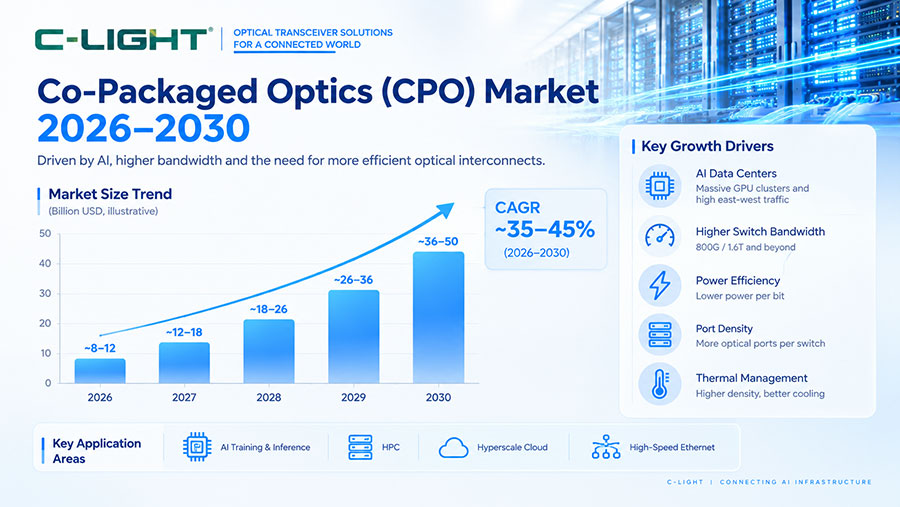
Co-Packaged Optics places optical engines closer to the switching ASIC. This reduces some electrical interconnect distance but creates new packaging and thermal challenges. Liquid cooling can be part of a CPO system-level thermal architecture.
33. Materials Compatibility
Materials used in optical modules must be evaluated carefully for liquid-cooled operation. Long-term exposure to coolant can affect adhesives, polymers, elastomers, coatings, labels, optical interfaces, and other materials if they are not properly qualified.
34. Connector Considerations
Optical connectors remain a critical reliability point. Liquid-cooled systems may require additional protection, sealing, or specialized interface designs depending on the cooling architecture. Connector cleanliness and optical alignment remain important in every case.
35. Fiber Cable Compatibility
Fiber cables connected to liquid-cooled equipment must be compatible with the mechanical and environmental conditions of the system. Bending, routing, connector access, fluid exposure, and long-term reliability should all be considered.
36. Reliability
Liquid cooling can provide a stable thermal environment, but it also introduces new qualification requirements. Reliability testing should evaluate thermal cycling, coolant exposure, mechanical interfaces, optical performance, electrical performance, and long-duration operation.
37. Maintenance and Serviceability
Air-cooled optical modules can normally be replaced through standard field procedures. Liquid-cooled systems require additional consideration for thermal interfaces, coolant connections, equipment removal, and service access. A good design must maintain the practical serviceability of pluggable optics.
38. Liquid Cooling Infrastructure
A liquid-cooled network system may include pumps, manifolds, cold plates, heat exchangers, control systems, and monitoring equipment. The optical transceiver is therefore only one part of the complete thermal architecture.
39. Energy Efficiency
The energy benefit of liquid cooling should be evaluated at system and facility level. Reducing fan power can be beneficial, but pumps, heat exchangers, and other liquid-cooling equipment also consume energy. The final efficiency depends on the entire cooling design.
40. Retrofitting Existing Data Centers
Retrofitting liquid cooling into an existing air-cooled data center can be challenging. Rack structure, switch cages, power distribution, cable management, thermal interfaces, and service procedures may all require modification.
41. New AI Data Center Design
New AI data centers can design computing, switching, networking, power, and cooling together from the beginning. This makes it easier to integrate liquid-cooled optical modules and other high-density thermal solutions into the overall architecture.
42. Selecting a Liquid-Cooled Optical Transceiver
Selection should begin with the host platform and cooling architecture. Key parameters include form factor, bandwidth, lane rate, optical reach, fiber type, connector, module power, thermal interface, operating temperature, coolant compatibility, management, coding, and interoperability.
43. Air Cooling or Liquid Cooling?
| Scenario | Potential Cooling Approach |
|---|---|
| Moderate optical-module power | Air cooling |
| High-density 800G switch | Air or liquid depending on thermal design |
| High-density 1.6T switch | Advanced liquid cooling may be considered |
| Liquid-cooled AI rack | Liquid-compatible optical architecture |
| Immersion data center | Immersion-qualified optics required |
44. Common Deployment Mistakes
Common mistakes include assuming every optical module is liquid compatible, confusing cold-plate cooling with immersion cooling, ignoring material compatibility, overlooking thermal-interface design, and selecting a module without checking the host switch's complete cooling architecture.
45. Troubleshooting Liquid-Cooled Optical Modules
When a liquid-cooled optical module shows abnormal temperature or optical performance, check coolant temperature, circulation, thermal-interface contact, module power, host airflow where applicable, optical power, temperature sensors, and module diagnostics. The cooling system and optical module should be analyzed together.
46. Frequently Asked Questions
Q1. What is a liquid-cooled optical transceiver?
Q2. Why are liquid-cooled optical modules important for AI data centers?
Q3. Can every 800G optical module use liquid cooling?
Q4. Is cold-plate cooling the same as immersion cooling?
Q5. Are 1.6T optical modules suitable for liquid cooling?
Q6. What is OSFP-RHS?
Q7. Does liquid cooling reduce optical module power consumption?
Q8. Can LPO and liquid cooling be used together?
Q9. What should be checked before using optics in an immersion system?
Q10. Is liquid cooling necessary for every AI optical network?
47. Summary
Liquid-cooled optical transceivers are becoming increasingly relevant as AI data centers adopt higher-bandwidth 800G and 1.6T networking. Unlike conventional air cooling, liquid-based architectures can remove heat through cold plates, integrated cooling structures, or immersion systems. The technology can help manage thermal density in high-port-count switches, but it also introduces new requirements for mechanical design, materials, connectors, cables, serviceability, and reliability. Optical technologies such as silicon photonics and architectures such as LPO or CPO can be combined with liquid cooling because they address different parts of the system. The most suitable solution depends on the complete optical module, switch, rack, and data center cooling architecture.
 >
>

 >
>
 >
>
 >
>
 >
>
 >
>
 >
>
 >
>