TEL:+86 132 6656 7067




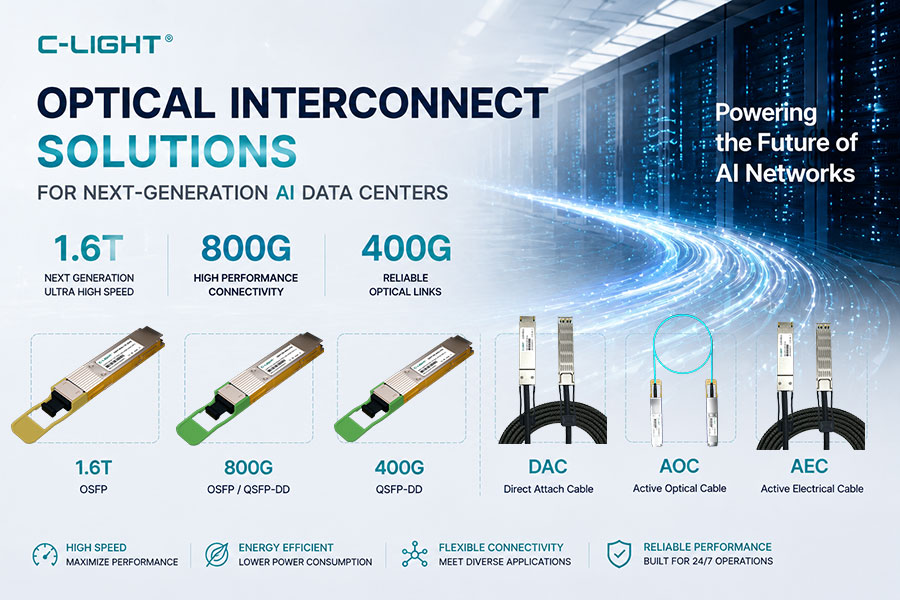
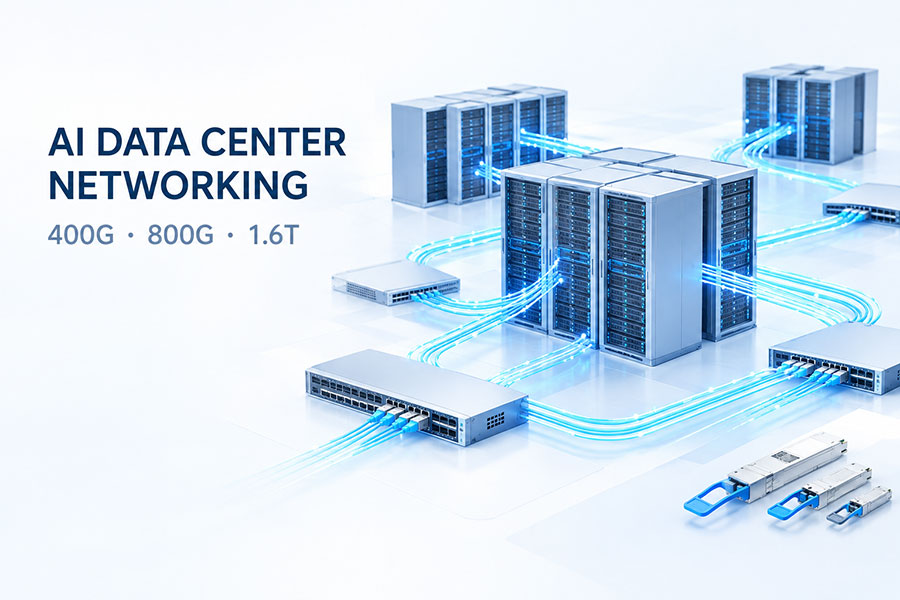
The rapid development of artificial intelligence is changing the architecture of modern data centers. Large language models, generative AI, high-performance computing, and distributed GPU clusters require massive amounts of data to move between computing nodes at extremely high speeds.
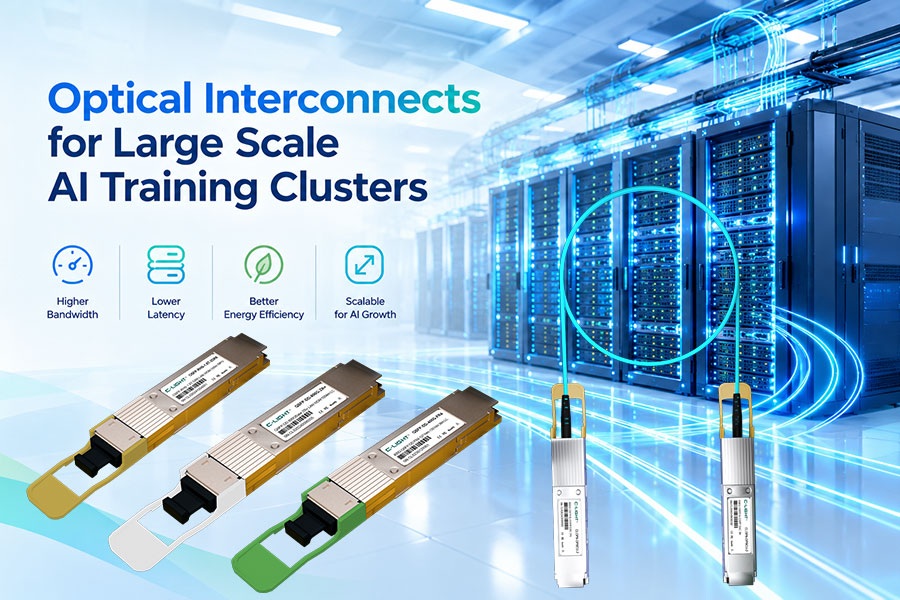
As computing performance continues increasing, network connectivity has become one of the most important factors determining overall AI system efficiency. Optical interconnect solutions provide the bandwidth, distance, signal integrity, and scalability required to connect GPUs, switches, storage systems, and data center infrastructure.
The transition from 400G to 800G and 1.6T optical connectivity is becoming a major step in the evolution of AI data center networks. At the same time, technologies such as PAM4, LPO, silicon photonics, CPO, DAC, AOC, and AEC are creating multiple approaches for solving different interconnect requirements.
1. Why Optical Interconnect Is Critical for AI Data Centers
1.1 AI Workloads Generate Massive East-West Traffic
Traditional enterprise applications often rely heavily on north-south traffic between users and servers. AI clusters are different. Thousands of GPUs may continuously exchange model parameters, gradients, activation data, and synchronization information during distributed training.
This creates extremely high east-west traffic between:
GPU servers
AI accelerators
High-speed switches
Storage systems
Spine and leaf networks
When network bandwidth cannot keep pace with computing performance, expensive GPU resources may spend more time waiting for data instead of processing workloads. Optical interconnect therefore becomes an essential part of AI infrastructure rather than simply a network accessory.
1.2 Electrical Interconnects Face Increasing Limitations
As electrical signaling speeds increase, insertion loss, crosstalk, jitter, channel attenuation, and power consumption become more difficult to manage.
Longer electrical paths between switch ASICs and optical interfaces can create significant signal integrity challenges. Optical transmission moves high-speed data over fiber with substantially lower loss over distance and strong immunity to electromagnetic interference.
2. Evolution of AI Data Center Optical Connectivity
2.1 From 100G to 400G
Earlier high-performance data centers commonly used 100G optical connectivity. As AI workloads expanded, 400G became an important technology for higher-density switch and server connectivity.
400G solutions generally use parallel optical architectures or higher-speed PAM4 lanes to achieve greater bandwidth.
2.2 From 400G to 800G
The increasing bandwidth requirements of large GPU clusters are accelerating the adoption of 800G optical transceivers.
800G solutions can provide higher switch port bandwidth while reducing the number of physical ports required for equivalent aggregate capacity.
Typical 800G technologies include:
800G SR8
800G DR8
800G 2xDR4 and other parallel optical architectures
2.3 Moving Toward 1.6T Optical Connectivity
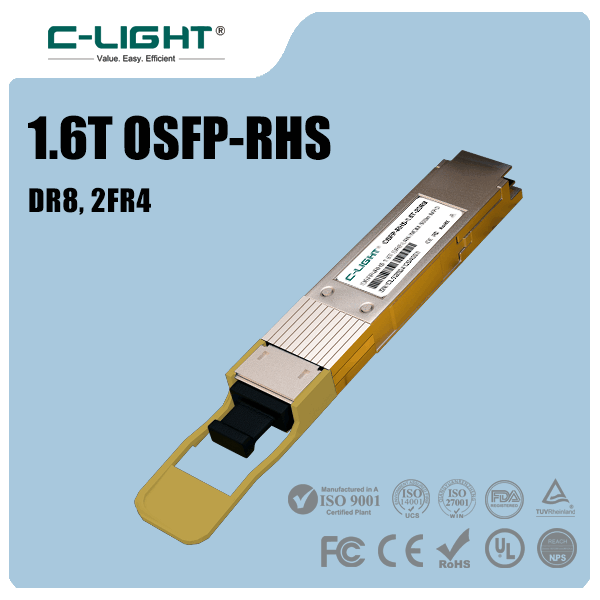
As next-generation switch ASICs and AI accelerators continue increasing their bandwidth capacity, 1.6T optical connectivity is becoming an important development direction.
The transition to 1.6T requires improvements in:
Electrical lane speed
Optical engine performance
Power efficiency
Thermal management
Signal integrity
3. Major Optical Interconnect Solutions for AI Data Centers
3.1 Optical Transceivers
Pluggable optical transceivers remain one of the most widely deployed interconnect solutions in AI data centers.
They provide flexible connections between switches, servers, and other network equipment while allowing individual modules to be replaced or upgraded.
Common high-speed solutions include:
400G optical transceivers
800G optical transceivers
3.2 DAC: Direct Attach Cable
DAC is designed primarily for very short-distance connections. It combines low cost and low latency and is often used inside racks or between nearby network devices.
DAC is suitable when distance is short and the system prioritizes cost efficiency.
3.3 AOC: Active Optical Cable
800G/400G/200G/100G/50G/40G/25G/10G AOC丨C-LIGHT
AOC integrates optical transceivers and fiber into a factory-terminated cable assembly. It provides an easy-to-deploy solution for short and medium-distance data center connections.
Compared with traditional discrete optical modules and fiber patch cords, AOC simplifies deployment and reduces the number of individual components that need to be installed.
3.4 AEC: Active Electrical Cable
800G AEC Active Electrical Cable | OSFP QSFP-DD Cable for AI Data Center丨C-LIGHT
AEC provides active signal conditioning for high-speed electrical connections. It is positioned between passive copper and fully optical solutions in terms of distance, cost, and signal performance.
AEC can be useful in AI server and switch environments where longer electrical reach is required without immediately moving to optical transmission.
4. Single-Mode and Multimode Optical Interconnect
4.1 Multimode Optical Solutions
Multimode fiber is commonly used for short-reach data center applications. VCSEL-based optical modules are widely associated with multimode transmission because of their relatively low cost and efficient short-distance operation.
Typical applications include:
400G SR8
800G SR8
Short-reach GPU cluster connections
4.2 Single-Mode Optical Solutions
Single-mode fiber supports longer transmission distances and greater scalability. It is increasingly important for large AI campuses, data center interconnects, and high-speed optical systems requiring longer reach.
Typical single-mode technologies include:
400G DR4
400G FR4
800G DR8
Future 1.6T optical solutions
5. PAM4 Technology in AI Optical Interconnects
5.1 Why PAM4 Is Important
PAM4 uses four signal levels to transmit two bits per symbol, improving the amount of information carried by each symbol compared with traditional NRZ signaling.
This approach has become an important technology for high-speed 400G, 800G, and future 1.6T optical systems.
5.2 PAM4 Design Challenges
The four-level signal structure creates smaller voltage differences between signal levels, making PAM4 more sensitive to noise, jitter, crosstalk, and signal distortion.
High-speed PAM4 systems therefore require advanced:
DSP processing
Equalization
Signal integrity testing
BER verification
TDECQ measurement
6. Power and Thermal Challenges in AI Optical Interconnects
6.1 Optical Module Power Consumption
Higher-speed optical modules require more sophisticated optical and electrical components. As the number of ports increases, the total power consumed by optical connectivity can become a significant part of data center energy consumption.
For example, a large AI cluster may contain thousands of high-speed optical modules. Even small improvements in power consumption per module can have a meaningful impact at the system level.
6.2 Thermal Management
AI infrastructure is already pushing rack power density to very high levels. Optical modules installed around high-power switch ASICs must operate reliably within demanding thermal environments.
Thermal management approaches include:
Improved heat dissipation structures
Higher-efficiency optical engines
Advanced chassis airflow
Liquid cooling system integration
7. LPO and the Development of Lower-Power Optical Connectivity
7.1 What Is LPO?
Linear Pluggable Optics, or LPO, reduces or removes some DSP functionality traditionally located inside optical modules. The host system and optical module therefore rely on a more direct electrical signal path.
Potential advantages include:
Lower power consumption
Lower latency
Reduced module complexity
7.2 LPO Design Considerations
LPO requires high-quality electrical channels and careful coordination between switch ASICs, connectors, PCB design, optical engines, and system-level equalization.
As a result, LPO is particularly relevant to AI networks where power efficiency has become a primary design objective.
8. CPO: A Fundamental Change in Optical Architecture
8.1 From Pluggable Optics to Co-Packaged Optics
Co-Packaged Optics integrates optical engines much closer to high-performance switching ASICs. This can dramatically shorten the electrical path between the ASIC and optical interface.
The architectural transition can be summarized as:
Traditional: ASIC → Electrical Channel → Pluggable Optical Module
Advanced: ASIC + Optical Engine → Fiber
8.2 CPO for Future AI Networks
CPO is attracting increasing attention for future high-bandwidth AI switching systems because it addresses challenges associated with electrical reach, power consumption, and bandwidth density.
However, pluggable optical modules remain important because they provide flexibility, field replacement, and established maintenance models. CPO is therefore more accurately viewed as part of the long-term evolution of optical architecture rather than an immediate replacement for every pluggable module.
9. Optical Interconnect Applications in AI Data Centers
9.1 GPU-to-Switch Connectivity
GPU servers communicate with high-speed Ethernet or InfiniBand switches through optical or high-speed electrical interconnects. This is one of the most important applications for 400G and 800G solutions.
9.2 Switch-to-Switch Connectivity
Leaf-spine and spine-super-spine architectures require high-capacity connections between switches. Optical transceivers provide the reach and bandwidth required for these links.
9.3 Data Center Interconnect
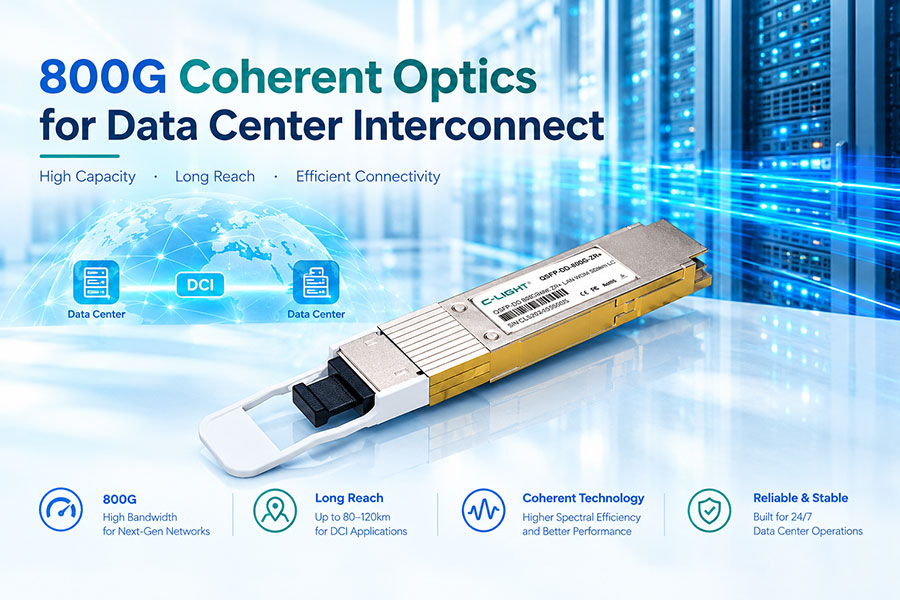
Large AI operators increasingly distribute computing resources across multiple data center buildings or locations. DCI solutions require higher transmission capacity and longer optical reach than intra-rack connections.
9.4 AI Storage Networks
AI workloads depend heavily on fast storage access. High-speed optical connectivity can reduce network bottlenecks between GPU systems and distributed storage infrastructure.
10. How to Choose the Right AI Optical Interconnect Solution
10.1 Consider Transmission Distance
The required reach is one of the first parameters to evaluate. Short in-rack links may use DAC, while longer links may require AOC or optical transceivers with multimode or single-mode fiber.
10.2 Consider Bandwidth
The optical solution should match the required network architecture and switch port speed. Current AI infrastructure commonly uses 400G and 800G connectivity, while future deployments are moving toward 1.6T.
10.3 Consider Power Consumption
Power efficiency becomes increasingly important as port counts and rack density increase. A higher-speed module should therefore be evaluated not only by bandwidth but also by energy consumed per transmitted bit.
10.4 Consider Thermal Environment
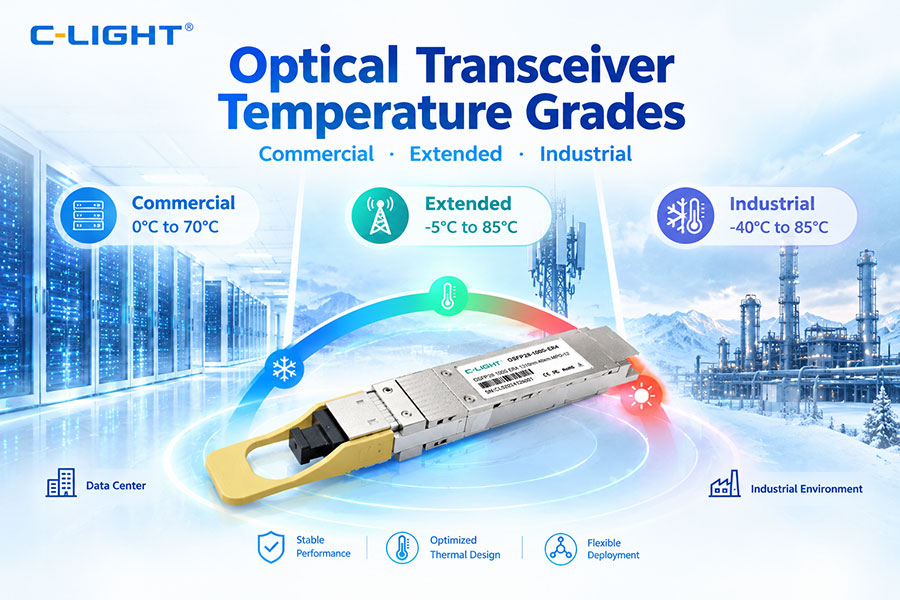
High-density AI racks may use advanced air or liquid cooling systems. Optical modules and cables should be evaluated for compatibility with the expected operating environment.
10.5 Consider Reliability and Compatibility
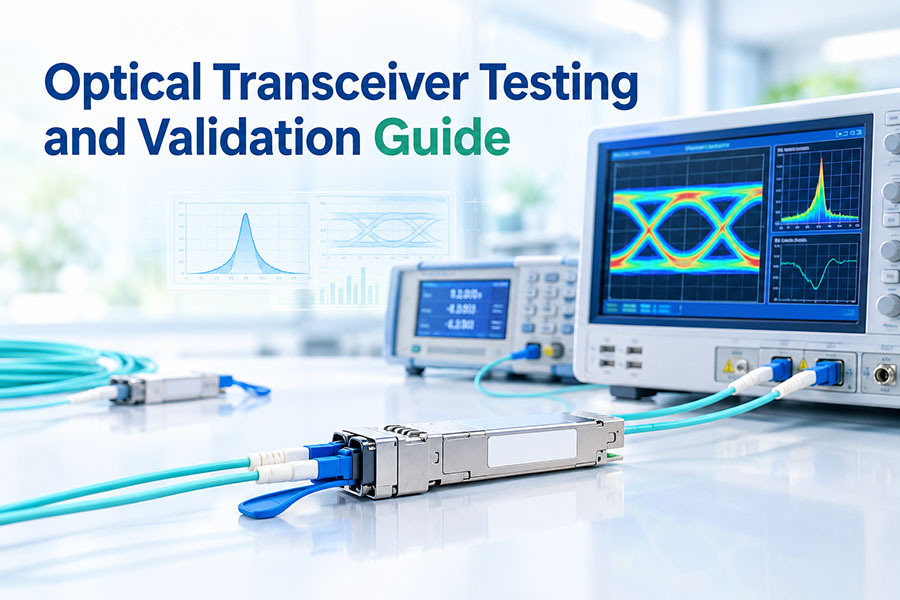
AI networks often operate continuously under heavy traffic. Optical interconnect products should undergo electrical, optical, thermal, and interoperability testing before large-scale deployment.
11. C-LIGHT Optical Interconnect Solutions for AI Data Centers
C-LIGHT provides a portfolio of high-speed optical connectivity solutions designed to support the evolution of AI data center networks.
Relevant solutions include:
400G Optical Transceivers
800G Optical Transceivers
1.6T Optical Interconnect Solutions
DAC Products
AOC Products
AEC Products
These products address different connectivity distances, bandwidth requirements, and network architectures, allowing customers to select appropriate solutions for GPU clusters, AI fabrics, high-performance computing, and data center interconnect applications.
12. Future Outlook for AI Optical Interconnect
12.1 800G Becomes a Key Deployment Technology
The growth of large AI clusters is accelerating the transition toward 800G connectivity. Higher bandwidth per port helps network operators build higher-density fabrics while supporting increasing GPU communication requirements.
12.2 1.6T Moves Toward Commercial Deployment
As switch and accelerator bandwidth continues increasing, 1.6T optical connectivity is expected to play a larger role in next-generation AI infrastructure.
12.3 Optical Technology Moves Closer to the Chip
The long-term evolution of AI networking is likely to move optical connectivity progressively closer to high-speed computing and switching chips, driven by the need to reduce electrical losses and improve energy efficiency.
This evolution includes:
Pluggable Optics
LPO
CPO
Optical I/O
13. Conclusion: Optical Interconnect Is the Foundation of AI Networking
Next-generation AI data centers require much more than faster GPUs. They require a high-performance network capable of moving enormous amounts of data between computing resources with minimal latency and energy overhead.
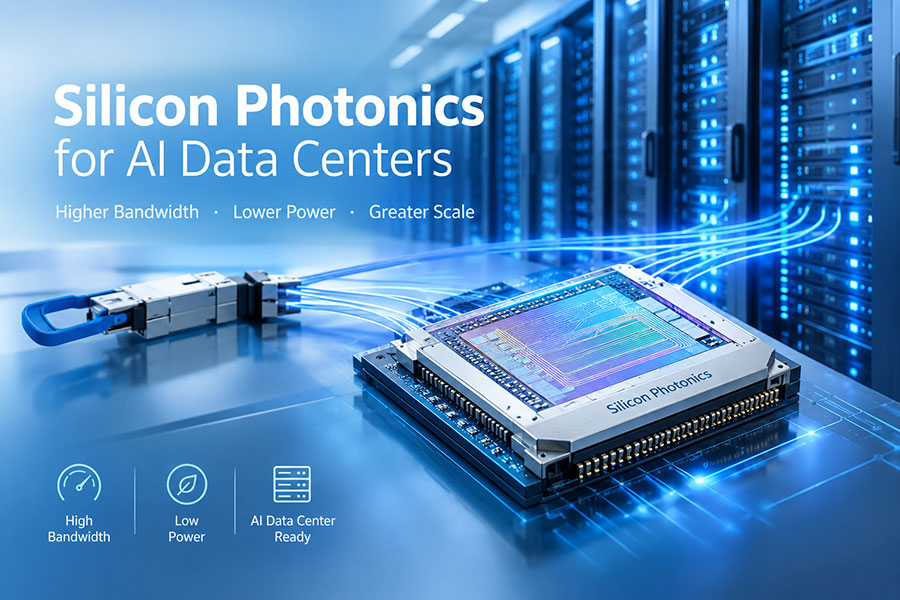
Optical interconnect technologies provide the bandwidth, reach, scalability, and reliability required for this transformation. From 400G and 800G pluggable transceivers to 1.6T, LPO, silicon photonics, and CPO, optical connectivity is becoming increasingly central to AI infrastructure.
As AI clusters continue expanding, the most successful data center architectures will combine different optical and electrical technologies according to distance, bandwidth, power, and system requirements. C-LIGHT supports this evolution with high-speed optical transceivers and interconnect solutions designed for the changing needs of AI data centers.
14.FAQ: Optical Interconnect Solutions for Next-Generation AI Data Centers
Q1: Why is optical interconnect important for AI data centers?
Answer: AI clusters generate massive east-west traffic between GPUs, switches, and storage systems. Optical interconnect provides the high bandwidth, low latency, and scalable transmission needed for these environments.
Q2: What optical speeds are used in AI data centers?
Answer: 400G and 800G are important high-speed connectivity technologies for current AI infrastructure, while 1.6T is emerging as a next-generation solution.
Q3: What is the difference between DAC, AOC, AEC, and optical transceivers?
Answer: DAC is primarily used for short-distance passive electrical connections, AOC integrates optical transmission into a cable assembly, AEC uses active electrical signal conditioning, and optical transceivers provide modular optical connectivity using separate fiber links.
Q4: Why is PAM4 widely used in high-speed optical modules?
Answer: PAM4 transmits two bits per symbol using four signal levels, enabling higher data rates without requiring a proportional increase in symbol rate.
Q5: Should AI data centers use multimode or single-mode optical connectivity?
Answer: Multimode solutions are generally suitable for shorter-reach applications, while single-mode solutions provide greater transmission distance and scalability for longer links and large network architectures.
Q6: What is LPO and why is it important?
Answer: LPO, or Linear Pluggable Optics, reduces or removes some DSP processing inside optical modules and can lower power consumption and latency, although it places greater demands on host electrical signal integrity.
Q7: What is CPO in AI data center networking?
Answer: CPO, or Co-Packaged Optics, integrates optical engines close to the switching ASIC. It is designed to reduce electrical transmission distance and improve bandwidth density and energy efficiency.
Q8: What challenges affect AI optical interconnect deployment?
Answer: Major challenges include power consumption, thermal management, signal integrity, high-density cabling, compatibility, testing, and the increasing cost of high-speed optical components.
Q9: How should an AI data center choose an optical interconnect solution?
Answer: Selection should consider transmission distance, bandwidth, power consumption, thermal conditions, network architecture, compatibility, and reliability requirements.
Q10: How does C-LIGHT support next-generation AI data centers?
Answer: C-LIGHT provides 400G, 800G, and 1.6T optical connectivity solutions together with DAC, AOC, and AEC products for AI clusters, high-performance computing, and data center networking.
 >
>

 >
>
 >
>
 >
>
 >
>
 >
>
 >
>
 >
>