TEL:+86 132 6656 7067





High-performance computing (HPC) systems rely on large numbers of interconnected processors, GPUs, accelerators, and storage resources to execute complex computational workloads. Scientific simulations, weather forecasting, molecular research, engineering analysis, and artificial intelligence all require computing resources to exchange large volumes of data efficiently.
As HPC clusters expand, the network connecting their compute nodes becomes a critical part of overall system performance. High-speed optical connectivity provides the bandwidth, transmission distance, and physical scalability needed for communication between servers, switches, and storage systems. Modern deployments increasingly use 100G, 200G, 400G, and 800G interfaces, while 1.6T technologies are emerging for next-generation infrastructure.
1. Why Optical Connectivity Is Essential for HPC Systems
HPC workloads are commonly distributed across multiple compute nodes. Each node performs part of a larger calculation and exchanges data with other nodes through a high-speed interconnect. Depending on the application, communication may involve frequent synchronization, collective operations, distributed memory access, or large-scale dataset transfers.
As processor performance increases, network communication can become a limiting factor. Insufficient bandwidth, congestion, packet loss, or excessive communication overhead may prevent computing resources from operating efficiently.
Optical links provide high-capacity connections between switches and computing nodes, supporting communication-intensive parallel workloads.
Fiber connectivity supports connections across multiple racks, equipment rows, and data center areas without relying entirely on short electrical connections.
Compact optical transceivers and multi-fiber cabling help accommodate large numbers of network connections in dense HPC environments.
Optical fiber is not affected by electromagnetic interference in the same way as electrical signal cables, making it suitable for complex equipment environments.
2. HPC Network Architecture and Interconnect Layers
An HPC environment usually contains several interconnected network layers. Compute nodes communicate through a high-speed backend fabric, while storage and management networks provide additional connectivity for data access, monitoring, and system administration.
The backend network is particularly important because it carries communication between processors participating in the same distributed workload. Its topology and switching architecture influence the number of communication hops, available bandwidth, and network scalability.
Typical HPC communication architecture:
Compute Nodes → Network Adapters → High-Speed Leaf Switches → Spine or Core Switching Layer → Destination Compute Nodes
Connects CPUs, GPUs, and accelerator nodes for distributed processing and parallel computation.
Provides access to shared storage, parallel file systems, and high-throughput data services.
Supports monitoring, provisioning, configuration, and administrative communication.
Connects separate computing environments or data center zones where additional optical transport capacity is required.
Not every HPC system uses the same topology. Smaller clusters may use a relatively simple switching design, while large supercomputers can use multi-stage fabrics or specialized topologies such as fat-tree and torus architectures. Optical connections must be selected according to the actual topology and port requirements.
3. InfiniBand and High-Speed Ethernet Connectivity
InfiniBand and Ethernet are two important networking technologies used in high-performance computing and accelerated data center environments. Both can support high-speed optical interconnects, but their network architectures, protocol behavior, and deployment requirements differ.
| Feature | InfiniBand | High-Speed Ethernet |
|---|---|---|
| Primary Applications | HPC clusters, supercomputing, and accelerator communication | HPC, AI infrastructure, storage, and general data center networking |
| Network Architecture | InfiniBand fabric with compatible adapters and switches | Ethernet switching fabric with compatible NICs and network devices |
| Communication Features | Supports RDMA and specialized HPC communication capabilities | Supports multiple transport and congestion-management approaches, including RoCEv2 |
| Optical Interfaces | Speed-specific and platform-qualified optical modules | Standards-based Ethernet optical interfaces |
| Deployment Considerations | Fabric configuration, subnet management, adapter compatibility, and cabling | Switch configuration, routing, congestion control, and end-to-end compatibility |
Remote Direct Memory Access (RDMA) is important in many HPC environments because it enables data transfer between systems with reduced CPU involvement compared with conventional communication paths. InfiniBand provides native RDMA capabilities, while Ethernet-based systems can use RoCEv2 to support RDMA over Converged Ethernet.
The optical transceiver does not independently determine whether a network uses InfiniBand or Ethernet. The host adapter, switch, protocol configuration, electrical interface, and optical module must all support the intended system.
4. Optical Data Rates: 100G, 200G, 400G, 800G and 1.6T
The bandwidth requirements of HPC networks continue to increase as computing clusters incorporate more GPUs, accelerators, and high-performance storage resources. Higher-speed optical interfaces help increase switch capacity and reduce the number of physical connections needed to achieve a given aggregate bandwidth.
| Data Rate | Typical Module Families | Potential HPC Application | Design Considerations |
|---|---|---|---|
| 100G | QSFP28 | Existing HPC fabrics and server-to-switch connectivity | Host compatibility, lane configuration, and required reach |
| 200G | QSFP56 and platform-specific modules | Intermediate-speed cluster connections | Electrical interface and optical standard |
| 400G | QSFP-DD, OSFP | High-capacity switch uplinks and accelerator networking | Fiber type, connector configuration, and thermal limits |
| 800G | OSFP, QSFP-DD800 | Next-generation HPC and AI cluster fabrics | Lane rate, host qualification, and optical power |
| 1.6T | OSFP224 and platform-specific interfaces | Emerging high-density switching infrastructure | Host electrical interface, optical architecture, and cooling |
The migration to higher data rates requires more than replacing one optical module with another. Switch ASIC capability, electrical lane configuration, module form factor, firmware support, optical standards, and thermal design must be considered together.
C-LIGHT 400G optical transceiver families provide OSFP and QSFP-DD options for high-speed data center and HPC network applications. Available optical configurations should be matched to the required transmission distance, fiber interface, and target switching platform.
View 400G OSFP ProductsView 400G QSFP-DD Products
800G optical connectivity provides higher aggregate bandwidth for dense switching environments. C-LIGHT 800G product families include different optical configurations for supported short-reach and single-mode applications. Selection should be based on the exact module specification and host platform.
View 800G OSFP ProductsView 800G QSFP-DD Products
The 1.6T OSFP-RHS product family addresses emerging high-density switching platforms. Its suitability for an HPC deployment depends on the supported host interface, optical configuration, link distance, and thermal requirements.
View 1.6T OSFP-RHS Products5. Optical Transceivers, AOC, DAC and AEC in HPC Networks
Different interconnect technologies serve different physical distances and deployment requirements. Short connections inside a server rack may use copper or active cable assemblies, while longer connections between racks and switching areas commonly use optical fiber.
| Interconnect Type | Typical Deployment | Main Characteristics | Selection Factors |
|---|---|---|---|
| DAC | Short server-to-switch connections | Direct electrical copper connection | Distance, cable flexibility, and host compatibility |
| AEC | Short-reach high-speed connections | Active electrical cable with signal conditioning | Power consumption, reach, and platform support |
| AOC | Short-to-medium optical cable connections | Integrated optical cable assembly | Supported distance, cable length, and connector type |
| Pluggable Optical Transceiver | Rack-to-rack and switch-to-switch links | Detachable module connected to a fiber infrastructure | Optical standard, wavelength, reach, and link budget |
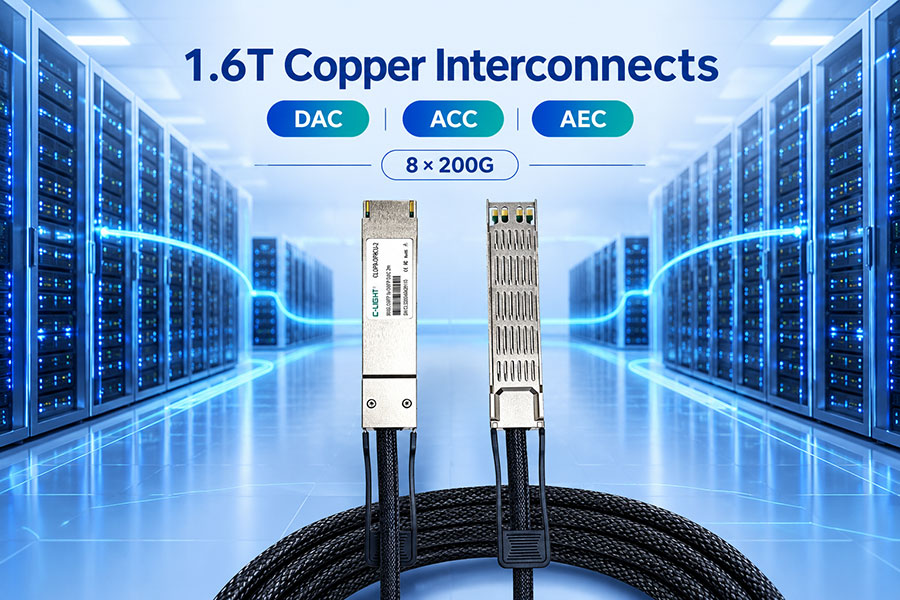
DAC and AEC solutions can be useful for suitable short connections where copper cabling is supported. AOC assemblies provide optical transmission in an integrated cable format, while pluggable transceivers offer greater flexibility for structured fiber installations and different link distances.
C-LIGHT 400G AOC solutions provide integrated optical connectivity for compatible high-speed switches and computing systems. They can be considered for supported short-reach connections where a fixed-length optical cable assembly is appropriate.
View 400G AOC Products6. Parallel Optical Transmission and MPO/MTP Fiber Connectivity
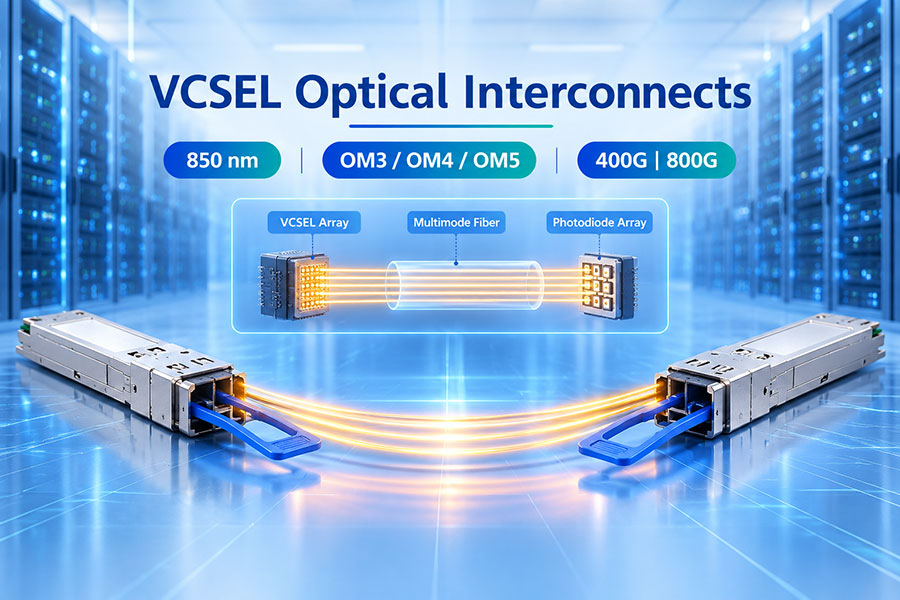
High-performance computing systems often require a large number of high-speed connections within a limited physical space. Parallel optical transmission uses multiple optical lanes to carry data across a multi-fiber connection, helping increase aggregate bandwidth while maintaining compact connector dimensions.
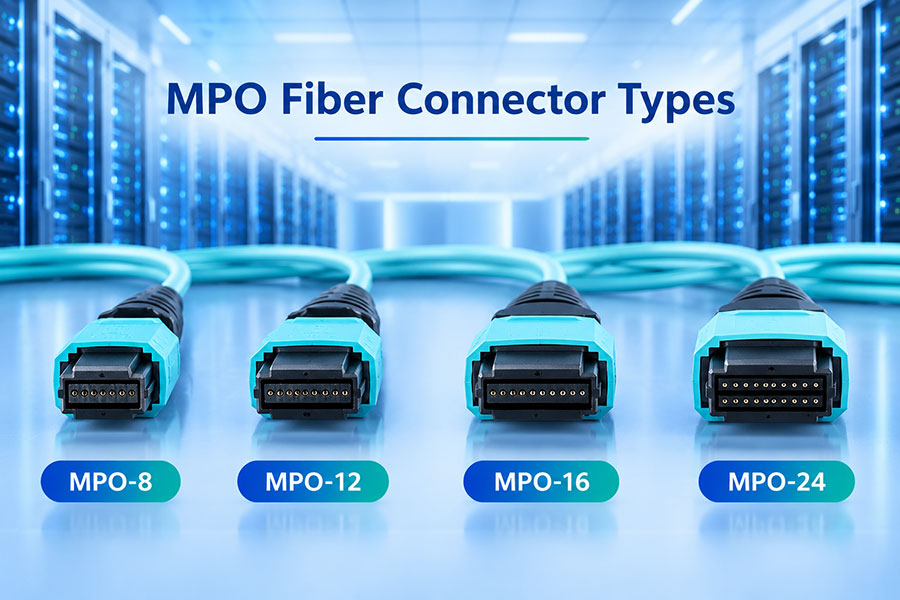
MPO/MTP connectors are widely used in high-density fiber environments. They support multi-fiber trunk cables and structured cabling systems that can connect network switches, distribution panels, and computing racks.
Consolidate multiple optical paths into organized assemblies and simplify large-scale cable routing.
Provide transitions between compatible parallel optical interfaces and individual fiber connections.
Maintain correct transmit-to-receive mapping across connectors, patch panels, and trunk assemblies.
Use patch panels and organized fiber pathways to improve serviceability and support future expansion.
Connector selection must follow the exact optical interface. MPO-12, MPO-16, and duplex LC configurations are designed for different applications and cannot be treated as interchangeable. Fiber count, polarity, connector gender, key orientation, and insertion loss should be verified before installation.
7. Multimode and Single-Mode Fiber Selection
Fiber selection depends on transmission distance, optical data rate, transceiver standard, and the existing cabling infrastructure. Both multimode and single-mode fiber can be used in HPC environments, provided the selected optical module supports the required fiber type and reach.
| Fiber Type | Common Application | Advantages | Planning Considerations |
|---|---|---|---|
| OM3 Multimode | Supported short-reach optical connections | Established multimode infrastructure | Distance limitations depend on the optical standard |
| OM4 Multimode | High-speed short-reach links | Higher modal bandwidth than OM3 | Verify the transceiver's specified reach |
| OS2 Single-Mode | Inter-rack, inter-row, and longer connections | Broad compatibility with single-mode optical applications | Wavelength, connector, and optical budget must match |
Multimode fiber is suitable for supported short-distance applications, while OS2 single-mode fiber provides flexibility for longer links and different optical reach requirements. For large HPC facilities, single-mode backbone infrastructure can also simplify the integration of multiple network zones.
The transmission distance must always be evaluated using the transceiver specification and the complete optical link budget. Connector loss, patch panels, splices, and cable length all contribute to the final link performance.
8. Network Latency, RDMA and Communication Efficiency
HPC workloads often rely on frequent communication between compute nodes. The time required to exchange data can affect application performance, particularly when parallel processes must synchronize before continuing computation.
RDMA enables direct data transfer between the memory spaces of connected systems with reduced CPU involvement. It is used in many high-performance networking environments to reduce software overhead and improve communication efficiency.
Optical links provide the physical transport capacity, but end-to-end communication performance also depends on network adapters, switch architecture, protocol implementation, congestion control, and application behavior.
Important network performance factors:
Available bandwidth between communicating compute nodes.
Number of switching hops along the communication path.
Network congestion and queueing behavior.
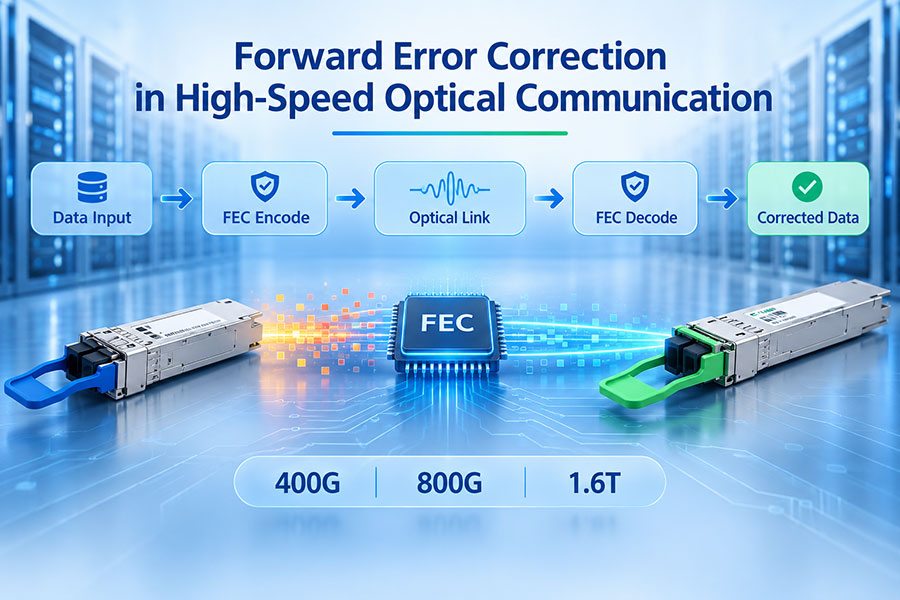
Packet loss, retransmissions, and error correction.
RDMA configuration and adapter performance.
Application communication patterns and synchronization frequency.
A high-speed optical connection can improve network capacity, but it does not independently guarantee lower application latency. The entire communication path must be evaluated under representative HPC workloads.
9. Power Consumption and Thermal Management
High-density HPC switches can contain dozens of high-speed optical ports. As link rates increase, the power consumption and heat generated by populated transceivers become important parts of equipment design.
Optical module power varies according to data rate, optical architecture, DSP requirements, transmission distance, and module implementation. A system using many 400G or 800G modules must account for their combined power consumption and the cooling capacity available around the switch.
Thermal planning should consider the following factors:
Maximum power specifications of the selected optical modules.
Number of populated ports and expected operating conditions.
Switch airflow direction and cooling capacity.
Module temperature limits and heatsink requirements.
Compatibility between the transceiver and the host platform.
Monitoring of temperature, voltage, and optical power where supported.
A balanced design should consider bandwidth, optical performance, module power, and system reliability together. Selecting a transceiver solely according to its nominal data rate can lead to compatibility or thermal problems during deployment.
10. Testing and Maintaining HPC Optical Infrastructure
The reliability of an HPC optical network depends on the quality of every connection in the physical path. A transceiver that meets its specification may still experience link instability if the fiber assembly is contaminated, incorrectly mapped, damaged, or installed beyond its supported optical budget.
Module compatibility: Confirm the transceiver form factor, coding, firmware, and supported host interface.
Fiber inspection: Inspect and clean connector endfaces before mating.
Polarity verification: Confirm the correct fiber mapping for parallel and duplex connections.
Optical power testing: Measure transmit and receive power against the module specifications.
Insertion loss testing: Validate the complete installed fiber path.
Network testing: Check link status, error counters, packet loss, and throughput.
Environmental monitoring: Observe module temperature and equipment operating conditions.
Documentation: Maintain records of cable routes, port assignments, module models, and test results.
Regular inspection and monitoring help identify developing problems before they affect large-scale computing jobs. In a large cluster, consistent labeling and structured fiber management also reduce the time required for maintenance and troubleshooting.
11. Designing Scalable Optical Connectivity for Future HPC Systems
HPC infrastructure continues to evolve as processor architectures, GPU accelerators, memory technologies, and parallel applications become more demanding. Network designs must therefore accommodate increasing port bandwidth and connection density without creating unnecessary complexity.
A scalable optical infrastructure should provide sufficient fiber capacity, organized cable pathways, flexible distribution panels, and clear port documentation. These elements make it easier to introduce higher-speed transceivers and expand the network as computing requirements change.
The transition from 400G to 800G and eventually 1.6T will depend on the capabilities of the switching platform, network adapters, optical interfaces, and fiber plant. Planning for these requirements at the beginning of a project can reduce the cost and disruption of future upgrades.
12. Conclusion
Optical connectivity is a fundamental component of modern high-performance computing systems. It connects distributed compute nodes, switching fabrics, and storage resources while providing the bandwidth and physical reach required for large-scale parallel workloads.
The right solution combines suitable InfiniBand or Ethernet infrastructure, compatible optical transceivers, appropriate fiber types, and well-managed cabling systems. As HPC networks move toward 400G, 800G, and emerging 1.6T interfaces, bandwidth planning, thermal management, optical link validation, and future expansion become increasingly important.
C-LIGHT provides high-speed optical transceiver and active optical connectivity solutions for data center and high-performance networking applications. Product selection should be based on the actual network protocol, host platform, optical reach, connector configuration, and deployment requirements.
Building or Upgrading an HPC Optical Network?
Contact C-LIGHT for optical transceiver specifications, connectivity options, and project support.
Contact C-LIGHT >

 >
 >
 >
 >
 >
 >
 >