TEL:+86 132 6656 7067




Since 2024, data center networks have been undergoing a generational leap from 400G to 800G, and 1.6T is poised for large-scale deployment in AI computing clusters. As the physical carrier of this transition, the form factor of optical transceivers has become a critical decision point affecting network architecture, supply chain strategy, and long-term TCO. The two major camps—QSFP-DD and OSFP—are engaged in fierce competition, each grounded in distinct technical philosophies and industry alliances, shaping the infrastructure landscape of the 800G era.
Packaging Evolution: The Technical Lineage from QSFP to 800G
Form Factor Divergence in the 400G Era
In the 100G era, QSFP28 became the absolute mainstream due to its mature ecosystem and broad compatibility. However, the bandwidth density requirements of 400G led to a divergence in packaging technologies: the traditional QSFP electrical interface supported only 4 lanes, meaning that achieving 400G required 100G PAM4 modulation per lane, placing extremely high demands on signal integrity; alternatively, an 8-lane 50G NRZ approach could be used, but this necessitated an increase in physical size.
This technical divergence gave rise to two evolutionary paths: the conservative evolution camp extended the QSFP foundation while maintaining backward compatibility, ultimately resulting in QSFP-DD; the radical reconstruction camp pursued a complete redesign optimized for thermal management and scalability, resulting in OSFP.
QSFP-DD: Incremental Innovation with Compatibility at Its Core
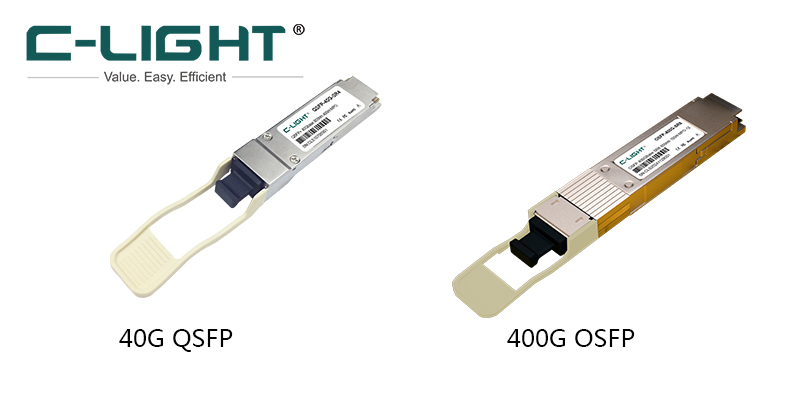
QSFP-DD (Quad Small Form-factor Pluggable Double Density) is defined by the QSFP-DD MSA (Multi-Source Agreement), with backward compatibility as its core philosophy. The "Double Density" nomenclature reflects its design characteristic—integrating eight electrical lanes into a compact form factor, doubling the density of QSFP28 while preserving mechanical compatibility.
Core Technical Specifications:
Physical Dimensions: 78.5mm (L) × 18.35mm (W) × 8.75mm (H)
Electrical Interface: 8 lanes, each supporting 50G PAM4 (for 400G) or 100G PAM4 (for 800G), backward compatible with 4-lane QSFP28
Thermal Design Power (TDP): Standard up to 12W, extended version up to 15W
Thermal Capability: The 8.75mm height restricts heatsink size; modules in the 15-20W range for 800G face thermal challenges
The greatest advantage of QSFP-DD lies in backward compatibility—QSFP-DD ports can accept QSFP+/QSFP28 modules, negotiating down to 4-lane operation, enabling phased upgrades without wholesale equipment replacement. In terms of ecosystem, QSFP-DD has garnered widespread adoption from Cisco, Juniper Networks, Arista, Dell, and the majority of traditional data center switch vendors.
OSFP: Performance-Oriented Redesign
OSFP (Octal Small Form-factor Pluggable) is defined by the OSFP MSA, developed by a consortium including Google and Arista, prioritizing thermal headroom and forward-looking electrical signal transmission. Its core design philosophy is optimized for 800G and higher bandwidths.
Core Technical Specifications:
Physical Dimensions: 100.4mm (L) × 22.5mm (W) × 13.0mm (H)
Electrical Interface: 8 electrical lanes, natively designed for 800G (8×100G PAM4), with reserved expansion capability for 1.6T
Thermal Design Power (TDP): Supports up to 20-25W, providing margin for higher-power 800G and beyond modules
Thermal Capability: Larger volume accommodates larger heatsinks, supporting higher-power silicon photonics and DSP chips; some variants feature an integrated heatsink mounted directly on the module, delivering superior thermal performance
OSFP's core strengths include robust thermal management, native 800G design, a clear evolutionary path to 1.6T, and additional pins supporting advanced CMIS 5.0 management features (real-time monitoring of temperature, voltage, and optical power). Its primary limitation is the lack of backward compatibility—an OSFP port cannot accept QSFP series modules, requiring a wholly new infrastructure. OSFP has garnered strong support primarily from hyperscale operators, and vendors like Arista, Cisco, and several white-box switch manufacturers now offer native OSFP platforms.
 >
>

 >
>
 >
>
 >
>
 >
>
 >
>
 >
>
 >
>