TEL:+86 132 6656 7067




Structured cabling and point-to-point cabling are two different approaches to building network connectivity between switches, servers, storage systems, and other equipment. Structured cabling introduces organized patching and distribution points between equipment, while point-to-point cabling connects network devices directly through a dedicated cable or fiber link.
The difference becomes particularly important in data centers. Structured cabling is designed around organized infrastructure, standardized pathways, patch panels, and cross-connects that can simplify moves, adds, and changes. Point-to-point cabling reduces intermediate connections and can provide a direct physical path between two devices.
Neither architecture applies equally well to every network. Traditional enterprise and data center environments may benefit from structured infrastructure, while dense AI and high-performance computing systems often contain large numbers of short direct-attached connections. In practice, many modern facilities use a combination of the two approaches.
1. What Is Structured Cabling?
Structured cabling is an organized cabling architecture that separates permanent infrastructure from equipment connections. Instead of running every equipment link directly from one device to another, cables are routed through defined cabling areas, patch panels, distribution frames, trunks, and cross-connects.
A typical structure can include horizontal cabling, backbone cabling, patch panels, fiber enclosures, equipment distribution areas, and standardized patch cords.
The objective is to create a repeatable physical infrastructure that can support equipment changes without requiring the entire cabling system to be redesigned each time.
2. What Is Point-to-Point Cabling?
Point-to-point cabling connects two network endpoints directly. A cable runs from one port to another without an intermediate patch panel or structured distribution layer in the link path.
Examples include:
Switch ↔ Server: A direct DAC, AOC, or optical transceiver connection.
Switch ↔ Switch: A direct fiber connection between two switch ports.
GPU ↔ Switch: A short high-speed cable directly connecting compute equipment to a network switch.
Point-to-point links are especially common where the physical relationship between devices is stable, the distance is short, and minimizing intermediate connections is desirable.
3. How Does Structured Cabling Work?
A structured cabling system typically divides the physical network into organized connection zones.
A simplified fiber architecture can be represented as:
Network Switch → Patch Cord → Patch Panel / Distribution Area → Trunk Cable → Patch Panel → Patch Cord → Server / Network Equipment
The intermediate distribution layer provides a standardized point where connections can be rearranged. When equipment is moved or replaced, technicians can often change patching at the distribution point rather than replacing the permanent cable infrastructure.
This makes structured cabling particularly useful for installations where equipment layouts are expected to change over time.
4. How Does Point-to-Point Cabling Work?
In a point-to-point system, the cable provides a direct physical connection between two endpoints.
A basic example is:
Switch Port → Optical Transceiver → Fiber Cable → Optical Transceiver → Switch Port
For short copper links, the same architecture can use a DAC:
Switch Port → DAC → Server or Switch Port
For active optical connections, an AOC can provide the complete optical link without separate optical transceivers at both ends.
Because there are fewer intermediate components, point-to-point cabling can provide a simple and direct physical topology.
5. What Are the Main Differences Between Structured and Point-to-Point Cabling?
| Feature | Structured Cabling | Point-to-Point Cabling |
|---|---|---|
| Architecture | Layered and organized | Direct connection |
| Patch Panels | Common | Usually not required |
| Permanent Cabling | Separated from equipment patching | Often serves as the direct equipment link |
| Reconfiguration | Usually easier at distribution points | May require cable replacement or rerouting |
| Cable Length | Can use standardized trunk and patch-cord lengths | Often cut or selected for the direct path |
| Initial Complexity | Higher | Lower |
| Scalability | High for structured deployments | Depends heavily on equipment layout |
| Common Application | Enterprise and conventional data centers | Short high-density equipment connections |
6. How Do the Two Architectures Differ in Cable Management?
Structured cabling generally provides more deliberate cable-management boundaries. Trunk cables can be routed through overhead pathways or underfloor systems, while patch cords are concentrated around equipment and patching areas.
Point-to-point cabling can be simpler when there are only a small number of connections. However, as the number of direct links grows, many individual cables can accumulate around racks and switches.
This becomes particularly important in high-density data centers. Large numbers of cables can obstruct airflow, increase rack congestion, and make troubleshooting more difficult when cable routing is not carefully planned.
7. Which Approach Is More Scalable?
Structured cabling generally provides a more systematic method for scaling a facility because the permanent cabling infrastructure can be designed separately from the equipment layout.
For example, a data center can install trunk fibers between distribution areas and then use patch cords to connect newly installed switches and servers.
Point-to-point cabling can also scale effectively when the network follows a highly repetitive architecture and device locations are stable. However, the number of individual direct cables increases rapidly as the number of endpoints grows.
Scalability therefore depends not only on cable count but also on how frequently the network is reconfigured.
8. Which Approach Is Easier to Reconfigure?
Structured cabling is generally designed to simplify moves, adds, and changes. Patch panels and cross-connects create dedicated locations where links can be rearranged without modifying the permanent backbone.
With point-to-point cabling, changing the physical relationship between devices may require removing an existing cable and installing another cable with an appropriate length or routing path.
This difference matters in enterprise data centers where rack layouts, server populations, and switch configurations can change over the operating life of the facility.
9. How Do Structured and Point-to-Point Cabling Differ in Link Loss?
Each additional connector, adapter, splice, or patching point can introduce optical insertion loss. A structured cabling system can therefore have more connection points than a direct point-to-point link.
A direct link can reduce the number of passive connections between two active devices, which can simplify the optical loss budget.
However, a properly designed structured cabling system can still provide excellent optical performance. The important consideration is the total channel loss, including fiber attenuation, connector loss, splice loss, patch panels, and other passive components.
As optical speeds increase, link-budget planning becomes increasingly important, particularly for multimode parallel optics and high-speed single-mode links.
10. What Cables Are Used in Structured Cabling?
Structured data center cabling can use a combination of fiber and copper media according to the network design.
| Cable / Component | Typical Role |
|---|---|
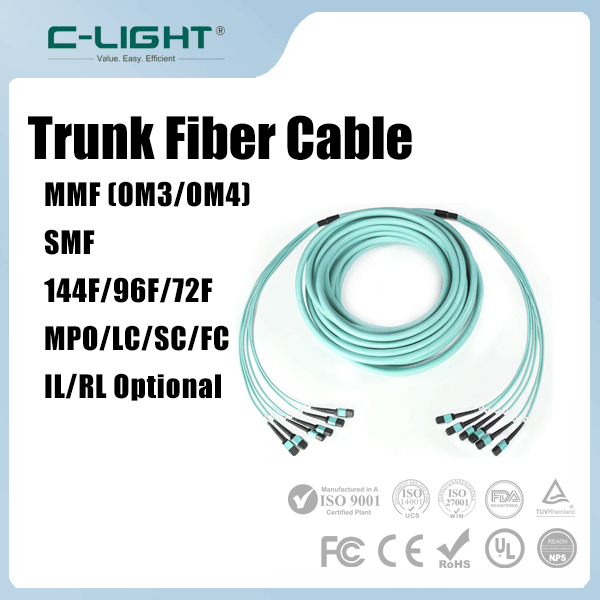
| MPO / MTP Trunk Cable | High-density backbone or distribution connections |
| LC Fiber Patch Cable | Equipment-to-panel and panel-to-panel patching |
| MPO / MTP Harness | Transition between high-density trunk connectivity and duplex interfaces |
| DAC | Short direct-attached copper equipment connections |
| AOC | Pre-terminated active optical equipment connection |
| Twisted-Pair Cabling | Ethernet and management connectivity where supported |
Fiber structured cabling becomes increasingly important as data rates rise. TIA-942-C notes the increasing use of fiber for high-speed switch-to-server connectivity and the growing cable density associated with modern AI systems.
11. What Cables Are Common in Point-to-Point Cabling?
Point-to-point connections often use pre-terminated cables designed for a specific equipment-to-equipment link.
DAC: Direct Attach Copper cables are commonly used for very short high-speed links inside racks.
AOC: Active Optical Cables integrate optical transceivers into the cable assembly and are suitable for longer short-reach connections than copper in many deployments.
Duplex Fiber Patch Cables: Fiber patch cables can connect optical transceivers directly between switches or other network devices.
MPO / MTP Cables: Parallel-fiber assemblies can provide high lane density for 40G, 100G, 200G, 400G, and newer high-speed architectures.
The appropriate cable depends on the transmission rate, distance, connector type, fiber type, and equipment interface.
12. How Does Structured Cabling Work with MPO and MTP?
MPO and MTP-based connectivity is well suited to structured data center cabling because high-fiber-count trunk assemblies can consolidate multiple optical lanes into a single organized cable path.
A typical architecture can use:
Switch → MPO/MTP Patch Cord → Patch Panel → MPO/MTP Trunk → Patch Panel → MPO/MTP Harness → Optical Transceivers
This approach is useful for high-density environments where many parallel optical connections need to be organized between distribution areas.
The exact connector type, fiber count, polarity, and pin configuration must match the optical transceiver and network architecture.
13. Why Is Point-to-Point Cabling Common in AI Data Centers?
AI and high-performance computing systems can require extremely large numbers of short, high-bandwidth connections between GPUs, switches, storage devices, and other components.
In these environments, many links are physically short and follow a tightly controlled equipment topology. Direct-attached DACs, AOCs, and short optical connections can therefore be practical for connecting equipment within a rack or across adjacent racks.
TIA has specifically noted that AI/HPC superclusters can contain very large numbers of short direct-attached links, creating a cabling environment that differs significantly from conventional structured data center layouts.
Point-to-point does not necessarily mean an entire AI data center has no structured cabling. It is common to use direct connections inside the compute fabric while retaining structured cabling for connections between pods, distribution areas, and external networks.
14. What Are the Advantages of Structured Cabling?
| Advantage | Description |
|---|---|
| Organized Infrastructure | Separates permanent cabling from equipment connections. |
| Easy Reconfiguration | Patch panels and cross-connects simplify moves, adds, and changes. |
| Scalability | Backbone and distribution infrastructure can support future equipment additions. |
| Cable Management | Trunks and distribution pathways help control cable routing. |
| Documentation | Standardized connection points make infrastructure easier to document. |
| Lifecycle Management | Permanent cabling can remain in place through multiple equipment upgrades. |
15. What Are the Advantages of Point-to-Point Cabling?
| Advantage | Description |
|---|---|
| Simple Architecture | Devices are connected directly without intermediate patching. |
| Fewer Passive Connections | Removing patch points can reduce connector count within the link. |
| Low Deployment Complexity | Pre-terminated DACs, AOCs, and fiber assemblies can be installed quickly. |
| Short Installation Path | Direct links are useful when devices are close together. |
| High Port Density | Suitable for dense switch and AI/HPC environments. |
| Easy Initial Deployment | Suitable for fixed and repetitive equipment layouts. |
16. What Are the Limitations of Structured Cabling?
Structured cabling requires more planning and physical infrastructure than a simple direct connection.
Patch panels, enclosures, cross-connects, trunks, cable trays, and distribution areas increase the number of components that must be designed and maintained. The additional connectors can also contribute to optical loss.
For extremely dense AI clusters with thousands of short links concentrated around compute racks, traditional patch-panel architectures can become difficult to fit within the available rack space and cable-management areas.
TIA's recent AI/HPC infrastructure discussion notes that conventional structured cabling models may not directly fit the physical requirements of very dense GPU superclusters.
17. What Are the Limitations of Point-to-Point Cabling?
Point-to-point cabling can become difficult to manage as the number of connections increases.
Because every link directly connects two endpoints, moving equipment may require a new cable or a different routing path. Large numbers of cables can also create congestion around switches and equipment racks.
Direct cabling can therefore be very efficient for stable and highly concentrated connections but less convenient when equipment locations and connectivity requirements change frequently.
18. Which Cabling Architecture Should Be Used?
| Scenario | Typical Cabling Approach | Reason |
|---|---|---|
| Enterprise data center with frequent equipment changes | Structured Cabling | Centralized patching and easier reconfiguration |
| Conventional data center backbone | Structured Cabling | Organized trunks, distribution, and scalable infrastructure |
| Server-to-ToR connections | Point-to-Point or Structured | Depends on rack layout and management requirements |
| AI GPU fabric inside a compute pod | Point-to-Point | Large numbers of short, high-density connections |
| Connections between AI pods | Structured or Hybrid | Longer distribution paths benefit from organized infrastructure |
| Fixed short switch interconnections | Point-to-Point | Direct connection with few intermediate components |
| Large multi-rack facility | Hybrid | Combines structured backbone with direct equipment connections |
For most large facilities, the practical choice is not necessarily one architecture throughout the entire site. A hybrid design can use structured cabling for the permanent backbone and distribution network while using direct-attached cables for short equipment-level connections.
19. Structured Cabling vs Point-to-Point Cabling for High-Speed Optical Networks
The evolution from 10G and 25G toward 100G, 200G, 400G, and 800G changes the physical cabling requirements.
Higher-speed parallel optics may require 8, 12, 16, or more optical fibers depending on the architecture. Structured trunk systems can consolidate these fibers and simplify high-density distribution, while point-to-point assemblies can reduce the number of intermediate components for direct links.
| Network Requirement | Structured Approach | Point-to-Point Approach |
|---|---|---|
| High-density backbone | MPO/MTP trunks and panels | Multiple direct fiber assemblies |
| 400G short-reach connections | MPO/MTP structured links | Direct AOC / DAC / optical link |
| 800G equipment connections | High-density structured fiber | Direct OSFP / QSFP-DD connectivity |
| Frequent reconfiguration | Strong fit | More cable changes may be required |
| Very short fixed connections | May add unnecessary patching | Strong fit |
As link speeds rise, the physical design must consider not only bandwidth but also connector density, insertion loss, bend radius, cable weight, airflow, polarity, and maintenance access.
20. Conclusion
Structured cabling and point-to-point cabling represent two different ways of organizing physical network connectivity.
Structured cabling separates permanent infrastructure from equipment connections and uses distribution points, patch panels, trunks, and standardized connection areas. It is well suited to facilities where scalability, documentation, cable management, and frequent reconfiguration are important.
Point-to-point cabling creates direct physical links between network devices. It can simplify short fixed connections and reduce intermediate passive components, making it particularly useful for dense equipment environments and many AI/HPC fabric connections.
Modern data centers increasingly use both approaches. Structured cabling can form the permanent backbone and distribution infrastructure, while DACs, AOCs, and direct optical links can handle short equipment-level connections. The appropriate architecture depends on the network topology, equipment density, link distance, expected changes, optical budget, and operational requirements.
 >
>

 >
>
 >
>
 >
>
 >
>
 >
>
 >
>
 >
>