TEL:+86 132 6656 7067





Distributed AI inference is increasingly performed across multiple GPUs, accelerator nodes, and interconnected computing systems. Instead of processing every model operation on a single device, large inference workloads can divide computation across several resources to increase throughput, support larger models, and serve multiple requests simultaneously.
This architecture places significant demands on the communication network. Intermediate tensors, attention data, expert-routing traffic, and other model information must move between computing nodes without introducing excessive communication overhead. Low-latency optical links provide high-bandwidth connectivity for these distributed systems, particularly where electrical interconnects face limitations in reach, port density, or power consumption.
1. Why Low Latency Matters in Distributed AI Inference
AI inference performance is not determined solely by GPU processing speed. When a model is distributed across multiple accelerators, each computing stage may depend on data produced by another node. Communication delays can therefore become part of the critical execution path.
This is particularly important for interactive AI services, where users expect consistent response times and smooth token generation. A delay introduced between distributed computing stages can affect the time required to produce the first token, the interval between subsequent tokens, or the overall completion time of a request.
Communication between model partitions can influence how quickly an inference service returns its first generated token.
Repeated communication during autoregressive generation can affect the consistency of token delivery.
Distributed computation requires data exchange and synchronization between participating accelerators.
Multiple requests and model instances compete for network resources, making congestion and traffic scheduling important.
The objective is not simply to maximize link speed. A well-designed inference network must also minimize unnecessary communication, maintain predictable traffic behavior, and provide enough capacity for concurrent workloads.
2. Optical Interconnects in Distributed Inference Architectures
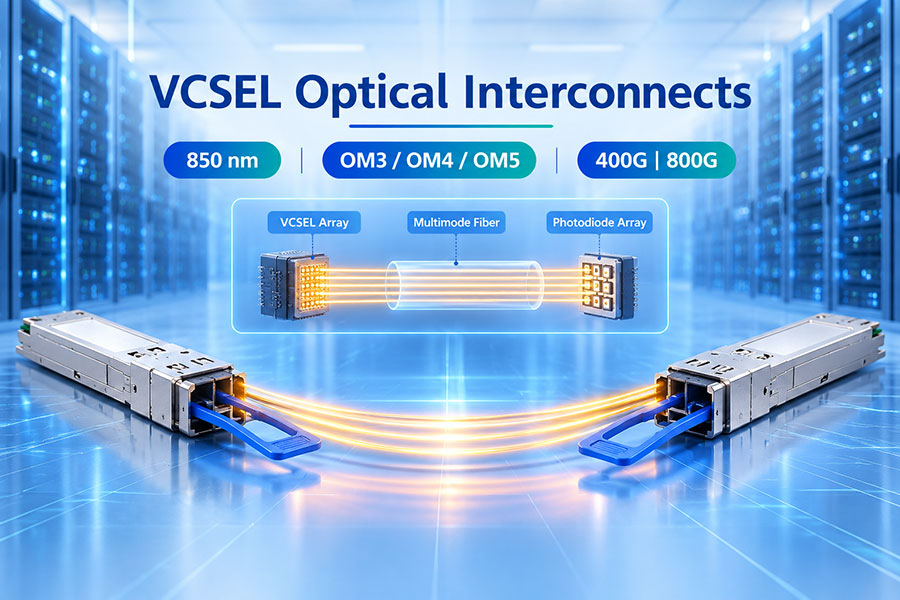
Optical links convert electrical data into optical signals for transmission over fiber and convert received signals back into electrical form at the destination. They provide a practical way to connect high-speed switching equipment and computing nodes across rack-scale and data center environments.
In distributed inference infrastructure, optical connectivity commonly appears in several network layers:
Connects accelerator servers to high-speed leaf switches through compatible optical interfaces or cable assemblies.
Provides high-capacity uplinks between rack-level switching systems and the network aggregation layer.
Links distributed inference nodes located in different server racks through structured fiber infrastructure.
Supports communication between separate compute resources used for prefill, decoding, and memory-related functions.
The optical transceiver is only one part of the complete communication path. Switch processing, network queues, routing, endpoint interfaces, and application-level synchronization also influence end-to-end latency.
3. Distributed Inference Workloads and Their Communication Patterns
Different inference architectures generate different network traffic patterns. The most suitable optical topology depends on how model computation is divided and how frequently data must move between devices.
| Inference Architecture | Communication Pattern | Network Requirement | Latency Sensitivity |
|---|---|---|---|
| Tensor Parallelism | Frequent exchange of intermediate tensors between GPUs | High bandwidth and low communication overhead | High |
| Pipeline Parallelism | Transfer of activations between model stages | Consistent inter-stage connectivity | Workload dependent |
| Expert Parallelism | All-to-all traffic between expert-processing nodes | High aggregate bandwidth and effective congestion management | High during routing-intensive operations |
| Prefill and Decode Disaggregation | Transfer of KV cache and related inference state | High-throughput links and efficient data placement | Depends on transfer volume and scheduling |
| Independent Model Replicas | Request distribution and service-level traffic | Scalable connectivity and predictable network performance | Depends on service requirements |
Tensor parallelism is especially sensitive to communication overhead because multiple GPUs may exchange intermediate results repeatedly during model execution. Expert parallelism can produce bursty all-to-all traffic when tokens are distributed among different experts.
For disaggregated prefill and decode architectures, transferring KV cache data between computing resources can become a major part of the overall request-processing path. Keeping frequently accessed data close to the compute resources that need it remains important, even when high-speed optical connectivity is available.
4. 400G, 800G and 1.6T Optical Links for AI Inference
As distributed inference clusters grow, the bandwidth required between switches and accelerator nodes increases. Higher-speed optical interfaces help aggregate more traffic through fewer physical ports, supporting denser network designs and larger inference deployments.
| Link Rate | Common Form Factors | Potential Deployment Role | Key Design Factors |
|---|---|---|---|
| 400G | QSFP-DD, OSFP | Leaf-spine links and high-speed rack connectivity | Reach, optical interface, and switch compatibility |
| 800G | OSFP, QSFP-DD800 | High-capacity inference fabrics and dense aggregation | Thermal limits, lane mapping, and fiber configuration |
| 1.6T | OSFP224 and platform-specific interfaces | Next-generation high-density switching infrastructure | Host electrical interface, optical architecture, and power budget |
A higher data rate can reduce serialization time for a given data transfer, but it does not automatically reduce every component of end-to-end latency. The actual benefit depends on packet size, network congestion, switching behavior, and the number of communication stages.
C-LIGHT 400G optical transceiver families include OSFP and QSFP-DD configurations for high-speed data center connectivity. They can be evaluated for compatible inference clusters that require high-capacity switch uplinks and inter-rack optical connections.
View 400G OSFP ProductsView 400G QSFP-DD Products
800G connectivity supports higher aggregate bandwidth for next-generation AI networking. C-LIGHT offers 800G OSFP and QSFP-DD product families with different optical configurations. The appropriate version should be selected according to the required reach, fiber interface, and supported host platform.
View 800G OSFP ProductsView 800G QSFP-DD Products
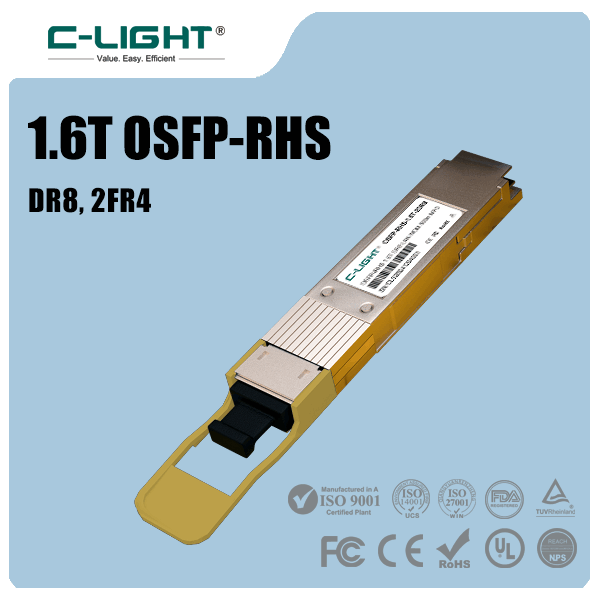
For emerging 1.6T switching platforms, OSFP-RHS optical connectivity provides a path toward higher port bandwidth and network density. Deployment requires a compatible host interface, supported optical configuration, and appropriate thermal design.
View 1.6T OSFP-RHS Products5. What Actually Determines Optical Link Latency?
Optical fiber provides high-speed signal transmission over long distances, but the total delay experienced by an AI workload is influenced by several separate components. Understanding these components helps network designers avoid attributing every latency problem to the optical module.
| Latency Component | What It Represents | Possible Optimization Direction |
|---|---|---|
| Serialization Delay | Time required to place a data packet onto a link | Use sufficient link bandwidth and suitable packet handling |
| Fiber Propagation | Time for the optical signal to travel through the fiber | Use shorter and more direct physical routes where practical |
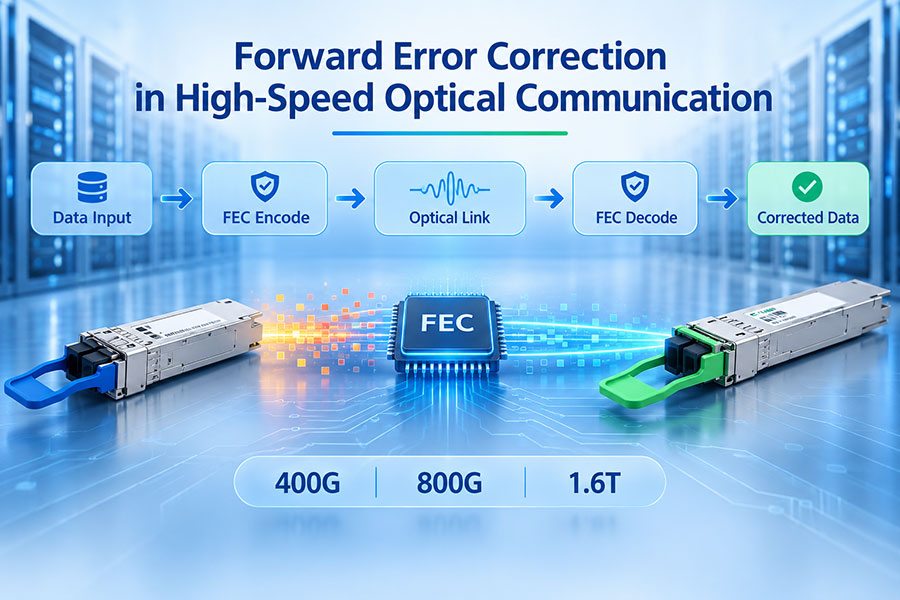
| Transceiver Processing | Electrical-to-optical and optical-to-electrical processing, including DSP and FEC where implemented | Evaluate module architecture and platform-specific latency specifications |
| Switching Delay | Time spent processing and forwarding traffic through switches | Choose suitable switching architecture and avoid unnecessary hops |
| Queueing Delay | Waiting time when traffic competes for shared network resources | Improve congestion management and traffic scheduling |
| Application Synchronization | Waiting for other computing nodes to complete dependent operations | Optimize workload partitioning and communication scheduling |
For fiber propagation, a useful engineering approximation is around 5 microseconds per kilometer of fiber in one direction. The actual value depends on the fiber's refractive index and physical characteristics. This means physical distance remains relevant even when the optical link has very high bandwidth.
Important distinction:
Optical transmission does not eliminate propagation delay, switching delay, or queueing. Its main value is providing high-capacity connectivity over practical distances with favorable bandwidth density and reach characteristics. Low end-to-end latency requires coordinated optimization across the optical layer, switching fabric, and inference software.
6. Network Topology and Traffic Management
The network topology determines how inference nodes communicate and how much shared capacity is available along each path. A leaf-spine architecture is commonly used for scalable data center fabrics because it provides multiple paths between rack-level switches and aggregation switches.
For latency-sensitive inference traffic, the topology should be evaluated against actual communication patterns rather than aggregate bandwidth alone. Tensor parallelism, for example, may benefit from predictable low-hop paths between participating GPUs. Expert parallelism requires sufficient capacity to handle traffic distributed across many nodes.
Traffic engineering is equally important. Quality of Service policies, congestion control, load balancing, and appropriate routing can help maintain predictable behavior when multiple inference jobs share the same fabric.
Keep frequently communicating GPU groups within efficient network domains where practical.
Provide sufficient uplink capacity for the expected communication pattern.
Reduce unnecessary routing hops on latency-sensitive paths.
Use traffic isolation and congestion management for mixed workloads.
Monitor latency distribution, packet loss, retransmissions, and link utilization.
Plan redundant paths without introducing avoidable traffic detours.
7. Fiber Selection and High-Density Optical Connectivity
Fiber infrastructure affects both the physical reach and deployment flexibility of distributed AI networks. The choice between multimode and single-mode fiber depends on the optical standard, transmission distance, module specification, and existing data center cabling system.
| Fiber Category | Typical Application | Advantages | Considerations |
|---|---|---|---|
| OM3 Multimode | Supported short-reach optical links | Established data center fiber infrastructure | Reach is limited by the selected optical standard |
| OM4 Multimode | Short-reach, high-speed connections | Higher modal bandwidth than OM3 | Verify supported distance at the target data rate |
| OS2 Single-Mode | Inter-rack, inter-row, and longer optical paths | Flexible reach options across multiple optical standards | Requires matching wavelength, connector, and link budget |
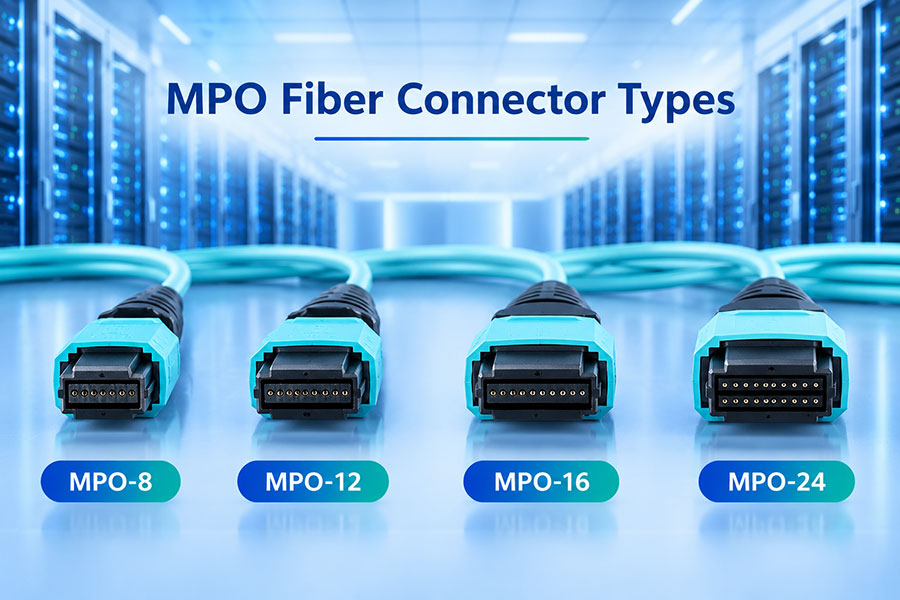
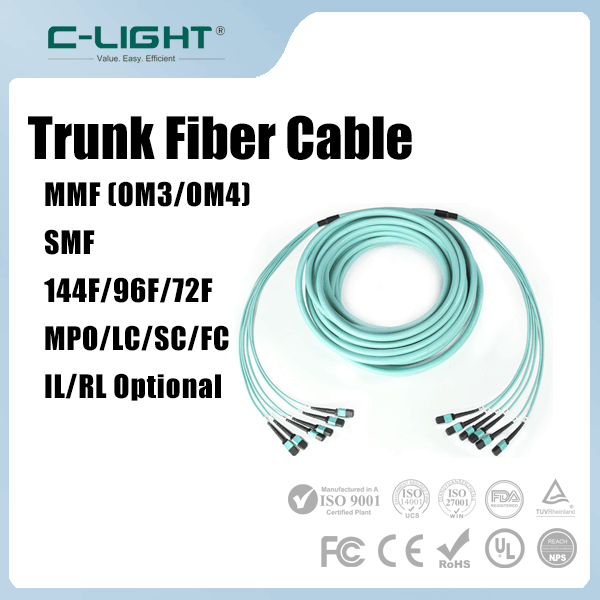
MPO/MTP trunk systems can help organize high-fiber-count connections in dense switching environments. For parallel optical interfaces, the fiber count, connector type, polarity, and breakout mapping must match the selected transceiver.
Duplex LC connections are used in many single-mode and duplex optical applications. Parallel MPO/MTP interfaces are common in multi-fiber configurations. These connector types serve different optical designs and should not be substituted without checking the module specification.
Clean connector endfaces, controlled bend radius, accurate labeling, and consistent fiber polarity are essential for reliable optical connectivity. In high-density environments, structured cable management also makes maintenance and future upgrades easier.
8. Optical Power Consumption and Thermal Considerations
Low-latency inference networks must also meet data center power and thermal constraints. High-speed optical transceivers consume electrical power to drive optical components and, depending on the architecture, perform signal processing and error correction.
As 400G, 800G, and 1.6T ports become more common, the combined power consumption of populated switch interfaces can become significant. Module temperature, switch airflow, heatsink design, and operating conditions should therefore be considered during deployment.
The lowest-power module is not necessarily the best option for every link. Reach, optical performance, host compatibility, and reliability must remain within the system requirements. A suitable balance between power consumption and transmission performance is more useful than optimizing one specification in isolation.
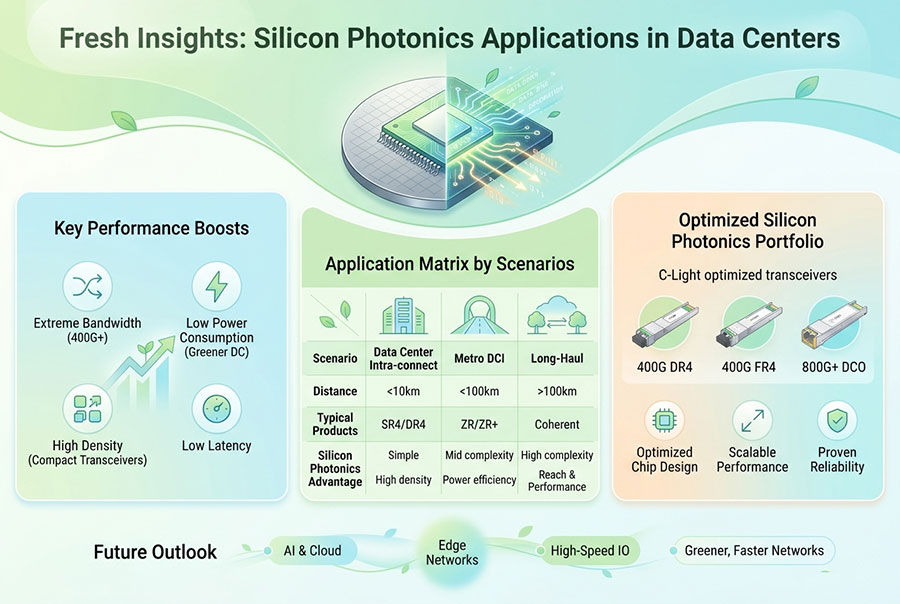
Emerging technologies such as LPO, silicon photonics, and co-packaged optics are also influencing optical interconnect development. These approaches aim to improve power efficiency and integration, but they involve different design and compatibility requirements. Their practical suitability depends on the network platform and deployment architecture.
9. Testing and Monitoring Low-Latency Optical Links
A low-latency optical network requires more than successful link establishment. Physical-layer performance and network behavior should be validated under representative operating conditions.
Optical power: Check transmit and receive power against the transceiver specifications.
Insertion loss: Verify the complete fiber path, including connectors, patch panels, and intermediate connections.
Link errors: Monitor FEC counters, symbol errors, CRC errors, and other platform-supported indicators.
Latency: Measure round-trip and one-way latency where accurate time synchronization is available.
Jitter: Evaluate latency variation under different traffic loads.
Congestion: Observe queue occupancy, packet drops, and network utilization during concurrent inference workloads.
Thermal conditions: Monitor module temperature and confirm that the host platform maintains suitable airflow.
Testing should distinguish between physical-link problems and higher-layer congestion. A healthy optical receive-power reading does not guarantee low application latency, just as a high network utilization reading does not necessarily indicate an optical fault.
10. Building an Efficient Optical Fabric for Distributed Inference
An efficient distributed inference network starts with workload-aware architecture planning. The number of accelerators, model partitioning strategy, expected request volume, and communication frequency all influence the required network capacity.
A practical deployment should combine appropriate optical data rates with efficient routing, suitable fiber infrastructure, and sufficient thermal headroom. High-speed optical modules can provide the bandwidth needed for distributed computing, while network software and workload scheduling help reduce unnecessary data movement.
For future expansion, 400G and 800G connectivity can support current high-capacity fabrics, while 1.6T platforms offer a path toward higher-density switching. The transition should be based on verified host compatibility, optical specifications, and the actual requirements of the inference architecture.
11. Conclusion
Low-latency optical links are an important part of distributed AI inference infrastructure. They connect GPU nodes, switching systems, and disaggregated computing resources through high-bandwidth optical paths, helping support communication-intensive inference workloads.
However, low latency is a system-level result rather than a property of the optical transceiver alone. Fiber distance, serialization, module processing, switching, congestion, and application synchronization all influence the final response time.
As AI inference clusters expand, 400G, 800G, and 1.6T optical connectivity will play an increasingly important role in scalable network design. Matching the transceiver, fiber infrastructure, switching platform, and traffic architecture is essential for achieving reliable performance and efficient resource utilization.
C-LIGHT provides optical transceiver and active optical connectivity solutions for high-speed data center and AI networking applications, supporting infrastructure requirements across different link rates and optical configurations.
Planning Optical Connectivity for Distributed AI Inference?
Contact C-LIGHT for optical transceiver specifications, connectivity options, and project support.
Contact C-LIGHT >

 >
 >
 >
 >
 >
 >
 >