TEL:+86 132 6656 7067




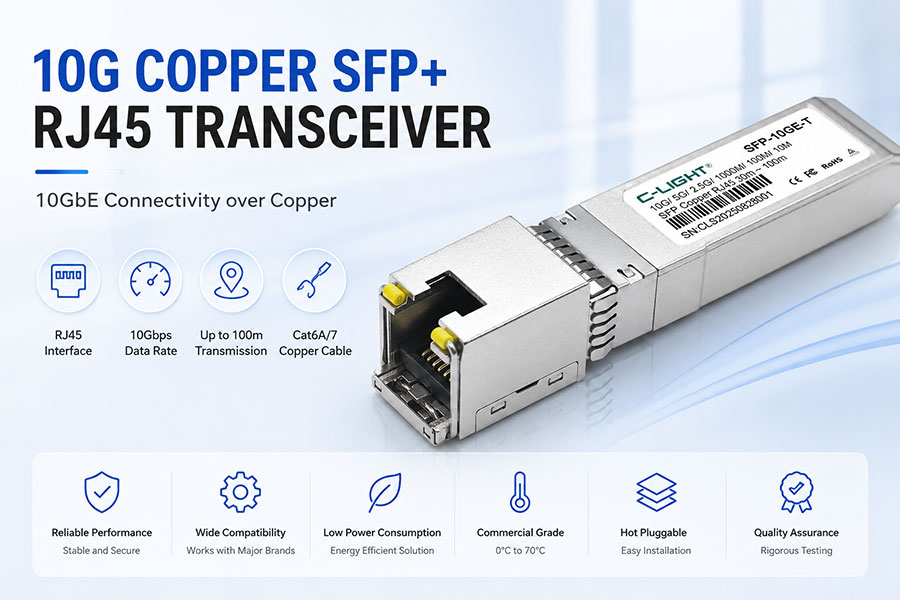
10 Gigabit Ethernet (10GbE) has become the mainstream standard for high-speed data center and enterprise network backbones, offering ten times the bandwidth of traditional Gigabit Ethernet with improved latency and scalability. A Small Form-Factor Pluggable Plus (SFP+) transceiver is the most common and compact interface module used for 10GbE connections.
The standard of 10 Gigabit Ethernet was established by ieee8023ae task force since March 1999, and 10 Gigabit Ethernet (10-GbE) standard was officially released in August 2002.
10 Gigabit Ethernet is developed on the basis of Ethernet technology, but the working speed is greatly improved, the scope of application has changed a lot, compared with the original Ethernet technology, there are great differences, mainly in: physical layer implementation mode, frame format, MAC working speed and adaptation strategy.
10 Gigabit Ethernet can be used as LAN or WAN, but the working environment between them is different, and there are many differences in the requirements of each index. In view of this situation, two different physical media (PHY) standards have been developed.
The cost of man and WAN based on Ethernet technology is about 25% lower than that of similar systems based on atmisonet technology. It is these factors that make Ethernet extends from
The LAN to MAN and WAN, and establishes a reliable and high working rate of 10Gbps fast data network.
Physical layer of 10G Ethernet
The common point of the two physical layers is that they share a MAC layer, only support full duplex, and omit CSMA / CD strategy. Optical fiber is used as the physical medium. The difference between these two PHY is that in the wide area network, the interface sublayer (WIS) contains
Simplified SONET / SDH frame. In order to reduce the operation cost of PHY in WAN, IEEE802.3ae working group has integrated SONET / SDH and other relevant standards, so that 10 Gigabit Ethernet can use SONET / SDH to smoothly pass through the wide area backbone network.
Features of 10G LAN Ethernet physical layer is to support 802.3 MAC complete duplex working mode. Frame format is in accordance with that of Ethernet. Working rate is 10Gbps. An existing LAN can be upgraded to a 10G LAN with minimal cost. And the network range of the LAN can reach up to 40 kilometers.
The physical layer of 10G WAN adopts OC-192c frame format for online transmission. Since sharing one MAC layer with 10G LAN Ethernet, WIS (WAN interface sub-layer) is needed for reflection function from Ethernet frame to OC-192c frame.
Because transferring rate of 10G WAN physical layer is 9.58464Gbps, and working rate of MAC lay is 10Gbps, it is necessary to lower down transferring rate 10Gbps of 10GMII interface as an adjustment accordingly, to match it with the physical layer's transmission rate of 9.58464Gbps. Here distance of data packages can be adjusted to match the lower data transferring rate of OC-192c with that of 10G Ethernet.
Physical interface of 10G Ethernet
10G Ethernet includes 10GBASE-X, 10GBASE-R and 10GBASE-W.

10GBASE-X uses a very compact package, which contains 1 simpler WDM device, 4 receivers and four lasers working at an interval of about 25nm near the 1300nm wavelength, each pair of transmitters/receivers working at a speed of 3.125Gbit/s (data flow speed of 25Gbit/s).
10GBASE-R is a serial interface using 64B / 66B encoding. The data stream is 10.000Gbit/s, resulting in a clock rate of 10.3125Gbit/s.
10GBASE-W is a WAN interface, which is compatible with SONET OC-192. Its clock is 9.585Gbit/s for 9.953Gbit/s data flow.
10 Gigabit Ethernet and Optical Transceiver FAQ
Q1: What is 10 Gigabit Ethernet (10GbE)?
A: 10 Gigabit Ethernet (10GbE) is an Ethernet standard that provides 10Gbps data transmission speed, which is ten times faster than traditional Gigabit Ethernet.
10GbE is designed to support high-bandwidth network applications, including:
Data center backbone networks
Enterprise network upgrades
Cloud computing infrastructure
Server aggregation networks
Telecom communication systems
Compared with previous Ethernet technologies, 10GbE improves:
Network bandwidth
Scalability
Data transmission efficiency
Network performance
It has become an important transition technology between Gigabit Ethernet and higher-speed networks such as 25G, 100G, and 400G Ethernet.
Q2: Why is 10 Gigabit Ethernet important for modern networks?
A: The growth of cloud computing, virtualization, video services, and data-intensive applications has increased the demand for higher network bandwidth.
10GbE provides:
Higher Bandwidth
Supports 10Gbps data transmission
Handles increasing network traffic
Better Scalability
Enables network expansion
Supports high-performance applications
Lower Upgrade Cost
Allows existing Ethernet infrastructure upgrades
Flexible Deployment
Supports LAN, MAN, and WAN applications
For many enterprises and data centers, 10GbE remains a widely deployed networking solution due to its maturity and reliability.
Q3: What are the main 10 Gigabit Ethernet standards?
A: 10 Gigabit Ethernet includes several physical layer standards designed for different transmission environments.
| Standard | Fiber Type | Typical Application |
|---|---|---|
| 10GBASE-SR | Multimode Fiber | Short-distance data center links |
| 10GBASE-LR | Single-mode Fiber | Enterprise and metro networks |
| 10GBASE-ER | Single-mode Fiber | Long-distance transmission |
| 10GBASE-W | WAN Interface | Carrier network applications |
Different standards provide different transmission distances and are selected according to network requirements.
Q4: What optical transceivers are used for 10 Gigabit Ethernet?
A: 10 Gigabit Ethernet can use several types of optical transceivers depending on network requirements.
Common 10G optical modules include:
10G SFP+ Transceiver
Most widely used 10G optical module
Compact size
Low power consumption
High port density
10G XFP Transceiver
Earlier 10G optical module technology
Used in telecom and legacy systems
10G BiDi SFP+
Uses single fiber transmission
Saves fiber resources
10G CWDM/DWDM Modules
Support wavelength multiplexing
Suitable for long-distance networks
SFP+ has become the mainstream choice for modern 10GbE deployments due to its compact design and ecosystem support.
Q5: What is the difference between 10G SFP+ and 10G XFP?
A: 10G SFP+ and XFP are both 10Gbps optical transceiver formats, but they differ in package design and application focus.
| Feature | 10G SFP+ | 10G XFP |
|---|---|---|
| Package | Smaller | Larger |
| Power Consumption | Lower | Higher |
| Port Density | Higher | Lower |
| Application | Data center, enterprise | Telecom, legacy networks |
| Market Adoption | Mainstream | Existing deployments |
SFP+ provides a more compact and power-efficient solution, while XFP remains useful in some existing 10G network systems.
Q6: What are the applications of 10 Gigabit Ethernet optical transceivers?
A: 10G optical transceivers are widely used in different network environments.
Data Center Networks
Applications:
Server-to-switch connections
Storage networks
Backbone links
Enterprise Networks
Applications:
Campus networks
Core switches
Network aggregation
Telecom Networks
Applications:
Metro networks
Optical transport systems
Long-distance communication
Cloud Infrastructure
Applications:
Virtualized environments
High-performance computing networks
10G optical modules provide a reliable and cost-effective solution for medium-speed network deployment.
Q7: How do you choose the right 10G optical transceiver?
A: Selecting a suitable 10G optical module requires evaluating several factors.
1. Transmission Distance
Choose based on:
300m
10km
40km
80km+
2. Fiber Type
Consider:
Multimode fiber (MMF)
Single-mode fiber (SMF)
3. Network Application
Determine whether it is used for:
Data center
Enterprise backbone
Telecom network
4. Equipment Compatibility
Confirm compatibility with:
Switches
Routers
Network platforms
Correct selection ensures stable transmission and efficient network deployment.
Q8: What is the future of 10 Gigabit Ethernet?
A: Although modern networks are moving toward 25G, 100G, 400G, and 800G technologies, 10GbE continues to play an important role.
Future trends include:
Continued use in enterprise networks
Upgrading legacy Gigabit infrastructure
Integration with higher-speed backbone networks
Replacement of older copper-based connections
10GbE remains an important foundation technology for many organizations because of its mature ecosystem, cost efficiency, and broad compatibility.
 >
>

 >
>
 >
>
 >
>
 >
>
 >
>
 >
>
 >
>