TEL:+86 132 6656 7067





As 400G Ethernet and InfiniBand infrastructure expands across AI data centers and high-performance computing environments, choosing the right physical interconnect becomes increasingly important. Direct Attach Copper (DAC) and Active Optical Cable (AOC) both provide high-bandwidth connectivity, but their electrical and optical architectures create different advantages in reach, power consumption, cable management, and deployment cost. The right choice depends on where the equipment is installed and what the network connection needs to achieve.
Direct copper transmission for short, power-efficient connections within equipment racks.
Integrated optical transmission for longer connections between servers, switches, and racks.
These are the listed length ranges for C-LIGHT's respective product families. Other manufacturers may offer different configurations, so the exact model specification should determine the final selection.
1. Understanding the Architecture of 400G DAC and AOC
400G DAC: Direct Electrical Transmission
A 400G DAC cable connects two compatible high-speed ports through copper conductors. Its passive architecture does not require optical transmitters or receivers inside the cable assembly. Electrical signals travel directly between the connected devices.
This makes passive DAC particularly suitable for short connections where minimizing power consumption, component cost, and installation complexity is important. However, electrical signal attenuation limits its practical reach.
400G AOC: Integrated Optical Transmission
A 400G AOC integrates optical conversion components into both cable ends. Electrical signals are converted into optical signals, transmitted through multimode fiber, and converted back into electrical signals at the receiving endpoint.
Because the transmission medium is optical fiber, AOC can support longer connections than passive copper DAC and provides immunity to electromagnetic interference along the fiber section.
2. Key Differences Between 400G DAC and 400G AOC
| Comparison Factor | 400G DAC | 400G AOC |
|---|---|---|
| Transmission Medium | Copper conductors | Multimode optical fiber |
| Data Rate | 400Gbps | 400Gbps |
| C-LIGHT Product Length | 0.5–3 m | 1–30 m |
| Optical Components | Not required in passive DAC | Integrated at both ends |
| Power Consumption | Very low for passive designs | Higher due to optical components |
| Signal Transmission | Electrical | Optical over fiber |
| Electromagnetic Interference | Requires appropriate electrical cable design and installation | Immune to EMI along the fiber transmission path |
| Cable Weight | Generally heavier and thicker | Generally lighter for comparable longer runs |
| Typical Application | Short intra-rack connections | Longer short-reach and inter-rack connections |
| Relative Cost | Generally lower | Generally higher |
3. Transmission Distance: The First Selection Factor
Distance is usually the most important factor when deciding between 400G DAC and AOC. A passive copper channel becomes more challenging as cable length increases because insertion loss and signal distortion reduce the available electrical margin.
For very short connections, DAC is often the most economical option. When equipment is separated by several meters, AOC becomes more practical because optical transmission supports a longer cable route without relying on a long copper electrical channel.
| Physical Link Distance | Preferred Starting Point | Deployment Consideration |
|---|---|---|
| 0.5–1 m | 400G DAC | Suitable for very short connections between adjacent equipment. |
| 1–2 m | 400G DAC | Check passive cable and host electrical channel support. |
| 2–3 m | 400G DAC or AOC | DAC may remain suitable if the exact system supports the length. |
| 3–10 m | 400G AOC | Useful for longer rack-level and nearby equipment connections. |
| 10–30 m | 400G AOC | Suitable for supported multimode optical connections. |
| Beyond 30 m | Separate optical transceivers | Select the appropriate optical interface and fiber system. |
The ranges above are selection guidance based on the C-LIGHT product portfolio, not universal electrical or optical limits. The exact supported length and platform compatibility must be confirmed before deployment.
4. Power Consumption and Operating Efficiency
Power consumption becomes significant when hundreds or thousands of high-speed connections are installed in a data center. Even a small difference in power per connection can affect the overall rack power budget and cooling requirements.
Passive 400G DAC does not require optical conversion components. C-LIGHT specifies less than 0.1W for its passive 400G DAC design. This makes it attractive for short connections where low power consumption is a priority.
AOC contains active optical components that require electrical power at both ends. Its power consumption is therefore higher than that of a passive DAC, although it provides the advantage of optical transmission over a longer distance.
For accurate power planning, use the maximum power specifications of the exact cable model and account for the number of installed connections. Do not compare passive DAC with an active copper cable or AOC as if they had the same internal architecture.
5. Cable Management, Weight, and Rack Layout
Cable management can become a major challenge in 400G data center deployments. High-speed switches contain many ports, and the resulting cable bundles can affect airflow, maintenance access, and equipment installation.
DAC is suitable for short, direct routes between equipment in the same rack. Its simple architecture is useful when the cable path is short and the rack layout provides sufficient space for copper cable routing.
AOC is generally lighter and more flexible for longer runs. Its fiber construction can simplify routing between adjacent racks and through dense cable pathways.
At higher data rates, copper cable bundles can become bulky and may require careful management around switch ports. AOC can reduce some of these physical constraints, particularly when a large number of connections extend beyond a single rack.
6. Latency and Signal Integrity
Both 400G DAC and AOC can provide low-latency connectivity for high-performance networking. Their transmission mechanisms differ, but neither should be selected based on an assumption that one automatically guarantees better application-level latency.
Passive DAC provides a direct electrical path without optical conversion stages. AOC introduces electrical-to-optical and optical-to-electrical conversion at the endpoints, but modern optical assemblies are designed for high-speed, low-latency applications.
In practical network design, host SerDes behavior, FEC configuration, switch processing, cable characteristics, and the complete system architecture all contribute to end-to-end latency.
Signal integrity also needs to be evaluated differently:
DAC: Evaluate insertion loss, return loss, impedance consistency, and the electrical channel margin.
AOC: Evaluate optical output power, receiver sensitivity, optical performance, and the specified fiber reach.
Both: Verify error performance and stable link operation using the intended network equipment.
7. Compatibility: QSFP-DD, OSFP, and Breakout Configurations
A 400G cable must match the form factor, electrical interface, and supported protocol of the connected devices. Physical connector compatibility alone does not guarantee that a link will operate correctly.
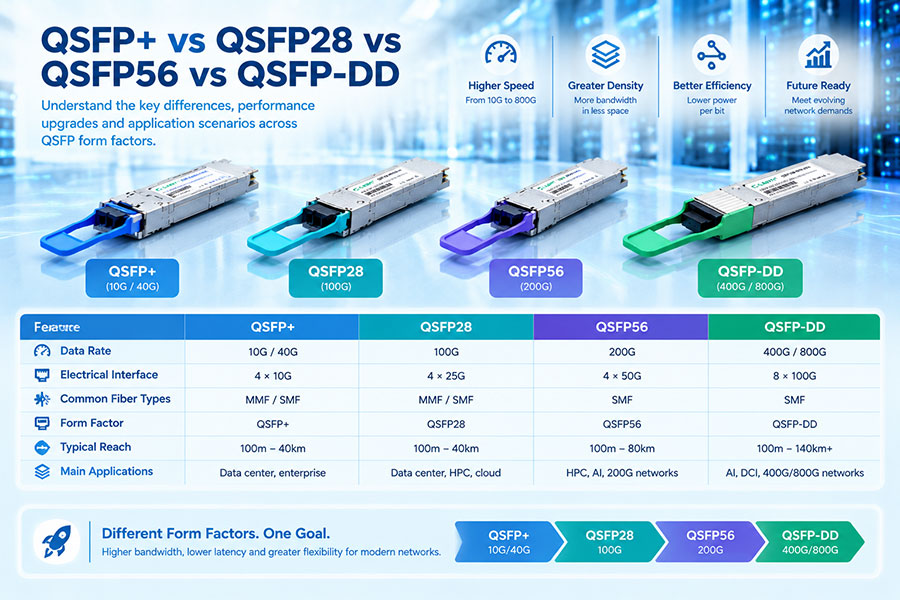
Common 400G cable configurations include QSFP-DD, OSFP, QSFP112, and other platform-specific interfaces. Native 400G connections and breakout configurations also require different endpoint arrangements.
| Configuration | Connection Architecture | What to Verify |
|---|---|---|
| 400G to 400G | Native high-speed connection | Both endpoints support the same interface and operating mode. |
| 400G to 2 × 200G | Two-way breakout | Switch breakout mode and compatible endpoint interfaces. |
| 400G to 4 × 100G | Four-way breakout | Lane mapping, port configuration, and supported breakout mode. |
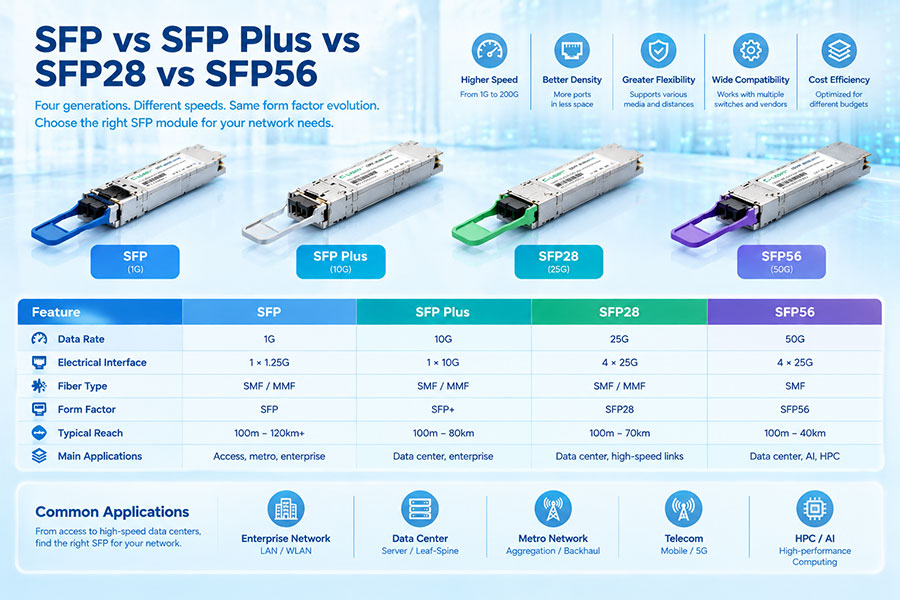
| 400G to 8 × 50G | Eight-way breakout | Supported SFP56 interfaces and platform configuration. |
8. Which Cable Is Better for AI Data Centers?
AI training clusters require high-bandwidth communication between GPU servers, network adapters, and switches. The best interconnect depends on the physical network topology rather than the workload name alone.
400G DAC for Intra-Rack Connections
When GPU servers and switches are installed in the same rack, short DAC connections can reduce power consumption and cable component costs. This is especially useful in dense computing environments where many short links are deployed.
400G AOC for Inter-Rack Connections
When network devices are distributed across neighboring racks, AOC provides additional reach and a lighter optical cable assembly. Its immunity to electromagnetic interference along the fiber also helps in environments with dense electrical infrastructure.
A practical AI network can use DAC for short local connections and AOC for longer short-reach connections. This hybrid design avoids unnecessary optical conversion on very short links while retaining the reach and routing flexibility required elsewhere.
9. Cost Comparison and Total Deployment Considerations
Passive 400G DAC generally has a lower initial cable cost because it does not contain integrated optical engines. For a large number of very short links, this can produce meaningful savings.
AOC generally costs more because it integrates optical components and fiber into the cable assembly. However, its longer reach can reduce the need for alternative cabling arrangements when equipment is distributed across racks.
A useful cost evaluation should consider more than the purchase price:
Initial cable procurement cost.
Power consumption across all installed connections.
Rack cable management and installation labor.
Cooling and airflow implications.
Maintenance and replacement requirements.
Future equipment relocation and network expansion.
10. C-LIGHT 400G DAC and AOC Product Solutions
400G DAC Cable Family
C-LIGHT's 400G DAC product family is designed for short-distance, high-bandwidth electrical connections in AI data centers, InfiniBand networks, HPC systems, and compatible Ethernet environments.
Listed configurations include QSFP112, OSFP112, OSFP56, and QSFP-DD interfaces, with cable lengths generally ranging from 0.5m to 3m. Selected QSFP112 and OSFP112 configurations are specified for 0.5m to 2m.
Breakout options include 400G to 2 × 200G, 400G to 4 × 100G, and 400G to 8 × 50G configurations, depending on the model.
400G AOC Cable Family
C-LIGHT's 400G AOC product family provides optical connectivity for longer short-reach data center links.
Listed configurations use 850nm multimode optical transmission over OM3 fiber, with available lengths from 1m to 30m. Supported interface options include OSFP112, QSFP112, and QSFP-DD, together with selected breakout arrangements.
These configurations are suitable for compatible server, switch, and high-performance computing interconnections where the required distance exceeds the practical range of passive copper.
C-LIGHT can support product selection according to interface type, required length, breakout topology, and equipment compatibility. For technical specifications, customized configurations, and project requirements, Contact C-LIGHT.
11. A Practical Selection Guide
The connection is very short, typically within 0.5–3m for the listed C-LIGHT products.
Both devices support the required passive copper interface.
Low power consumption and lower initial cost are priorities.
The rack layout can accommodate the cable's thickness and bend requirements.
The required connection is longer than the supported passive DAC length.
The equipment is distributed across racks or other nearby locations.
Lower cable weight and greater routing flexibility are important.
Optical isolation from electromagnetic interference is beneficial.
12. Conclusion
400G DAC and 400G AOC are complementary interconnection solutions. DAC is generally the better choice for very short, power-conscious, cost-sensitive connections within a rack. AOC is more appropriate when the link requires greater reach, lighter cable routing, or the advantages of optical transmission.
For C-LIGHT's listed products, 400G DAC covers 0.5m to 3m, while 400G AOC covers 1m to 30m. By evaluating transmission distance, equipment compatibility, power requirements, breakout topology, and cable management together, network designers can select the appropriate solution for each connection in a 400G infrastructure.
 >

 >
 >
 >
 >
 >
 >
 >