TEL:+86 132 6656 7067





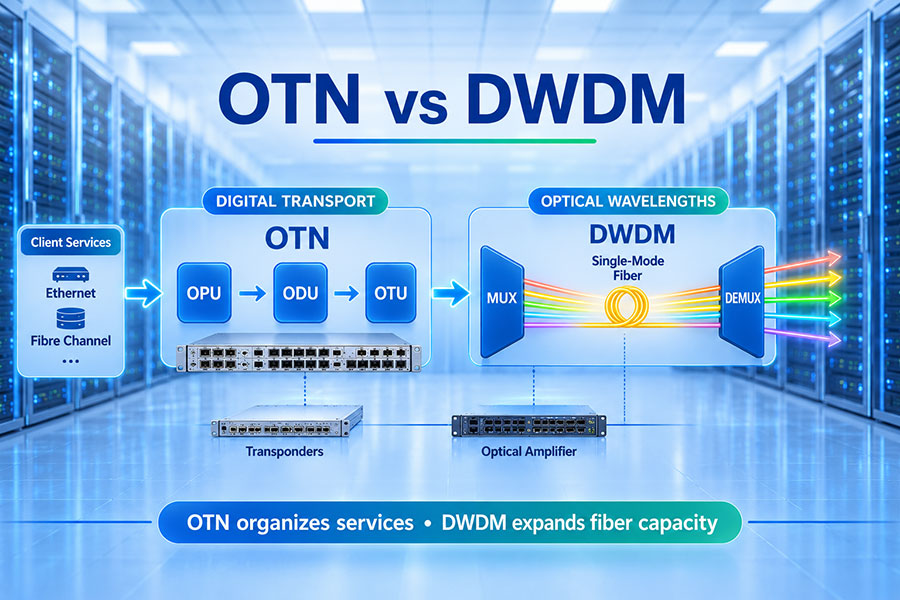
As optical networks expand to support cloud computing, telecommunications, and large-scale data center interconnects, maximizing the capacity of existing fiber infrastructure becomes increasingly important. Dense Wavelength Division Multiplexing (DWDM) addresses this requirement by transmitting multiple optical channels through a shared fiber.
Unlike CWDM, which uses a fixed 20nm wavelength grid, DWDM operates with much narrower frequency spacing. Depending on the available optical bandwidth and channel configuration, a DWDM system can support dozens or even more than one hundred wavelength channels.
Common reference configurations include 40 channels at 100GHz spacing and 80 channels at 50GHz spacing within an illustrative 4THz usable spectrum. Actual channel capacity depends on the selected optical band, frequency grid, equipment, and transmission design.
1. How Many Channels Can DWDM Support?
There is no single fixed maximum channel count for all DWDM systems. The number of available channels depends primarily on the usable optical spectrum and the spacing between adjacent channel center frequencies.
For example, if a system has approximately 4THz of usable spectrum, the theoretical channel count can be estimated as follows:
The result is an illustrative planning estimate. Actual channel allocation must account for spectrum boundaries, channel slots, guard bands, and equipment limitations.
| Channel Spacing | Illustrative 4THz Capacity | Relative Channel Density |
|---|---|---|
| 100GHz | Approximately 40 channels | Standard density |
| 50GHz | Approximately 80 channels | Higher density |
| 25GHz | Approximately 160 grid positions | Very high grid density |
| 12.5GHz | Approximately 320 grid positions | Fine frequency granularity |
These figures illustrate frequency-grid density rather than guaranteed independent data-channel counts. A narrower grid does not automatically mean that every position can carry a separate conventional transceiver signal. Signal bandwidth, modulation, filtering, guard bands, and flexible-grid slot allocation must also be considered.
2. Why Does DWDM Support More Channels Than CWDM?
The main reason is channel spacing. CWDM uses nominal 20nm wavelength intervals, whereas DWDM uses much narrower frequency intervals, commonly 100GHz or 50GHz in traditional fixed-grid deployments.
Because DWDM channels are closer together, more channels can fit within the same optical frequency range.
CWDM
Uses a nominal 20nm wavelength grid. It is generally suitable for moderate channel counts and comparatively simple optical deployments.
DWDM
Uses closely spaced frequency channels. It supports higher channel density and is widely deployed in high-capacity optical transport systems.
For a simplified comparison, consider the following configurations:
| Technology | Typical Grid Spacing | Illustrative Channel Count |
|---|---|---|
| CWDM | 20nm | 18 nominal channels |
| DWDM | 100GHz | Approximately 40 channels in 4THz |
| DWDM | 50GHz | Approximately 80 channels in 4THz |
The actual channel count comparison depends on the optical bandwidth being considered. CWDM and DWDM use different grid definitions, so their channel counts should not be compared without considering the available spectrum.
3. What Is the Relationship Between Channel Spacing and Channel Count?
Channel spacing determines the frequency interval between adjacent DWDM channel centers. Smaller spacing allows more center frequencies within the same spectrum, provided the transmitters, receivers, and optical filters support the tighter arrangement.
ITU-T G.694.1 defines the DWDM frequency grid around a reference frequency of 193.1THz. Supported fixed-grid spacings include 100GHz, 50GHz, 25GHz, and 12.5GHz, with flexible-grid operation also defined.
For a fixed frequency grid, channel center frequencies are calculated using the selected spacing. For example, on a 50GHz grid, adjacent channel centers differ by 0.05THz.
193.10THz
193.15THz
193.20THz
193.25THz
193.30THz
Each adjacent frequency in this example is separated by 50GHz.
DWDM channel spacing is normally specified in frequency units rather than fixed nanometer intervals. This is because a constant frequency difference corresponds to slightly different wavelength differences at different positions in the optical spectrum.
4. How Many Channels Can C-Band DWDM Support?
The C-band is one of the most widely used wavelength regions for DWDM transmission. It is particularly important in long-distance optical networks because erbium-doped fiber amplifiers (EDFAs) can amplify multiple optical channels within their supported operating band.
The number of channels depends on the usable C-band width and the selected frequency spacing. Two familiar planning examples are:
100GHz C-Band Configuration
A traditional 100GHz grid can provide approximately 40 channels across a 4THz usable frequency range.
50GHz C-Band Configuration
A 50GHz grid can provide approximately 80 channels across the same 4THz usable frequency range.
Some commercial systems use extended C-band bandwidth and can support higher channel counts. The exact number depends on the supported spectral boundaries, filter passbands, transceiver frequency range, and line-system design.
Channel counts such as 40, 80, or 96 therefore describe particular equipment and spectrum configurations rather than universal limits imposed by the DWDM technology.
5. Can DWDM Support More Than 100 Channels?
Yes. DWDM systems can support more than 100 channels when sufficient optical bandwidth and suitable channel spacing are available.
There are several ways to increase the number of available channels:
Use narrower channel spacing: Moving from a 100GHz grid to a 50GHz grid increases the number of available frequency positions within the same spectrum.
Extend the usable optical band: Equipment designed for a wider spectral range can accommodate additional channels.
Use C-band and L-band: Suitable systems can operate across both bands, increasing the total available optical spectrum.
Adopt flexible-grid architecture: Flexible-grid systems allocate frequency slots with different widths to accommodate different signal bandwidth requirements.
6. What Is Flexible-Grid DWDM?
Traditional fixed-grid DWDM systems assign channels to predefined frequency intervals. Every channel follows the selected grid spacing, such as 50GHz or 100GHz.
Flexible-grid DWDM uses variable frequency slots instead of requiring every signal to occupy an identical fixed-width channel. This allows the optical system to allocate spectrum according to the bandwidth required by a particular signal.
This approach is useful for modern coherent transmission systems, where different data rates and modulation formats may require different spectral widths.
| Feature | Fixed-Grid DWDM | Flexible-Grid DWDM |
|---|---|---|
| Frequency allocation | Predefined channel spacing | Variable frequency-slot width |
| Channel width | Generally follows a fixed grid arrangement | Can be allocated according to signal requirements |
| Signal support | Depends on the selected fixed grid | More adaptable to different signal bandwidths |
| Network planning | Based on predefined channel positions | Requires coordinated spectrum allocation |
| Typical application | Conventional DWDM line systems | Modern high-capacity optical transport |
Flexible-grid operation is particularly relevant to superchannels, where multiple optical subcarriers can be arranged together within a wider frequency allocation. The usable capacity is determined by the allocated slot width and the signal's spectral requirements, not simply by counting every 12.5GHz grid position as an independent channel.
7. Does a Higher Channel Count Always Mean Higher Network Capacity?
No. The number of optical channels and the total network capacity are related, but they are not the same measurement.
Aggregate capacity depends on both the number of active channels and the data rate carried by each channel.
Actual payload throughput may be lower because of framing, FEC, and protocol overhead.
| Active Channels | Data Rate per Channel | Aggregate Line Rate |
|---|---|---|
| 40 | 10Gbps | 400Gbps |
| 40 | 100Gbps | 4Tbps |
| 80 | 100Gbps | 8Tbps |
| 80 | 200Gbps | 16Tbps |
| 80 | 400Gbps | 32Tbps |
These are simplified capacity calculations. Whether a particular DWDM system can support a given combination of channel count and data rate depends on the transponder, modulation format, spectral efficiency, optical signal quality, and line-system capabilities.
8. What Limits the Number of Usable DWDM Channels?
Although the frequency grid defines available channel positions, practical deployment requires every channel to operate within the limits of the complete optical transmission system.
Available Optical Bandwidth
The usable spectrum determines how much frequency space is available. A system restricted to a portion of the C-band cannot use channels outside its supported range.
Transmitter Frequency Accuracy
DWDM transmitters must operate at the correct center frequency. Their frequency stability and tolerance must remain compatible with the channel allocation and optical filter passband.
Optical Filter Characteristics
MUX/DEMUX equipment must separate adjacent channels without unacceptable interference. Narrower channel spacing places greater demands on filter characteristics and signal spectral width.
Optical Signal-to-Noise Ratio
OSNR is an important performance parameter in amplified DWDM systems. Amplifier noise and accumulated transmission impairments can affect the quality of individual channels.
Fiber Nonlinear Effects
When many channels share a fiber, their optical powers and interactions can produce nonlinear impairments. Channel loading and launch power must be carefully managed.
Dispersion and Transmission Distance
Chromatic dispersion and other transmission impairments can limit the performance of certain modulation formats and data rates, particularly over long fiber spans.
Amplifier Bandwidth
Optical amplifiers must support the intended wavelength range. A system operating across multiple bands may require different amplifier configurations and additional line-system planning.
9. How to Select the Right DWDM Channel Configuration
The appropriate channel count should be determined by the network's capacity requirements, transmission distance, available fiber, and planned expansion.
| Network Requirement | Potential Configuration | Selection Consideration |
|---|---|---|
| Moderate channel density | 100GHz grid | Suitable where wider channel spacing meets capacity requirements. |
| Higher channel density | 50GHz grid | Provides more frequency positions within the same spectrum. |
| Variable signal bandwidth | Flexible grid | Allows frequency-slot allocation according to signal requirements. |
| Very high aggregate capacity | Extended-band or multi-band DWDM | Requires compatible amplifiers, filters, transponders, and line equipment. |
Before choosing a configuration, engineers should:
Calculate the required aggregate bandwidth and number of optical services.
Determine the available optical band and usable frequency range.
Select the channel spacing or flexible-grid slot arrangement.
Match transponder frequencies with the MUX/DEMUX channel plan.
Verify fiber attenuation, insertion loss, and receiver power limits.
Evaluate OSNR, dispersion, and nonlinear effects for the intended distance.
Reserve sufficient spectrum for future capacity expansion.
10. C-LIGHT High-Speed Optical Connectivity
DWDM line systems rely on compatible optical transceivers, transponders, multiplexers, and transmission equipment. The optical interface must match the required wavelength or frequency, data rate, modulation format, and system architecture.
C-LIGHT provides high-speed optical connectivity product families for data center and telecommunications infrastructure, including:
Designed for supported 400G network interfaces and high-bandwidth data center applications.
View 400G QSFP-DD ProductsAvailable across different optical interface configurations for supported high-speed network deployments.
View 400G OSFP ProductsFor next-generation high-bandwidth data center connectivity and network infrastructure.
View 800G QSFP-DD ProductsHigh-speed optical connectivity options for supported 800G network architectures.
View 800G OSFP ProductsThese product families should not automatically be treated as DWDM line interfaces. Their suitability for a specific DWDM deployment must be verified against the exact product wavelength, optical specifications, and transmission architecture.
11. Conclusion
DWDM can support dozens or more than one hundred optical channels, depending on the available spectrum, channel spacing, and equipment configuration. Common reference systems include approximately 40 channels at 100GHz spacing and 80 channels at 50GHz spacing across an illustrative 4THz usable spectrum.
Higher channel counts are possible through narrower frequency grids, extended optical bands, C-band and L-band operation, and flexible-grid architectures. However, practical capacity also depends on optical filtering, transmitter accuracy, OSNR, amplifier performance, and fiber transmission conditions.
For network planning, the most important task is not simply maximizing the number of channels. It is selecting a channel configuration that provides the required aggregate capacity while maintaining reliable optical performance and allowing future expansion.
Contact C-LIGHT with your channel count, frequency spacing, data rate, transmission distance, and optical interface requirements for connectivity support.
Contact C-LIGHT >

 >
 >
 >
 >
 >
 >
 >