TEL:+86 132 6656 7067





Fiber capacity is not determined only by the transmission rate of an individual optical module. In wavelength division multiplexing systems, several optical signals can share the same fiber by operating at different wavelengths. Coarse Wavelength Division Multiplexing (CWDM) uses this principle to increase network capacity without requiring a separate fiber for every optical connection.
Under the standard ITU-T CWDM wavelength grid, up to 18 nominal wavelength channels are defined, with 20nm spacing from 1271nm to 1611nm. However, the number of channels available in a practical link depends on the optical components, fiber characteristics, wavelength compatibility, and system design.
1. How Many Wavelength Channels Does CWDM Support?
The standard CWDM grid defined in ITU-T G.694.2 provides 18 nominal wavelength channels. These channels are spaced 20nm apart, beginning at 1271nm and extending to 1611nm.
Each channel can carry an independent optical signal. A CWDM multiplexer combines the signals, and a demultiplexer separates them at the receiving end.
| Channel | Nominal Wavelength | Channel | Nominal Wavelength |
|---|---|---|---|
| CH1 | 1271nm | CH10 | 1451nm |
| CH2 | 1291nm | CH11 | 1471nm |
| CH3 | 1311nm | CH12 | 1491nm |
| CH4 | 1331nm | CH13 | 1511nm |
| CH5 | 1351nm | CH14 | 1531nm |
| CH6 | 1371nm | CH15 | 1551nm |
| CH7 | 1391nm | CH16 | 1571nm |
| CH8 | 1411nm | CH17 | 1591nm |
| CH9 | 1431nm | CH18 | 1611nm |
2. What Does 20nm Channel Spacing Mean?
Channel spacing is the nominal wavelength difference between adjacent CWDM channels. With a 20nm grid, each channel is separated from its neighbor by 20nm.
For example:
1271nm to 1291nm: 20nm
1291nm to 1311nm: 20nm
1511nm to 1531nm: 20nm
1591nm to 1611nm: 20nm
The relatively wide spacing allows CWDM systems to use less tightly controlled wavelength sources and broader optical filters than dense WDM systems. It also makes channel planning comparatively straightforward.
3. Does Every CWDM System Support All 18 Channels?
No. Eighteen channels represent the complete nominal channel set defined by the standard CWDM grid, not a guarantee that every CWDM product supports all 18 channels.
Commercial CWDM equipment is available in different channel configurations, such as 2-channel, 4-channel, 8-channel, 9-channel, and 18-channel systems. The actual configuration depends on the MUX/DEMUX design and the intended application.
4-Channel CWDM
Suitable for applications requiring a small number of independent optical links over a shared fiber route.
8-Channel CWDM
Provides additional capacity for enterprise, campus, and metropolitan fiber aggregation.
9-Channel CWDM
Uses a selected portion of the standard grid, depending on the equipment's wavelength configuration.
18-Channel CWDM
Uses the full nominal 18-channel grid when the complete optical system supports the required wavelength range.
A system with an 8-channel multiplexer cannot automatically use all 18 channels simply because the standard defines them. Additional channels require compatible optical hardware and a suitable wavelength plan.
4. Can CWDM Carry 18 Channels Over One Fiber Strand?
Yes, an 18-channel CWDM system can combine all 18 wavelengths onto one optical fiber strand in a single transmission direction, provided the equipment and fiber path support the full channel plan.
For bidirectional communication, the network design needs to account for the direction of transmission. A common arrangement uses a pair of fibers, with one fiber carrying the multiplexed channels in one direction and the other carrying channels in the opposite direction.
Some CWDM systems use a single fiber for bidirectional transmission by assigning different wavelength groups to opposite directions through appropriate optical components. This is a specific system architecture, not an automatic feature of every 18-channel MUX/DEMUX.
5. How Much Capacity Can an 18-Channel CWDM System Provide?
The aggregate capacity depends on the data rate assigned to each wavelength channel. A simple calculation is:
For example, if every channel carries 10Gbps, the theoretical aggregate channel rate is:
Other simplified examples include:
| Active Channels | Rate per Channel | Theoretical Aggregate Rate |
|---|---|---|
| 4 | 10Gbps | 40Gbps |
| 8 | 10Gbps | 80Gbps |
| 8 | 25Gbps | 200Gbps |
| 18 | 10Gbps | 180Gbps |
| 18 | 25Gbps | 450Gbps |
These figures represent the sum of the nominal channel rates, not guaranteed application throughput. Actual payload throughput depends on Ethernet framing, FEC, protocol overhead, and equipment capabilities.
6. What Limits the Number of Usable CWDM Channels?
Although the standard grid defines 18 channels, practical channel availability depends on the entire optical link. Several factors can reduce the number of channels that can be deployed reliably.
Wavelength Range and Fiber Characteristics
The full CWDM grid extends across a broad wavelength range. Fiber attenuation is not identical at every wavelength, and performance near the edges of the grid may be affected by fiber characteristics and the specific optical equipment. The fiber type and link conditions must support the selected channels.
MUX/DEMUX Channel Availability
Each multiplexer and demultiplexer has a defined set of channels and optical passbands. A device designed for four or eight wavelengths cannot be treated as an 18-channel system without additional compatible equipment.
Insertion Loss
Multiplexers, demultiplexers, connectors, splices, and other passive components introduce optical loss. The total loss must remain within the transmitter-to-receiver power budget.
Transceiver Wavelength Compatibility
Each optical transmitter must operate within the intended channel passband. A nominal wavelength label alone is not sufficient; the transmitter's wavelength tolerance and the filter's passband must be compatible.
Optical Power and Receiver Performance
Every channel must reach the receiver at an acceptable optical power level. Receiver sensitivity and overload limits both matter. If optical amplifiers are used, their gain, noise, wavelength coverage, and total output power must also be considered.
7. CWDM Channel Count vs. DWDM Channel Count
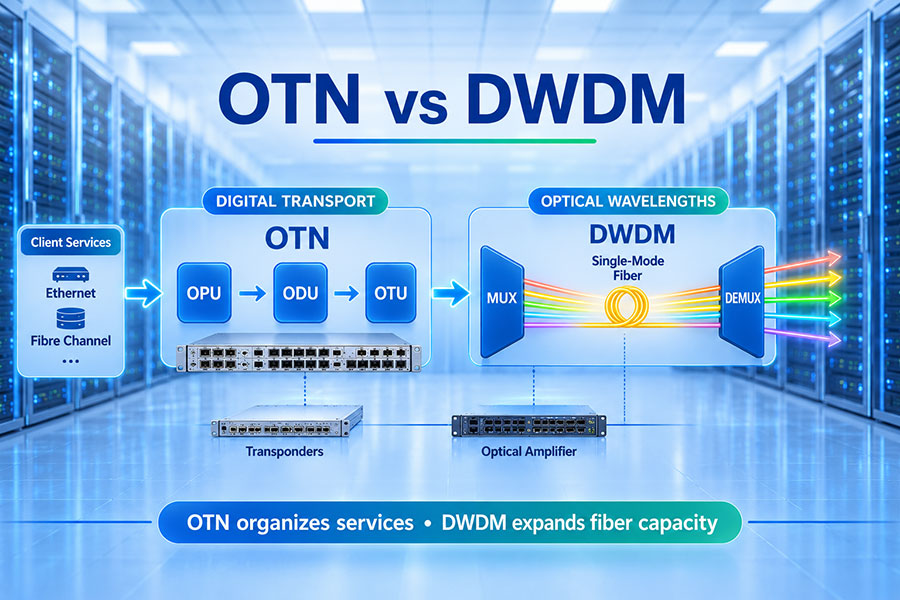
CWDM and DWDM use different wavelength or frequency grids. CWDM has 18 nominal channels on its standard 20nm grid, while DWDM can support substantially higher channel density within a defined optical band.
| Feature | CWDM | DWDM |
|---|---|---|
| Standard grid | ITU-T G.694.2 | ITU-T G.694.1 |
| Typical spacing | 20nm | 100GHz, 50GHz, and other supported grids |
| Standard channel set | 18 nominal wavelengths | Depends on the selected frequency grid and optical band |
| Channel density | Lower | Higher |
| Typical applications | Metro, access, and enterprise networks | High-capacity metro, long-haul, and DCI |
DWDM is often selected when a network needs more wavelength channels than a CWDM configuration can provide. However, it also requires more precise wavelength control and more detailed optical system engineering.
8. How to Select an 18-Channel CWDM System
Before deploying a full-grid CWDM system, network engineers should verify that all selected channels can operate within the intended optical link.
Confirm the required channel count: Identify the number of independent optical links and their expected data rates.
Check the wavelength plan: Match each transceiver to a supported CWDM channel.
Verify the MUX/DEMUX: Confirm the device supports the complete required channel set and the correct optical direction.
Check fiber compatibility: Confirm fiber type, attenuation, and transmission conditions across the selected wavelength range.
Calculate the optical budget: Include fiber loss, passive component insertion loss, connector loss, and engineering margin.
Check receiver operating limits: Verify both minimum sensitivity and maximum input power.
Plan for future expansion: Reserve unused channels where possible and confirm that additional transceivers can be integrated later.
9. C-LIGHT Optical Connectivity for WDM Networks
CWDM deployments require wavelength-matched optical transceivers and compatible passive optical components. C-LIGHT provides optical connectivity products for enterprise networks, telecommunications, and high-speed data center infrastructure.
For projects involving multiple optical channels, the selection of transceivers should be coordinated with the CWDM MUX/DEMUX channel plan. Data rate, wavelength, fiber type, transmission distance, and optical budget must all be verified together.
For higher-capacity network infrastructure, C-LIGHT also offers optical transceiver families including:
400G QSFP-DD optical transceivers for high-speed data center and network connectivity.
400G OSFP optical transceivers for supported 400G interface applications.
800G QSFP-DD optical transceivers for next-generation high-bandwidth infrastructure.
800G OSFP optical transceivers for high-density data center environments.
These high-speed product families are not automatically CWDM channel interfaces. Their suitability for a particular WDM system must be confirmed using the exact product specifications and line-system architecture.
10. Conclusion
The standard CWDM wavelength grid supports 18 nominal channels, spaced 20nm apart from 1271nm to 1611nm. These wavelengths can be multiplexed onto a single optical fiber strand in one transmission direction, allowing multiple independent data streams to share the same fiber infrastructure.
However, the practical number of usable channels depends on the MUX/DEMUX configuration, transceiver wavelength compatibility, fiber characteristics, insertion loss, optical power, and receiver performance. An 18-channel system is achievable only when the complete optical link supports the required wavelength plan.
For networks requiring more wavelength channels or greater aggregate capacity, DWDM may provide a more scalable solution, subject to its optical design and equipment requirements.
Contact C-LIGHT with your channel count, wavelength plan, data rate, fiber type, and transmission distance for optical connectivity support.
Contact C-LIGHT >

 >
 >
 >
 >
 >
 >
 >