TEL:+86 132 6656 7067




Silicon photonics is an optical technology that uses silicon-based photonic circuits to transmit, modulate, route, and receive optical signals. It integrates optical functions with semiconductor manufacturing technologies, enabling compact and high-density optical solutions for data centers, AI networks, telecommunications, and high-speed optical interconnects.
1. What Is Silicon Photonics?
Silicon photonics is a technology that uses silicon as a platform for building integrated photonic circuits. Instead of relying on separate discrete optical components for every optical function, multiple photonic functions can be integrated onto a silicon photonic chip.
This makes it possible to build compact optical engines and transceivers for high-speed communication.
2. How Does Silicon Photonics Work?
A simplified silicon photonics transmission path is:
Electrical Data → Driver → Silicon Photonic Modulator → Optical Signal → Fiber
For the receive path:
Fiber → Silicon Photonic Receiver → Photodetector → TIA → Electrical Data
The silicon photonic chip controls and processes the optical signal, while lasers provide the optical carrier and photodetectors convert received light back into electrical signals.
3. What Are the Main Components of Silicon Photonics?
A silicon photonics system may include:
Silicon photonic chip
Laser source
Optical modulators
Waveguides
Photodetectors
Optical couplers
Drivers
TIAs
Control and monitoring circuits
The exact components depend on the optical architecture and application.
4. What Is a Silicon Photonic Chip?
A silicon photonic chip contains integrated optical structures that guide and manipulate light. These structures can include waveguides, modulators, splitters, combiners, filters, and couplers.
The chip provides the optical path needed to perform multiple functions within a compact semiconductor-based platform.
5. How Does Light Travel Through Silicon?
Silicon photonics uses optical waveguides to confine and guide light across the photonic chip.
The geometry and refractive-index difference of the waveguide structure keep the optical signal within the desired path while allowing it to travel between different photonic components.
6. What Is an Optical Waveguide?
An optical waveguide is a structure designed to guide light from one location to another. In silicon photonics, waveguides are typically formed from silicon structures on a silicon-based substrate.
Waveguides connect different photonic components on the chip and form the optical routing network.
7. How Does Silicon Photonics Modulate Light?
The optical signal must be modulated to carry digital data. A silicon photonics modulator changes an optical property such as phase or intensity according to the electrical input signal.
Modern high-speed systems can use modulators based on technologies such as carrier-depletion or carrier-injection effects in silicon structures.
8. What Is the Role of the Laser?
Silicon itself is not an efficient light source for conventional integrated optical communication. Therefore, silicon photonics systems normally use an external or integrated laser source to generate the optical carrier.
The laser provides continuous optical energy that the silicon photonic modulator can then encode with data.
9. What Is External Laser Silicon Photonics?
In an external-laser architecture, the laser is physically separated from the silicon photonic chip. Optical power is coupled from the laser into the photonic circuit.
This approach can simplify some aspects of laser integration and thermal management while allowing the silicon photonic chip to focus on modulation and optical routing functions.
10. What Is the Role of the Optical Modulator?
The optical modulator converts an electrical data signal into changes in the optical carrier. This allows digital information to be encoded onto light.
The modulated optical signal then travels through the silicon waveguide and is eventually coupled into optical fiber.
11. What Is a Mach-Zehnder Modulator?
A Mach-Zehnder modulator, or MZM, uses interference between optical paths to control the intensity of the output optical signal.
MZMs are widely used in high-speed optical communication and can be implemented using silicon photonics technology.
12. How Does Silicon Photonics Receive Optical Signals?
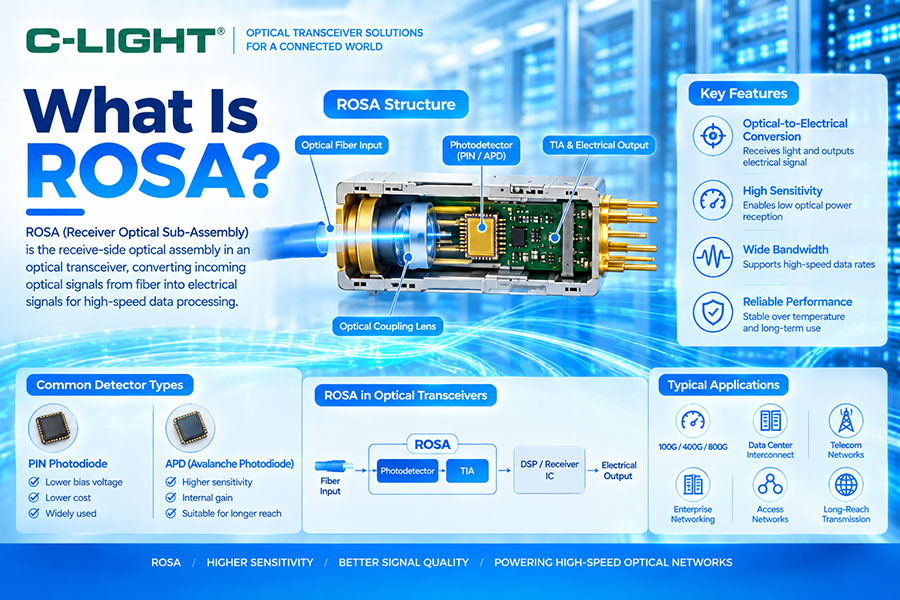
On the receive side, incoming light from the fiber is coupled into the silicon photonic circuit and directed toward a photodetector.
The photodetector converts the optical signal into an electrical current. A TIA then amplifies and converts that signal into a suitable electrical waveform for subsequent processing.
13. What Is a Silicon Photonics Photodetector?
A photodetector converts received optical power into an electrical signal. Silicon photonics systems commonly use semiconductor photodetectors integrated with or closely attached to the photonic circuit.
Depending on the wavelength and architecture, materials such as germanium can be integrated with silicon to provide efficient detection in communication bands.
14. Why Is Germanium Used in Silicon Photonics?
Silicon has limited absorption in important telecom communication wavelengths. Germanium has better optical absorption characteristics in common communication bands and can therefore be integrated with silicon to form high-speed photodetectors.
This combination allows silicon photonics to perform both optical routing and optical detection within a compact architecture.
15. What Is Optical Coupling in Silicon Photonics?
Optical coupling connects the photonic chip to an external optical fiber or another optical component.
Common approaches include edge coupling and grating coupling. The coupling structure must minimize optical loss while providing stable mechanical and optical alignment.
16. What Is Grating Coupling?
Grating couplers use periodic structures to redirect light between the silicon photonic waveguide and an optical fiber.
They can simplify wafer-level optical testing and packaging, although coupling efficiency and wavelength sensitivity must be carefully managed.
17. What Is Edge Coupling?
Edge coupling launches light between the fiber and the edge of the photonic chip through an optical interface designed to match the mode of the incoming or outgoing light.
Edge coupling can provide low optical coupling loss but may require more precise packaging and alignment.
18. How Does Silicon Photonics Support WDM?
Silicon photonics can integrate wavelength-selective components such as multiplexers, demultiplexers, filters, and wavelength routing structures.
This allows multiple optical wavelengths to be combined onto one fiber, increasing the aggregate capacity of the optical link.
19. What Is WDM in Silicon Photonics?
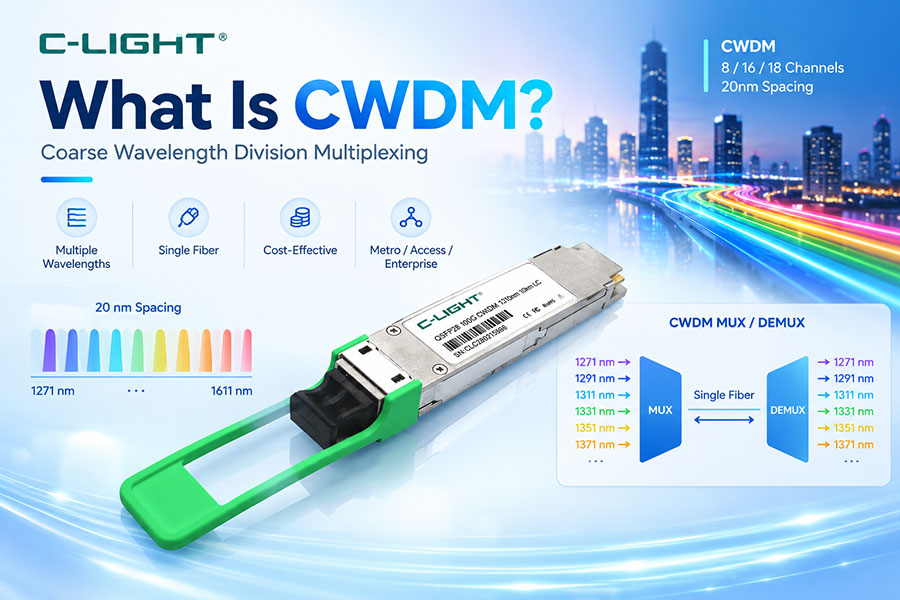
Wavelength Division Multiplexing allows multiple independent optical wavelengths to carry separate data channels over the same fiber.
Silicon photonic circuits can integrate WDM functions into a compact optical engine, which is particularly useful for high-density 400G, 800G, and 1.6T optical systems.
20. How Does Silicon Photonics Support PAM4?
Silicon photonics can be combined with PAM4 signaling for high-speed optical communication. PAM4 carries two bits per symbol using four amplitude levels.
The electrical and optical components must maintain adequate linearity, bandwidth, and signal quality to support PAM4 transmission.
21. What Is the Role of the Driver?
The driver provides the electrical signal required to control the optical modulator or laser. It must provide sufficient bandwidth, output swing, and signal integrity for the target data rate.
In high-speed systems, driver performance is closely linked to modulator performance.
22. What Is the Role of the TIA?
The transimpedance amplifier, or TIA, converts the photodetector current into a voltage signal suitable for subsequent electrical processing.
A high-performance TIA must provide adequate bandwidth, gain, noise performance, and linearity for the target optical interface.
23. How Does Silicon Photonics Work in a 400G Module?
A 400G silicon photonics module can use multiple high-speed electrical lanes and one or more optical wavelengths depending on the architecture.
The electrical signal is processed by the driver and modulator, converted into optical data, and transmitted through fiber. On the receive side, photodetectors and TIAs recover the signal.
24. How Does Silicon Photonics Work in an 800G Module?
800G systems require significantly higher aggregate bandwidth. Silicon photonics can support this through multiple high-speed lanes, integrated WDM functions, and compact optical engines.
The exact architecture may use different wavelength and lane configurations depending on the optical standard and target reach.
25. How Does Silicon Photonics Support 1.6T?
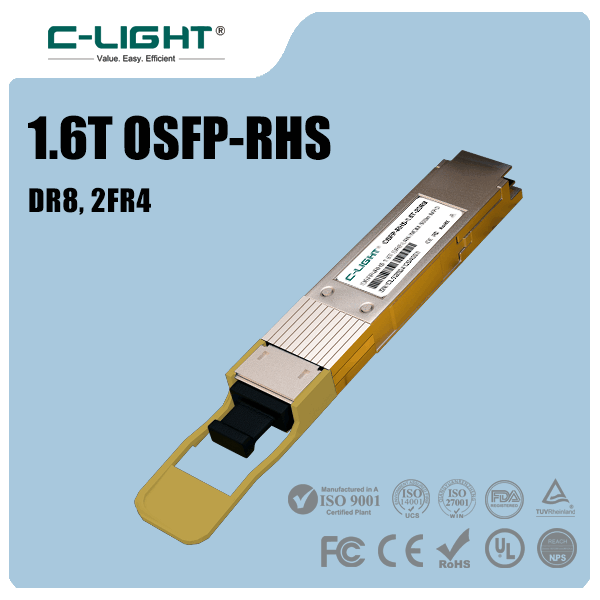
1.6T optical systems require extremely high aggregate electrical and optical bandwidth. Silicon photonics can support these systems through highly integrated modulators, photodetectors, WDM structures, and optical coupling technology.
Higher data rates also increase requirements for packaging, thermal management, optical loss, signal integrity, and manufacturing precision.
26. Why Is Silicon Photonics Suitable for High-Speed Optical Interconnects?
Silicon photonics combines multiple optical functions in a compact platform. This makes it suitable for high-density optical engines where space, bandwidth, power, and scalability are important.
Its semiconductor manufacturing compatibility also provides a potential path toward large-scale production of integrated photonic devices.
27. What Is the Difference Between Silicon Photonics and Traditional Discrete Optics?
| Feature | Silicon Photonics | Discrete Optics |
|---|---|---|
| Integration | High | Lower |
| Optical components | Multiple functions on photonic chip | More separate components |
| Size | Compact | Generally larger |
| Manufacturing approach | Semiconductor-based fabrication | More component-level assembly |
| Scalability | High integration potential | More assembly-intensive |
28. What Is the Difference Between Silicon Photonics and EML?
Silicon photonics and EML represent different approaches to optical transmission. EML combines a laser and electro-absorption modulator in one optical device, while silicon photonics integrates waveguides, modulators, couplers, and other optical functions on a silicon photonic platform.
Both technologies can support high-speed optical communication, and the appropriate choice depends on data rate, reach, power, packaging, and application requirements.
29. Silicon Photonics vs EML
| Parameter | Silicon Photonics | EML |
|---|---|---|
| Basic architecture | Integrated photonic platform | Laser + electro-absorption modulator |
| Integration | High | Device-level integration |
| WDM integration | Strong potential | Usually requires additional optical components |
| Typical applications | High-density optical engines and data center interconnects | High-speed optical transceivers and long-reach applications |
30. What Are the Main Advantages of Silicon Photonics?
The main advantages include:
High optical integration
Compact optical engine design
Potentially high manufacturing scalability
Integrated WDM capability
Support for high-speed optical interfaces
Suitability for dense optical interconnects
Compatibility with advanced packaging technologies
31. What Are the Main Challenges of Silicon Photonics?
Silicon photonics also has several technical challenges:
Laser integration
Optical coupling loss
Thermal management
Packaging complexity
Photonic device variability
Manufacturing yield
Testing and calibration
32. Why Is Packaging Important for Silicon Photonics?
Photonic chips must be connected to lasers, fibers, drivers, TIAs, and other electronic components. These interfaces require accurate optical alignment and high-speed electrical connections.
Packaging can therefore have a major impact on optical loss, thermal performance, manufacturing yield, and overall module reliability.
33. How Does Thermal Management Affect Silicon Photonics?
Optical and electronic components generate heat, while laser wavelength and photonic device performance can also depend on temperature.
Effective thermal management helps maintain stable optical performance and can improve the reliability of high-density optical systems.
34. How Does Silicon Photonics Reduce Optical Module Size?
Multiple optical functions can be integrated onto a single photonic chip, reducing the number of discrete optical components and the space required for optical routing.
This high level of integration is particularly valuable for compact optical engines used in high-density data center systems.
35. Why Is Silicon Photonics Important for AI Data Centers?
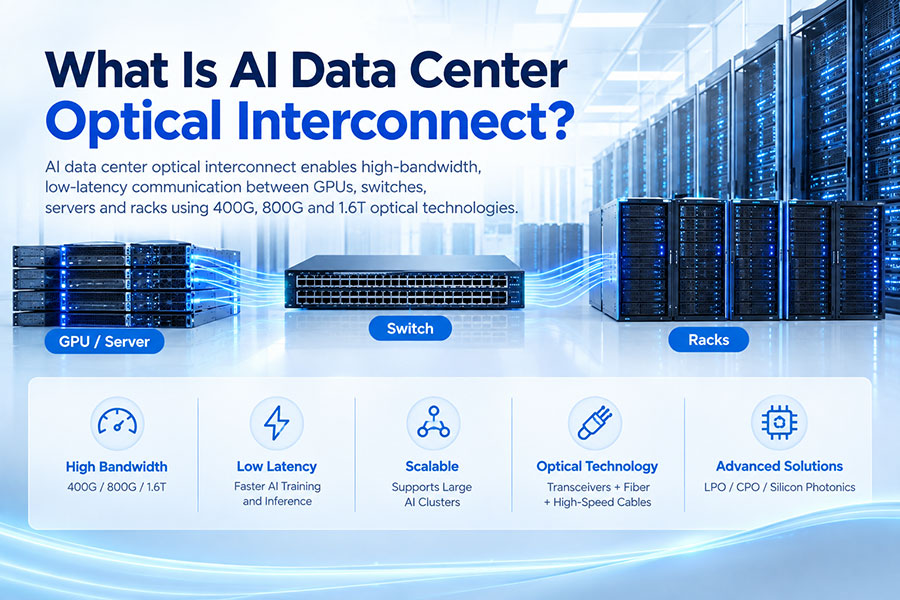
AI data centers require large numbers of high-speed optical connections between GPUs, switches, servers, and other systems. Bandwidth density and power efficiency are becoming increasingly important as network speeds rise.
Silicon photonics provides an integrated platform for building compact, high-bandwidth optical engines suitable for these environments.
36. What Is the Future of Silicon Photonics?
Silicon photonics is expected to remain an important technology for high-speed optical interconnects as data center bandwidth continues to increase.
Future development is likely to focus on higher-speed modulators and photodetectors, better laser integration, lower-loss coupling, advanced packaging, improved thermal performance, and higher-density WDM architectures.
37. FAQ
Q1. What is silicon photonics?
Q2. How does silicon photonics work?
Q3. Does silicon photonics include a laser?
Q4. Why is silicon photonics used in data centers?
Q5. What is the difference between silicon photonics and EML?
Q6. Can silicon photonics support 800G and 1.6T?
38. Summary
Silicon photonics works by integrating optical waveguides, modulators, photodetectors, couplers, and other photonic functions onto a silicon-based platform. Laser light is modulated with high-speed data, guided through the photonic circuit, coupled into optical fiber, and then detected and converted back into electrical signals at the receiver. Its high integration and scalability make silicon photonics an important technology for 400G, 800G, 1.6T, AI data centers, and next-generation optical interconnects.
 >
>

 >
>
 >
>
 >
>
 >
>
 >
>
 >
>
 >
>