TEL:+86 132 6656 7067




LPO, or Linear Pluggable Optics, is an optical transceiver architecture designed to reduce power consumption and latency by removing the traditional DSP from the optical module. Instead of using a DSP inside the transceiver to process high-speed signals, LPO uses linear optical components that work more directly with the host switch or accelerator ASIC.
1. What Is LPO?
Linear Pluggable Optics is a high-speed optical interconnect approach in which the optical module uses linear electrical-to-optical and optical-to-electrical components rather than a full DSP-based signal-processing architecture.
LPO is mainly discussed for high-speed data center applications such as 400G, 800G, and future 1.6T optical connectivity, where optical module power consumption and system latency are increasingly important.
2. How Does LPO Work?
The basic LPO signal path is relatively simple:
Host ASIC SerDes → Linear Driver → Optical Transmitter → Fiber → Optical Receiver → Linear TIA → Host ASIC SerDes
In a conventional DSP-based optical module, the module DSP performs functions such as equalization, signal conditioning, and clock/data processing. In an LPO architecture, much of this work is shifted toward the host ASIC and its electrical interface, allowing the optical module itself to remain more linear.
3. Why Does LPO Remove the DSP?
DSPs provide powerful signal processing, but they also consume electrical power and introduce additional processing stages. At very high data rates, the DSP can become one of the major power-consuming components inside an optical module.
Removing the DSP can significantly simplify the optical module and reduce its power consumption, especially in large-scale AI and data center deployments with thousands of optical links.
4. What Components Are Used in an LPO Module?
An LPO module generally contains the main optical and electrical components required for direct or near-direct linear signal transmission.
Optical transmitter such as EML or silicon photonics
Linear electrical driver
Optical receiver
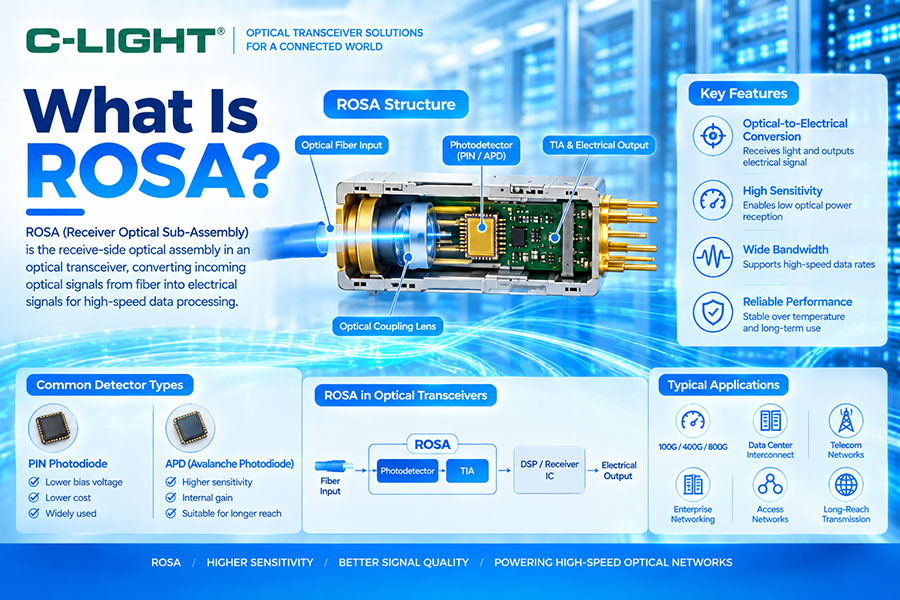
Linear TIA
Optical coupling and wavelength components where required
Monitoring and management circuitry
The exact architecture depends on the module type, data rate, optical technology, and vendor implementation.
5. What Is the Difference Between LPO and Traditional Pluggable Optics?
| Feature | Traditional DSP Optics | LPO |
|---|---|---|
| Module DSP | Typically included | Removed |
| Module power | Higher | Lower potential |
| Latency | Includes DSP processing | Lower optical-module processing latency |
| Signal processing | More processing inside module | More processing handled by host system |
| System dependency | More flexible | Higher host-side dependency |
6. Why Is LPO Attractive for AI Data Centers?
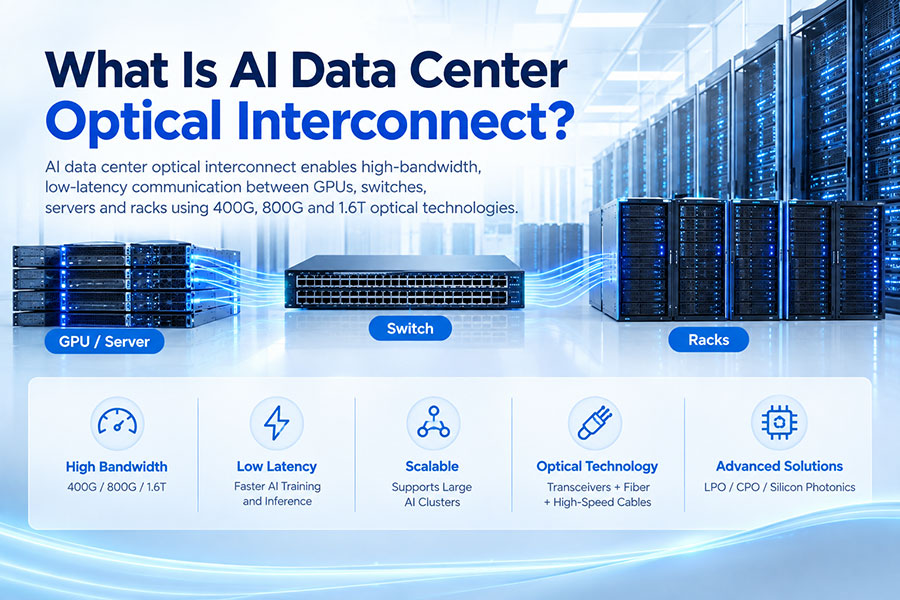
AI clusters use large numbers of high-speed optical links between GPUs, switches, servers, and other network devices. Even a small reduction in optical module power can become significant at rack and data center scale.
LPO is therefore attractive because it can provide a lower-power optical interconnect architecture while maintaining the high electrical and optical bandwidth required by modern AI networks.
7. How Does LPO Reduce Power Consumption?
The main power saving comes from removing the high-speed DSP from the optical module. A conventional DSP-based module must continuously process high-speed electrical signals before and after optical conversion.
In LPO, the module uses a linear driver and linear TIA, reducing the amount of active signal processing inside the pluggable module.
The total system power advantage depends on the host ASIC, SerDes design, optical components, link conditions, and implementation.
8. How Does LPO Reduce Latency?
Because the module does not perform the same level of high-speed digital signal processing as a DSP-based optical module, the optical path can have lower module-side processing latency.
The actual end-to-end system latency still depends on the switch ASIC, SerDes, FEC, electrical path, optical components, and network architecture.
9. How Does PAM4 Work with LPO?
PAM4 is important for LPO because modern 400G and 800G optical links commonly use high-speed PAM4 electrical and optical signaling.
Unlike NRZ, which carries two voltage levels, PAM4 uses four signal levels to transmit two bits per symbol. This increases the bit rate without requiring the same increase in symbol rate.
However, PAM4 has tighter signal-quality requirements, which makes the electrical and optical characteristics of the entire LPO link particularly important.
10. Why Is Signal Integrity Important for LPO?
Signal integrity is one of the most important considerations in an LPO system. Because the optical module does not contain a full DSP to compensate for channel impairments, the electrical path between the host ASIC and the optical module must be carefully designed.
Important factors include:
Insertion loss
Return loss
Inter-symbol interference
Equalization capability
Jitter
Noise
Transmitter linearity
Receiver sensitivity
11. What Does the Host ASIC Do in an LPO System?
The host ASIC becomes much more important in an LPO architecture because it performs signal-conditioning functions that would otherwise be handled inside the optical module.
Modern switch ASICs and accelerator platforms provide increasingly advanced SerDes equalization and signal-processing capabilities, making them suitable for direct connection to linear optical modules in supported systems.
12. What Is the Role of a Linear Driver?
The linear driver converts the high-speed electrical signal from the host interface into a suitable analog electrical drive signal for the optical transmitter.
Unlike a DSP-based architecture, the linear driver does not perform the same level of digital signal regeneration and processing. Its objective is to preserve the signal characteristics required by the optical transmitter.
13. What Is the Role of a Linear TIA?
The linear transimpedance amplifier, or TIA, converts the received photodiode current into a high-speed electrical signal for the host ASIC.
The TIA must maintain adequate bandwidth, gain, noise performance, and linearity while preserving signal integrity for the host SerDes.
14. How Is LPO Different From LRO?
LPO and LRO are related approaches but are not identical. LPO generally refers to a linear optical module architecture without a module DSP, while LRO, or Linear-drive Receive Optical, is often used to describe architectures that retain some signal-processing functionality on the receiving side.
Terminology can vary between vendors, so the exact implementation should always be checked against the specific module architecture.
15. What Are the Main Advantages of LPO?
LPO has several potential advantages for high-speed optical networking:
Lower optical module power consumption
Reduced module-side processing latency
Simpler optical module architecture
Potentially lower thermal requirements
Lower power density in large AI clusters
Better scalability for power-sensitive high-speed networks
16. What Are the Main Challenges of LPO?
The major challenge is that removing the DSP also removes some of the signal-conditioning capabilities normally used to compensate for channel impairments.
This creates stricter requirements for the complete electrical and optical link. Host ASIC SerDes performance, PCB design, connector loss, transmitter linearity, receiver performance, and cable characteristics all become more critical.
17. Why Does LPO Have Higher Host Compatibility Requirements?
A DSP-based optical module can compensate for a wider range of electrical and optical conditions internally. LPO depends more heavily on the host SerDes to provide equalization and signal conditioning.
As a result, an LPO module may require specific host ASIC characteristics, electrical channel conditions, and validated system configurations.
18. Does LPO Support 400G?
Yes. LPO is being applied to 400G optical connectivity, particularly in data center and AI networking environments where power efficiency is important.
400G LPO modules can use high-speed PAM4 signaling and are designed to work with compatible 400G switch ASIC SerDes interfaces.
19. Does LPO Support 800G?
Yes. 800G is another major application area for LPO because the power consumed by high-speed DSP-based optical modules becomes increasingly significant as data rates increase.
800G LPO implementations are typically designed around high-speed electrical interfaces and optical technologies capable of supporting multiple 100G-class lanes.
20. Can LPO Be Used for 1.6T?
LPO concepts can also be extended toward 1.6T optical connectivity. However, as data rates increase, signal-integrity and host-compatibility requirements become even more demanding.
The practical implementation of 1.6T LPO depends on the maturity of host SerDes, linear optical components, packaging, thermal design, and interoperability standards.
21. How Does LPO Compare with CPO?
| Feature | LPO | CPO |
|---|---|---|
| Optical interface | Pluggable | Co-packaged with switching ASIC |
| Serviceability | Easy module replacement | More integrated |
| DSP architecture | Linear module architecture | Depends on implementation |
| Deployment | Pluggable network equipment | Highly integrated platforms |
| Upgrade flexibility | Higher | Lower |
22. What Is the LPO Signal Path?
A simplified 800G LPO signal path can be represented as:
Switch ASIC → High-Speed SerDes → Linear Driver → PAM4 Optical Transmitter → Fiber → PAM4 Optical Receiver → Linear TIA → High-Speed SerDes → ASIC
The key difference is that the optical module does not contain the traditional DSP signal-processing stage between the electrical interface and optical components.
23. Does LPO Need FEC?
FEC is a system-level error-correction mechanism and is not the same as the DSP inside an optical module. An LPO link can operate with FEC implemented in the host Ethernet or networking system where required by the applicable architecture or standard.
FEC can provide error-correction capability without requiring a full DSP inside the optical module.
24. Is LPO Suitable for Long-Distance Transmission?
LPO is generally most attractive for short- and medium-reach high-speed links where the electrical and optical channels can be tightly controlled.
Longer-distance applications can introduce greater optical and signal-integrity challenges, so the suitability of LPO depends on the specific reach, optical technology, host platform, and system design.
25. Why Is Thermal Design Important for LPO?
Removing the DSP can reduce the heat generated inside the optical module. This can simplify thermal management and provide additional power headroom for high-density deployments.
However, the total thermal benefit should be evaluated at the system level because some signal-processing functions may shift into the host ASIC.
26. How Does LPO Affect Optical Module Size?
Because LPO removes the high-speed DSP, the internal optical module architecture can become simpler. This can provide more design flexibility for thermal management, optical components, and high-density packaging.
The external form factor can still remain the same as a standard pluggable module such as QSFP-DD or OSFP.
27. What Applications Are Suitable for LPO?
LPO is primarily suited to high-bandwidth, power-sensitive applications such as:
AI data center networks
GPU-to-switch connections
High-performance computing
400G Ethernet networks
800G Ethernet networks
High-density leaf-spine architectures
Short-reach data center interconnects
28. What Needs to Be Validated Before Deploying LPO?
LPO deployment should be validated as a complete system rather than by testing the optical module alone.
Important validation items include host ASIC compatibility, SerDes performance, electrical channel loss, equalization, optical power, BER, temperature, interoperability, and link stability.
29. LPO vs Traditional DSP Optics
| Parameter | DSP-Based Optics | LPO |
|---|---|---|
| Architecture | DSP + optical components | Linear optical components |
| Module power | Higher | Lower potential |
| Module latency | Higher | Lower potential |
| Signal conditioning | Strong module-side processing | More host-dependent |
| Channel tolerance | Generally higher | More demanding |
| Typical focus | Broad deployment flexibility | Power-sensitive high-speed systems |
30. What Is the Future of LPO?
LPO is an important optical interconnect approach for reducing power consumption in high-speed data center networks. Its value becomes more significant as electrical and optical data rates increase.
The broader adoption of LPO will depend on improvements in host SerDes, linear optical components, system interoperability, signal-integrity engineering, and standardized testing.
31. FAQ
Q1. What does LPO mean?
Q2. How does LPO work?
Q3. Why does LPO use less power?
Q4. Is LPO suitable for 400G and 800G?
Q5. What is the main challenge of LPO?
Q6. Is LPO better than DSP-based optics?
32. Summary
LPO works by removing the traditional DSP from the optical module and using linear drivers, optical transmitters, optical receivers, and linear TIAs to connect more directly with the host ASIC. This architecture can reduce optical module power and latency, making it attractive for 400G, 800G, and future high-speed AI data center networks. The trade-off is greater dependence on host SerDes performance and overall signal integrity.
 >
>

 >
>
 >
>
 >
>
 >
>
 >
>
 >
>
 >
>