TEL:+86 132 6656 7067




DWDM, or Dense Wavelength Division Multiplexing, is an optical transmission technology that combines multiple closely spaced wavelengths onto a single optical fiber. Each wavelength carries an independent data channel, allowing network operators to greatly increase fiber capacity without installing additional fiber.
1. What Is DWDM?
DWDM stands for Dense Wavelength Division Multiplexing. It uses multiple optical wavelengths, or channels, to transmit separate data streams simultaneously through the same single-mode fiber.
Instead of sending one signal through one fiber, DWDM allows many wavelength channels to share the same fiber pair while remaining logically independent.
2. How Does DWDM Work?
The basic DWDM transmission process is:
Multiple Data Signals → Optical Transmitters → DWDM MUX → Single Fiber → DWDM DEMUX → Optical Receivers → Multiple Data Signals
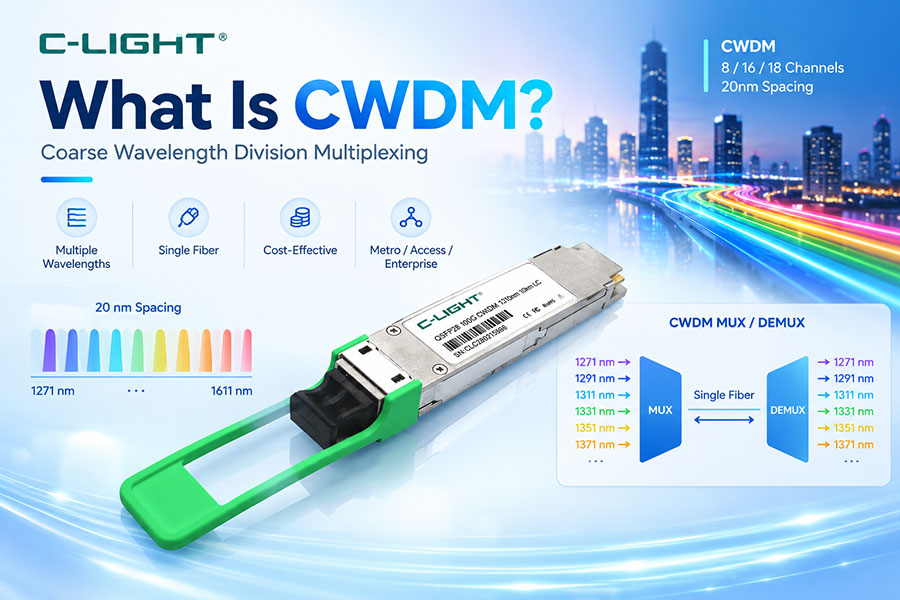
At the transmitting side, separate optical signals are generated at different wavelengths and combined by a multiplexer. The combined signal travels through one fiber. At the receiving side, a demultiplexer separates the wavelengths and sends each channel to its corresponding receiver.
3. Why Does DWDM Increase Fiber Capacity?
DWDM increases fiber capacity by allowing multiple optical channels to operate simultaneously on the same fiber.
For example, a system carrying 40 channels at 100Gbps per channel can provide an aggregate line capacity of 4Tbps, assuming all channels are active and the system overhead is excluded from this simplified calculation.
4. What Is a DWDM Channel?
A DWDM channel is an individual optical wavelength used to carry one data stream. Each channel is assigned a specific wavelength or corresponding optical frequency.
Because the channels are closely spaced, a large number of wavelengths can fit within the usable optical spectrum.
5. What Wavelengths Does DWDM Use?
DWDM commonly operates in the optical bands around 1550nm, particularly the C-band. The exact channel wavelengths depend on the selected ITU-T frequency grid and system design.
Some systems can also use the L-band to provide additional wavelength capacity.
6. What Is DWDM Channel Spacing?
DWDM uses much narrower channel spacing than CWDM. Common standardized frequency spacings include 100GHz and 50GHz, while denser grids can use smaller spacing.
Narrower spacing allows more channels to be carried within the same optical spectrum but also increases the requirements for wavelength accuracy and system engineering.
7. What Is the ITU-T DWDM Grid?
The ITU-T grid defines standardized optical channel frequencies for wavelength division multiplexing systems. Using a standardized grid allows transceivers, multiplexers, demultiplexers, and other optical components to operate together within compatible channel plans.
DWDM systems commonly reference the ITU-T G.694.1 frequency grid.
8. What Is a DWDM MUX?
A DWDM MUX, or multiplexer, combines multiple wavelengths into a single composite optical signal.
For example, if four transceivers transmit at four different wavelengths, the MUX combines those four signals so they can travel together over one optical fiber.
9. What Is a DWDM DEMUX?
A DWDM DEMUX, or demultiplexer, performs the reverse operation. It separates the combined optical signal into its individual wavelengths at the receiving end.
Each separated channel can then be connected to the appropriate optical transceiver or receiver.
10. What Is the DWDM Optical Path?
A simplified point-to-point DWDM link can be represented as:
Client Signals → DWDM Transmitters → MUX → Fiber → DEMUX → DWDM Receivers → Client Equipment
Long-haul systems may also include optical amplifiers, dispersion compensation, ROADMs, monitoring equipment, and other transmission components.
11. What Is the Role of DWDM Optical Transceivers?
DWDM optical transceivers convert electrical data into optical signals at specific wavelengths and convert received optical signals back into electrical data.
The transceiver wavelength must match the assigned DWDM channel so that the optical signal can pass correctly through the MUX and DEMUX.
12. What Is a Tunable DWDM Transceiver?
A tunable DWDM transceiver can operate on different DWDM wavelengths by electronically adjusting its operating channel rather than being permanently fixed to one wavelength.
Tunable modules are useful in systems where flexible channel assignment, network reconfiguration, or operational efficiency is important.
13. What Is a Fixed-Wavelength DWDM Transceiver?
A fixed-wavelength DWDM transceiver is designed to operate on one specified DWDM channel. Different modules are used when different wavelengths are required.
Fixed-wavelength modules can provide a straightforward solution for stable point-to-point or static WDM deployments.
14. Why Is DWDM Mainly Used With Single-Mode Fiber?
DWDM is primarily designed for single-mode fiber because long-distance transmission requires controlled optical propagation, low attenuation, and predictable wavelength behavior.
Single-mode fiber is therefore the standard medium for most DWDM transport and telecom networks.
15. How Far Can DWDM Transmit?
DWDM can support distances ranging from metropolitan links to hundreds or even thousands of kilometers in appropriately engineered transport systems.
The achievable distance depends on the transceiver technology, optical power budget, fiber loss, dispersion, nonlinear effects, amplification, modulation format, and system architecture.
16. Why Are Optical Amplifiers Used in DWDM?
Optical signals become weaker as they travel through fiber. For long-distance DWDM systems, optical amplifiers can compensate for this loss without converting every wavelength back into electrical signals.
EDFA is a widely used optical amplification technology for DWDM systems operating in the C-band.
17. What Is an EDFA?
EDFA stands for Erbium-Doped Fiber Amplifier. It amplifies optical signals in the erbium transmission band without requiring optical-electrical-optical conversion.
Because an EDFA can amplify multiple DWDM wavelengths simultaneously, it is well suited to multi-channel optical transport.
18. What Is a DWDM Optical Link Budget?
The optical link budget represents the available optical power margin between the transmitter output and the receiver sensitivity.
A simplified calculation is:
Optical Budget = Transmitter Output Power − Receiver Sensitivity
The available budget must cover fiber attenuation, connector loss, MUX/DEMUX insertion loss, splice loss, amplifier-related losses, and an appropriate engineering margin.
19. What Losses Affect a DWDM System?
A DWDM link can experience several types of optical loss:
Fiber attenuation
Connector insertion loss
Splice loss
DWDM MUX/DEMUX insertion loss
Patch panel and component loss
Optical switching or ROADM loss
Other passive component losses
These losses must be considered when designing the complete optical path.
20. What Is Chromatic Dispersion in DWDM?
Chromatic dispersion causes different spectral components of an optical signal to travel at different velocities through the fiber. Over long distances, this can broaden the signal and reduce transmission performance.
Dispersion becomes increasingly important as data rates, transmission distances, and channel counts increase.
21. What Are Nonlinear Effects in DWDM?
When multiple high-power wavelengths propagate through the same fiber, nonlinear optical effects can become significant.
Examples include four-wave mixing, self-phase modulation, cross-phase modulation, and stimulated Raman scattering. Proper channel spacing, optical power management, and system design help control these effects.
22. What Is Four-Wave Mixing?
Four-wave mixing is a nonlinear interaction in which multiple optical wavelengths interact inside the fiber and generate additional optical frequencies.
The generated components can interfere with DWDM channels, particularly when channel spacing, dispersion, and optical power conditions make the effect more pronounced.
23. How Does DWDM Support 100G, 400G, and 800G?
DWDM separates the transmission capacity into multiple wavelength channels. Each wavelength can carry a high-speed optical signal such as 100G, 400G, or other rates supported by the transceiver and transport system.
The aggregate capacity is determined by the number of active wavelengths and the line rate assigned to each channel.
24. What Is Coherent DWDM?
Coherent DWDM uses coherent detection and advanced digital signal processing to recover high-speed optical signals. Coherent systems can support high data rates and long transmission distances by using advanced modulation formats and DSP-based compensation.
They are widely used in modern long-haul and metro optical transport networks.
25. What Is the Difference Between Coherent DWDM and Direct-Detect DWDM?
| Feature | Direct-Detect DWDM | Coherent DWDM |
|---|---|---|
| Detection | Direct optical detection | Coherent detection |
| DSP | May be limited or application-dependent | Extensive DSP |
| Typical reach | Shorter optical links | Metro and long-haul |
| Complexity | Lower | Higher |
26. What Is a DWDM ROADM?
ROADM stands for Reconfigurable Optical Add-Drop Multiplexer. It allows selected DWDM wavelengths to be added, dropped, or routed through an optical network without converting every channel into electrical signals.
ROADMs are important for flexible and dynamically configurable optical transport networks.
27. How Does a DWDM Network Add and Drop Wavelengths?
In a DWDM transport network, an add-drop node can remove selected wavelengths from the optical path for local equipment while allowing other wavelengths to continue through the network.
This makes it possible to build multi-node optical networks rather than limiting DWDM to simple point-to-point links.
28. What Are the Main Applications of DWDM?
DWDM is commonly used in:
Long-haul telecom networks
Metro optical networks
Data center interconnects
Carrier backbone networks
Cloud infrastructure
Internet service provider networks
High-capacity enterprise and regional networks
29. DWDM vs CWDM
| Feature | CWDM | DWDM |
|---|---|---|
| Channel spacing | Typically 20nm | Much narrower frequency spacing |
| Channel count | Lower | Higher |
| Capacity | Lower | Higher |
| System complexity | Lower | Higher |
| Typical applications | Access, enterprise, metro | Metro, backbone, long-haul, DCI |
30. Why Is DWDM More Complex Than CWDM?
DWDM uses closely spaced optical channels, which requires tighter control of wavelength accuracy, optical filtering, insertion loss, channel isolation, power levels, and system performance.
Long-distance DWDM systems may also require amplifiers, dispersion management, ROADMs, and coherent DSP technology.
31. What Are the Main Advantages of DWDM?
The main advantages of DWDM include:
Very high fiber capacity
Efficient use of existing fiber infrastructure
Support for multiple independent wavelengths
Long-distance transmission capability
Scalability to higher aggregate capacity
Support for optical transport and data center interconnects
32. What Are the Main Limitations of DWDM?
DWDM also introduces higher system complexity and cost compared with simpler WDM technologies.
Accurate wavelength control, optical power management, system testing, and careful link engineering are required, particularly for high-channel-count and long-distance deployments.
33. How Does DWDM Improve Existing Fiber Networks?
One of the major advantages of DWDM is that it can increase capacity on existing fiber infrastructure. Instead of installing new fiber for every additional service, network operators can add optical channels to the same fiber.
This makes DWDM an effective technology for expanding network capacity while making better use of existing fiber resources.
34. What Is the Future of DWDM?
DWDM remains an important foundation of high-capacity optical transport networks. Increasing channel rates, coherent transmission, better optical components, tunable transceivers, ROADMs, and advanced DSP technologies continue to improve overall network capacity and flexibility.
As traffic from cloud computing, AI infrastructure, data centers, and telecom networks continues to grow, DWDM will remain an important method for efficiently transporting large volumes of data over optical fiber.
35. FAQ
Q1. What does DWDM stand for?
Q2. How does DWDM work?
Q3. What fiber does DWDM use?
Q4. What wavelength does DWDM use?
Q5. What is the difference between CWDM and DWDM?
Q6. Can DWDM support 400G and 800G?
36. Summary
DWDM works by assigning separate optical wavelengths to different data channels, combining those wavelengths onto a single fiber, and separating them at the receiving end. With closely spaced channels, optical amplifiers, coherent technology, tunable transceivers, and advanced network components, DWDM provides a scalable way to build high-capacity metro, long-haul, telecom, and data center interconnect networks.
 >
>

 >
>
 >
>
 >
>
 >
>
 >
>
 >
>
 >
>