TEL:+86 132 6656 7067




CPO, or Co-Packaged Optics, is an optical networking architecture that integrates optical engines closely with a switch ASIC inside the same package. By shortening the high-speed electrical path between the ASIC and optical components, CPO can reduce electrical losses, improve power efficiency, and support the increasing bandwidth requirements of AI and high-performance data center networks.
1. What Is CPO?
Co-Packaged Optics is a packaging architecture in which optical engines are placed alongside a high-speed switching ASIC rather than being located several centimeters away in a conventional pluggable optical module.
The goal is to move optical conversion closer to the switching silicon and reduce the electrical interconnect distance between the two.
2. How Does CPO Work?
The basic CPO signal path is:
Switch ASIC → Short Electrical Interconnect → Optical Engine → Optical Fiber
For an incoming optical signal, the process works in the opposite direction:
Optical Fiber → Optical Engine → Short Electrical Interconnect → Switch ASIC
Because optical engines are positioned directly beside the ASIC, the electrical path is much shorter than in a conventional pluggable architecture.
3. What Is the Main Difference Between CPO and Pluggable Optics?
| Feature | Pluggable Optics | CPO |
|---|---|---|
| Optical location | Front-panel module | Integrated near ASIC |
| Electrical path | Longer | Very short |
| Serviceability | High | More complex |
| Power optimization | Limited by module architecture | Strong potential |
| Scalability | Mature and flexible | More tightly integrated |
4. Why Does CPO Move Optics Closer to the ASIC?
As switch ASIC bandwidth increases, electrical signals must travel at increasingly high data rates between the ASIC and optical module. Longer electrical traces introduce insertion loss, reflections, crosstalk, and other signal-integrity challenges.
Placing the optical engine close to the ASIC reduces the length of this high-speed electrical connection and can therefore simplify the electrical channel.
5. What Is an Optical Engine in CPO?
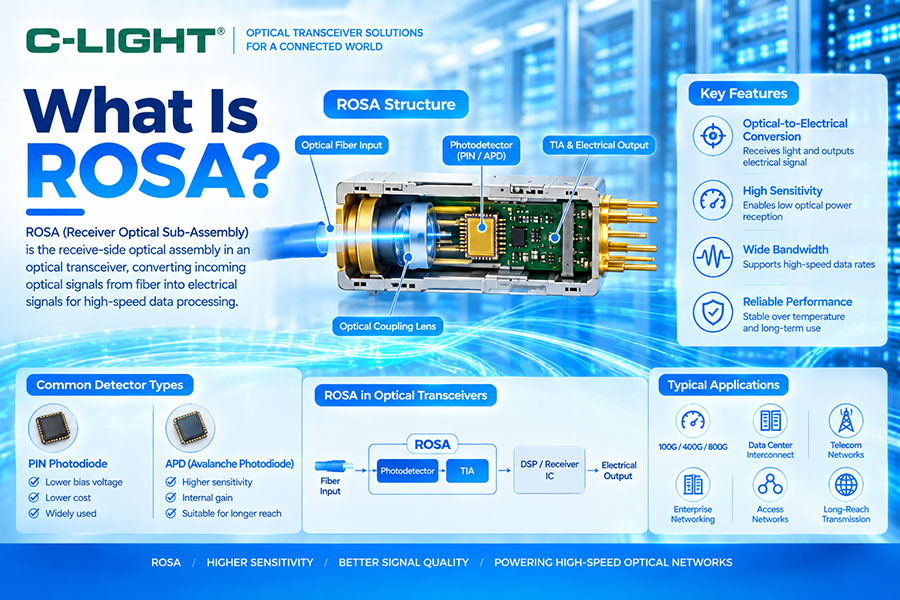
An optical engine is the optical conversion portion of the system. It typically includes optical transmitters, receivers, drivers, TIAs, photonic components, and optical coupling structures required to convert electrical signals into optical signals and optical signals back into electrical signals.
In a CPO architecture, the optical engine is designed for direct integration with the switching package or its surrounding package substrate.
6. What Components Are Included in a CPO System?
A CPO implementation can include several major components:
High-speed switch ASIC
Optical engines
Laser sources
Optical modulators
Photodetectors
Drivers and TIAs
Optical coupling components
Fiber connectors or fiber attach structures
Thermal management components
7. How Does CPO Reduce Electrical Loss?
In a conventional switch, the electrical signal may travel from the ASIC across the PCB, through connectors and traces, and into a front-panel optical module.
CPO places the optical conversion much closer to the ASIC. The shorter electrical path reduces channel loss and signal degradation, which can become increasingly important at 800G and 1.6T data rates.
8. How Does CPO Improve Power Efficiency?
CPO can improve system-level power efficiency by shortening the electrical channel and potentially reducing the amount of electrical signal conditioning required between the ASIC and optical components.
The exact power savings depend on the ASIC, optical engine, SerDes architecture, packaging, cooling system, and overall implementation.
9. Why Is Power Efficiency Important for AI Data Centers?
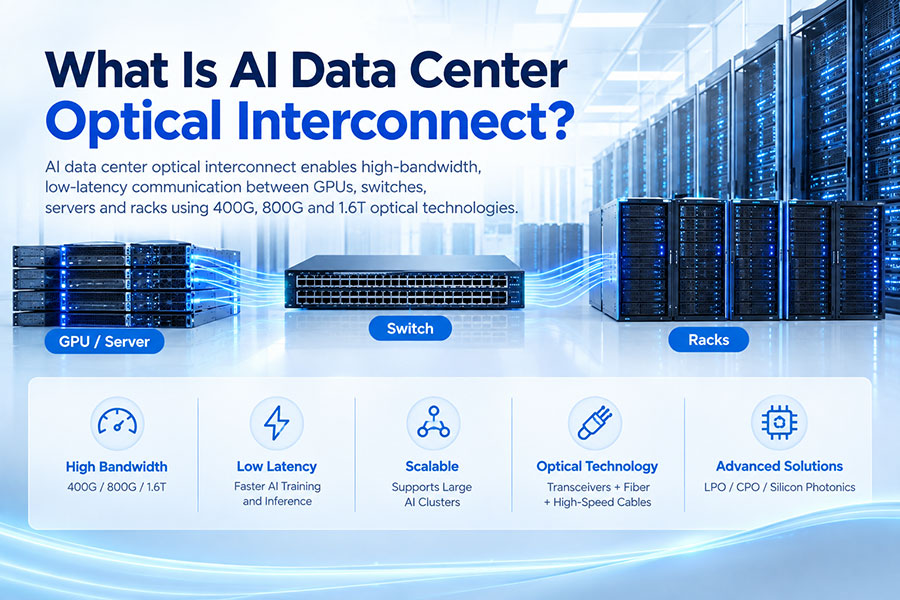
AI clusters require large numbers of high-speed network links between GPUs, switches, servers, and storage systems. As aggregate bandwidth increases, optical and electrical interconnect power can become a significant part of total system power.
CPO is being considered as one approach to improving the power efficiency of future high-bandwidth switching platforms.
10. How Does CPO Handle High-Speed Electrical Signals?
The switch ASIC generates high-speed electrical signals that travel across a very short interconnect to the nearby optical engine. The optical engine converts these signals into optical signals for transmission through fiber.
For received signals, photodetectors and receiver electronics convert the optical signal back into electrical data for the ASIC.
11. What Optical Technologies Can Be Used in CPO?
CPO can be implemented using different optical technologies depending on the required data rate, reach, power budget, and manufacturing architecture.
Possible technologies include silicon photonics, EML-based optical devices, VCSEL-based solutions for appropriate reaches, and other integrated photonic technologies.
12. What Role Does Silicon Photonics Play in CPO?
Silicon photonics is particularly attractive for CPO because optical functions can be integrated into compact photonic structures that are suitable for close integration with electronic devices.
Silicon photonics can support functions such as optical modulation, wavelength multiplexing, optical routing, and optical coupling depending on the implementation.
13. What Is the Role of the Laser in CPO?
The laser provides the optical carrier required to transmit data. Depending on the architecture, the laser source may be integrated close to the optical engine or positioned remotely.
Remote laser approaches can separate high-heat laser components from the main package and may simplify thermal management and service strategies.
14. What Is External Laser Source CPO?
Some CPO architectures use external laser sources rather than placing all laser components directly inside the co-packaged assembly.
This approach can simplify thermal management and allow the laser source to be serviced or replaced independently from the main switching package, depending on the implementation.
15. Why Is Thermal Management Important for CPO?
Thermal design is one of the major challenges of CPO because the switch ASIC and optical engines are located in close proximity.
High-power switching silicon generates significant heat, while optical components also have operating-temperature limits. Efficient heat spreading, heatsinks, cooling plates, and other thermal structures are therefore critical to maintaining reliable operation.
16. Why Is CPO Difficult to Service?
Conventional pluggable optics can be replaced individually when a module fails or when a network operator wants to upgrade the optical interface.
With CPO, the optical engine is integrated much more tightly with the switching platform. This increases integration and can improve electrical performance, but it makes component replacement and field maintenance more complicated.
17. Is CPO a Type of Optical Transceiver?
CPO is better understood as a system and packaging architecture rather than a conventional pluggable optical transceiver form factor.
The optical engine inside a CPO system performs many of the functions associated with an optical module, but it is integrated directly with the switching package instead of being inserted as a separate front-panel module.
18. How Does CPO Support 800G?
800G switch systems require very high aggregate electrical bandwidth between the switching ASIC and optical interfaces. CPO can reduce the electrical channel length and help manage the signal-integrity challenges associated with these high-speed links.
This makes CPO an important architecture for next-generation 800G switching platforms.
19. How Does CPO Support 1.6T?
As switch bandwidth moves toward 1.6T-class interfaces, electrical channel loss and power consumption become even more challenging.
CPO can address part of this challenge by placing optical conversion close to the ASIC. However, successful 1.6T CPO implementation also requires advances in SerDes, photonic devices, packaging, thermal management, fiber coupling, and manufacturing.
20. What Is the CPO Signal Path?
A simplified transmit path can be represented as:
ASIC SerDes → Short Electrical Path → Linear Driver → Optical Modulator → Fiber
A simplified receive path is:
Fiber → Photodetector → TIA → Short Electrical Path → ASIC SerDes
This short electrical path is one of the defining characteristics of the CPO architecture.
21. How Does CPO Compare with LPO?
| Feature | LPO | CPO |
|---|---|---|
| Architecture | Linear pluggable module | Co-packaged optical engine |
| Optical location | Front panel | Near or within ASIC package |
| Replaceability | High | Lower |
| Electrical path | Shorter than traditional DSP optics | Extremely short |
| Integration | Module-level | Package-level |
22. What Is the Difference Between CPO and On-Board Optics?
CPO places optical engines closely within the switch package architecture, while on-board optics generally places optical modules on the circuit board near the ASIC.
Both approaches shorten electrical connections compared with front-panel pluggable optics, but their packaging and service models are different.
23. What Are the Main Advantages of CPO?
The main advantages of CPO include:
Very short electrical interconnects
Potentially lower electrical channel loss
Improved power efficiency potential
High-density optical integration
Scalability for very high switch bandwidth
Reduced dependence on long PCB SerDes paths
24. What Are the Main Challenges of CPO?
CPO introduces several engineering challenges:
Complex optical and electronic packaging
Thermal management
Optical coupling and fiber routing
Manufacturing yield
Testing and repair
Limited field replaceability
Technology and ecosystem maturity
25. How Does CPO Affect Network Upgrades?
Pluggable optics allow network operators to replace optical modules independently from the switch ASIC. CPO tightly couples the optical engine and switching silicon, so upgrades can require changes to the broader switching platform.
This creates a trade-off between integration efficiency and deployment flexibility.
26. Is CPO Suitable for All Data Center Networks?
No. CPO is mainly being considered for high-bandwidth switching and AI infrastructure where power, density, and electrical signal integrity are major concerns.
For many conventional data center environments, pluggable optics remain attractive because of their maturity, interoperability, upgrade flexibility, and serviceability.
27. What Applications Can Use CPO?
Potential CPO applications include:
AI data center networks
GPU clusters
High-performance computing
High-density Ethernet switching
800G network switches
Future 1.6T switching platforms
Large-scale data center interconnect infrastructure
28. How Does CPO Help AI Networking?
AI workloads require high-bandwidth and low-latency communication between computing nodes. CPO can reduce the electrical distance between switching silicon and optical interfaces while improving integration density.
These characteristics make CPO particularly relevant to high-radix switches used in large AI clusters.
29. What Must Be Considered When Designing CPO?
CPO design requires simultaneous consideration of electrical, optical, mechanical, and thermal requirements.
Important factors include ASIC SerDes performance, optical engine design, laser architecture, package layout, fiber coupling, thermal resistance, power consumption, manufacturing yield, testing, and serviceability.
30. What Is the Future of CPO?
CPO is being developed as a potential architecture for next-generation high-bandwidth networking as switch ASIC speeds continue to increase.
Its future adoption will depend on improvements in optical integration, packaging, thermal management, manufacturing, testing, interoperability, and field-service strategies. Pluggable optics are also expected to remain important because they provide strong flexibility and serviceability.
31. FAQ
Q1. What does CPO mean?
Q2. How does CPO work?
Q3. Why does CPO reduce power consumption?
Q4. What is the main advantage of CPO?
Q5. What is the main challenge of CPO?
Q6. Is CPO better than pluggable optics?
32. Summary
CPO works by placing optical engines close to the switch ASIC, reducing the distance that high-speed electrical signals must travel before optical conversion. This architecture can improve signal integrity, power efficiency, and optical density for 800G, 1.6T, and future AI data center networks. The main trade-offs are greater packaging complexity, thermal challenges, and lower serviceability compared with conventional pluggable optics.
 >
>

 >
>
 >
>
 >
>
 >
>
 >
>
 >
>
 >
>