TEL:+86 132 6656 7067




1. Concept Analysis: Broad vs. Narrow Definition
Broad Definition: Electrical Port Module
Refers generally to any physical interface or device that uses an RJ45 connector and transmits electrical signals over copper cabling (Ethernet cable) . In network engineering contexts, the standard Ethernet port on a server NIC or a fixed RJ45 port on a switch is often colloquially called an "electrical port." This distinguishes it from an "optical port" (SFP/SFP+ slot) which transmits light signals.
Narrow Definition: Electrical Port Module
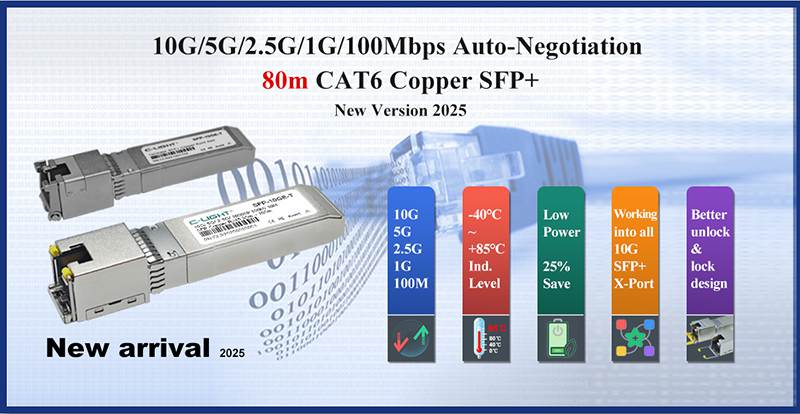
Refers specifically to an optoelectronic converter module, typically encapsulated in an SFP or SFP+ form factor with an RJ45 interface. Its core purpose is to convert the optical port (SFP cage) of a switch or router into an electrical port (RJ45 interface) . This allows equipment to perform short-distance data transmission over standard twisted-pair copper cables (Cat5e/Cat6) without the need to rewire with fiber optics.
2. Hardware Architecture: Internal Construction and Core Chips
From a hardware perspective, the narrow-definition electrical module (SFP/SFP+ Copper) is a precision component integrating a Physical Layer (PHY) chip and signal conditioning circuits.
Core Component: Unlike optical transceivers, the electrical module does not contain lasers (TOSA/ROSA) . Instead, it is built around a PHY Chip (Physical Layer Interface Chip) and an RJ45 Connector .
Mainstream Chip Solutions: The market primarily utilizes Marvell or Taiwanese-manufactured PHY chips. Marvell chips are often optimized for the circuit architecture of specific switch brands (e.g., Cisco), offering better compatibility and lower power consumption. Some Taiwanese chip solutions utilize special designs to support both Gigabit and Fast Ethernet auto-negotiation, making them widely used in third-party compatible modules.
Key Component Limitations: Due to the physical size constraints and heat dissipation limits of the SFP package, the PHY chip in 10G electrical modules consumes significant power. Consequently, the transmission distance is compressed (maximum 30 meters at 10G speed), and the module generates considerably more heat than an optical transceiver.
3. Software Logic: Link Negotiation and Intelligent Identification
On the software side, the behavior of an electrical module differs fundamentally from an optical module, primarily in link establishment mechanisms and status monitoring.
Auto-Negotiation and Forced Mode: Electrical modules follow the IEEE 802.3 standard, supporting 10/100/1000M and even 2.5G/5G/10G auto-negotiation. Note: Circuit designs vary across switch vendors. Cisco devices tend to favor 10/100/1000M adaptive modules, while some Huawei devices only recognize forced Gigabit (1000M) modules. Incorrect selection may result in the port failing to establish a link (Link Down).
Lack of DDM (Digital Diagnostics Monitoring) : This is the most significant software difference compared to optical modules. Standard optical modules support DDM, allowing real-time monitoring of temperature, voltage, and optical power. In contrast, electrical modules typically lack DDM functionality. Network Management Systems (NMS) cannot read their real-time operating parameters, posing a challenge for troubleshooting and maintenance.
PoE Support: Some SFP copper modules support PoE (Power over Ethernet). The software layer must control the power negotiation mechanism to transmit both data and power over the same cable, simplifying the deployment of endpoints like IP cameras.
4. Testing Strategies and Key Indicators
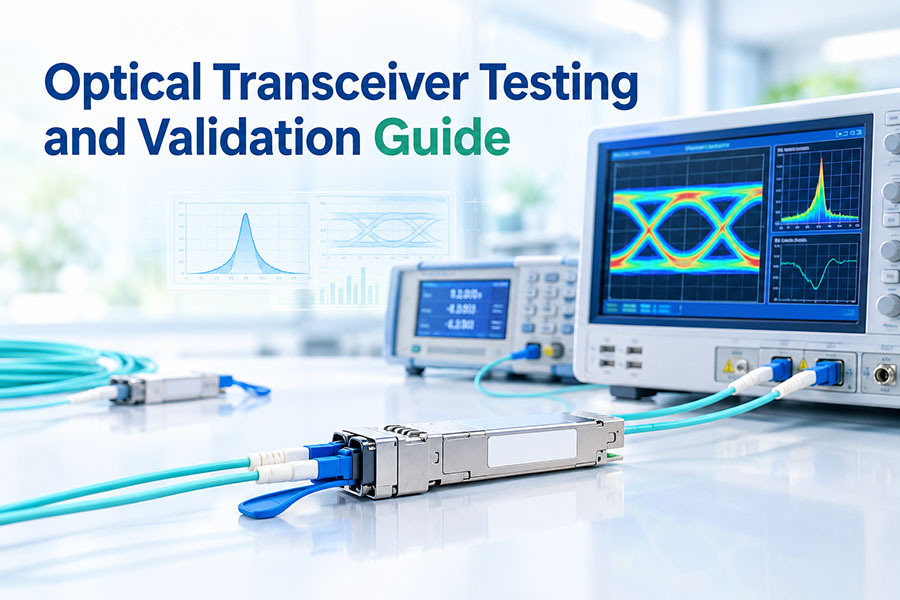
Testing and validation of electrical modules must cover both hardware electrical performance and software protocol compatibility.
| Test Dimension | Focus | Standard / Parameter Reference |
| Electrical Performance | Contact Resistance: Measures impedance between RJ45 gold fingers and cable plug to prevent signal attenuation. | Initial ≤50mΩ; Post-aging ≤100mΩ |
| Electrical Performance | Dielectric Withstand & Insulation: Verifies isolation capability under abnormal high voltage for safety. | Insulation Resistance ≥100MΩ (500V DC); No breakdown during voltage test. |
| Signal Integrity | Eye Diagram & Crosstalk: Evaluates signal quality and Bit Error Rate (BER) at 10G speeds. | Ensure eye opening complies with IEEE 802.3an; Minimal jitter. |
| Compatibility Testing | Interoperability: Validates adaptation with major switch brand | Verify link Up status, correct rate negotiation, and zero packet loss. |
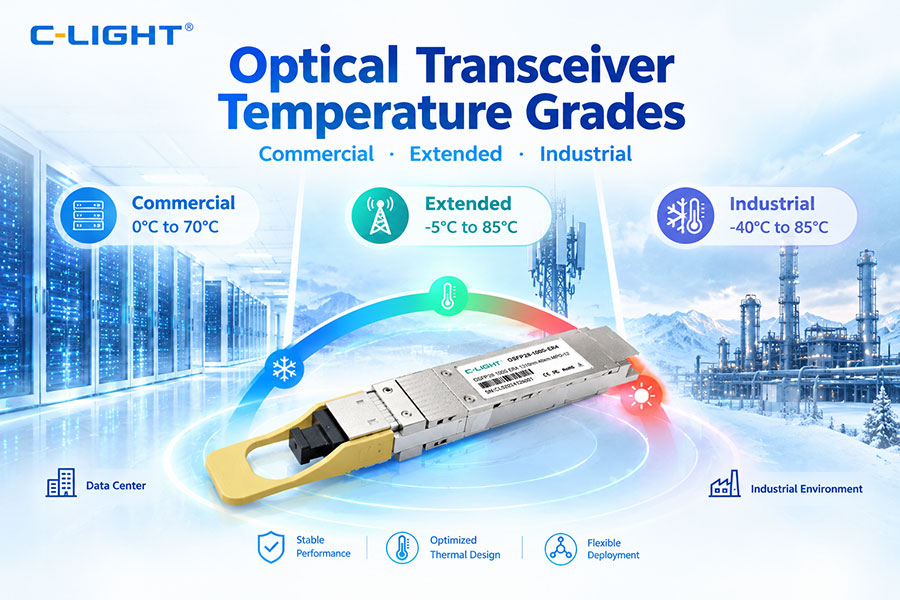
| Environmental Reliability | High/Low Temp & Burn-in: Verifies BER performance under standard rack temperature ranges. | Conduct thermal cycling from -40°C to +85°C; Monitor BER ≤10^-12. |
| Hot-Swap & Durability | Mating Cycles: Verifies mechanical life with the switch cage. | Typically ≥5000 cycles while maintaining contact resistance specs. |
5. Horizontal Comparison: Electrical Module vs. Optical Module vs. DAC/AOC
To better contextualize the value of the electrical module, here is a comparison in a 10G deployment scenario:
| Comparison Item | 10G Copper SFP+ | 10G Optical SFP+ | DAC | AOC |
| Interface Type | RJ45 | LC/SC | Fixed Cable Assembly | Fixed Cable Assembly |
| Transmission Medium | Cat6a/Cat7 Copper | Optical Fiber | Twinax Copper | Optical Fiber |
| Max Distance | Approx. 30m (10G rate) | 300m - 10km+ | ≤7m | Approx. 100m |
| Key Advantage | Copper Reuse, saves rewiring cost | Long distance, ultra-low latency | Lowest cost, plug & play | Lightweight, EMI resistant |
| Power Consumption | High (Significant heat) | Low | Very Low | Medium |
| Typical Scenario | Intra-rack/ Short-reach copper interconnect | Inter-building/ Campus backbone | Server-to-ToR Switch interconnect | Data Center ToR interconnect |
Summary
Broadly, "electrical port module" refers to the category of RJ45 interfaces. Narrowly, it refers to the SFP/SFP+ Copper Transceiver, whose core value lies in flexibility of converting optical slots to copper and the ability to reuse existing copper cabling. In hardware, it relies on high-performance PHY chips; in software, it lacks DDM diagnostic capabilities; in testing, compatibility and thermal management are key concerns. In real-world networking, it serves as an effective supplement to optical modules and DAC/AOC solutions for short-distance connections (under 100m) where copper cabling is already installed.
 >
>

 >
>
 >
>
 >
>
 >
>
 >
>
 >
>
 >
>