TEL:+86 132 6656 7067





As fiber networks carry increasing volumes of Ethernet and data center traffic, wavelength selection becomes an important part of optical network design. A standard gray optical transceiver typically uses a conventional wavelength for a direct optical connection. A DWDM optical transceiver operates at a precisely assigned wavelength within a dense wavelength division multiplexing channel plan.
Both types convert electrical data into optical signals and receive optical signals back into electrical data. Their main difference is how their optical wavelengths are allocated and used within the fiber network. This distinction determines whether multiple independent channels can be combined onto the same fiber through a DWDM system.
1. What Is a Standard Gray Optical Transceiver?
A standard gray optical transceiver is designed for conventional optical connections without requiring its wavelength to occupy a specific DWDM channel in a wavelength multiplexing plan. The term "gray" distinguishes this type of interface from colored CWDM and DWDM interfaces.
Common gray optical transceivers include SR, LR, ER, and other Ethernet optical modules. Depending on the application, they may operate at wavelengths such as 850nm, 1310nm, or 1550nm. The exact wavelength, fiber type, connector, and transmission distance depend on the module standard and model.
Transceiver
Transceiver
In a conventional point-to-point link, one transceiver transmits an optical signal to the receiver at the opposite end. A duplex connection commonly uses separate fibers for transmit and receive, while BiDi modules use different wavelengths for the two directions over a single fiber.
Conventional optical bands
Gray modules commonly use 850nm for multimode applications or wavelengths around 1310nm and 1550nm for single-mode applications. The actual wavelength is determined by the specific interface.
Direct device connections
Gray optics are widely used for switch-to-switch, server-to-switch, router-to-router, and other point-to-point optical connections.
2. What Is a DWDM Optical Transceiver?
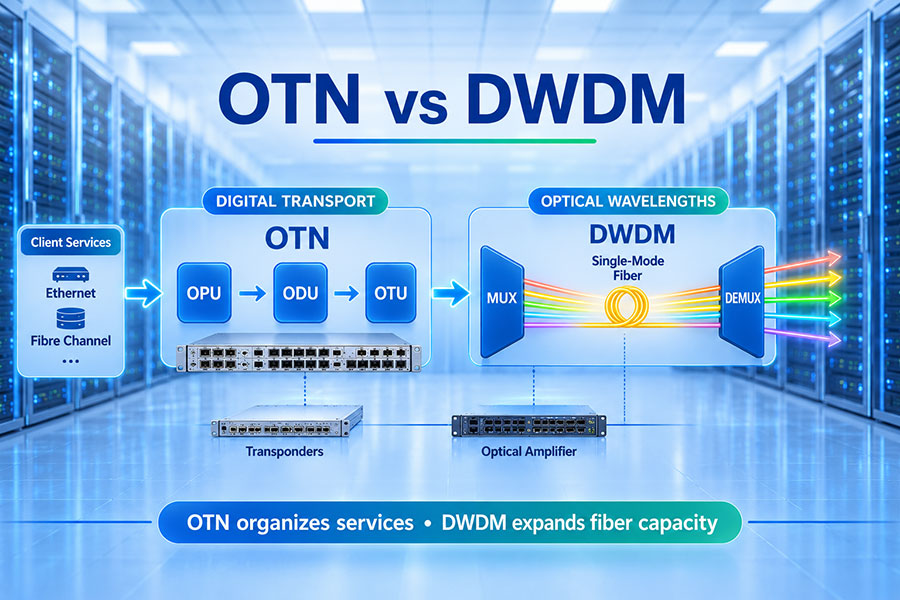
A DWDM optical transceiver is designed to transmit and receive signals at a wavelength or optical frequency assigned to a Dense Wavelength Division Multiplexing channel. Multiple DWDM channels can be combined by an optical MUX and transported simultaneously over the same fiber.
DWDM systems use closely spaced optical channels. The ITU-T G.694.1 frequency grid is anchored at 193.1THz and supports fixed channel spacings such as 100GHz, 50GHz, 25GHz, and 12.5GHz, as well as flexible-grid arrangements.
Because adjacent channels are closely spaced, a DWDM transmitter must maintain its optical frequency within the applicable channel specification. Wavelength accuracy and stability are therefore important design characteristics.
DWDM Optics
MUX
Multiple Channels
DEMUX
For example, a DWDM system may allocate separate channels to different 10G, 25G, 100G, or other supported optical services. The actual capacity depends on the channel count, transceiver rates, line-system design, and optical performance.
3. Key Differences Between DWDM and Gray Transceivers
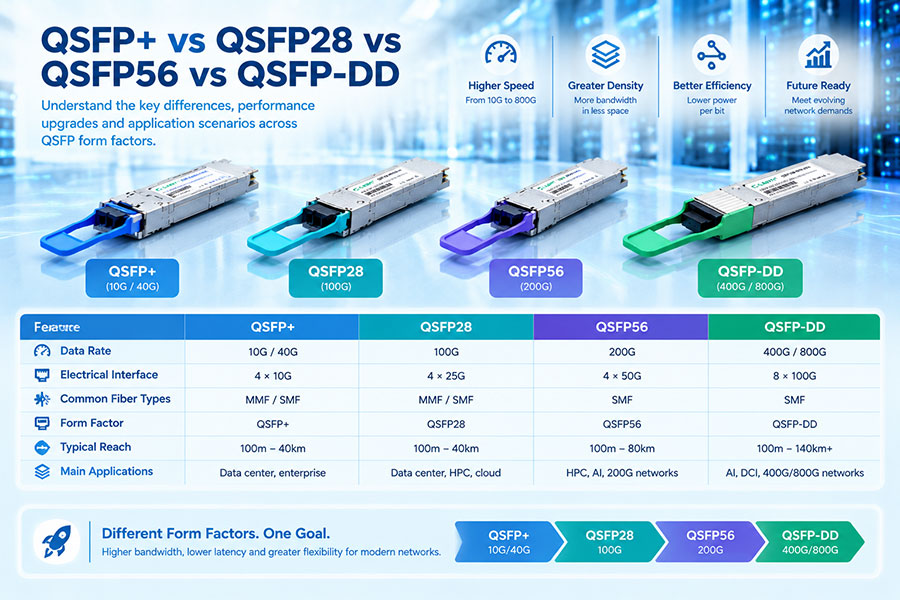
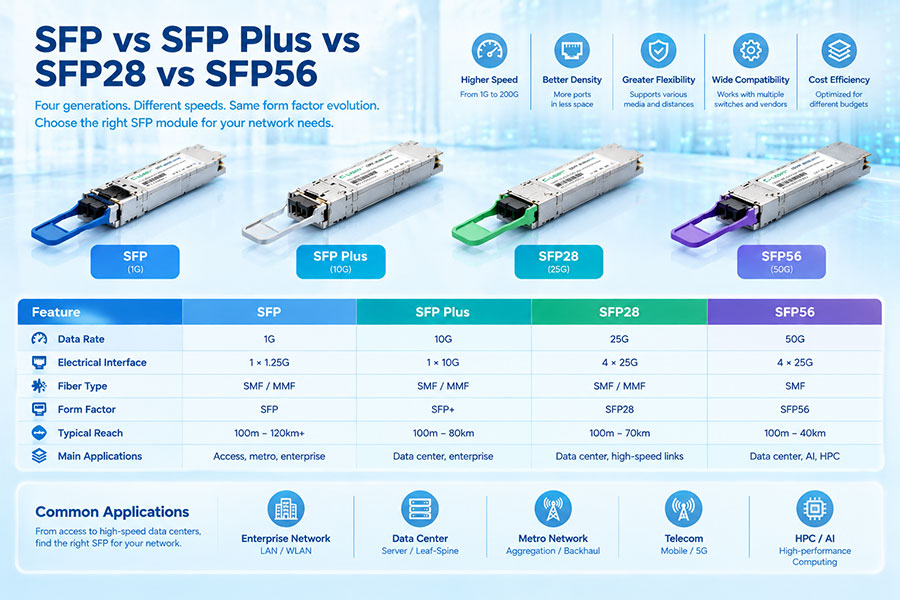
Although both module types may use the same pluggable form factor, such as SFP+, SFP28, or QSFP28, their optical interfaces are designed for different network requirements.
| Comparison | DWDM Optical Transceiver | Standard Gray Transceiver |
|---|---|---|
| Wavelength allocation | Assigned to a specific DWDM channel or supported tuning range. | Uses a conventional wavelength defined by its optical interface. |
| Wavelength spacing | Designed for operation within a dense frequency grid. | Not designed to occupy an individual DWDM grid channel. |
| Wavelength stability | Requires accuracy and stability appropriate to the specified channel spacing. | Follows the wavelength tolerance of its standard or product specification. |
| Network architecture | Commonly used with DWDM MUX/DEMUX, OADM, or compatible line systems. | Commonly used for direct point-to-point optical connections. |
| Fiber utilization | Multiple wavelength channels can share a fiber. | Normally provides a conventional optical connection rather than a DWDM channel. |
| Wavelength selection | May be fixed-wavelength or tunable, depending on the model. | Usually has a fixed nominal wavelength. |
| Optical filtering | Must match the relevant DWDM MUX/DEMUX channel passband. | Does not normally connect directly to an individual DWDM filter channel as a DWDM line optic. |
| Typical application | High-capacity fiber links, metro DWDM, and wavelength-multiplexed transport. | Enterprise Ethernet, data center links, and conventional optical networking. |
| Cost considerations | Can cost more because of wavelength control and specialized optical design. | Often more economical for conventional point-to-point links. |
4. How Wavelength Allocation Affects Fiber Capacity
The main network advantage of DWDM is its ability to carry multiple independent optical channels over one fiber. Instead of assigning a separate fiber pair to every connection, a WDM system combines different wavelengths onto a shared optical path.
A gray transceiver generally uses a conventional wavelength for its own optical link. Multiple gray connections usually require separate fiber paths unless another technology or active transport system adapts and combines their signals.
Conventional gray connection
A direct link carries the signal generated by one optical interface. Additional independent connections typically need additional fiber resources or a separate aggregation architecture.
DWDM multiplexed connection
Several transmitters use different assigned wavelengths. A DWDM MUX combines the channels, and a remote DEMUX separates them for their respective receivers.
For illustration, a DWDM system carrying 40 channels at 100G per channel has a nominal aggregate client rate of 4Tbps before accounting for line overhead, protection capacity, and implementation constraints. The actual usable capacity depends on the transport architecture and supported interfaces.
5. Fixed-Wavelength and Tunable DWDM Transceivers
DWDM optical transceivers are available in fixed-wavelength and tunable configurations. Both are designed for DWDM channel operation, but they offer different deployment and inventory characteristics.
Fixed-wavelength DWDM transceivers
A fixed-wavelength module operates on one assigned DWDM channel. For example, a module may be designed for a particular ITU grid frequency. The MUX port and the remote receiving channel must be configured for the corresponding wavelength.
Suitable for stable, predefined wavelength assignments.
Channel selection is determined by the module model.
Multiple channels require the corresponding fixed-wavelength modules.
Procurement and spare inventory must account for channel assignments.
Tunable DWDM transceivers
A tunable DWDM transceiver can be configured to operate on different supported DWDM channels within its tuning range. This provides more flexibility when channel assignments change or when one hardware type is used across several network locations.
Supports channel selection within the specified tuning range.
Can simplify spare-module inventory.
Requires correct channel configuration at both ends of the optical path.
Must be compatible with the MUX/DEMUX grid and the host equipment.
| Feature | Fixed DWDM | Tunable DWDM |
|---|---|---|
| Channel operation | One assigned channel | Selectable channels within the supported tuning range |
| Deployment flexibility | Depends on the installed wavelength | Greater flexibility for channel assignment |
| Inventory | May require separate stock for different channels | Can reduce the number of wavelength-specific spare types |
| Configuration | Channel is determined by the module | Channel must be configured and verified |
| Compatibility | Must match the assigned filter channel | Tuning range and channel grid must match the line system |
6. Can a Gray Transceiver Replace a DWDM Transceiver?
In most conventional DWDM MUX/DEMUX applications, a standard gray transceiver cannot directly replace a DWDM transceiver. The reason is that the gray module does not generate the specific optical frequency required by an individual DWDM channel.
For example, a DWDM MUX may have separate ports for channels on a 100GHz grid. Each port is designed to pass a specific wavelength range. A gray transceiver operating at a conventional wavelength such as 1310nm will not become a compatible DWDM channel simply because it has the same data rate or connector as the DWDM module.
There are architectures where gray client optics can still be used. An active transponder can receive a gray client signal and convert it to a DWDM line wavelength. This is a different arrangement from connecting a gray transceiver directly to a passive DWDM MUX.
Gray Optics
Transponder
Optics
Line System
7. What Should Be Checked When Selecting a DWDM Transceiver?
Choosing a DWDM module requires more than checking its data rate and connector. The transceiver must match the optical channel plan and the electrical requirements of the host device.
| Parameter | What to Verify |
|---|---|
| Channel frequency | Confirm the exact ITU channel frequency and the corresponding wavelength. |
| Channel spacing | Check whether the line system uses 100GHz, 50GHz, or another supported grid. |
| Wavelength accuracy | Verify frequency tolerance and stability against the channel specification. |
| Data rate | Confirm the supported client protocol, line rate, and host interface. |
| Transmission distance | Evaluate fiber attenuation, dispersion, optical power budget, and OSNR requirements. |
| Optical power | Check transmitter output, receiver sensitivity, and maximum receiver input power. |
| Connector and fiber | Confirm connector type, single-mode fiber requirements, and polarity. |
| Host compatibility | Check port form factor, electrical interface, power consumption, module coding, and supported operating conditions. |
| Line-system compatibility | Verify MUX/DEMUX passband, channel plan, amplifier characteristics, and supported optical interface specifications. |
For standardized single-channel DWDM interfaces, ITU-T G.698.1 defines optical parameter values for specific multichannel DWDM applications. The applicable interface specification should be checked against the actual equipment and network design.
8. DWDM Transceivers in High-Speed Optical Networks
As network interfaces move from 100G toward 400G, 800G, and higher rates, the relationship between client optics and DWDM line optics becomes increasingly important.
A high-speed client transceiver does not automatically operate as a DWDM line transceiver. For example, a parallel-optics 400G or 800G module may use multiple optical lanes and a multimode or single-mode interface designed for a specific short- or medium-reach application. A DWDM line interface must meet the wavelength and optical performance requirements of its intended channel plan.
Some high-speed transport designs use coherent optical technology, which can encode high-capacity signals onto precisely controlled optical carriers. Other designs use dedicated transponders or muxponders to adapt client traffic to the line system. The correct architecture depends on the supported optical interface and transport platform.
High-Speed Client-Side Optical Transceiver Options
C-LIGHT offers 400G and 800G optical transceiver product families for high-bandwidth data center and network connections. These modules may serve as client-side interfaces in a DWDM transport architecture when the specific module configuration matches the host equipment and client-service requirements.
400G QSFP-DD Optical Transceivers | 400G OSFP Optical Transceivers | 800G QSFP-DD Optical Transceivers | 800G OSFP Optical Transceivers
These product families include different optical configurations. Confirm the exact model datasheet before treating any module as a DWDM line-side or coherent transceiver.
9. Typical Applications of DWDM and Gray Optical Transceivers
Gray transceiver applications
Server-to-switch connections in data centers.
Switch-to-switch Ethernet links.
Enterprise campus fiber connections.
Conventional point-to-point single-mode links.
Short-reach multimode optical connections.
DWDM transceiver applications
Metro optical transport networks.
Data center interconnect over shared fiber.
High-capacity enterprise fiber infrastructure.
Wavelength-multiplexed carrier networks.
Optical links requiring multiple channels on limited fiber resources.
For short, direct connections, standard gray optics are often sufficient. When multiple services must share the same fiber infrastructure, DWDM provides a way to allocate separate optical channels and increase fiber utilization.
10. Conclusion
The main difference between a DWDM optical transceiver and a standard gray transceiver is wavelength allocation. Gray optics use conventional wavelengths for direct optical connections, while DWDM optics operate on precisely assigned channels within a dense wavelength grid.
Gray transceivers are suitable for many conventional Ethernet and data center links. DWDM transceivers are designed for wavelength-multiplexed networks where multiple optical channels share the same fiber. Selecting the correct type requires checking the wavelength plan, channel spacing, optical budget, host compatibility, and line-system requirements.
For high-speed optical connectivity and transceiver selection, Contact C-LIGHT.
 >

 >
 >
 >
 >
 >
 >
 >