TEL:+86 132 6656 7067





High-speed data center networks depend on reliable connections between switches, servers, storage systems, and computing nodes. As port speeds increase from 100G to 400G and 800G, selecting the right cabling technology becomes increasingly important for signal integrity, power consumption, installation density, and overall network cost.
Direct Attach Copper (DAC) and Active Optical Cable (AOC) assemblies are two common solutions for short-reach, high-speed connections. Both integrate connectors at the cable ends and plug directly into compatible equipment ports, but they use different transmission media. DAC carries electrical signals through copper conductors, while AOC converts electrical signals into optical signals for transmission through fiber.
1. What Are DAC and AOC Cables?
Direct Attach Copper (DAC)
A DAC cable is a factory-terminated copper cable assembly, typically using twinaxial conductors. Its connector modules are designed to plug directly into compatible SFP, QSFP, QSFP-DD, OSFP, or other supported host interfaces.
DAC transmits electrical signals between connected devices without converting the data into optical signals. Passive DAC assemblies do not require active signal-conditioning electronics in the cable, making them especially attractive for short connections where low power consumption and cost efficiency are priorities.
Active Optical Cable (AOC)
An AOC is an integrated optical cable assembly with optical transceiver electronics built into both connector ends. It converts electrical signals from the host equipment into optical signals, transmits them through fiber, and converts them back into electrical signals at the receiving end.
Because AOC uses optical fiber as its transmission medium, it can support longer cable runs than typical passive DAC solutions at comparable high-speed interfaces. Its fiber construction is also generally lighter and more flexible than high-speed copper cabling.
Core distinction:
DAC = Electrical transmission through copper conductors.
AOC = Electrical-to-optical conversion, optical transmission through fiber, and optical-to-electrical conversion.
2. How Do DAC and AOC Cables Work?
Although both cable types have integrated connectors, their internal signal paths are fundamentally different.
DAC Signal Path
Switch Port → Copper Connector → Twinax Copper Cable → Copper Connector → Server Port
The host electrical interface drives the signal through the copper cable. The receiving port recovers the electrical data without optical conversion.
AOC Signal Path
Switch Port → Optical Conversion → Fiber Cable → Optical Conversion → Server Port
Integrated electronics convert electrical signals into light, transmit them through optical fiber, and recover the electrical signals at the opposite end.
The optical conversion in AOC requires power at the connector assemblies. Passive DAC, by contrast, does not need active optical or electrical signal-conditioning circuitry in the cable itself. Both cable types may contain identification memory so compatible equipment can recognize the connected assembly.
3. DAC vs. AOC: Main Technical Differences
| Comparison Factor | DAC Cable | AOC Cable |
|---|---|---|
| Transmission medium | Twinaxial copper | Optical fiber |
| Signal type inside cable | Electrical | Optical |
| Signal conversion | No optical conversion | Electrical-to-optical and optical-to-electrical |
| Power consumption | Very low for passive DAC; higher for active copper designs | Requires power for optical conversion electronics |
| Transmission distance | Generally shorter, especially at higher data rates | Generally longer than passive DAC at comparable interfaces |
| Cable weight and flexibility | Usually thicker and heavier | Generally lighter and more flexible |
| Electromagnetic interference | Shielding helps control interference | Fiber is immune to electromagnetic interference along the optical path |
| Latency | Very low, with no optical conversion | Very low, but includes optical conversion circuitry |
| Initial cost | Usually lower for short links | Usually higher than passive DAC |
| Typical deployment | Short connections within a rack | Longer connections within or between racks and rows |
These comparisons describe general design characteristics. Actual power, latency, supported distance, and cost depend on the specific cable model, data rate, connector format, and host platform.
4. Passive DAC, Active DAC, and AOC
DAC itself has multiple implementation types. Understanding these distinctions helps avoid treating every copper cable as having the same reach and power characteristics.
| Technology | Transmission Medium | Signal Processing | Main Characteristic |
|---|---|---|---|
| Passive DAC | Copper | No active signal conditioning | Lowest power and cost for short connections |
| Active DAC / ACC | Copper | Signal conditioning or equalization | Can extend copper reach within product limits |
| AEC | Copper | Advanced electrical processing, often including retiming | Designed for selected extended-reach electrical connections |
| AOC | Optical fiber | Optical conversion at both ends | Longer reach and lighter cable construction |
Active DAC and AEC terminology can vary between manufacturers. AOC is a separate optical architecture rather than a type of copper cable. When comparing products, check whether the supplier specifies passive copper, active copper, retimed electrical cable, or active optical cable.
5. Transmission Distance: When Does AOC Become More Suitable?
Distance is one of the most important factors in choosing between DAC and AOC. Copper signal attenuation and other electrical impairments become increasingly challenging as cable length and signaling rate increase.
Passive DAC is commonly used for short connections inside a rack. At higher data rates, its supported reach can become more limited. Active copper designs may extend the distance, but they introduce additional electronics and power requirements.
AOC uses fiber to carry optical signals between the integrated connector assemblies. This makes it suitable for longer high-speed connections where copper cabling may become difficult to route or may not meet the required electrical performance.
| Network Situation | DAC Consideration | AOC Consideration |
|---|---|---|
| Very short in-rack connection | Often a practical and cost-efficient option | Suitable, but may add unnecessary optical cost |
| Longer rack-level connection | Check electrical reach at the target data rate | Often more suitable when the distance exceeds passive DAC capability |
| Adjacent rack connection | Possible when the cable meets the reach specification | Useful for longer paths and dense cable routing |
| High-density cable bundles | Thicker copper can make routing more difficult | Smaller diameter can simplify cable management |
| Electromagnetically noisy environment | Requires appropriate shielding and installation | Optical transmission provides strong EMI immunity |
There is no universal maximum distance for either DAC or AOC. The supported length must be checked against the exact cable specification, interface standard, data rate, and equipment compatibility list.
6. Power Consumption, Latency, and Signal Integrity
Power and signal performance are particularly important in large data centers and AI computing clusters, where thousands of high-speed links may operate simultaneously.
Power Consumption
Passive DAC has a major power advantage because it does not require active signal conversion within the cable. Active copper products consume additional power for signal conditioning, while AOC requires powered optical electronics at both ends.
When many links are deployed, the cumulative power difference can influence rack-level power planning and cooling requirements. However, the correct comparison should use actual per-end or per-link power specifications rather than assuming all products have identical consumption.
Latency
DAC offers a direct electrical transmission path without optical conversion, making it attractive for applications that prioritize very low latency. AOC introduces electrical-to-optical and optical-to-electrical conversion, but its latency remains very low for typical data center interconnect applications.
In most network designs, the difference should be evaluated using product-level latency data and the requirements of the complete system. Cable selection should not be based on latency alone.
Signal Integrity
DAC performance depends on electrical characteristics such as insertion loss, return loss, impedance consistency, crosstalk, and shielding. As lane rates increase, these factors become more demanding.
AOC avoids the long electrical transmission path by using fiber. However, its optical transmitters, receivers, and internal fiber assembly must also meet the relevant performance and reliability requirements.
7. DAC vs. AOC for 100G, 400G, and 800G Networks
Higher-speed Ethernet and AI networking have increased demand for both copper and optical cable assemblies. The preferred solution depends on link distance, port architecture, cable density, and the electrical or optical requirements of the host interface.
| Data Rate | DAC Applications | AOC Applications | Selection Priority |
|---|---|---|---|
| 100G | Short switch-to-server and switch-to-switch links | Longer rack and row-level connections | Distance, power, and cable layout |
| 200G | Short high-speed electrical connections | Optical connections where additional reach is required | Lane architecture and host compatibility |
| 400G | Short-reach switch and server interconnects | Longer high-speed data center connections | Electrical reach, cable density, and power |
| 800G | Very short connections where supported by the cable and host | Optical connections requiring greater reach and flexible routing | Port format, lane configuration, and system design |
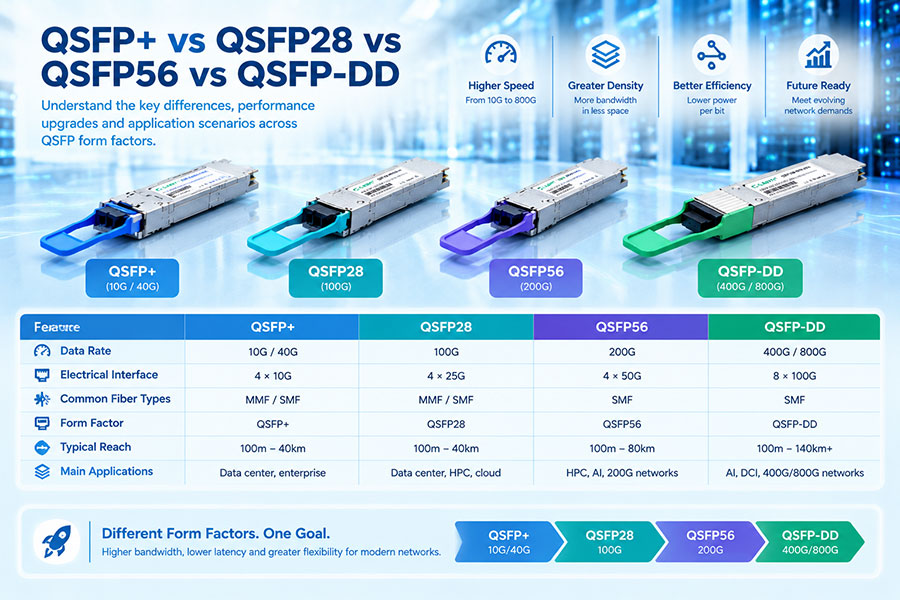
At 400G and 800G, connector format and lane architecture become especially important. QSFP-DD and OSFP are different form factors, and a cable designed for one interface should not be assumed to work with the other simply because both support a similar aggregate data rate.
8. C-LIGHT DAC and AOC Cable Solutions
C-LIGHT provides high-speed connectivity products for data center, enterprise, and AI network applications. DAC and AOC serve different installation requirements, so selecting the right product begins with the target data rate, port format, cable length, and equipment compatibility.
400G Active Optical Cable (AOC)
The C-LIGHT 400G AOC is designed for high-speed optical interconnections between compatible 400G network ports.
AOC is worth considering when a connection needs the benefits of optical transmission, including longer reach than typical passive copper assemblies and lighter cable routing. Check the selected variant's wavelength, fiber type, length, connector format, and host compatibility before deployment.
800G Direct Attach Copper (DAC)
The C-LIGHT 800G DAC cable provides a direct electrical interconnect option for compatible 800G equipment.
It is relevant to short-reach, high-bandwidth connections where copper cabling can meet the electrical reach and signal-integrity requirements. Confirm the cable length, connector type, host port support, and electrical specifications for the intended application.
Additional 800G Optical Connectivity
For network designs requiring separate optical transceivers and fiber patch cables rather than an integrated AOC assembly, C-LIGHT also offers:
800G QSFP-DD Optical Transceiver — for compatible QSFP-DD optical interfaces.
800G OSFP Optical Transceiver — for compatible OSFP optical interfaces.
These are separate pluggable optical transceiver product families, not integrated AOC cables. They provide an alternative architecture when detachable fiber cabling and transceivers are preferred.
9. How to Choose Between DAC and AOC
The selection process should begin with the actual link requirements rather than choosing a cable solely by its data rate.
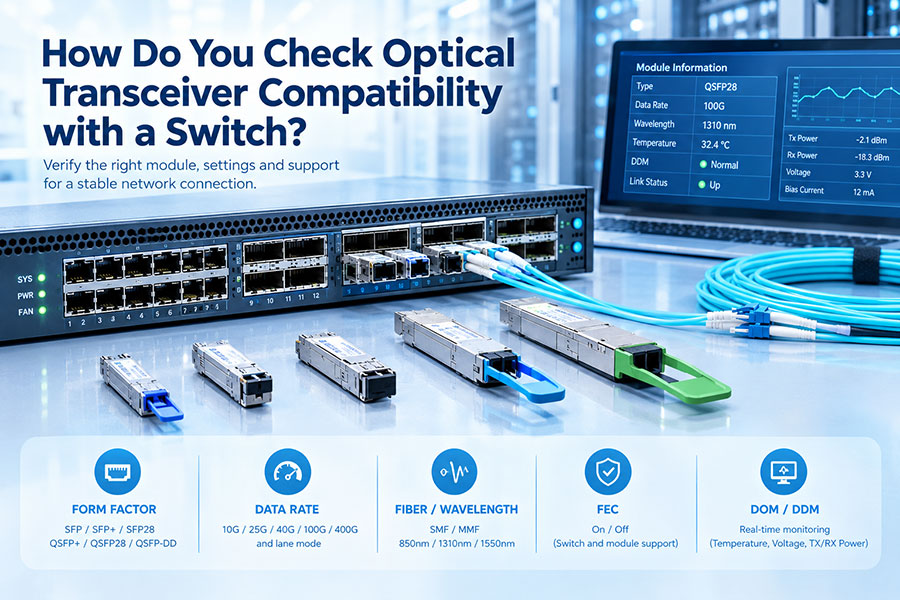
Check these factors before deployment:
Required distance: Measure the actual cable route, including rack height, horizontal routing, and service slack.
Port compatibility: Confirm the connector format and supported cable type at both ends.
Data rate: Verify the cable's supported speed and lane configuration.
Power budget: Compare passive DAC, active copper, and AOC power requirements.
Cable management: Consider cable thickness, bend radius, weight, and rack airflow.
Environmental conditions: Evaluate electromagnetic interference and installation requirements.
Breakout support: Confirm lane mapping and host support for configurations such as 400G to 4 × 100G.
Equipment recognition: Check vendor coding, cable identification, firmware, and compatibility requirements.
Future expansion: Consider whether the selected cabling architecture can support planned port-speed upgrades.
For a short server-to-switch connection within one rack, passive DAC is often a strong starting point. For longer paths, denser cable bundles, or environments where copper reach becomes restrictive, AOC may offer a more practical solution.
10. Conclusion
DAC and AOC cables both provide integrated high-speed connectivity, but their transmission technologies create different advantages. DAC uses copper to deliver low-cost, low-power electrical connections over short distances. AOC uses optical fiber and integrated conversion electronics to support longer connections with lighter and more flexible cable construction.
For short in-rack links, DAC is often the preferred option. For longer high-speed connections, dense cabling environments, and applications requiring electromagnetic immunity, AOC is often more suitable.
As data center networks advance toward 400G and 800G, the right choice should be based on cable length, electrical or optical performance, connector format, power consumption, and host compatibility. Matching these factors to the actual deployment ensures a reliable and scalable interconnect design.
Looking for 400G or 800G DAC and AOC connectivity?
Share your equipment models, data rate, connector format, and required cable length to identify a suitable solution for your network.
Contact C-LIGHT >

 >
 >
 >
 >
 >
 >
 >