TEL:+86 132 6656 7067




With the rapid expansion of cloud computing, artificial intelligence, 5G networks, and global data traffic, optical communication networks are facing increasing demands for higher capacity and longer transmission distances.
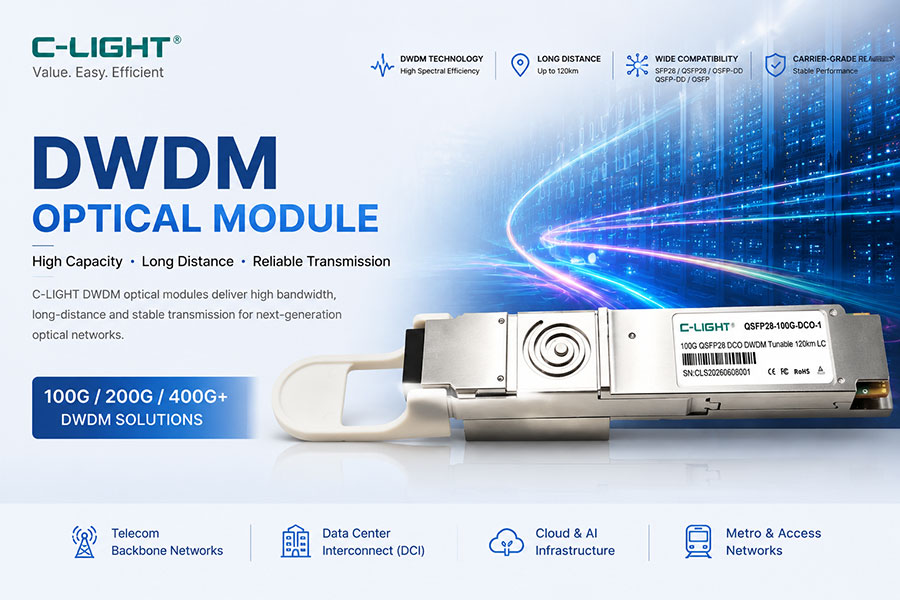
DWDM (Dense Wavelength Division Multiplexing) optical modules have become a critical technology for maximizing fiber capacity by transmitting multiple wavelengths over a single optical fiber. They enable high-capacity optical transmission for telecom backbone networks, data center interconnects, metro networks, and enterprise communication systems.
The DWDM optical module market is entering a new growth phase driven by higher bandwidth requirements, coherent optical technology development, and the rapid expansion of AI data center infrastructure. :contentReference[oaicite:1]{index=1}
1. Overview of DWDM Optical Module Market
1.1 What Is a DWDM Optical Module?
A DWDM optical module is an optical transceiver that uses Dense Wavelength Division Multiplexing technology to transmit multiple optical signals at different wavelengths through a single optical fiber.
Compared with traditional optical modules that transmit one optical channel, DWDM technology significantly increases fiber utilization efficiency.
The basic functions include:
Optical signal transmission and reception
Wavelength multiplexing
Long-distance optical communication
High-capacity network expansion
1.2 DWDM Optical Module Market Growth Drivers
The growth of the DWDM optical module market is mainly driven by:
AI Data Centers: Large-scale AI clusters require massive bandwidth between data centers.
Cloud Computing: Hyperscale cloud providers continue expanding high-capacity optical networks.
5G Infrastructure: Mobile networks require higher-capacity transport networks.
Fiber Capacity Expansion: Operators need more bandwidth without deploying additional fiber cables.
2. DWDM Technology Principle
2.1 How DWDM Works
DWDM technology combines multiple optical wavelengths into one fiber through optical multiplexing technology.
A typical DWDM system includes:
DWDM Optical Transceiver
Optical Multiplexer (MUX)
Optical Demultiplexer (DEMUX)
Optical Amplifier
Fiber Optical Link
Each wavelength carries an independent data channel, allowing one fiber pair to support multiple high-speed connections.
2.2 DWDM vs CWDM
| Feature | DWDM | CWDM |
|---|---|---|
| Channel Spacing | Narrow spacing | Wide spacing |
| Number of Channels | Higher | Lower |
| Transmission Distance | Long Distance | Short / Medium Distance |
| Main Application | Backbone, DCI, Metro | Enterprise Access |
| Cost | Higher | Lower |
3. Key DWDM Optical Module Technologies
3.1 Fixed Wavelength DWDM Modules
Fixed wavelength DWDM modules use predefined wavelengths and are commonly deployed in traditional optical networks.
Typical products include:
10G DWDM SFP+
25G DWDM SFP28
100G DWDM Optical Modules
3.2 Tunable DWDM Optical Modules
Tunable DWDM modules can dynamically adjust operating wavelengths, providing greater flexibility for modern optical networks.
Advantages include:
Reduced inventory requirements
Flexible wavelength management
Easier network maintenance
3.3 Coherent DWDM Optical Modules
Coherent optical technology has become a key direction for high-capacity DWDM networks.
Modern coherent modules support:
100G transmission
200G transmission
400G transmission
800G future evolution
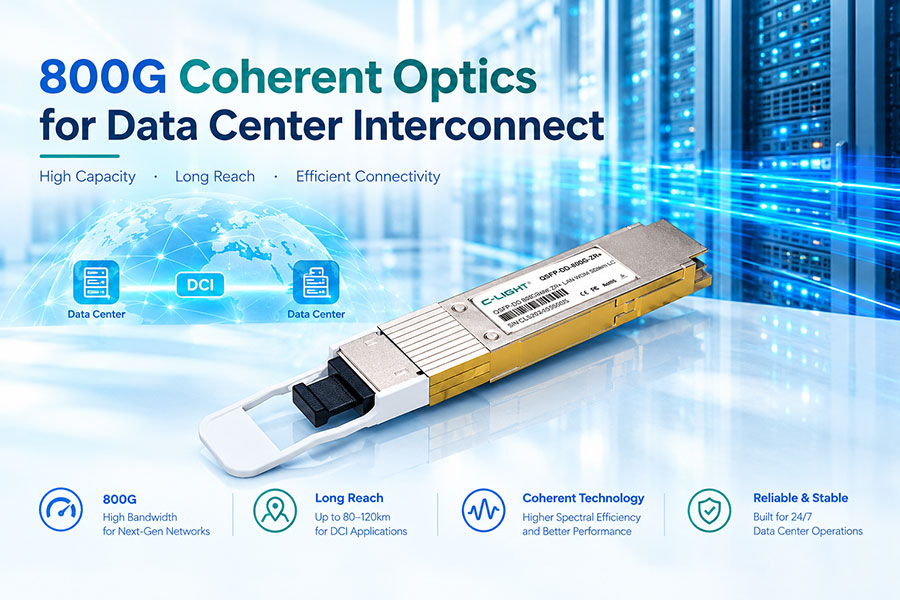
Coherent pluggable modules are increasingly used in data center interconnect applications due to their high capacity and compact form factor. :contentReference[oaicite:2]{index=2}
4. DWDM Optical Module Market Segmentation
4.1 By Data Rate
10G DWDM Optical Module
25G DWDM Optical Module
100G DWDM Optical Module
400G DWDM Optical Module
800G Coherent Optical Module
4.2 By Application
Telecommunication Networks: Backbone and metro optical networks.
Data Center Interconnect: High-capacity links between distributed data centers.
Cloud Infrastructure: Large-scale cloud service provider networks.
Enterprise Networks: Private optical networks.
5. DWDM Optical Module Applications
5.1 Telecom Backbone Networks
Telecom operators use DWDM technology to increase backbone network capacity while reducing the need for additional fiber deployment.
DWDM optical modules provide:
Long-distance transmission
High spectral efficiency
Reliable carrier-grade communication
5.2 Data Center Interconnect (DCI)
AI computing and cloud services are accelerating the growth of distributed data centers.
DWDM optical modules enable:
Data center-to-data center connectivity
High bandwidth transmission
Low latency communication
5.3 AI Data Center Networks
The rapid deployment of AI clusters is creating new requirements for optical transmission capacity.
Future AI networks require:
Higher wavelength capacity
Lower power consumption
Higher optical integration
400G/800G optical interconnect solutions
6. Market Trends of DWDM Optical Modules
6.1 Transition Toward 400G and Higher-Speed DWDM
The optical industry is moving from traditional 100G networks toward 400G and beyond.
Higher-speed DWDM modules provide:
Higher bandwidth per wavelength
Lower cost per bit
Improved fiber utilization
6.2 IP-over-DWDM Architecture
Modern networks are increasingly integrating DWDM optics directly into routers and switches, reducing system complexity and improving network efficiency. :contentReference[oaicite:3]{index=3}
6.3 Silicon Photonics and Optical Integration
Silicon photonics technology is expected to improve DWDM module integration, reduce power consumption, and support future high-capacity optical communication.
7. Challenges Facing DWDM Optical Modules
7.1 High Manufacturing Complexity
DWDM modules require precise optical wavelength control and advanced components.
7.2 Thermal Management
Higher-speed optical modules generate more heat, requiring improved thermal design.
7.3 Cost Optimization
Reducing cost while maintaining optical performance remains a major challenge for large-scale deployment.
8. Future Outlook of DWDM Optical Module Market
The DWDM optical module market will continue growing as global data traffic increases and optical networks evolve toward higher capacity.
Future development directions include:
400G/800G coherent DWDM modules
Lower-power optical solutions
Compact pluggable optical modules
AI-driven optical networks
Next-generation DCI solutions
9. C-LIGHT DWDM Optical Module Solutions
C-LIGHT provides advanced optical transceiver solutions for telecom networks, data centers, and high-speed optical communication systems.
The product portfolio includes:
DWDM SFP/SFP+ Optical Modules
DWDM SFP28 Optical Modules
100G DWDM Optical Solutions
High-Speed Optical Interconnect Products
C-LIGHT supports customers in building reliable, scalable, and high-capacity optical networks.
10. Conclusion: DWDM Optical Modules Enable Future High-Capacity Networks
DWDM optical modules remain a fundamental technology for expanding fiber network capacity.
Driven by AI data centers, cloud computing, 5G, and increasing bandwidth requirements, DWDM technology is evolving toward higher speeds, greater integration, and more flexible optical architectures.
From traditional telecom backbone networks to next-generation AI data center interconnects, DWDM optical modules will continue playing a critical role in the future of optical communication.
11. FAQ: DWDM Optical Module Market
Q1: What is a DWDM optical module?
Answer: A DWDM optical module is a transceiver that uses multiple wavelengths to transmit several optical channels over a single fiber.
Q2: Why is DWDM important for optical networks?
Answer: DWDM increases fiber capacity and enables high-bandwidth long-distance optical transmission.
Q3: What are the main applications of DWDM modules?
Answer: Major applications include telecom backbone networks, data center interconnects, cloud networks, and enterprise optical systems.
Q4: What speeds do DWDM optical modules support?
Answer: DWDM modules support various speeds including 10G, 25G, 100G, 400G, and future higher-speed coherent solutions.
Q5: What is the difference between DWDM and CWDM?
Answer: DWDM uses tighter wavelength spacing and supports more channels and longer distances compared with CWDM.
Q6: How does AI impact the DWDM optical module market?
Answer: AI data centers require massive bandwidth and long-distance interconnection, increasing demand for high-capacity DWDM optical solutions.
 >
>

 >
>
 >
>
 >
>
 >
>
 >
>
 >
>
 >
>