TEL:+86 132 6656 7067




A complete DWDM system is more than just the fiber and the lasers. It is a carefully orchestrated ecosystem of specialized components:
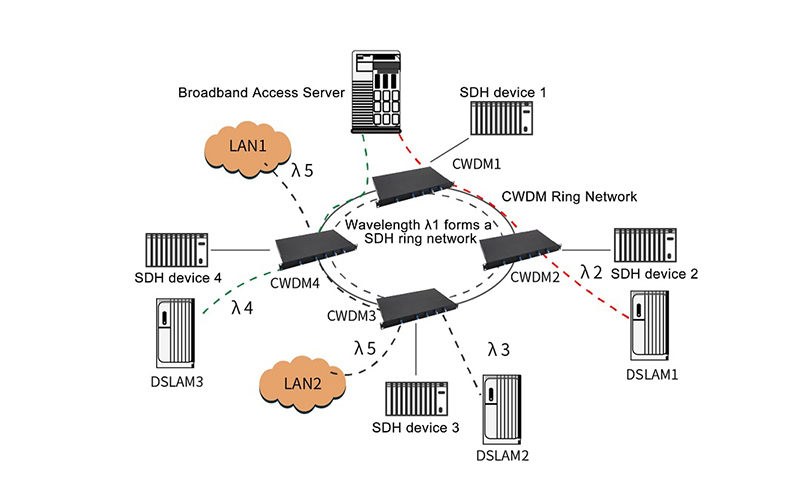
1. DWDM MUX / DEMUX (Multiplexer / Demultiplexer)
These are the core optical filters that combine and separate wavelengths. They are passive devices that use technologies such as thin-film filters or arrayed waveguide gratings (AWG) to precisely route specific wavelengths with minimal insertion loss and high channel isolation.
2. Optical Amplifiers (EDFA and Raman)
Because optical signals attenuate as they travel through glass fiber, they must be periodically boosted. Erbium-Doped Fiber Amplifiers (EDFAs) are the standard choice for DWDM systems because they can amplify the entire C-band spectrum simultaneously without converting the signal back to electrical form.For ultra-long-haul applications, Raman amplifiers may be deployed to further improve the optical signal-to-noise ratio (OSNR).
3. Transponders and Muxponders
These are the active electronic interfaces that connect client equipment (such as routers, switches, or SAN directors) to the DWDM optical layer.
A Transponder maps a single client signal (e.g., 100G Ethernet) onto a specific DWDM wavelength.
A Muxponder aggregates multiple lower-rate client signals (e.g., 8 × 10GE or 4 × 25GE) and multiplexes them onto a single high-speed DWDM wavelength, improving fiber efficiency.
4. Coherent Optical Modules and DSP
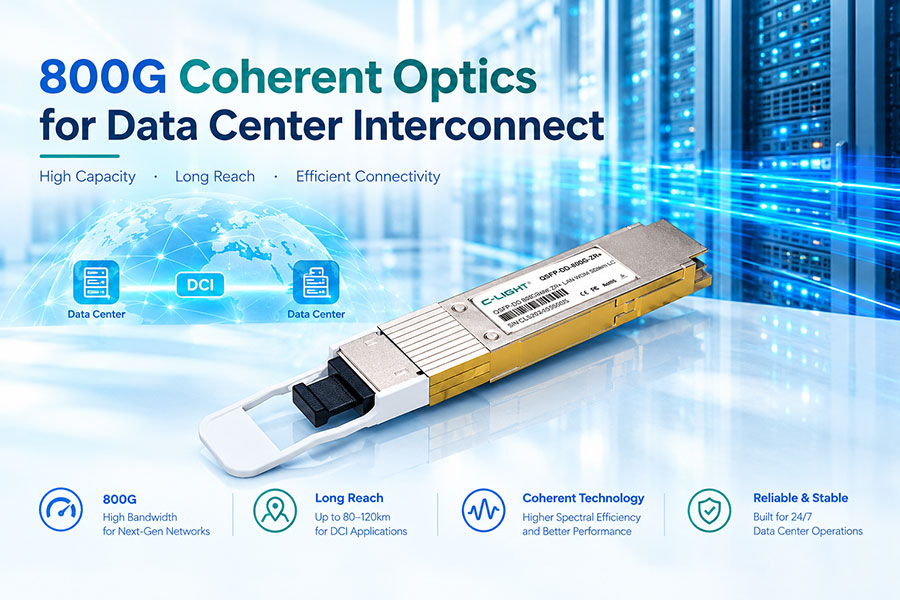
Modern high-speed DWDM (100G, 400G, 800G) relies on coherent detection combined with advanced Digital Signal Processing (DSP) . Unlike traditional direct detection, coherent technology encodes information in both the amplitude and phase of light, dramatically increasing spectral efficiency. DSP compensates for fiber impairments such as chromatic dispersion and polarization mode dispersion (PMD), enabling longer reach without regeneration.
5. ROADM (Reconfigurable Optical Add-Drop Multiplexer)
In mesh and ring network topologies, ROADMs allow network operators to remotely add, drop, or pass through specific wavelengths at any node without manual intervention. This enables flexible, software-defined optical networking.
6. Optical Channel Monitoring and Protection
Modern DWDM systems incorporate Optical Channel Monitors (OCM) and Optical Line Protection (OLP) units to detect signal degradation and automatically switch traffic to backup fibers in the event of a cut or failure, ensuring carrier-grade reliability.
 >
>

 >
>
 >
>
 >
>
 >
>
 >
>
 >
>
 >
>