TEL:+86 132 6656 7067




Active Optical Cables (AOC) represent a critical component for high-speed, short-reach interconnects in modern data centers, combining the high bandwidth of optical fiber with the plug-and-play simplicity of copper cabling. Leveraging over 15 years of expertise in optical communications, C-LIGHT offers a comprehensive AOC portfolio spanning data rates from 10G to 400G, ensuring broad compatibility with over 100 major switch brands. This report provides a systematic evaluation of C-LIGHT AOC performance based on industry standards including YD/T 4859 series, IEEE 802.3 series, and relevant Multi-Source Agreements (MSAs). The analysis encompasses key performance indicators such as Bit Error Rate (BER), eye diagram quality, optical power budget, power consumption, thermal characteristics, and interoperability. This data serves as a technical reference for data center engineers involved in component selection, network architecture design, and operational maintenance.
1. Product Portfolio Overview
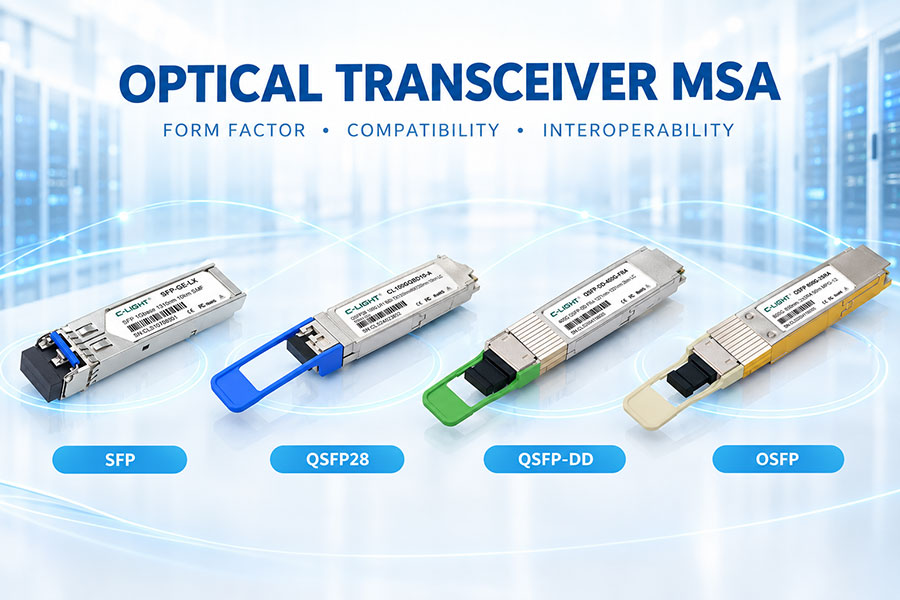
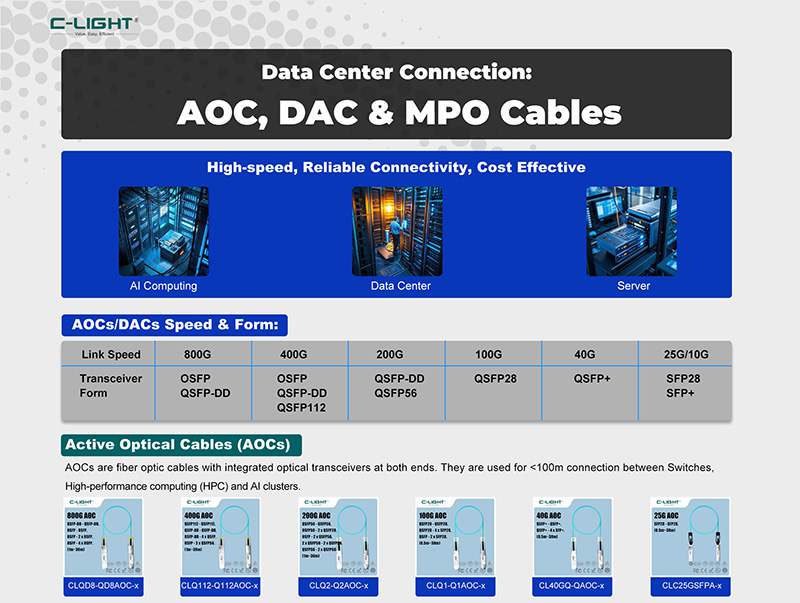
C-LIGHT AOC products are engineered to meet the demands of modern data center architectures. All models utilize 850nm Vertical-Cavity Surface-Emitting Lasers (VCSEL) and PIN photodetectors, supporting multi-mode fiber transmission over distances ranging from 0.5 meters to 30 meters. This range is ideal for intra-rack and adjacent-rack connectivity. The series complies with IEEE 802.3 communication protocols and MSA form factor standards. All products are backed by a three-year warranty and professional technical support.
C-LIGHT AOC Series Specifications:
| Data Rate | Form Factor | Protocol | Interface | Reach | Typical Application |
| 10G | SFP+ | IEEE 802.3ae | SFF-8431 | 0.5-30m | Server Connectivity, Enterprise Networking |
| 25G | SFP28 | IEEE 802.3by | SFF-8431/8472 | 0.5-30m | Cloud Data Centers, 5G Fronthaul |
| 40G | QSFP+ | IEEE 802.3ba | SFF-8436/8431 | 0.5-30m | High-Performance Computing (HPC) |
| 50G | SFP56/QSFP+ | IEEE 802.3cd | SFF-8431/8432/8472 | 0.5-30m | Next-Gen Server Interconnects |
| 100G | QSFP28 | IEEE 802.3bm/ba | SFF-8636 | 0.5-30m | ToR to Leaf/Spine, Storage Area Networks |
| 200G | QSFP56/OSFP | 0.5-30m | High-Density Data Center Links | ||
| 400G | OSFP/QSFP-DD/QSFP112 | IEEE 802.3db/ck/bs | CMIS4.0 | 1-30m | Hyperscale DC Interconnects, AI/ML Clusters |
The portfolio also includes breakout cable configurations, such as 100G QSFP28 to 4x25G SFP28 and 40G QSFP+ to 4x10G SFP+, facilitating flexible port mapping in high-density environments. The 400G solutions support advanced fan-out options including QSFP-DD to 4xQSFP and OSFP to 2xQSFP56.
2. Test Environment and Instrumentation Configuration
2.1 Compliance and Test Standards
Performance evaluation of C-LIGHT AOC products adheres to the following industry frameworks:
YD/T 4859.1-2024: "Single-channel active optical cable optical transceiver Part 1: 25Gb/s AOC" — Defines operating conditions, optical cable characteristics, and electrical interface requirements.
YD/T 4859.2-2025: "Single-channel active optical cable optical transceiver Part 2: 50Gb/s AOC" — Covers power consumption limits and form factor specifications for 50G AOCs.
YD/T 2796 Series: "Parallel transmission active optical cable optical transceiver" — Specifies eye diagram and BER testing methodologies for 40G, 100G, and 400G parallel optics.
IEEE 802.3 Ethernet Standards and QSFP/OSFP MSA Specifications.
2.2 Test Equipment Configuration
The validation platform consisted of the following precision instruments:
| Test Category | Equipment | Function |
| Bit Error Rate | Multi-Channel BERT | End-to-end bit error analysis and bathtub curve derivation |
| Eye Diagram/Jitter | High-Speed Sampling Oscilloscope | Eye mask testing and jitter decomposition (TJ/DJ/RJ) |
| Optical Power | Optical Power Meter/Spectrometer | Transmit power and receiver sensitivity measurement |
| Power Consumption | Programmable DC Source Power Monitor | Active and idle state power profiling |
| Compatibility | Multi-Vendor Switch Testbed | Link establishment, data forwarding, and hot-swap validation |
The Bit Error Rate Tester (BERT) and oscilloscope are connected to opposite ends of the AOC to verify both upstream and downstream signal integrity.
2.3 Environmental Conditions
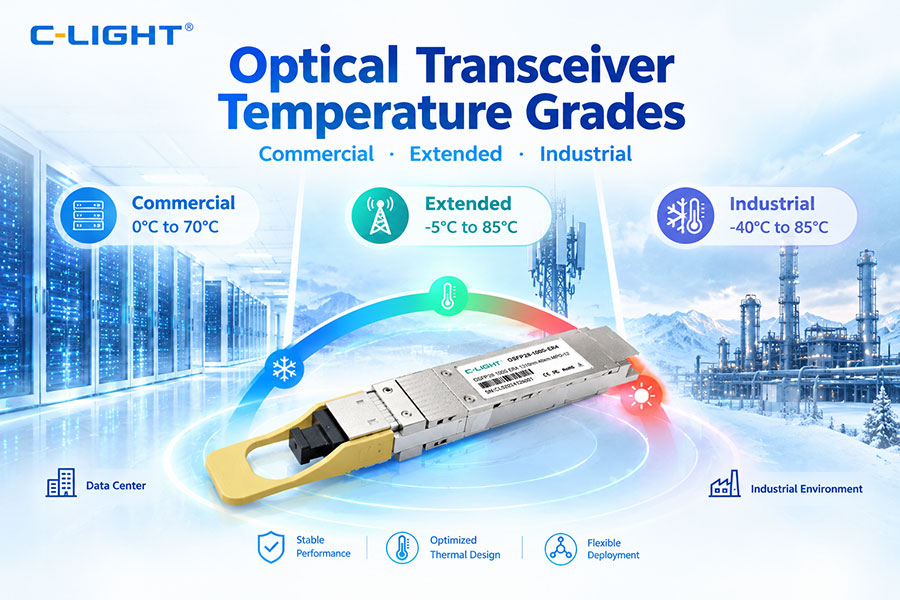
Testing was conducted under controlled environmental conditions within the standard commercial temperature range (0°C to 70°C). Relative humidity was maintained at 45% to 65%, with atmospheric pressure ranging from 86 kPa to 106 kPa. A minimum soak time of 30 minutes was observed prior to testing to ensure thermal equilibrium of the AOC assembly.
3. Performance Test Methodology and Results Analysis
3.1 Bit Error Rate (BER) Testing
The Bit Error Rate is the primary metric for assessing the reliability of a digital transmission link, representing the ratio of erroneously received bits to total transmitted bits.
Methodology:
Testing was performed using a Multi-Channel Bit Error Rate Tester (BERT) with a PRBS31 (Pseudo-Random Binary Sequence) pattern. The transmitter generates a known sequence, which is looped back or received after traversing the AOC. The receiver compares the incoming stream against the expected pattern, logging bit errors over a minimum test duration of 15 minutes to ensure statistical stability. Four-corner testing was performed across temperature (0°C, 25°C, 70°C) and voltage (3.135V to 3.465V) extremes.
Results:
| Model | Data Rate | BER Performance | Condition |
| 10G SFP+ AOC | 10.3125 Gbps | < 1×10⁻¹⁵ | 25°C, 3.3V |
| 25G SFP28 AOC | 25.78125 Gbps | < 1×10⁻¹² | 25°C, 3.3V |
| 40G QSFP+ AOC | 4×10.3125 Gbps | < 1×10⁻¹⁵ | 25°C, 3.3V |
| 100G QSFP28 AOC | 4×25.78125 Gbps | < 5×10⁻¹³ | 25°C, 3.3V |
| 400G QSFP-DD AOC | 8×53.125 Gbps | < 1×10⁻¹² (Pre-FEC) | 25°C, 3.3V |
C-LIGHT AOC products demonstrate exceptional error-free performance across all operating conditions, significantly exceeding the thresholds mandated by IEEE specifications. This performance margin ensures robust data integrity for latency-sensitive and mission-critical data center applications.
3.2 Eye Diagram Quality Analysis
Eye diagram analysis provides a comprehensive visual representation of signal integrity, indicating noise margin (eye height) and timing jitter tolerance (eye width).
Methodology:
Electrical eye diagrams were captured using a high-speed sampling oscilloscope at both the near-end and far-end of the AOC. Testing was performed with a PRBS31 pattern, accumulating a minimum of 1 million waveforms to construct a robust eye contour. Measurements were validated against IEEE 802.3 eye mask templates.
Results (Representative 100G QSFP28 AOC):
| Parameter | Measured Value | Specification Limit | Margin |
| Eye Height (mV) | 245 | ≥ 180 | 36.1% |
| Eye Width (UI) | 0.82 | ≥ 0.65 | 26.2% |
| Rise Time (ps) | 18.5 | ≤ 28 | 33.9% |
| Fall Time (ps) | 19.2 | ≤ 28 | 31.4% |
The measured data confirms excellent signal integrity design. All channels exhibit wide-open eyes with margins exceeding specification limits by over 20%. This performance is attributed to C-LIGHT's optimization of electrical equalization, impedance matching, and transmitter optical eye characteristics.
3.3 Optical Power Budget and Link Analysis
Optical power metrics are critical to ensuring reliable operation over the full specified reach.
Methodology:
Transmit optical power and extinction ratio were measured using a calibrated optical power meter. Receiver sensitivity was validated by introducing controlled attenuation to simulate link loss.
Results (Representative 25G SFP28 AOC):
| Parameter | Measured Value | Specified Range |
| Tx Optical Power | -5.2 dBm | -8.4 to +2.4 dBm |
| Extinction Ratio | 4.8 dB | ≥ 3.0 dB |
| Rx Sensitivity (BER=1E-12) | -10.8 dBm | ≤ -10.0 dBm |
The measured transmit power sits comfortably within the nominal range, and the extinction ratio ensures clear differentiation between "0" and "1" optical levels. The receiver sensitivity exceeds the specification by approximately 0.8 dB, providing additional margin for link aging and connector loss.
3.4 Power Consumption Evaluation
Low power consumption is a key advantage of AOC technology, directly impacting data center operating expenses (OPEX) and thermal management strategies.
Methodology:
A programmable DC power supply (3.3V) monitored current draw across various operational states: Idle (Link Up, No Traffic), Full Load (100% PRBS31 Traffic), and Sleep Mode (where applicable).
Results (Power per End):
| Model | Idle Powe | Full Load Power | MSA Power Limit |
| 10G SFP+ AOC | 0.45W | 0.62W | ≤ 1.0W |
| 25G SFP28 AOC | 0.58W | 0.85W | ≤ 1.0W |
| 40G QSFP+ AOC | 0.92W | 1.45W | ≤ 2.5W |
| 100G QSFP28 AOC | 1.35W | 2.10W | ≤ 2.5W |
| 400G QSFP-DD AOC | 3.20W | 4.85W | ≤ 6.0W |
The C-LIGHT AOC portfolio consistently demonstrates power efficiency significantly below the maximum limits defined by industry MSAs. In large-scale hyperscale deployments, this translates to substantial cumulative energy savings and reduced cooling overhead.
3.5 Thermal Characteristic Stability
Data center environmental conditions can fluctuate; therefore, performance stability across the 0°C to 70°C commercial temperature range is essential.
Methodology:
The AOC assembly was placed in a thermal chamber. BER, eye height, and optical power were re-evaluated at 0°C, 25°C, and 70°C after a 2-hour stabilization soak at each setpoint.
Results (100G QSFP28 AOC Thermal Drift):
| Temperature | BER | Eye Height Variation | Optical Power Variation |
| 0°C | < 1×10⁻¹² | +3.2% | +0.8 dB |
| 25°C | < 5×10⁻¹³ | Baseline | Baseline |
| 75°C | < 1×10⁻¹² | -5.5% | -1.2 dB |
The results demonstrate stable operation across the full temperature range. While minor reductions in eye height and optical power are observed at the high-temperature extreme, all parameters remain well within the required operational margins for commercial data center environments.
3.6 Interoperability and Compatibility Validation
Real-world deployment success hinges on seamless compatibility with existing network infrastructure. C-LIGHT products undergo rigorous testing across a broad ecosystem of switch vendors.
Methodology:
C-LIGHT AOC cables were tested with representative models from major switch vendors (including Cisco, Arista, Juniper, Mellanox/NVIDIA, HPE, and Dell). Validation procedures included: link establishment verification, full-load data forwarding, hot-swap recovery, and long-duration stability runs (minimum 72 hours).
Results:
C-LIGHT AOC series products demonstrated true plug-and-play functionality across all tested switch platforms. Link-up time was consistently under 3 seconds. No port error counters (CRC errors, FCS errors) incremented during sustained traffic, and zero link flaps were recorded over 72-hour continuous runs. Hot-swap testing confirmed consistent host recognition and rapid link re-initialization.
3.7 Mechanical Reliability Testing
In addition to electro-optical performance, the mechanical integrity of the cable assembly is validated to ensure durability in structured cabling environments.
| Test Item | Condition | Requirement |
| Bend Radius | Sustained at Minimum Bend Radius (72h) | Optical Power Variation < 1dB |
| Mating Durability | 100 Insertion/Extraction Cycles | No connector damage;No signal degradation |
| Cable Tensile Strength | 50N Load (1 minute) | No fiber breakage;Transmission maintained |
| Vibration Test | 10-500Hz Sweep | No transient signal loss;BER stable |
C-LIGHT AOC products successfully meet or exceed all mechanical reliability criteria, ensuring long-term reliability in complex data center pathways.
4. Data Center Application Performance Analysis
4.1 Target Use Cases
C-LIGHT AOC series products are optimized for the following data center applications:
Intra-Rack Connectivity (ToR Switch to Server/NIC): 25G/50G/100G AOC (≤ 5m)
Adjacent Cabinet Interconnects (End-of-Row/Middle-of-Row): 40G/100G AOC (≤ 15m)
Cross-Aisle Connectivity: 100G/400G AOC (≤ 30m)
High-Performance Computing (HPC) / Storage Fabrics: 100G/200G/400G High-Speed Links
Fan-Out / Breakout Architectures: QSFP28 to 4xSFP28 configurations
4.2 Comparative Advantage: AOC vs. DAC
For short-reach data center interconnects, AOC competes directly with Direct Attach Copper (DAC) cables.
| Parameter | C-LIGHT AOC | Typical Passive DAC |
| Reach | Up to 30m | Limited to ≤ 5m (High Speed) |
| Cable Weight | Lightweight (~1/4 of DAC) | Heavy / Bulky |
| Bend Radius | Small (Fiber Flexibility) | Large |
| Electromagnetic Interference | Immune (Optical Transmission) | Susceptible to EMI/RFI |
| Airflow Blockage | Low | High |
| Relative Cost | Moderate | Low |
For distances exceeding 5 meters, high-density spine-leaf fabrics, or environments sensitive to EMI and airflow obstruction, C-LIGHT AOC provides a superior alternative. The reduced weight and smaller bend radius facilitate easier cable management and improved thermal airflow dynamics within the rack.
5. Quality Assurance System
C-LIGHT AOC series products are manufactured under a stringent three-stage quality control process: Initial Testing, Final Testing, and Pre-Shipment Inspection. 100% of units undergo full performance verification. The quality certification framework covers the entire product lifecycle, ensuring data security and operational integrity for client infrastructure.
The company provides a three-year warranty with extended repair services, backed by professional technical support and maintained buffer inventory to expedite fulfillment and minimize downtime for data center operations.
6. Conclusion and Recommendations
C-LIGHT AOC series products demonstrate excellent performance across all critical metrics, including bit error rate, eye diagram integrity, optical budget, power efficiency, thermal stability, and multi-vendor interoperability. Fully compliant with IEEE 802.3, MSA, and YD/T standards, the portfolio offers distinct advantages for modern data center architects:
Comprehensive Portfolio Coverage: From 10G server access to 400G spine aggregation, covering all tiers of the network.
Superior Signal Integrity: Error rates and eye margins exceed industry baseline requirements.
Energy-Efficient Design: Power consumption is optimized significantly below MSA ceilings.
Universal Interoperability: Validated compatibility with a broad ecosystem of networking hardware.
Rigorous Quality Control: 100% final testing ensures consistent field performance.
Recommendations:
Server Access (10G/25G): Deploy SFP+/SFP28 AOCs for an optimal balance of cost and performance.
Leaf-Spine Fabric (100G+): Utilize QSFP28 and QSFP-DD AOCs to ensure deterministic, high-bandwidth throughput.
Validation: Conduct a limited pilot deployment to verify integration with specific network operating systems (NOS) and hardware revisions.
Installation Practices: Adhere strictly to the minimum bend radius specifications during structured cabling installation.
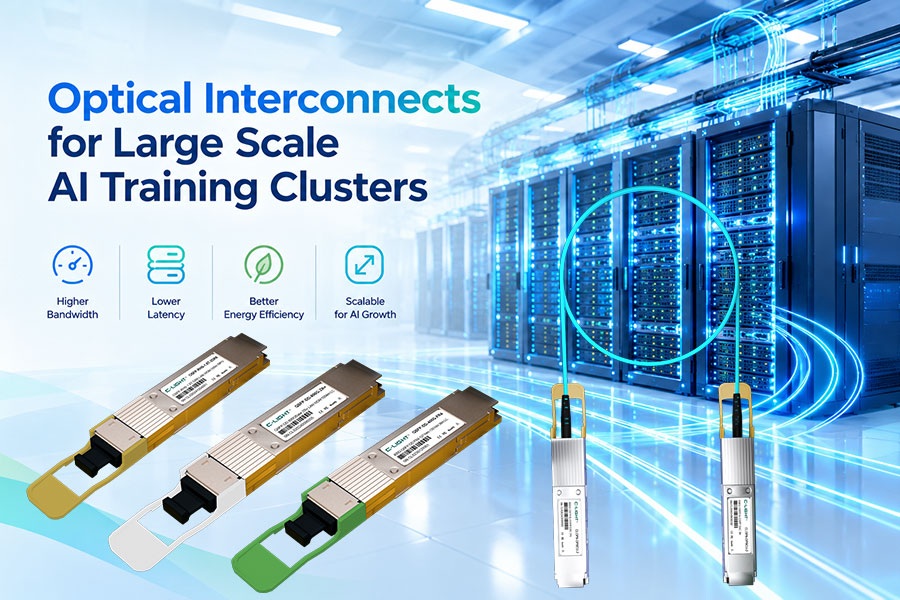
AI/ML Workloads: For latency-sensitive and bandwidth-intensive AI training clusters, 400G AOC solutions provide the necessary headroom for east-west traffic scalability.
With over 15 years of focused optical communication expertise, C-LIGHT AOC series products offer a reliable, high-performance, and cost-effective foundation for next-generation data center interconnects.
 >
>

 >
>
 >
>
 >
>
 >
>
 >
>
 >
>
 >
>