TEL:+86 132 6656 7067




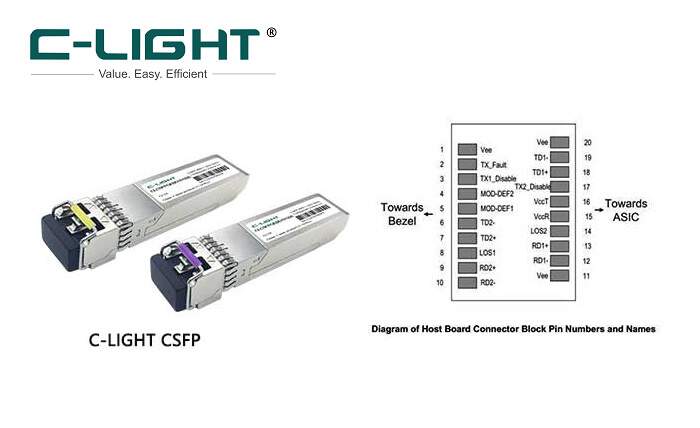
In the field of optical communications, the SFP transceiver has served as a core component of global optical communication networks since its introduction in the late 1990s, thanks to its compact size, hot-swappable capability, and broad compatibility. However, with data center space becoming increasingly constrained and the cost of carrier aggregation resources continuing to rise, the traditional "one module, one port" design logic of SFP has struggled to meet the demands of high-density deployment scenarios. It is against this backdrop that the Compact SFP (CSFP) has emerged, offering a revolutionary breakthrough in port density for network equipment through its dual-channel integrated design.
SFP: The Cornerstone of Optical Communications
The SFP transceiver is a compact optical communication module that integrates optical transmission and reception functions. Its core principle is to achieve bidirectional conversion between electrical signals and optical signals through built-in TOSA (Transmitter Optical Sub-Assembly), ROSA (Receiver Optical Sub-Assembly), and signal processing chips, enabling high-speed, long-distance data transmission over optical fiber.
In terms of transmission rates, the SFP product line covers a complete matrix from 100Mbps, 1Gbps, to 10Gbps and beyond. Fast Ethernet SFPs (100Mbps) are primarily used in traditional enterprise office network access and surveillance camera data transmission, offering low cost and high stability, and remain widely deployed in legacy networks. Gigabit SFPs (1Gbps) constitute the mainstream category in the current market, suitable for small and medium-sized enterprise LANs and non-core links within data centers. 10G SFP+ (10Gbps) modules feature high bandwidth and low latency, driven by demand from AI data centers and high-end enterprise networks, making them the fastest-growing segment in recent years.
According to QYResearch data, the global SFP optical transceiver market size was approximately USD 1.256 billion in 2025, with sales volume reaching 8.3755 million units and an average price of around USD 150 per unit. It is projected that this market will grow at a compound annual growth rate (CAGR) of 6.0% to reach USD 1.893 billion by 2032. The downstream applications of SFP transceivers span multiple fields including data centers, enterprise networks, telecom access networks, industrial control, and security surveillance, forming an indispensable infrastructure for the digital economy era.
CSFP: The Port Density Multiplier
The CSFP (Compact Small Form-Factor Pluggable) is a more compact packaging solution evolved from the SFP form factor. Its core concept is to integrate two independent bidirectional optical channels within exactly the same external dimensions as a standard SFP.
Working Principle
A traditional SFP module is a dual-fiber transceiver requiring two fibers for transmit (TX) and receive (RX) signals respectively. BiDi SFP, on the other hand, achieves "single-fiber bidirectional" transmission, requiring only one fiber for both transmission and reception, offering significant advantages in scenarios where fiber resources are scarce or fiber leasing is necessary. The CSFP takes this concept further—within a single SFP port, through a dual-BOSA (Bidirectional Optical Sub-Assembly) design, it simultaneously carries two independent BiDi bidirectional data streams, delivering 2×GE communication capacity from a single SFP port.
As stated in C-LIGHT's official technical article: "Compared with ordinary SFP, our CSFP adopts the MSA standard package but integrates the design of two ordinary SFP optical modules in hardware and software systems through dual BOSA. The hardware and software of these two optical modules can work simultaneously in the optical port of equipment supporting the CSFP protocol standard. Therefore, one CSFP module possesses the working capability of two SFP modules but occupies only the optical port resources of one SFP optical module."
Technical Specifications Comparison
The dual-channel CSFP has exactly the same mechanical dimensions as industry-standard SFP transceivers and is compatible with standard SFP cages; the single-channel CSFP is only half the size of standard SFP and SFF packages. The CSFP design adopts a modular approach, supporting configurations with integrated 2-channel modules, with potential future expansion to 4-channel modules.
The CSFP MSA (Multi-Source Agreement) defines the standard for this new type of miniaturized pluggable optical module. By utilizing existing SFP/SFP interfaces, it significantly reduces the size of optical transceiver modules and optical system equipment, substantially increases optical communication port density, and greatly enhances the data throughput of optical system equipment.
Core Differences Between SFP and CSFP
| Comparison Dimension | SFP | BiDi SFP | CSFP |
| Number of Channels | Single channel (1×TX, 1×RX) | Single channel, single-fiber bidirectional | Dual channel, dual-fiber bidirectional |
| Fiber Required | 2 fibers (dual-fiber) | 1 fiber (single-fiber) | 2 fibers (dual-fiber, 1 per channel) |
| Port Density | 1x baseline | 1x baseline | 2x of SFP |
| Dimensions | Standard SFP size | Standard SFP size | Same as SFP (dual-channel) Half (single-channel) |
| Typical Applications | General optical interconnects | Fiber-constrained scenarios | FTTx, high-density aggregation |
| Equipment Compatibility | Widely compatible | Widely compatible | Requires line card support for CSFP |
Typical Application Scenarios for CSFP
The most common application scenario for CSFP is point-to-point connections in FTTx deployments—deploying CSFP modules at the central office/aggregation site to connect to two CPE (Customer Premises Equipment) sites, where each CPE site can communicate using ordinary BiDi SFP modules. With CSFP, the port density at the aggregation site can be doubled—delivering 2×GE communication capacity from one aggregation port—while halving the number of ports required at the central office and reducing power consumption accordingly.
Additionally, CSFP is widely used in the networks of Internet Service Providers (ISPs) and Multiple System Operators (MSOs). By inserting CSFP transceivers integrated with two bidirectional fiber ports into CSFP ports, the number of users supported per port can be doubled without increasing switch count or rack space, simultaneously reducing deployment space and heating/cooling costs.
C-LIGHT CSFP Product Overview
As a professional manufacturer with 15 years of experience in optical module R&D and production, C-LIGHT has continuously invested in its CSFP product line, developing a complete industrial-grade product matrix covering data rates of 1.25G, 2.5G, and 10G. Leveraging strong manufacturing capabilities, C-LIGHT provides reliable optical interconnect solutions to global customers.
1.25G CSFP Series
2.5G/1.25G CSFP Dual Rate Optical Transceiver Module丨C-LIGHT
C-LIGHT's independently developed 1.25G CSFP optical transceivers support various transmission distances including 2km, 15km, 40km, 80km, and 120km, with data rates up to 1.25 Gb/s. This series complies with IEEE 802.3z Gigabit Ethernet 1000BASE-2BX10 communication standards, SFF-8472 interface protocols, and CSFP MSA option2 package specifications. It supports multiple bidirectional wavelength combinations such as 1310nm/1490nm and 1310nm/1550nm, offering both commercial (0°C to 70°C) and industrial (-40°C to 85°C) operating temperature grades. These modules are widely deployed in network equipment interconnects, data centers and cloud computing, enterprise and campus networks, and industrial Ethernet scenarios.
2.5G CSFP Series
2.5G/1.25G CSFP Dual Rate Optical Transceiver Module丨C-LIGHT
Targeting applications such as SONET/SDH and Fibre Channel, C-LIGHT's 2.5G CSFP optical transceivers feature full-duplex transceiver integrated design, with each channel supporting OC-48/STM-16 and 2G Fibre Channel standards. They achieve transmission distances up to 20km over a pair of single-mode fibers, include built-in digital diagnostics, and operate stably within commercial temperature ranges (0°C to 70°C).
10G CSFP Series
In 2018, C-LIGHT introduced its new 10G CSFP series optical modules to address higher bandwidth application requirements.
Core Product Features
According to C-LIGHT's official information, its CSFP modules offer the following outstanding features:
Comprehensive Product Portfolio. The company has launched a full range of CSFP optical modules covering Gigabit Ethernet (GE) distances from 10km to 80km, supporting wavelength schemes including 1310nm/1490nm/1510nm/1550nm/1570nm and other CWDM wavelengths, with both industrial and commercial grade options available.
Low Power Consumption. Verified through testing, CSFP optical modules demonstrate excellent power consumption performance across the full industrial temperature range.
Strong Interoperability. CSFP optical modules achieve seamless compatibility with first-tier brands such as Cisco, Huawei, and Nokia (Alcatel-Lucent), requiring no module replacement or equipment upgrades. C-LIGHT's CSFP optical modules have been verified to function normally on CSFP switches and routers including the Cisco WS-C4503-E, Huawei S5700-52X-LI-48CS-AC, and Nokia 3HE10642AA 7750SR.
High Cost-Effectiveness. Compared to various brand-name CSFP optical modules (e.g., 34050525/GLC-28X-D), choosing C-LIGHT's CSFP optical modules can help reduce costs by 30% to 50%.
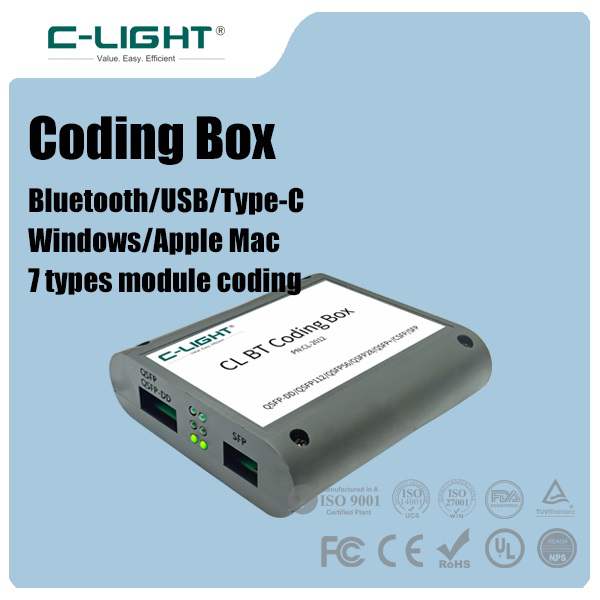
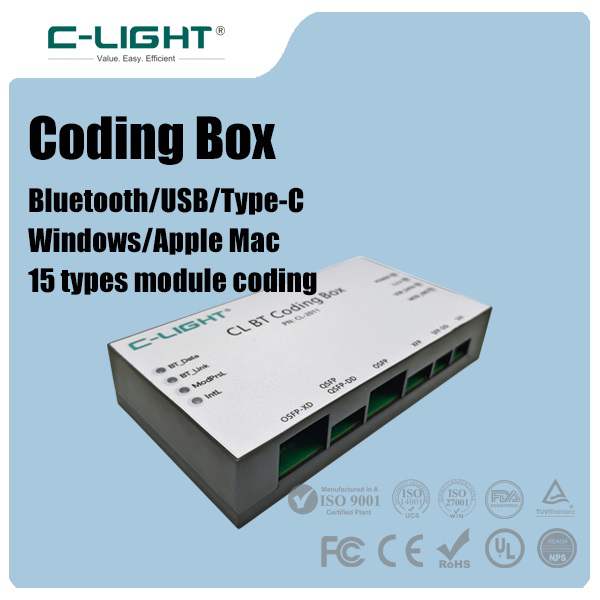
Notably, C-LIGHT also offers a Coding Box product that supports EEPROM encoding and writing for various transceiver types including SFP/SFP+/SFP28/SFP56/SFP112/CSFP, providing convenient customized programming solutions for MSA customers.
Market Outlook and Future Prospects
CSFP combines highly integrated optoelectronic integration technology. While retaining all the technical advantages of SFP, it significantly reduces the physical dimensions of optical transceiver modules and optical system equipment, markedly increases communication port density and data throughput, and effectively lowers system costs, promising broad development prospects in the data communication market.
From the perspective of the industry ecosystem, first-tier equipment vendors including Cisco, Huawei, and Nokia have already launched switches and routers supporting CSFP. The advancement of the CSFP MSA multi-source agreement has also laid a solid foundation for industry chain collaboration. With the large-scale deployment of 5G networks, the continuous acceleration of data center construction, and the growing demand for FTTx access, CSFP—leveraging its core advantage of doubled port density—is poised to occupy an increasingly important position in high-density aggregation and optical access network scenarios.
For network planners and procurement personnel, the key to selecting SFP or CSFP modules lies in matching actual deployment requirements. If the network equipment line card supports the CSFP protocol standard and there is an urgent need to address rack space constraints or increase port density, CSFP is undoubtedly the superior choice. For general optical interconnect scenarios, standard SFP and BiDi SFP, with their broad equipment compatibility and mature, stable ecosystem, remain the most cost-effective and practical solutions.
Frequently Asked Questions (FAQ)
Q1. What is the difference between Compact SFP (CSFP) and traditional SFP optical transceivers?
Answer: The main difference between CSFP and traditional SFP optical transceivers is channel capacity. A standard SFP module supports one optical channel, while a CSFP module integrates two independent bidirectional optical channels into the same SFP form factor. This allows CSFP to provide twice the connection capacity without increasing switch port space.
Q2. What is a CSFP optical transceiver used for?
Answer: A CSFP (Compact Small Form-Factor Pluggable) optical transceiver is designed for high-density optical networks where port space and fiber resources are limited. It is commonly used in FTTx networks, ISP access networks, metropolitan area networks (MAN), and aggregation systems that require higher connection density.
Q3. How does CSFP increase optical network port density?
Answer: CSFP increases port density by integrating two independent optical transceiver channels into one SFP-sized module. Compared with traditional SFP solutions, one CSFP module can provide the functionality of two SFP modules while occupying only one optical port, helping operators reduce equipment footprint and improve network scalability.
Q4. What is the difference between CSFP and BiDi SFP?
Answer: Both CSFP and BiDi SFP use bidirectional optical transmission technology, but they serve different purposes. A BiDi SFP uses one fiber to transmit and receive signals through different wavelengths, while CSFP integrates two independent bidirectional optical channels within one module, enabling two separate connections from a single SFP port.
Q5. Can CSFP modules work in standard SFP ports?
Answer: CSFP modules have the same physical dimensions as standard SFP modules, but they require network equipment that supports CSFP protocols. If the device does not support CSFP functionality, the module may not activate both channels or may not operate correctly.
Q6. What are the main applications of CSFP optical modules?
Answer: CSFP optical modules are widely used in FTTx deployments, telecom access networks, ISP networks, enterprise aggregation networks, and high-density fiber infrastructure. They are especially suitable for scenarios where operators need to support more users without adding additional equipment racks or switch ports.
Q7. What are the advantages of using CSFP instead of traditional SFP modules?
Answer: The key advantages of CSFP include higher port density, reduced equipment footprint, lower power consumption, and improved network scalability. By supporting multiple optical channels in a compact package, CSFP helps operators optimize infrastructure utilization and reduce deployment costs.
Q8. What CSFP data rates and transmission distances are available?
Answer: CSFP optical transceivers are available in multiple data rate options, including 1.25G, 2.5G, and 10G solutions. Depending on the optical design and wavelength configuration, CSFP modules can support various transmission distances for access networks, metro networks, and industrial applications.
 >
>

 >
>
 >
>
 >
>
 >
>
 >
>
 >
>
 >
>