TEL:+86 132 6656 7067





The rapid growth of AI computing, high-performance networking, and large-scale data processing is placing increasing pressure on data center interconnect architecture. Modern switch ASICs must handle higher aggregate bandwidth while maintaining manageable power consumption, signal integrity, and physical port density.
Traditional pluggable optical transceivers provide a flexible way to connect switches through front-panel optical interfaces. However, as electrical signaling speeds increase, the electrical path between the switch ASIC and external optical modules becomes more challenging. Co-Packaged Optics (CPO) addresses this limitation by integrating optical engines close to the switch silicon within a shared package architecture.
By bringing optical conversion closer to the switching chip, CPO can reduce high-speed electrical interconnect length, improve bandwidth density, and reduce the energy required for data movement. It represents an important architectural direction for next-generation AI data centers and high-capacity networking systems.
1. What Is Co-Packaged Optics?
Co-Packaged Optics is an optical integration architecture in which optical engines are placed alongside a switch ASIC or another high-performance computing chip within the same package or closely integrated packaging platform.
In a conventional pluggable optical system, electrical signals travel from the switch ASIC through PCB traces and high-speed electrical interfaces to a front-panel transceiver. The transceiver then converts electrical signals into optical signals for transmission through fiber.
CPO changes this arrangement by moving the optical engine much closer to the ASIC. The shorter electrical connection reduces the distance over which high-speed electrical signals must travel before optical conversion takes place.
Optical transceivers are installed in front-panel cages and connected to the switch ASIC through electrical traces and host interfaces.
Optical engines are integrated near the ASIC inside a shared package architecture, shortening the high-speed electrical connection.
Optical input and output interfaces enable data to move between computing silicon and external systems through optical connections.
Photonic integrated circuits use silicon-compatible manufacturing processes to implement optical functions in compact components.
CPO is particularly relevant to high-bandwidth switch platforms used in AI clusters, hyperscale data centers, and high-performance computing environments.
2. Why Traditional Pluggable Optics Are Facing New Challenges
Pluggable optical transceivers have supported generations of data center networking, including 10G, 25G, 100G, 400G, and 800G connectivity. Their modular design allows operators to replace modules independently, select different transmission distances, and maintain flexible front-panel configurations.
However, increasing electrical lane rates create additional challenges between the switch ASIC and the optical module. PCB trace loss, connector discontinuities, signal equalization, and retiming requirements can increase the complexity and power consumption of the electrical interface.
| Traditional Design Challenge | Technical Impact | CPO's Architectural Response |
|---|---|---|
| Long electrical signal paths | Greater insertion loss and signal integrity challenges | Places optical engines closer to the ASIC |
| Electrical signal conditioning | Additional DSP or retiming power may be required | Reduces the electrical path between the ASIC and optical engine |
| Front-panel port density | Physical module cages and connectors consume space | Moves optical interfaces into the package architecture |
| Increasing bandwidth demand | More electrical lanes and higher aggregate data rates | Supports dense optical I/O integration |
| System power constraints | High-speed electrical interfaces contribute to total link power | Can reduce electrical interface power through shorter connections |
CPO does not make pluggable optics obsolete. Modular transceivers remain useful because of their serviceability, flexibility, and established deployment ecosystem. The two approaches address different system design priorities and are expected to coexist across different data center applications.
3. How a CPO Architecture Works
A CPO system combines electrical switching, optical conversion, photonic integration, and fiber coupling within a coordinated package design. The switch ASIC performs packet processing and switching functions, while optical engines handle the conversion between electrical and optical signals.
Switch ASIC → Short Electrical Interconnect → Electronic Integrated Circuit (EIC) → Photonic Integrated Circuit (PIC) → Optical Fiber → Remote Optical Interface
The receiving direction performs the corresponding optical-to-electrical conversion before data enters the switching or computing system.
The electronic integrated circuit provides electrical functions such as driver and receiver circuitry. The photonic integrated circuit performs optical functions including modulation, detection, and wavelength-related operations, depending on the selected architecture.
These components are integrated into optical engines positioned near the main switch silicon. Their design must account for electrical interfaces, optical coupling, mechanical packaging, power delivery, and thermal behavior.
Processes and forwards network traffic while providing high-bandwidth electrical interfaces to the optical engines.
Provides electrical signal conditioning, modulation drive, and receiver functions within the optical engine.
Performs optical signal generation, modulation, detection, and other photonic functions.
Connects the integrated optical engines to external fiber infrastructure and the wider network.
4. Silicon Photonics and Optical Engine Integration
Silicon photonics is one of the important technology platforms supporting CPO development. It integrates optical functions into compact photonic circuits using semiconductor manufacturing processes and specialized optical components.
A silicon photonics platform can incorporate waveguides, modulators, photodetectors, and other optical structures. These components work with electronic circuits to transmit and receive high-speed data.
The optical engine typically combines photonic and electronic functions. Its performance depends on optical coupling efficiency, modulation capability, receiver sensitivity, electrical signal quality, and the integration process.
Why silicon photonics matters:
Enables compact integration of multiple optical functions.
Supports high optical bandwidth density.
Provides a manufacturing platform for increasingly complex photonic systems.
Can support multiple optical channels and wavelength configurations.
Enables close integration between electronic and photonic components.
Silicon photonics is not the same as CPO. Silicon photonics describes a technology platform for implementing optical functions, while CPO describes how optical engines are integrated with the main electronic chip. A CPO design may use silicon photonics, but the two terms represent different aspects of the system.
5. External Laser Sources in CPO Systems
Light generation is an important consideration in CPO architecture. Many designs use an External Laser Source (ELS) to supply continuous-wave optical light to the photonic engines.
Separating the laser source from the main switch package can provide advantages in thermal management and serviceability. Laser components can be sensitive to operating temperature and long-term reliability requirements, so keeping them outside the main package can make maintenance more practical.
The external laser supplies optical power through fiber connections to the integrated photonic engine. The optical engine then uses this light for modulation and transmission.
The laser source supplies continuous-wave light to the photonic engine through an optical connection.
Separating the laser from the high-power switch package can provide additional thermal design flexibility.
External laser arrangements can allow the light source to be serviced independently of the main switch package.
Laser power must be distributed to the optical engines with suitable optical loss and connection reliability.
The number of laser sources, optical distribution architecture, redundancy strategy, and connector design vary between CPO implementations. These details are important when evaluating the reliability and maintenance requirements of a complete system.
6. CPO, NPO, LPO and Traditional Pluggable Optics
CPO is part of a broader transition toward closer integration between electronic processing and optical communication. Near-Packaged Optics (NPO), Linear Pluggable Optics (LPO), and traditional DSP-based pluggable transceivers represent different approaches to managing the electrical and optical interfaces.
| Technology | Optical Placement | Primary Design Objective | Main Considerations |
|---|---|---|---|
| DSP Pluggable Optics | Front-panel module cage | Flexible optical connectivity and signal conditioning | Module power, electrical reach, and serviceability |
| LPO | Front-panel pluggable module | Reduce module power by simplifying or removing DSP functions | Host signal quality and system-level interoperability |
| NPO | Near the switch ASIC, outside or adjacent to its main package | Shorten electrical paths while retaining a degree of modularity | Packaging, connections, and maintenance access |
| CPO | Integrated within the ASIC package architecture | Maximize electrical integration and optical bandwidth density | Thermal design, packaging complexity, and serviceability |
These technologies should not be evaluated only by their physical distance from the ASIC. Their electrical interfaces, signal conditioning, optical engines, mechanical integration, and maintenance models are also different.
NPO can provide an intermediate architecture between conventional pluggable optics and CPO. LPO focuses on reducing signal-processing complexity in pluggable modules, while CPO changes the physical integration of optical engines and switching silicon.
7. Bandwidth Density and the 400G, 800G and 1.6T Transition
One of the main reasons for developing CPO is the need to increase the amount of optical bandwidth available around high-performance switch ASICs. As AI networks expand, switch chips must support increasingly large aggregate throughput while maintaining manageable package dimensions and power requirements.
Bandwidth density describes how much data capacity can be delivered within a defined physical interface area or package boundary. In CPO discussions, beachfront or shoreline bandwidth density is often used to describe optical bandwidth relative to the available package edge.
Higher bandwidth density allows switch designers to connect more optical capacity without depending entirely on conventional front-panel module cages.
| Network Generation | Optical Connectivity Development | Infrastructure Focus |
|---|---|---|
| 400G | Established high-speed pluggable optical interfaces | Switch uplinks and data center aggregation |
| 800G | Higher-density OSFP and QSFP-DD optical platforms | AI clusters and high-capacity switching |
| 1.6T | Emerging next-generation optical interfaces | Higher switch bandwidth and denser optical integration |
| Beyond 1.6T | Increasing interest in CPO and advanced optical I/O | Package-level bandwidth density and energy efficiency |
The development of CPO does not mean that every 400G or 800G connection must immediately move to a co-packaged architecture. Pluggable transceivers remain important for existing infrastructure, network upgrades, and applications that benefit from independent module replacement.
8. Power Efficiency and Thermal Management
Power efficiency is one of the strongest motivations for CPO adoption. In conventional architectures, electrical signals must travel between the switch ASIC and the optical transceiver through high-speed PCB traces. As signaling rates increase, additional signal conditioning may be required to maintain signal integrity.
By shortening the electrical connection, CPO can reduce losses and the associated power required for high-speed electrical transmission. This can improve energy efficiency per transmitted bit, particularly in systems with very high aggregate bandwidth.
However, CPO introduces its own thermal engineering challenges. The switch ASIC and optical engines are integrated within a compact package, creating a concentrated thermal environment that requires coordinated cooling and mechanical design.
Shorter electrical connections can reduce signal degradation between the switch ASIC and optical engine.
Reduced electrical signal-conditioning requirements can improve system energy efficiency.
Thermal solutions must accommodate both the high-power switch silicon and nearby optical components.
External laser arrangements can help separate temperature-sensitive light sources from the main package.
CPO is not automatically a low-power solution under every operating condition. Total system efficiency depends on optical engine design, laser power, electrical interfaces, cooling requirements, and the complete switching architecture.
9. Fiber Connectivity and Optical Distribution
Although CPO moves optical engines closer to the switch ASIC, the system still requires external fiber connections to communicate with other switches and network devices. Fiber management therefore remains a major part of the overall architecture.
The optical interface may use fiber pigtails, internal fiber routing, connectorized assemblies, or front-panel distribution systems, depending on the implementation. High-density fiber routing must maintain optical performance while providing adequate mechanical protection and service access.
Optical signals must be efficiently transferred between the photonic engine and the external fiber interface.
High-capacity optical systems require compact fiber interfaces and organized distribution arrangements.
Internal and external fiber paths must account for bend radius, mechanical stress, and accessibility.
Connector quality, coupling efficiency, fiber length, and connection count influence the overall optical budget.
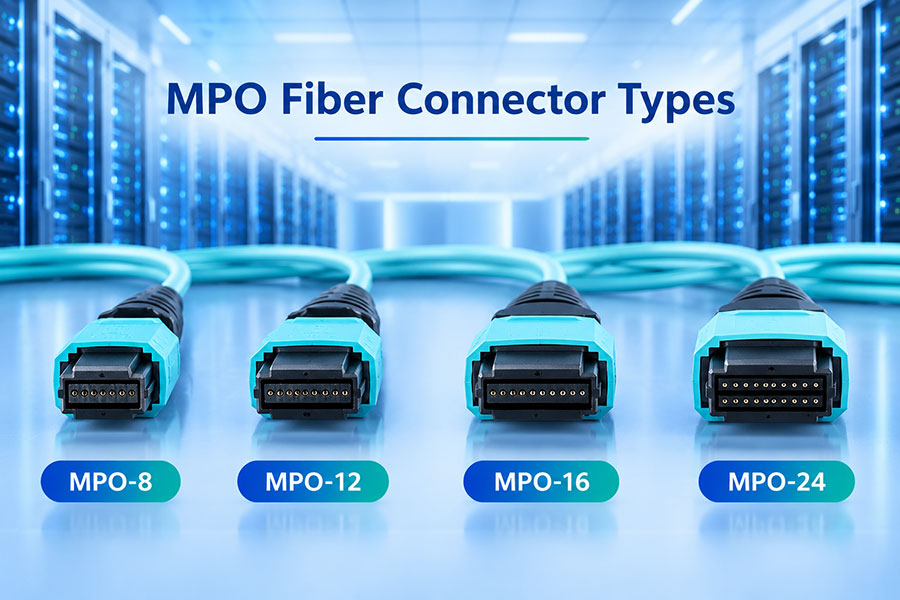
MPO/MTP and LC connector systems can both play roles in high-density optical infrastructure, depending on the optical engine interface and fiber architecture. The selected fiber count, polarity, connector type, and external laser connections must be matched to the specific CPO platform.
10. Reliability, Testing and Maintenance Challenges
CPO changes the traditional maintenance model of optical networking. In a pluggable system, a faulty optical transceiver can generally be removed and replaced independently. When optical engines are integrated into the switch package, replacing a failed component may involve a more complex service procedure.
This makes reliability testing and manufacturing quality especially important. Optical engines, electrical interfaces, fiber coupling, laser distribution, and package assembly must be validated as parts of a complete system.
Optical engine performance and manufacturing consistency.
Laser lifetime and optical power stability.
Thermal cycling and package reliability.
Fiber coupling stability and connector durability.
Electrical signal integrity across package interfaces.
Field replacement strategy and system-level redundancy.
Manufacturing test coverage and long-term reliability validation.
Modular optical subassemblies and external laser sources can improve certain aspects of serviceability, but the actual maintenance model depends on the architecture. System designers must evaluate how individual components can be tested, replaced, or isolated without requiring unnecessary replacement of the entire switching system.
11. Where CPO Will Be Used in Next-Generation Data Centers
CPO is particularly relevant to applications where extremely high aggregate bandwidth and energy efficiency are major design priorities. AI infrastructure is one of the most important application areas because large GPU clusters require continuous communication between processors, switches, and distributed computing resources.
High-bandwidth optical switching can support communication among large groups of GPUs and accelerator nodes.
Dense switching systems can use closer optical integration to address bandwidth and power constraints.
Large computing fabrics can benefit from increased optical I/O capacity and reduced electrical interconnect distance.
Optical integration can support high-capacity connections within computing domains and between distributed network resources.
The adoption path will depend on system cost, optical engine reliability, manufacturing capacity, serviceability, and compatibility with existing data center infrastructure. CPO is therefore likely to develop alongside pluggable and near-package optical technologies rather than replacing every optical interface at once.
12. C-LIGHT Optical Connectivity for the Transition to Higher-Speed Data Centers
The development of CPO does not remove the need for conventional optical transceivers. Existing data centers continue to deploy pluggable optical modules for switch-to-switch, rack-to-rack, and other network connections. During the transition toward closer optical integration, pluggable optics remain an important part of the wider data center connectivity ecosystem.
C-LIGHT provides high-speed optical transceiver and active optical connectivity solutions for data center networking. Its 400G, 800G, and 1.6T product families can be considered for compatible conventional optical links and high-bandwidth switching environments.
400G optical transceivers support high-capacity data center connectivity through compatible OSFP and QSFP-DD host interfaces. Different optical configurations are available for supported transmission distances and fiber applications.
View 400G OSFP ProductsView 400G QSFP-DD Products
800G OSFP optical connectivity addresses higher-bandwidth switching requirements in AI and data center networks. Available configurations should be selected according to the exact optical reach, fiber interface, and supported host platform.
View 800G OSFP ProductsThe 1.6T OSFP-RHS product family addresses emerging high-density switching platforms. It represents an important area of next-generation pluggable optical connectivity, although it is architecturally different from CPO.
View 1.6T OSFP-RHS ProductsFor compatible short-reach applications, 400G AOC solutions provide integrated optical cable connectivity without requiring separately installed transceivers and patch cords at both ends.
View 400G AOC Products13. The Future of Optical Integration
The evolution of data center optical connectivity is moving toward closer integration between electronic processing and photonic transmission. As switch bandwidth continues to increase, the electrical interface between the ASIC and optical engine becomes an increasingly important part of system design.
CPO, NPO, silicon photonics, and optical I/O represent different approaches to addressing this challenge. Their development will depend not only on bandwidth and power efficiency but also on manufacturing yield, thermal performance, optical coupling, reliability, and field maintenance.
Future architectures may combine multiple optical integration techniques across different layers of the same data center. Pluggable optics will continue to serve applications requiring flexibility, while CPO and related technologies will target systems where package-level bandwidth density and electrical power efficiency are particularly important.
14. Conclusion
Co-Packaged Optics represents an important development in next-generation data center architecture. By integrating optical engines close to switch ASICs, CPO reduces high-speed electrical interconnect distance and creates opportunities for higher bandwidth density and improved energy efficiency.
Its success depends on more than photonic integration alone. Silicon photonics, electronic ICs, laser distribution, fiber coupling, advanced packaging, thermal management, and system-level reliability must work together to deliver a practical solution.
As AI clusters and hyperscale networks continue to expand, CPO is expected to become an increasingly important part of high-capacity optical networking. Meanwhile, 400G, 800G, and 1.6T pluggable optical connectivity will remain essential for current infrastructure and the broader transition toward next-generation optical systems.
C-LIGHT continues to provide high-speed optical transceiver and active optical connectivity solutions for evolving data center requirements, supporting network deployments across multiple generations of optical interfaces.
Planning a Next-Generation Data Center Optical Network?
Contact C-LIGHT for high-speed optical transceiver specifications, connectivity options, and project support.
Contact C-LIGHT >

 >
 >
 >
 >
 >
 >
 >