TEL:+86 132 6656 7067




1. Introduction
Co-Packaged Optics (CPO) is being developed to address the bandwidth, power, and electrical interconnect limitations of next-generation AI systems. By placing optical engines much closer to the switching ASIC, CPO can shorten high-speed electrical paths and reduce some signal-processing and interconnect losses. However, moving optics into the switch package introduces new challenges in thermal management, packaging, manufacturing, serviceability, and system integration.
2. What Is CPO?
CPO integrates optical engines and switching silicon within a closely coupled package or system assembly. Instead of placing the optical transceiver at the front panel and connecting it to the ASIC through relatively long electrical traces, the optical engine is positioned much closer to the switching silicon.
3. Why AI Data Centers Are Considering CPO
AI networks require large amounts of bandwidth between GPUs, NICs, switches, and other accelerators. As switch capacity increases, electrical interconnects become more difficult to scale because of insertion loss, power consumption, and signal-integrity limitations. CPO provides an architectural approach to shorten these electrical paths.
4. The Main CPO Challenge
The fundamental challenge is that CPO improves electrical distance by integrating optics closer to the ASIC, but it also places high-power optical components in the same thermal and mechanical environment as high-power switching silicon.
5. CPO vs Pluggable Optics
| Parameter | Pluggable Optics | CPO |
|---|---|---|
| Optical Location | Front panel | Close to switch ASIC |
| Electrical Path | Longer | Much shorter |
| Power Efficiency | Architecture dependent | Potentially improved |
| Thermal Density | Distributed near front panel | Concentrated near ASIC |
| Serviceability | High | More complex |
| Packaging | Module-based | Advanced package integration |
6. Thermal Management
Thermal management is one of the most important CPO challenges. The switch ASIC and optical engines can generate substantial heat in a small physical area. The cooling system must remove this heat without causing excessive temperature rise in temperature-sensitive optical components.
7. Thermal Density
CPO can reduce total system power while increasing local power density. This distinction is important: lower energy per transmitted bit does not necessarily mean easier cooling. A smaller physical area can contain a high concentration of heat-generating devices.
8. Laser Temperature
Lasers are particularly sensitive to temperature. Their wavelength, threshold behavior, efficiency, and reliability can change with temperature. Placing the laser close to a high-power ASIC can therefore create a difficult thermal environment.
9. Remote Laser Sources
One approach is to locate the laser away from the hottest part of the package. A remote or external laser source can reduce the temperature stress on the laser while allowing the modulator and other photonic functions to remain close to the ASIC.
10. Thermal Monitoring
A single package temperature measurement may not fully represent the temperatures of all critical components. Monitoring the laser case or base temperature and relevant junction temperatures can provide a more complete view of thermal conditions.
11. Cooling Architecture
CPO can use advanced air cooling, cold plates, or liquid-based cooling depending on system requirements. The cooling solution must account for both the switching ASIC and optical engine rather than treating the optics as a separate front-panel component.
12. Air Cooling Challenges
Air cooling can remain attractive because it uses familiar infrastructure, but concentrated package-level heat can create local thermal hotspots. Heat-sink geometry, airflow resistance, and package layout become especially important.
13. Liquid Cooling Challenges
Liquid cooling can provide greater heat-transfer capability, but it introduces additional infrastructure and mechanical requirements. Cold plates, pumps, manifolds, coolant compatibility, and maintenance procedures must all be considered.
14. Mechanical Packaging
CPO requires multiple optical and electronic components to operate within a highly integrated package. Mechanical tolerances become tighter because optical alignment, electrical connections, thermal interfaces, and package structures must work together.
15. Optical Coupling
Efficiently coupling light between the photonic integrated circuit and external fibers is a major CPO engineering challenge. Coupling losses directly affect optical margin, and packaging must maintain alignment over temperature changes and mechanical stress.
16. Fiber Attachment
Fiber arrays must be attached securely and accurately to the optical engine. Unlike a conventional pluggable module, where the optical interface can be replaced with the module, CPO fiber attachment becomes a more tightly integrated part of the package.
17. Mux and Demux Integration
WDM architectures require optical multiplexers and demultiplexers. CPO places strong pressure on the size of these components because available package volume is much smaller than that of a conventional pluggable module.
18. Optical Engine Miniaturization
CPO optical engines must deliver high bandwidth within a very compact footprint. This requires higher integration of modulators, photodetectors, wavelength components, and optical interfaces.
19. Electrical Signal Integrity
CPO shortens the electrical path, but signal integrity does not disappear. High-speed SerDes interfaces still require careful control of impedance, insertion loss, crosstalk, reflections, power delivery, and package parasitics.
20. Power Delivery
The package must deliver stable power to both the switching ASIC and optical engines. High current density, power integrity, voltage regulation, and package routing become more challenging when multiple high-power devices share the same system.
21. Signal Integrity vs Thermal Design
Thermal and signal-integrity requirements can conflict. Package structures designed for mechanical or thermal performance can introduce electrical discontinuities, while high-speed electrical routing can restrict thermal placement. CPO therefore requires co-design across electrical, optical, mechanical, and thermal domains.
22. Manufacturing Complexity
CPO combines technologies that have traditionally been manufactured separately. Semiconductor packaging, photonics, laser integration, fiber coupling, and high-speed electrical assembly must be coordinated in a much tighter manufacturing flow.
23. Manufacturing Yield
Yield becomes especially important because a defect in one integrated optical engine or package can affect a larger functional assembly. Higher integration can reduce component count while increasing the value of each manufacturing step.
24. Wafer-Level Testing
Testing photonic circuits before final package assembly can help identify defective dies early. Wafer-level optical and electrical testing can therefore become an important part of a scalable CPO manufacturing strategy.
25. Package-Level Testing
Final package testing must evaluate optical performance, electrical performance, thermal behavior, and management functions together. This is more complex than testing a conventional pluggable module independently.
26. Reliability
CPO reliability must account for semiconductor devices, photonic components, laser sources, fiber coupling, package interfaces, and thermal cycling. Failure mechanisms can be different from those of conventional removable transceivers.
27. Thermal Cycling
Repeated heating and cooling can create mechanical stress because different materials expand and contract at different rates. Optical alignment, solder joints, fiber attachments, and package interfaces must remain stable throughout the expected operating life.
28. Serviceability
Serviceability is one of the largest differences between CPO and pluggable optics. A failed pluggable can normally be removed and replaced individually. A tightly integrated CPO assembly may require more extensive system-level service.
29. Failure Domain
When optics and switching silicon are closely integrated, an optical failure can have a different impact on the overall system. Designers must consider how individual optical-engine failures are isolated and how the system behaves during partial degradation.
30. Field Replacement
Field replacement procedures must be considered early in CPO design. A system that minimizes power but is difficult to diagnose or repair can create operational challenges for large data center deployments.
31. Optical Connector Reliability
High-density optical interfaces must maintain low loss while supporting repeated handling and environmental variation. Connector design becomes especially important when multiple optical engines share a common package or system-level interface.
32. CPO and Silicon Photonics
Silicon photonics is frequently considered for CPO because integrated photonic circuits can provide compact modulators, waveguides, multiplexers, and photodetectors. However, CPO is an integration architecture, while silicon photonics is one possible optical technology used within that architecture.
33. CPO and LPO
CPO and LPO address different parts of the system. LPO reduces selected module-level signal-processing functions, while CPO changes the physical location of the optical engine. The two approaches can be viewed as different paths toward reducing electrical interconnect power and latency.
34. Optical Standards
Standardization is important for interoperability between optical engines, switches, fibers, connectors, management systems, and test equipment. CPO must support an ecosystem rather than a single proprietary package.
35. Management and Monitoring
Even when optics are co-packaged, operators still need visibility into temperature, optical power, device status, alarms, and other diagnostic parameters. Standardized management approaches are therefore important for practical deployment and maintenance.
36. Interoperability
Interoperability can become more difficult when optics are tightly integrated with switching silicon. Electrical interfaces, optical engines, lasers, management systems, firmware, and package-level components must work together within defined specifications.
37. AI Data Center Deployment
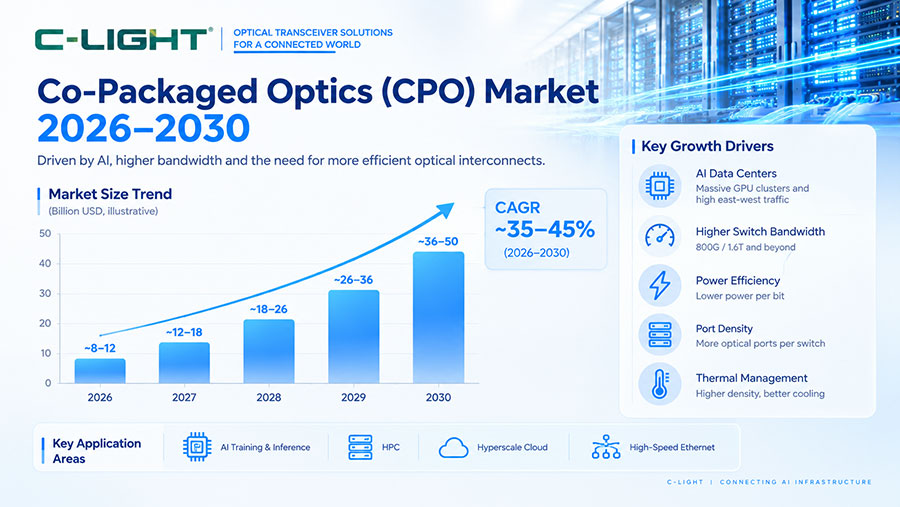
AI data centers are a major target for CPO because they require high-bandwidth scale-out and scale-up connectivity. However, AI environments also place heavy demands on reliability, thermal management, serviceability, and continuous operation.
38. 800G CPO
800G CPO architectures can reduce electrical interconnect distance between switching silicon and optical engines. This can improve energy efficiency and signal integrity, but the thermal and packaging challenges increase as optical density rises.
39. 1.6T and 3.2T CPO
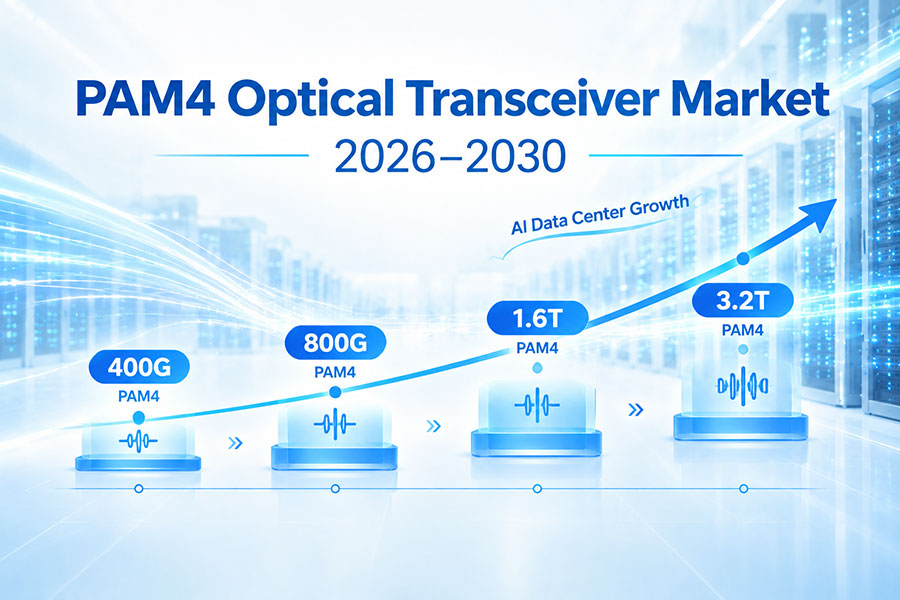
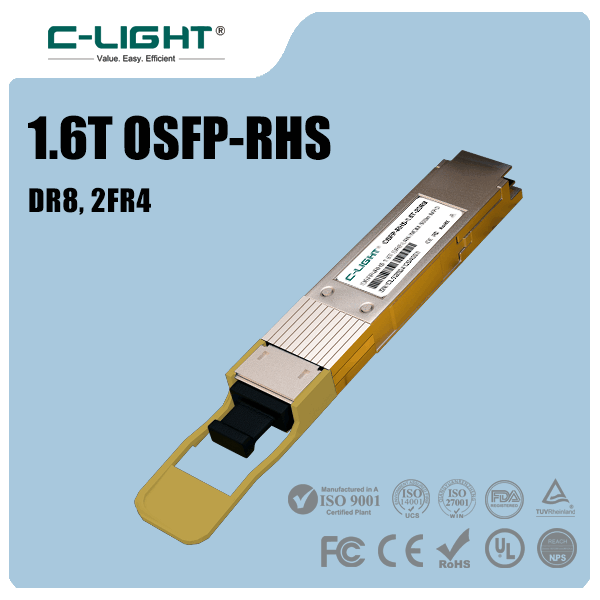
Higher-speed CPO generations increase the bandwidth handled by each optical engine. Industry work is already extending toward 3.2T-class co-packaged optical engines, making package power density, optical coupling, and thermal design increasingly important.
40. Cost Considerations
CPO may reduce certain system-level costs through lower power and higher bandwidth density, but advanced packaging, photonic integration, testing, and manufacturing can increase initial complexity. Total cost should be evaluated across the complete system lifecycle.
41. CPO vs Pluggable Economics
Pluggable optics provide modular replacement and established supply chains. CPO can potentially improve power and density, but it requires greater integration. The economic balance depends on bandwidth requirements, production scale, reliability, maintenance strategy, and system architecture.
42. Common Deployment Challenges
Common CPO deployment challenges include thermal hotspots, optical coupling loss, packaging tolerances, power delivery, limited serviceability, manufacturing yield, diagnostics, and interoperability. These issues become more significant as bandwidth density increases.
43. How the Industry Is Addressing CPO Challenges
Current development directions include remote light sources, advanced silicon photonics, improved optical coupling, detachable optical interfaces, better thermal structures, advanced packaging, wafer-level testing, and standardized management and interoperability frameworks.
44. Frequently Asked Questions
Q1. What is the biggest challenge of CPO in AI data centers?
Q2. Why are lasers difficult to place near the switch ASIC?
Q3. Can CPO reduce power consumption?
Q4. Does CPO always require liquid cooling?
Q5. Why is CPO harder to repair than pluggable optics?
Q6. Is silicon photonics required for CPO?
Q7. Can CPO support 1.6T?
Q8. What happens if one CPO optical engine fails?
Q9. Why is optical coupling important in CPO?
Q10. What are the main CPO challenges?
45. Summary
CPO offers a promising path for scaling AI data center networks because it moves optical engines closer to the switching ASIC and can reduce high-speed electrical interconnect distance. However, this integration creates substantial engineering challenges. Thermal density, laser temperature, optical coupling, package mechanical reliability, power delivery, signal integrity, manufacturing yield, testing, serviceability, and interoperability all become more important. Advanced air or liquid cooling, remote light sources, silicon photonics, improved packaging, detachable optical interfaces, and standardized management are among the approaches being developed to address these issues. CPO is therefore not simply a smaller optical module; it is a system-level architecture that requires coordinated optical, electrical, mechanical, thermal, and manufacturing design.
 >
>

 >
>
 >
>
 >
>
 >
>
 >
>
 >
>
 >
>