TEL:+86 132 6656 7067




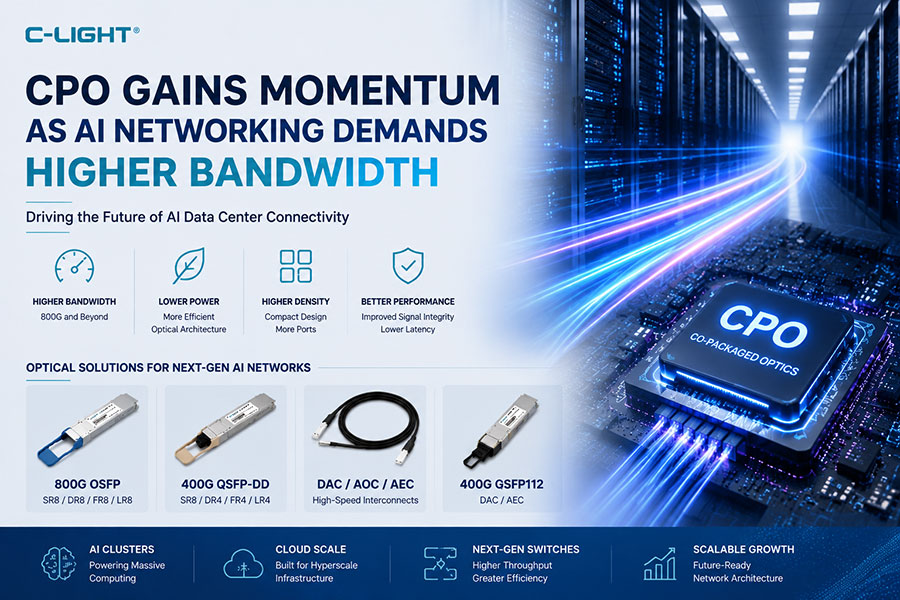
The rapid growth of artificial intelligence (AI), large language models (LLMs), and high-performance computing (HPC) is driving unprecedented bandwidth requirements in modern data centers. As AI clusters scale from thousands to millions of computing nodes, traditional optical interconnect architectures face increasing challenges in power consumption, signal integrity, and port density.
Co-Packaged Optics (CPO) is emerging as a revolutionary optical interconnect technology designed to overcome the limitations of conventional pluggable optical modules. By integrating optical engines closer to switching ASICs, CPO enables higher bandwidth density, lower power consumption, and improved signal performance for next-generation AI data center networks.
1. AI Networking Drives the Evolution of Optical Connectivity
AI workloads require massive data exchange between GPUs, accelerators, and storage systems. Distributed AI training and inference workloads generate extremely high east-west traffic, creating new requirements for network bandwidth and efficiency.
100G Optical Connectivity – Traditional data center networking
400G Optical Modules – Large-scale cloud infrastructure
800G Optical Modules – Current AI cluster deployment
1.6T Optical Connectivity – Next-generation AI fabric networks
As switch bandwidth continues increasing toward 51.2T and beyond, conventional pluggable optical modules face limitations in power consumption, thermal management, and electrical signal loss. CPO provides a new approach to solving these challenges.
2. What Is Co-Packaged Optics (CPO)?
Co-Packaged Optics (CPO) is an advanced optical networking technology that integrates optical engines directly with switching ASICs inside the same package.
Unlike traditional optical module architectures, CPO reduces the electrical transmission distance between the switch chip and optical interface, significantly improving signal performance and energy efficiency.
Traditional Optical Architecture:
Switch ASIC → Electrical Trace → Optical Module → Fiber
CPO Architecture:
Switch ASIC + Optical Engine → Fiber Interface
The main components of CPO include:
Optical Engines
Silicon Photonics Chips
Photonic Integrated Circuits (PIC)
Laser Sources
High-Speed Electrical Interfaces
3. Why CPO Is Important for AI Data Centers
3.1 Lower Power Consumption
Power efficiency has become a critical factor for AI data centers. As optical speeds move toward 800G and 1.6T, electrical signal transmission consumes more energy due to increased SerDes complexity.
CPO reduces electrical connection distance and improves system efficiency by integrating optical components closer to the switching chip.
Lower switch power consumption
Improved thermal management
Higher rack-level energy efficiency
3.2 Higher Bandwidth Density
AI clusters require extremely high-density networking. CPO enables more optical channels within limited space, allowing future data centers to achieve higher throughput with smaller physical footprints.
CPO is especially suitable for:
AI GPU Clusters
High Performance Computing (HPC)
Hyperscale Cloud Data Centers
Machine Learning Infrastructure
3.3 Improved Signal Integrity
At 800G and 1.6T speeds, signal loss becomes a major challenge. CPO improves high-speed transmission performance by shortening electrical paths and reducing insertion loss.
Reduced electrical trace length
Lower signal attenuation
Improved SerDes performance
Enhanced network reliability
4. CPO vs Traditional Pluggable Optical Modules
| Feature | Pluggable Optical Modules | CPO Technology |
| Architecture | Independent optical module | Optical engine integrated with ASIC |
| Power Consumption | Higher | Lower |
| Bandwidth Density | Limited by front panel space | Higher integration density |
| Signal Performance | Longer electrical path | Shorter electrical connection |
| Main Application | 400G / 800G networking | Future AI and HPC networks |
5. The Relationship Between CPO and Silicon Photonics
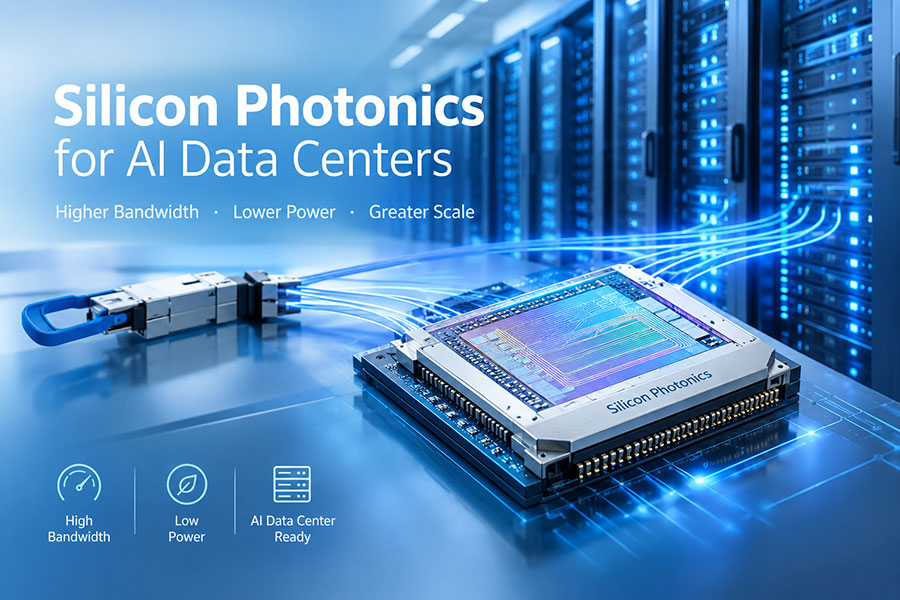
Silicon photonics is a key technology supporting future CPO development. By integrating optical components onto silicon platforms, silicon photonics provides higher integration capability and improved scalability.
Higher optical integration density
Smaller optical footprint
Lower manufacturing complexity
Support for 800G and 1.6T optical systems
The combination of CPO and silicon photonics will become an important foundation for future AI data center optical architectures.
6. CPO Application Scenarios
AI Data Centers
CPO provides high-bandwidth and low-latency connectivity for large-scale GPU clusters and AI computing networks.
Cloud Infrastructure
Hyperscale cloud providers can use CPO technology to build scalable networking systems with improved energy efficiency.
High Performance Computing
Scientific computing, simulation, and AI research require massive interconnect bandwidth, making CPO an attractive solution for future HPC systems.
7. Future Market Outlook of CPO Optical Connectivity
The transition from traditional optical modules to CPO will be a gradual evolution rather than an immediate replacement.
Current Stage: 400G and 800G pluggable optical modules dominate AI networks.
Medium Term: 800G/1.6T optical modules will coexist with early CPO deployments.
Future Stage: CPO will become a key architecture for ultra-scale AI clusters.
8. C-LIGHT Optical Connectivity Solutions for AI Networks
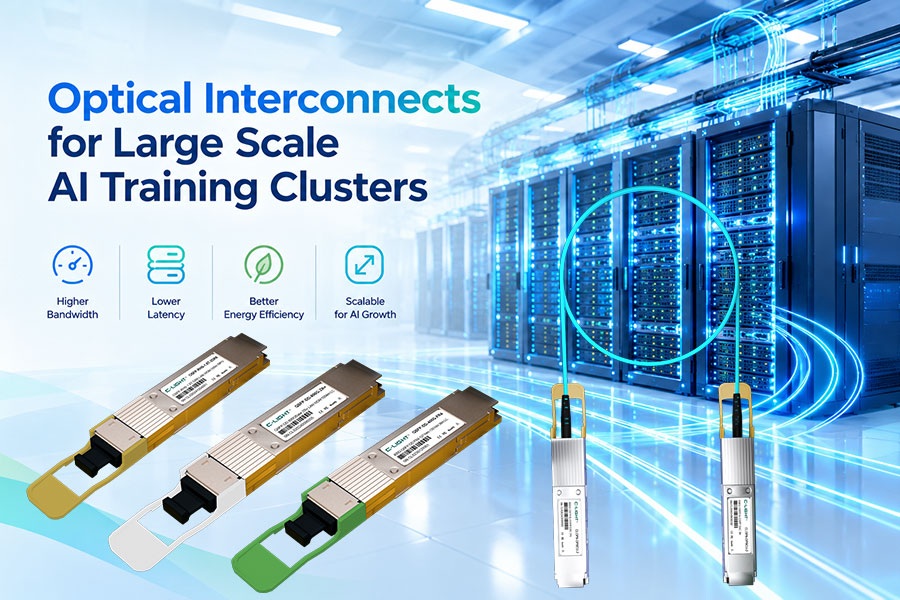
As AI infrastructure moves toward higher bandwidth and greater integration, C-LIGHT provides advanced optical connectivity solutions designed for next-generation data center applications.
400G Optical Transceivers
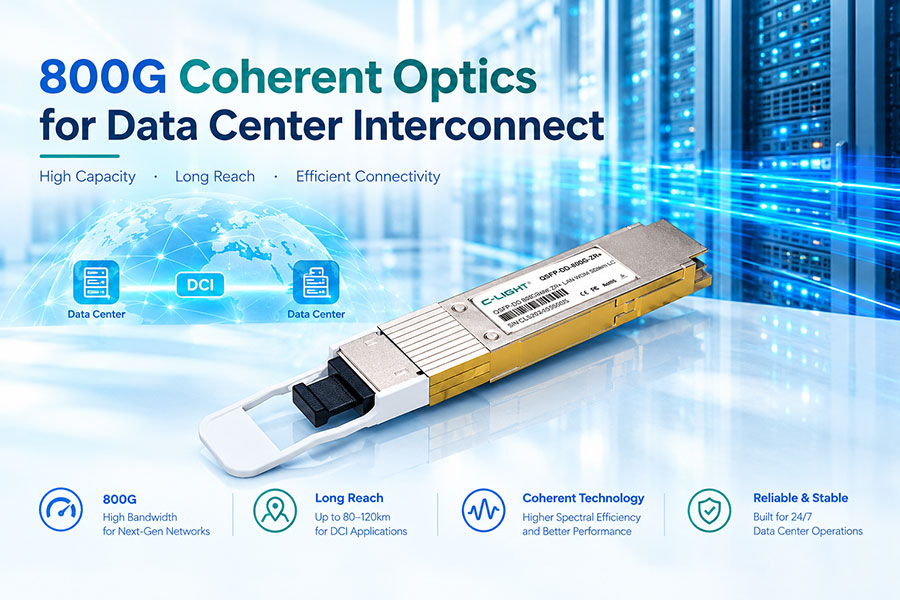
800G Optical Modules
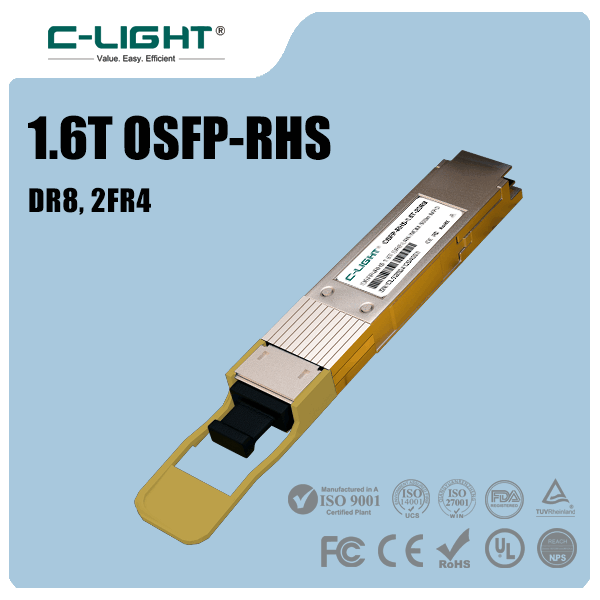
1.6T Optical Connectivity Solutions
DAC / AOC / AEC High-Speed Interconnects
Advanced Optical Networking Technologies
9. Conclusion
CPO is becoming a critical technology direction as AI networking demands higher bandwidth, lower power consumption, and increased connectivity density.
With the evolution from 800G to 1.6T optical connectivity, CPO combined with silicon photonics will play an increasingly important role in future AI data center architectures.
10.CPO Gains Momentum as AI Networking Demands Higher Bandwidth - Q&A
Q1: What is CPO in optical networking?
Answer: Co-Packaged Optics (CPO) integrates optical engines directly with switching ASICs to improve bandwidth density, reduce power consumption, and enhance signal performance.
Q2: Why does AI networking require CPO technology?
Answer: AI clusters require extremely high bandwidth and low-latency communication. CPO helps overcome the power and signal limitations of traditional optical modules.
Q3: Will CPO replace pluggable optical modules?
Answer: CPO will coexist with pluggable optical modules. Pluggable optics remain important for flexible deployments, while CPO targets ultra-high-density AI networks.
Q4: What optical speeds can CPO support?
Answer: Future CPO solutions are expected to support 800G, 1.6T, and higher bandwidth optical connectivity for AI and HPC applications.
Q5: How does silicon photonics support CPO?
Answer: Silicon photonics improves optical integration, scalability, and manufacturing efficiency, making it a key technology for future CPO systems.
Q6: What applications use CPO technology?
Answer: CPO is mainly used in AI data centers, hyperscale cloud networks, HPC systems, and future Ethernet infrastructure.
Q7: What is the difference between CPO and LPO?
Answer: LPO reduces optical module complexity by removing DSP components, while CPO integrates optical engines directly with switching ASICs for maximum efficiency.
Q8: How will CPO affect the optical networking market?
Answer: CPO will create new opportunities for optical components, silicon photonics, fiber connectivity, and next-generation AI networking solutions.
 >
>

 >
>
 >
>
 >
>
 >
>
 >
>
 >
>
 >
>