TEL:+86 132 6656 7067




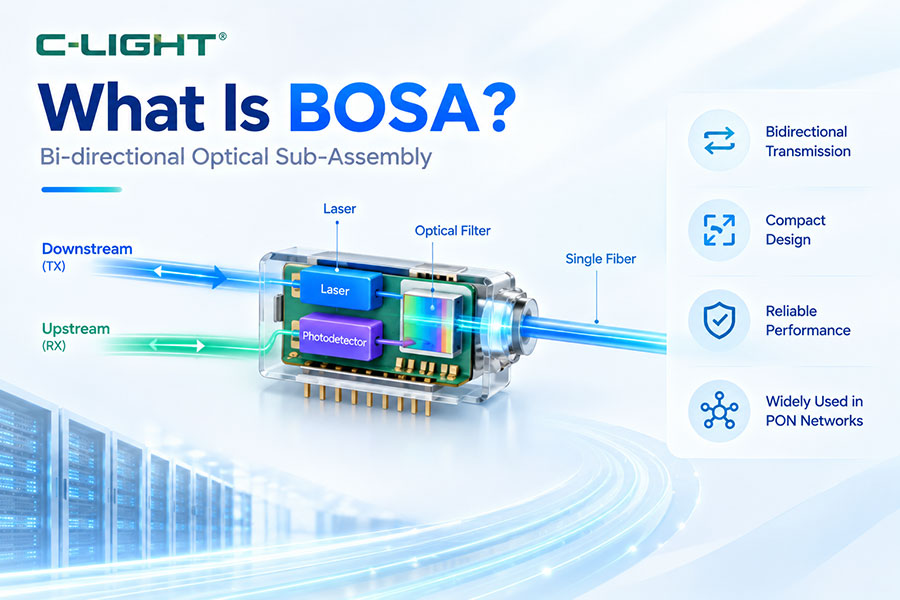
What is the BIDI SFP module? It uses WDM (Wavelength Division Multiplexing) two-way transmission technology to achieve bidirectional transmission in an optical channel simultaneously on one fiber.It has only one port for transmitting and receiving signals on a single fiber optic cable through an integrated two-way coupler. Therefore, it must be paired.
How does the BIDI SFP module work? In order to work efficiently, BIDI SFP modules must be paired to achieve bidirectional transmission of data by tuning the duplexer to match the desired wavelength of the transmitter and receiver.
What is the difference between SFP and BiDi SFP ? As is well known, a common SFP module usually has two ports, one for the TX port to transmit signals and the other for the RX port to receive signals. Unlike common SFP modules, the BiDi SFP module has only one port that uses an integral WDM coupler to transmit and receive signals on a single fiber.
Why choose to use BiDi SFP?
(1) The BiDi SFP module integrates a duplex data link through a single fiber. It can reduce the cost of fiber cabling infrastructure. As the bundle is cut in half, the number of jumpers and patch panel ports can be reduced accordingly.
(2) Using BiDi SFP modules, it is possible to increase the capacity and reliability by operating at multiple wavelengths simultaneously.
(3) It supports transmission distances up to 120 km.
BIDI SFP connection method
For BiDi SFP, because it uses different wavelengths to transmit and receive signals, (security weak current ring) we should connect two BiDi SFPs with opposite wavelengths together. For example, we use the TX1310/RX1550nm BiDi SFP on one end, then we should use the TX1550/RX1310nm BiDi SFP on the other end.
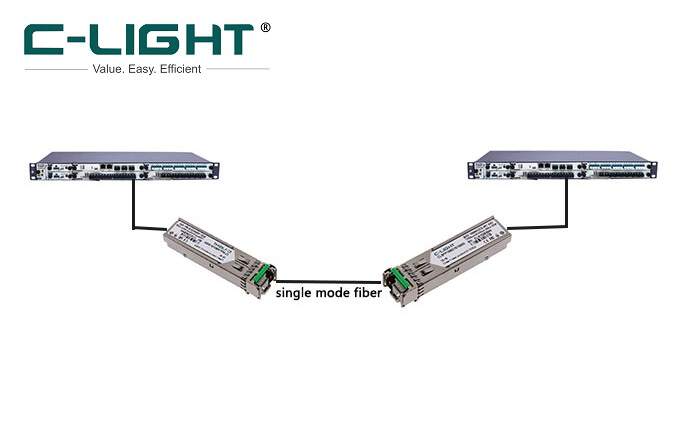
Application of BiDi SFP
BIDI SFP modules are usually applied to high-performance integrated duplex data links through a single fiber. If the transmission distance is within 40km, the wavelength scheme of BIDI SFP modules is 1310nm/1550nm, 1310nm/1490nm. If the transmission distance is above 40km, the wavelength scheme of the BIDI SFP module is 1550 nm/1490 nm.
Currently, BiDi SFP is mainly used for fiber-to-the-home deployment of P2P (peer-to-peer) connections. An FTTH/FTTB active Ethernet network consists of a central office (CO) connected to a client device (CPE). BiDi SFP allows for two-way communication on a single fiber using wavelength division multiplexing, which makes CO and CPE connections simpler.
Conclusion
The deployment of BiDi transceivers effectively enhances the bandwidth capacity of existing fiber infrastructure and contributes to the economic and reliable performance of optical networks.By specializing in design, C-Light provides customers with one-stop optical network devices and Cost-effective optical communication products,supplying a range of SFP optical module products. For more details, please visit the official website of C-LIGHT.
BiDi SFP Optical Transceiver FAQ
Q1: What is a BiDi SFP optical transceiver?
Answer: A BiDi SFP (Bidirectional Small Form-Factor Pluggable) optical transceiver is a compact optical module that enables bidirectional communication over a single optical fiber. Unlike traditional duplex SFP modules that require two fibers for transmission and reception, BiDi SFP uses different wavelengths for TX and RX directions to achieve two-way communication through one fiber.
Q2: How does a BiDi SFP optical module work?
Answer: A BiDi SFP optical module works based on Wavelength Division Multiplexing (WDM) technology. The transmitter and receiver operate at different wavelengths, allowing optical signals traveling in opposite directions to share the same fiber without interference. For example, one module may transmit at 1310nm and receive at 1550nm, while the opposite module uses the reverse wavelength configuration.
Q3: What is the difference between BiDi SFP and traditional SFP optical transceivers?
Answer: The main difference is fiber usage. Traditional SFP optical transceivers typically require two fibers, one for transmitting and one for receiving. BiDi SFP modules use a single fiber for both transmission and reception, reducing fiber requirements and improving fiber resource utilization.
Q4: What are the advantages of BiDi SFP optical transceivers?
Answer: The main advantages of BiDi SFP optical transceivers include:
Reduced fiber deployment requirements
Improved fiber resource utilization
Lower network expansion costs
Simple installation and maintenance
Support for long-distance optical transmission
These advantages make BiDi SFP solutions suitable for networks where fiber resources are limited or expensive to expand.
Q5: What transmission rates and distances are available for BiDi SFP modules?
Answer: BiDi SFP modules are available in multiple data rates and reach options depending on network requirements. Common solutions include 1.25G, 2.5G, 10G, and 25G BiDi optical transceivers, with transmission distances ranging from short-reach applications to long-distance links over single-mode fiber.
Q6: What are the typical applications of BiDi SFP optical transceivers?
Answer: BiDi SFP optical transceivers are widely used in:
Fiber access networks
5G fronthaul networks
Enterprise backbone networks
Data center interconnects
Metro optical networks
Video transmission systems
They are especially valuable in scenarios where reducing fiber consumption and simplifying network deployment are important.
Q7: Can BiDi SFP modules replace standard duplex SFP modules?
Answer: BiDi SFP modules cannot directly replace all duplex SFP modules because they require matched wavelength pairs at both ends of the fiber link. However, in compatible network environments, BiDi SFP provides a more efficient alternative by reducing fiber requirements while maintaining reliable optical communication.
Q8: How do I choose the right BiDi SFP optical transceiver for my network?
Answer: Selecting the right BiDi SFP optical transceiver depends on several factors, including data rate, transmission distance, wavelength pair, fiber type, optical budget, and equipment compatibility. Network designers should choose the appropriate BiDi SFP solution based on whether the application is for access networks, telecom transport, enterprise connectivity, or data center communication.
 >
>

 >
>
 >
>
 >
>
 >
>
 >
>
 >
>
 >
>