TEL:+86 132 6656 7067





AI clusters rely on continuous communication between GPUs, compute nodes, and high-speed switches. As distributed training workloads increase the volume of east-west traffic, the physical network must deliver high bandwidth without creating unnecessary cabling complexity or signal-integrity limitations.
Active Optical Cables (AOCs) provide an integrated optical connection for short- and medium-reach data center links. By combining optical interfaces and fiber into a factory-terminated assembly, AOCs offer a practical way to connect AI servers and switches across racks while supporting high-density 400G and 800G network architectures.
1. Why AI Clusters Need Active Optical Cables
Modern AI infrastructure distributes computing tasks across multiple GPUs and servers. During model training, these devices exchange parameters, gradients, and intermediate data through high-speed network fabrics. Communication patterns such as AllReduce and other collective operations can generate substantial traffic between compute nodes.
As cluster size increases, the number of network links and the aggregate bandwidth requirements also rise. Copper cabling remains useful for very short connections, but its reach and signal-integrity constraints can make large-scale cable deployment more challenging at higher data rates.
AOC technology addresses several practical requirements:
High-speed connectivity: Supports high-bandwidth connections between compatible network ports.
Longer reach than many passive copper links: Fiber transmission provides more flexibility for connections across equipment positions and racks.
Reduced electromagnetic interference: Optical transmission is not affected by electrical noise in the same way as copper signaling.
Integrated cable construction: Factory-terminated optical ends simplify installation and reduce the need to source separate transceivers and fiber patch cords.
High-density cabling: Fiber-based assemblies can help manage cable weight and routing in densely populated AI infrastructure.
2. How AOC Works in an AI Network
An AOC integrates optical transmitter and receiver components into the cable ends. At the transmitting end, electrical signals from the host equipment are converted into optical signals. The signals travel through the fiber and are converted back into electrical signals at the receiving end.
Unlike a conventional pluggable optical transceiver installation, an AOC combines both optical ends and the fiber cable into one assembly. The cable is therefore supplied with a defined interface combination and cable length.
| Component | Function | Role in AI Connectivity |
|---|---|---|
| Host interface | Connects the cable to the switch or server port. | Provides the electrical interface to the network device. |
| Optical transmitter | Converts electrical data into optical signals. | Starts optical transmission from the source device. |
| Fiber cable | Carries optical signals between the two ends. | Enables high-speed transmission across the required cable route. |
| Optical receiver | Converts received optical signals back into electrical signals. | Delivers data to the destination device. |
Because the optical interfaces are integrated into the assembly, users need to select the correct connector type, port configuration, cable length, and equipment compatibility before deployment.
3. AOC Deployment in AI Cluster Architecture
AOCs can be deployed at different points in an AI network, depending on the physical layout and the distance between devices.
GPU Server to Top-of-Rack Switch
In a rack-based AI system, GPU servers connect to top-of-rack (ToR) switches through high-speed network interfaces. AOC can be used when the required connection distance, port type, and system specifications are suitable for optical cabling.
Leaf-to-Spine Switch Connections
Leaf-spine architectures provide scalable connectivity between server-facing switches and the network core. AOCs can support selected short-reach connections between switches, particularly where equipment is distributed across adjacent racks or within the same data hall.
GPU Cluster Interconnection
Large AI clusters require communication between many compute nodes. AOC links can form part of the physical fabric connecting GPU servers, network switches, and other high-performance computing equipment.
Distributed Rack Connectivity
When AI equipment is spread across multiple racks, cable routing and distance become important design considerations. Fiber-based AOCs can provide a practical option for supported short- and medium-reach connections without requiring separate optical modules at both ends.
4. 400G and 800G AOC in AI Data Centers
As AI networks move toward higher port speeds, 400G and 800G AOCs provide connectivity options for different generations of switching and computing equipment.
| Category | Typical Network Role | Deployment Considerations |
|---|---|---|
| 400G AOC | 400G switch links, HPC networks, and selected GPU cluster connections. | Check OSFP, QSFP112, or QSFP-DD interface requirements and supported cable length. |
| 800G AOC | Higher-bandwidth AI fabrics and next-generation data center switching. | Confirm host port type, lane configuration, cable reach, and system compatibility. |
| Breakout AOC | Connecting one high-speed port to multiple lower-speed ports. | Verify the breakout mapping and whether the switch supports the required port configuration. |
400G AOC Configurations
400G AOC is available in several interface combinations, including OSFP112, QSFP112, and QSFP-DD. Breakout configurations can also connect a 400G port to multiple lower-speed interfaces, such as 4 × 100G or 2 × 200G, when supported by the host equipment.
C-LIGHT's listed 400G AOC product configurations use 850nm multimode optical transmission and OM3 fiber, with cable lengths from 1m to 30m. The available configurations include direct connections and selected breakout combinations.
C-LIGHT 400G AOC Active Optical Cable
Data rate: 400G
Interface options: OSFP112, QSFP112, QSFP-DD and selected breakout configurations
Optical wavelength: 850nm
Fiber type: Multimode fiber, OM3
Listed cable length: 1m–30m
800G AOC for Higher-Density AI Networks
800G connectivity increases the bandwidth available through each network link. This is important in AI environments where GPU clusters generate substantial east-west traffic and switch port capacity must scale with compute density.
800G AOC can be considered for compatible short-reach connections in high-speed AI fabrics. Before selecting a cable, engineers should confirm the switch interface, optical lane architecture, supported cable length, firmware requirements, and interoperability with the target platform.
For broader product options, see the C-LIGHT AOC and high-speed cable portfolio.
5. AOC vs. DAC, AEC and Pluggable Optical Transceivers
AOC is one of several interconnect technologies used in modern data centers. The right choice depends on connection distance, bandwidth, power consumption, installation method, and equipment architecture.
| Technology | Transmission Medium | Typical Application | Main Consideration |
|---|---|---|---|
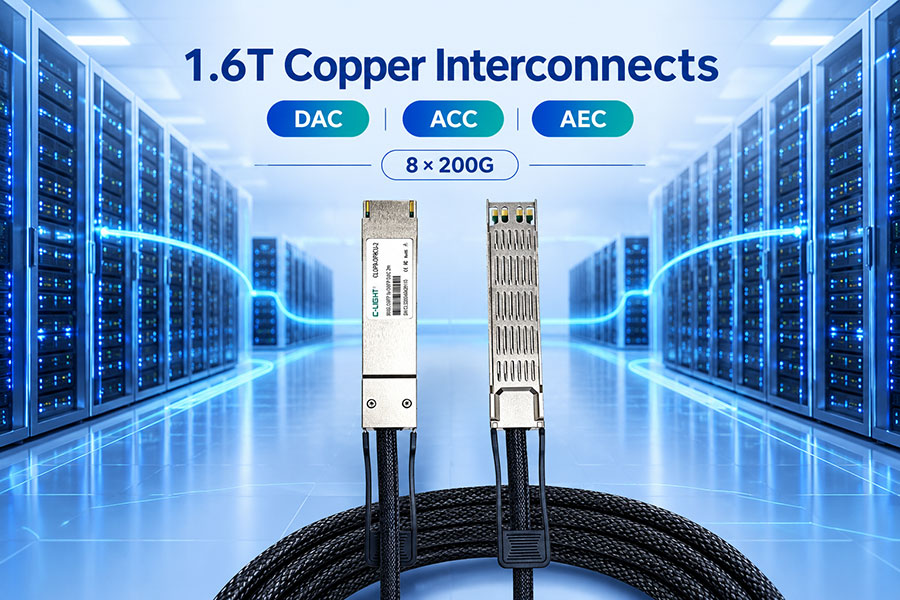
| DAC | Copper | Very short connections within a rack. | Cost-effective, but reach becomes more constrained at higher speeds. |
| AEC | Active copper | Short-reach high-speed connections requiring signal conditioning. | Requires power and careful compatibility checks. |
| AOC | Optical fiber | Short- and medium-reach connections between compatible devices. | Integrated cable assembly simplifies optical deployment. |
| Pluggable optical transceiver | Optical fiber | Flexible links across different distances and network locations. | Requires separate transceivers and fiber cabling. |
For very short connections, DAC may offer a straightforward and economical solution. AEC can extend the practical reach of electrical connections in supported configurations. AOC is useful when optical transmission and an integrated cable assembly are preferred. Pluggable transceivers provide greater flexibility when different fiber types, distances, or link configurations are required.
For a related discussion of active electrical connectivity, see C-LIGHT 800G AEC.
6. Key Factors When Selecting AOC for AI Clusters
Choosing an AOC requires more than matching the nominal data rate. The cable must work with the complete host system and the intended physical network layout.
Interface and Form Factor
Check whether the equipment uses QSFP-DD, QSFP112, OSFP, or another supported interface. The connector type and mechanical design must match both ends of the connection.
Data Rate and Breakout Mapping
Confirm the required aggregate bandwidth and lane mapping. A 400G-to-4 × 100G breakout cable, for example, must match the switch's supported breakout mode and the connected devices' port configurations.
Cable Length and Routing
Measure the actual cable route rather than relying only on the straight-line distance between devices. Allow enough length for rack routing while avoiding unnecessary excess cable that can complicate airflow and maintenance.
Fiber Type and Optical Specifications
Verify the supported fiber type, wavelength, optical interface, and reach. Multimode and single-mode optical systems are not interchangeable simply because their connector shapes appear similar.
Compatibility and Management
Confirm compatibility with the switch or server platform, including supported cable identification, management interface requirements, firmware, and vendor-specific restrictions. Where possible, validate the cable on the target equipment before large-scale deployment.
Power and Thermal Conditions
Active cable ends contain electronic and optical components that consume power and generate heat. In high-density AI racks, engineers should consider port-level power limits, module temperature, airflow, and the thermal design of the host equipment.
7. AOC Installation and Network Validation
Large AI clusters can contain thousands of high-speed physical connections. A consistent installation and validation process helps reduce cabling errors and simplifies future maintenance.
Confirm the network design: Identify the source and destination ports, data rate, interface type, and required cable length.
Check product compatibility: Verify the AOC part number and supported host platforms before installation.
Inspect the cable assembly: Check the connector housing, cable jacket, labels, and physical condition.
Install and identify each link: Follow the equipment manufacturer's handling and insertion instructions, then label both ends clearly.
Verify link status: Confirm that the host devices recognize the cable and establish the expected link speed.
Run network tests: Check link stability, error counters, traffic performance, and operation under representative workloads.
Document the deployment: Record port mapping, cable part numbers, lengths, and test results for future troubleshooting.
8. Common AOC Deployment Challenges
Link Does Not Establish
Possible causes include an incompatible cable configuration, unsupported host coding, incorrect port settings, or a mismatch in the expected data rate. Check device compatibility and port configuration first.
Unexpected Link Speed
A link may operate below its expected speed when the host port is configured for a different mode or when breakout settings do not match the cable architecture. Verify the port mode and lane mapping at both ends.
Intermittent Link Errors
Intermittent errors can be associated with damaged cable assemblies, connector contamination, poor handling, thermal conditions, or equipment compatibility issues. Inspect the connection and review host diagnostics before replacing components.
Overcrowded Cable Routes
Dense GPU racks can accumulate large numbers of optical and electrical cables. Consistent labeling, suitable cable lengths, organized routing, and documented port mapping help improve serviceability and airflow management.
9. C-LIGHT AOC Solutions for AI Data Centers
C-LIGHT provides high-speed interconnect products for data center, AI computing, and high-performance networking applications. Its AOC portfolio includes different data rates and interface configurations for short-reach optical connectivity.
Relevant product and technical resources include:
400G AOC Active Optical Cable – 400G direct and breakout configurations for supported data center interfaces.
AOC/DAC/AEC Product Portfolio – High-speed cable options for different network distances and deployment requirements.
800G AOC Cable for AI Networks – Related technical information for higher-bandwidth AI network connectivity.
800G AEC Cable – An active copper alternative for supported short-reach GPU and switch connections.
For AI cluster deployments, product selection can be based on port type, bandwidth, cable length, fiber requirements, host compatibility, and the planned network topology. Technical support can help confirm the appropriate configuration before deployment.
10. Conclusion
Active Optical Cables are an important connectivity option for AI clusters that require high bandwidth, flexible cable routing, and reliable short- to medium-reach optical links. Their integrated optical interfaces and fiber construction simplify connections between compatible GPU servers, switches, and other data center equipment.
As AI networks evolve from 400G toward 800G and beyond, AOC selection must consider interface compatibility, optical specifications, cable reach, thermal conditions, and network architecture together. A well-planned combination of AOC, DAC, AEC, and pluggable optical transceivers can help build a scalable and manageable interconnect infrastructure for demanding AI workloads.
Build Your AI Cluster Connectivity with C-LIGHT
Looking for 400G or 800G AOC solutions for GPU clusters, high-performance computing, or data center switching? Contact our team for product specifications, compatibility support, and customized cable configurations.
Contact C-LIGHT >

 >
 >
 >
 >
 >
 >
 >