TEL:+86 132 6656 7067




The AI data center optical transceiver market has entered a historic growth phase, driven by the exponential expansion of AI computing clusters and the accelerated migration from traditional copper-based interconnects to high-speed optical connectivity. As of 2026, the market is valued at approximately $26 billion for Ethernet optical transceivers used in AI clusters, reflecting a remarkable 60% year-over-year growth rate-. By 2030, multiple research firms project the broader AI optical transceiver market to reach $8.95 billion to $73 billion, with silicon photonics-enabled shipments expected to more than quintuple by 2030, reaching a total market value exceeding $45 billion.

1. Market Overview: Explosive Growth Across the Forecast Horizon
The AI-driven demand for optical transceivers represents the most significant growth catalyst in the optical communications industry. According to LightCounting, the AI optical transceiver segment—spanning Ethernet transceivers, LPO, and CPO for AI clusters—grew from approximately $5 billion in 2024 to more than $10 billion by 2026, effectively doubling in size within two years. The research firm estimates the market reached $16.5 billion in 2025 and will reach $26 billion in 2026, corresponding to a 60% growth rate for both 2025 and 2026-.
The overall optical transceiver market, which encompasses telecom, enterprise networking, and data center applications, is estimated at $10–12 billion in 2025 and is expected to double by 2030, reaching between $20–25 billion. Grand View Research valued the global optical transceivers market at $15.44 billion in 2025, projecting it to reach $36.24 billion by 2033 at a CAGR of 11.1%.
In terms of annual growth trajectory, LightCounting forecasts 30–35% annual growth for 2025 and 2026, followed by a moderation to 15–20% in 2027–2030 as the initial wave of AI enthusiasm subsides-. This represents a "soft-landing" scenario, though historical patterns indicate the market experiences periodic adjustments roughly every three years—previous downturns in 2019 and 2022 stemmed from capital expenditure cuts by major cloud providers and supply chain inventory buildup-.
2. Key Market Drivers and Structural Shifts
2.1 AI Cluster Scaling: From Scale-Out to Scale-Up Networks
The primary demand driver for optical transceivers is the rapid expansion of AI training and inference clusters. As GPU cluster sizes grow—Oracle Cloud Infrastructure, for example, is deploying clusters with 131,000 Nvidia Blackwell GPUs interconnected via NVLink72—interconnect requirements are growing faster than the number of XPUs themselves. This has created an urgent demand for high-bandwidth, low-latency optical networking solutions.
The market is undergoing a fundamental shift from traditional Scale-Out (horizontal expansion across switches and racks) to Scale-Up (vertical expansion within high-density GPU enclosures) architectures. Scale-Up networks represent a new market opportunity for optical interconnects, as copper cable solutions face increasingly severe bandwidth-distance limitations in high-density AI racks.
The limitations of copper interconnects have become a critical constraint in AI data centers. At 200G data rates, high-quality copper cables are effective only within a distance of approximately 2 meters. Beyond this threshold, signal attenuation rises sharply, with electrical losses reaching 22 dB—rendering copper economically and technically unviable for large-scale AI cluster deployments. This physics-driven bottleneck is accelerating the transition from copper to optical connectivity. Bank of America projects that the AI optical connectivity market will grow from $14 billion in 2025 to $73 billion by 2030, achieving a remarkable CAGR of 39%. By 2030, optical ports will account for 71% of AI network ports, while copper will decline to just 29%
LightCounting emphasizes that Scale-Up networks will be the key driver for LPO and CPO adoption, with deployments expected to begin in 2026–2027 and reach high volumes by 2028, returning the market to double-digit growth through 2030.
2.2 High-Speed Module Ramp: 800G Dominance and 1.6T Emergence
The transition from 400G to 800G and 1.6T optical modules is accelerating dramatically:
800G Modules: Shipments of 800GbE modules are expected to reach approximately 20 million units in 2025, with continued strong growth projected for 2026. The total addressable market for 400G+ datacom modules is expected to reach nearly $30 billion by 2029, even as blended prices fall below $0.40 per gigabit by the end of the forecast period. In Q3 2025, 800G module shipment forecasts were revised upward to over 20 million units, with vendors reporting no softening in demand.
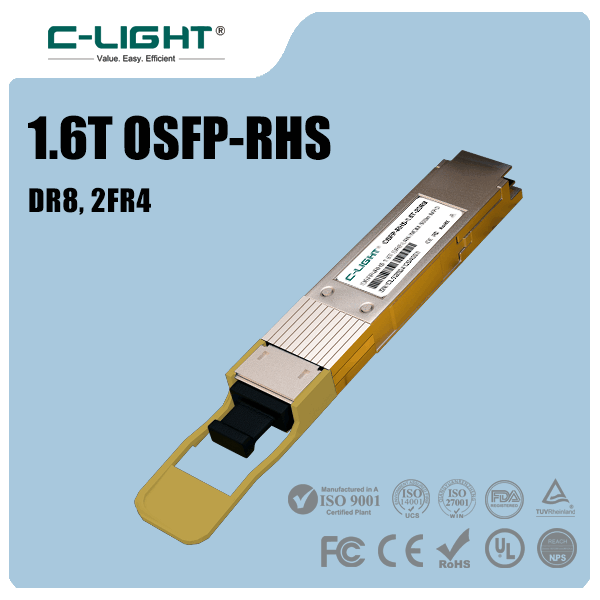
1.6T Modules: 2026 is widely recognized as the volume ramp year for 1.6T commercialization. Cignal AI forecasts that 1.6T module shipments will exceed 5 million units in 2026, with rapid growth continuing thereafter. LightCounting notes that 1.6T technology is already shipping, with Nvidia and Google having integrated the technology, and Meta and Oracle expected to follow in 2026.
3.2T Development: Development of 3.2T optical modules, centered on 400G per-lane designs, is advancing in parallel with 1.6T deployment, opening doors for new form factors and reinforcing the case for LPO and CPO adoption.
Total shipments of high-speed datacom modules (400G and above) reached 42 million units in 2025, led by 800G growth, while 1.6T modules will grow rapidly in 2026. In Q3 2025, 400G+ datacom module shipments surpassed 10 million units for the first time, generating over $5 billion in quarterly revenue.
2.3 Cloud Provider Capital Expenditure Surge
North American cloud service providers are significantly expanding capital expenditure to support AI infrastructure buildout. LightCounting estimates that sales of optics to the TOP 5 cloud companies will account for 3.1% of their total capex in 2026, up from 2.7% in 2025, and will increase to 4.1% by 2031.
Meta and Oracle plan to double their capex in 2026, while other major cloud providers have yet to update their spending plans—suggesting that current forecasts may prove conservative. Broadcom CEO Hock Tan has noted that networking costs in data centers are climbing, from 5–10% of capital expenditures today to an expected 15–20% by 2030. The optical module and optical device sector has demonstrated particularly strong financial performance, with Chinese optical module companies reporting revenue of 66.2 billion yuan in the first three quarters of 2025, up 65% year-on-year, while net profit surged 123% year-on-year—both driven by AI demand
3. Technology Evolution: Silicon Photonics, LPO, and CPO
3.1 Silicon Photonics: The Mainstream Platform
Silicon photonics has emerged as the core technology platform for high-speed optical transceivers, driven by its advantages in power efficiency, cost-effectiveness, and integration density. TechInsights projects that shipments of optical transceivers will more than quintuple by 2030, reaching a market of more than $45 billion enabled by silicon photonics.
Silicon photonics is primarily deployed in short-range data communication within data centers, specifically in pluggable optical transceivers that interconnect servers, racks, switches, ASICs, and GPUs. As data center, HPC, AI, and machine learning workloads continue to escalate, silicon photonics has become essential for meeting the growing demands for bandwidth, low latency, and reduced power consumption
LightCounting's analysis indicates that silicon photonics is expected to support next-generation CPO and LPO modules, with the technology now well-positioned to capture increasing market share as the industry transitions to higher data rates.
3.2 Linear-Drive Pluggable Optics (LPO): Eliminating DSP for Power Efficiency
LPO technology removes the DSP chip from the optical module, significantly reducing power consumption while maintaining pluggable form factor compatibility. 800G LPO modules achieve approximately 50% reduction in power consumption compared to traditional DSP-based modules.
LPO has already been adopted by four to five companies including Oracle, and Google has begun deploying 1.6T linear receiver optical modules in preparation for volume ramp in 2026. LightCounting expects LPO and CPO deployment in Scale-Up networks to begin in 2026–2027, reaching high volumes by 2028 and returning the market to double-digit growth in 2028–2030.
3.3 Co-Packaged Optics (CPO): The Next Frontier
CPO technology integrates the optical engine directly with the switch ASIC package, eliminating the need for separate pluggable modules and significantly reducing power consumption. According to Nvidia, shifting from pluggable optics to CPO can reduce optical power consumption from 30W to 9W for a 1.6Tbps link—a 3.5x improvement in power efficiency.
CPO technology is transitioning from research to commercialization. The key turning point occurred in 2025 when Meta announced at the OCP Summit that Broadcom's Bailly CPO switch had undergone 15 million device-hours of testing with zero failures. Mean time between failures improved from less than 1 million hours for pluggable optics to over 2.5 million hours for CPO, demonstrating that reliability is not a weakness but a strength of CPO technology. In a 24,000-GPU cluster, this reliability improvement translates to a 90% increase in GPU utilization
Bank of America projects that CPO will begin volume deployment in 2027, reaching a market size of $15 billion by 2030 and accounting for 31% of AI optical ports. Approximately two-thirds of 3.2T ports are expected to utilize CPO technology
Nvidia's Spectrum-X photonics switch with 512 800G ports and total bandwidth of 409.6 TB/s is scheduled to launch in the second half of 2026. Broadcom has advanced to its third-generation CPO product (Davisson), while Marvell has acquired Celestial AI, whose "photonic fabric" technology enables optical devices to sit directly on top of chips rather than at the edge—enabling tighter integration and shorter transmission distances.
4. Supply Chain Dynamics and Competitive Landscape
4.1 Supply Chain Constraints and Resolution Timeline
Between 2023 and 2025, optical transceiver shipments were constrained by shortages of VCSELs and InP lasers. The VCSEL shortage eased in mid-2024 as Nvidia transitioned from SR8 to DR8 800G transceivers. InP laser chip suppliers added capacity in 2024–2025, with most of this new capacity expected to be qualified for production by mid-2026.
LightCounting expects the supply shortage to ease by mid-2026, which is positive news for customers but presents a double-edged sword for suppliers: they can ship more volume, but demand tends to drop when shortages abate. The research firm does not forecast a market downturn but anticipates a possible one-to-two-quarter period of flat growth in late 2026 as the supply chain finds a new equilibrium.
4.2 Competitive Landscape
Manufacturing Dominance: Chinese manufacturers hold a dominant position in optical transceiver manufacturing, accounting for approximately 70% of global optical module supply, leveraging substantial production capacity in InP substrates.
Market Leaders: According to J.P. Morgan, the largest optical component suppliers are Coherent and Innolight (each with approximately 20% market share), followed by Broadcom at 10%.
In the 800G optical module segment, Innolight maintains a leading position, though the gap with competitors such as Eoptolink, Coherent, and Nvidia is narrowing.
Core Chip Dominance: Despite manufacturing leadership by Chinese firms, core optoelectronic chip technologies remain largely controlled by U.S. companies. Coherent holds key positions in InP lasers, Lumentum in MEMS optical switches, and Broadcom in switch ASICs and DSPs. Early entrants in advanced packaging and CPO technologies such as Broadcom, Marvell, Ayar Labs, Celestial AI, and Lightmatter are poised to benefit from the next wave of optical integration.
4.3 Regional Dynamics
The Americas are witnessing increased demand for hyperscale cloud deployments. Europe, the Middle East, and Africa are focusing on energy-efficient modules due to regulatory emphasis on green data centers. The Asia-Pacific region, driven by robust cloud service growth, is seeing significant investment in fiber backbones.
5. Future Outlook: 2027–2030
5.1 Growth Moderation and Rationalization
Following the explosive growth of 2025–2026, the market is expected to enter a more measured growth phase. LightCounting forecasts moderation in market growth for 2027–2031, assuming an eventual return to rational spending patterns among top cloud companies. The optical spending share of TOP 5 cloud provider capex is projected to rise from 3.1% in 2026 to 4.1% by 2031
Cignal AI forecasts that datacom optical component revenue will grow at a CAGR exceeding 20% from 2024 through 2029, reaching nearly $29 billion by the end of the forecast period.
5.2 Technology Roadmap Acceleration
The transition timeline for next-generation optics is compressing rapidly across the industry. 1.6T technology is already shipping, while 3.2T development centered on 400G per-lane designs is advancing in parallel. Silicon photonics, LPO, and CPO represent three concurrent technology paths that will coexist in the near term: silicon photonics has achieved mainstream status in 800G/1.6T applications, LPO is rapidly penetrating specific use cases due to DSP-free power advantages, and CPO represents the longer-term evolutionary path toward fully integrated optical interconnects.
5.3 Scale-Up Networks as the Next Growth Engine
CPO adoption for Scale-Up connectivity may exceed current forecasts and lead to stronger market growth in 2028–2031. Higher spending on optical connectivity can be attributed to new applications such as Scale-Up networking and rapid growth in GPU bandwidth for both Scale-Out and Scale-Up connectivity.
The AI optical connectivity market is projected to reach $73 billion by 2030, with optical ports comprising 71% of AI network ports, underscoring the fundamental and irreversible shift from electrical to optical interconnects in next-generation AI data center architectures.
The AI data center optical transceiver market is undergoing the most significant growth phase in its history, driven by the convergence of exponential AI workload expansion, the physics-imposed limitations of copper interconnects, and rapid technology transitions to 800G, 1.6T, and eventually 3.2T data rates. From a base of approximately $16.5 billion in 2025, the AI-specific Ethernet optical transceiver and CPO market is projected to reach $26 billion in 2026, representing 60% year-over-year growth, and will continue expanding through 2030 as Silicon Photonics, LPO, and CPO technologies mature and Scale-Up networking requirements accelerate optical adoption across all segments of the AI data center infrastructure.
 >
>

 >
>
 >
>
 >
>
 >
>
 >
>
 >
>
 >
>