TEL:+86 132 6656 7067




I. Market Overview: Data Center Optical Transceiver Market Size in 2026
The global optical transceiver market is reaching a historic inflection point in 2026. The large-scale deployment of AI computing clusters has pushed data center interconnection demands to unprecedented heights. While estimates vary slightly among research firms due to differing methodologies, all indicators point to robust double-digit growth:
LightCounting (Focus on Ethernet optical transceivers in AI clusters): Market size forecast for 2026 is $26 billion, representing a 60% YoY increase from $16.5 billion in 2025.
Research Nester (Comprehensive market view): The global optical transceiver industry is estimated at approximately $17.8 billion in 2026, projected to reach $55.4 billion by 2035, with a CAGR of 13.4%.
Fortune Business Insights: Market size estimated at $17.15 billion in 2026, expected to reach $46.12 billion by 2034, at a CAGR of 17.00%.
Global Market Insights: Market size estimated at approximately $15.4 billion in 2026, projected to reach $48.1 billion by 2035, with a CAGR of 13.5%.
360iResearch: Market size estimated at approximately $15.72 billion in 2026, reaching $25.67 billion by 2032, at a CAGR of 8.35%.
China Industrial Research Institute (Including overall optical module market): Global optical module market size projected to reach $16.697 billion in 2026, up 29% YoY.
The discrepancies in these figures stem primarily from differences in scope definition—LightCounting focuses specifically on transceiver sales within AI cluster deployments, while other agencies cover broader applications including telecommunications, enterprise networking, and traditional data centers.
Data centers remain the largest application segment for optical transceivers, and their share of the overall market continues to rise. Forecasts indicate that data center applications will account for approximately 48.4% of the total optical transceiver market by 2035, up from an estimated 39.5% share in 2026.
II. AI Data Centers Ignite a Bandwidth Revolution
2.1 Rapid Growth in High-Speed Optical Module Shipments
The explosive growth in the 2026 data center optical transceiver market is primarily driven by the accelerated upgrade cycle within AI data centers, shifting from 400G to 800G and 1.6T connectivity.
800G Optical Modules: Shipments are expected to surpass 40 million units. North American cloud providers are the primary purchasers, with Meta leading demand at 10 to 12 million units; Google and Microsoft combined require approximately 12 million units; Amazon demand sits around 5.5 million units. Goldman Sachs has revised its 2026 sales forecast for 800G modules upward by 58%, from 25 million to 33.5 million units.
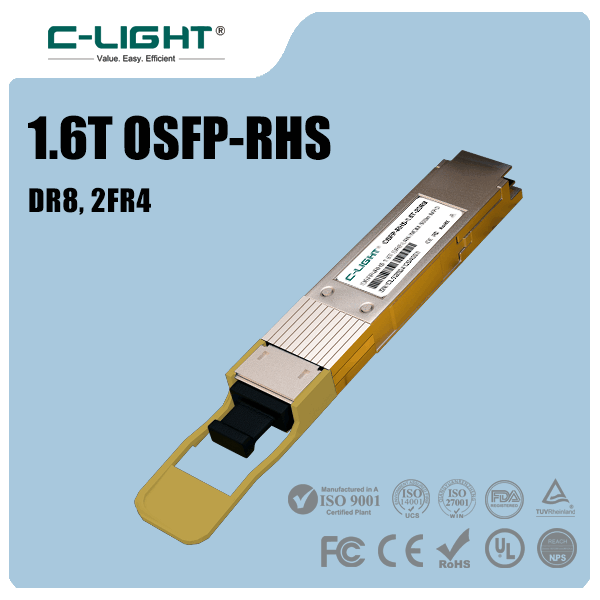
1.6T Optical Modules: 2026 is widely recognized as the first year of 1.6T commercialization, with global demand projected between 8.6 million and 20 million units. Nvidia is an aggressive driver in this segment, with demand exceeding 5 million units in 2026; Google requires approximately 4 million units, and Meta requires about 1 million units.
LightCounting predicts that 800G transceiver shipments will more than double in 2026, while 1.6T port shipments will grow from a small base in 2025 to tens of millions. Sales of 1.6T chipset solutions are expected to surpass $2 billion in 2026 and maintain rapid growth through 2029.
According to TrendForce, the share of optical transceivers operating at 800G and above is expected to jump from 19.5% of total shipments in 2024 to over 60% in 2026, solidifying its status as the standard for AI data center infrastructure. Looking at Google alone, based on an estimated shipment of nearly 4 million TPUs in 2026, the corresponding demand for 800G+ optical modules is forecasted to exceed 6 million units.
2.2 From Scale-Out to Scale-Up: Comprehensive Upgrade of AI Interconnects
The demand for optical interconnects within AI clusters has expanded beyond traditional horizontal expansion (Scale-Out) to include vertical scaling (Scale-Up). As GPU cluster sizes increase and rack density rises, the limitations of passive copper cable solutions for intra-data center connectivity become more apparent. Optical connections are transitioning from an option to a necessity.
AI optics will be the primary growth contributor to the data center optics market over the next five years. By 2030, the total addressable market for AI optics is projected to exceed $20 billion annually, supporting high-speed optical throughput requirements of 400G, 800G, 1.6T, and 3.2T.
2.3 Significant Increase in Capital Expenditure by North American Cloud Providers
The expansion of capital expenditure (CapEx) by North American cloud service providers is a direct catalyst for the demand surge in 2026. Major providers are substantially increasing investments, with Meta and Oracle planning to double their spending in 2026. The proportion of optical spending relative to the total CapEx of the TOP 5 cloud providers is expected to rise from 2.7% in 2025 to 3.1% in 2026.
III. Technology Evolution: The Race Among Silicon Photonics, LPO, and CPO
3.1 Silicon Photonics (SiPh): The Mainstream Approach
Silicon photonics has become the core technology direction for 800G and 1.6T high-speed modules due to its low power consumption and cost efficiency. The penetration rate of silicon photonics in 800G and 1.6T optical modules is expected to reach between 50% and 70%.
3.2 Linear-drive Pluggable Optics (LPO): Reducing Power by Eliminating DSP
LPO technology optimizes both power consumption and latency by removing the Digital Signal Processor (DSP) chip. 800G LPO modules achieve a 50% reduction in power consumption and have already secured orders from major customers like Meta and Amazon. LPO module revenue is expected to account for 15% of the market share in 2026, becoming a significant growth segment.
3.3 Co-Packaged Optics (CPO): Frontier Exploration
CPO technology integrates the optical engine directly with the switch ASIC package, potentially reducing data center power consumption by over 40%. 2026 is recognized as the inaugural year for CPO volume deployment. However, CPO currently faces technical challenges related to alignment precision and thermal management. Furthermore, supply is limited, with Broadcom currently being the sole supplier of CPO switches. Large-scale application is expected to materialize more broadly after 2027.
IV. Supply Chain Dynamics and Capacity Bottlenecks
Market growth in 2026 continues to navigate supply chain constraints. Between 2023 and 2025, optical transceiver shipments were hampered by shortages of VCSELs and InP lasers. While VCSEL shortages eased in mid-2024 as Nvidia transitioned to DR8 800G transceivers, InP laser chip suppliers are still in the process of ramping up production capacity. Supply constraints are expected to improve significantly by mid-2026.
V. Competitive Landscape: Chinese Manufacturing Ascends, U.S. Dominates Core Chips
5.1 Global Position of Chinese Manufacturers
Chinese manufacturers hold a dominant position in the optical transceiver manufacturing segment. In the 2023 global Top 10 ranking for optical modules, Chinese companies occupied seven spots. Leveraging substantial global production capacity in Indium Phosphide (InP) substrates, Mainland Chinese manufacturers account for approximately 70% of the global optical module supply.
5.2 U.S. Firms Dominate Core Photonic Chips
While manufacturing is dominated by Chinese firms, the core optoelectronic chip segment remains largely controlled by U.S. companies. Coherent holds key positions in InP lasers, Lumentum in MEMS optical switches, and Broadcom in switch silicon and DSPs. Notably, ahead of OFC 2026, Nvidia made a $4 billion strategic investment in Lumentum and Coherent, a move widely interpreted as external validation of the strategic importance of the optical infrastructure supply chain.
VI. Future Outlook
Growth Normalization Expected: The second half of 2026 may see a brief period of stabilization lasting one to two quarters as the supply chain finds a new equilibrium between supply and demand. Market growth is expected to moderate from 2027 through 2031, though the proportion of optical spending relative to TOP 5 cloud provider CapEx is projected to increase from 3.1% in 2026 to 4.1% by 2031.
Advance Planning for Higher Speeds: While 1.6T deployment scales significantly, development efforts for 3.2T optical modules have already been initiated. Woodside Capital Partners forecasts that 1.6T could surpass 800G as the primary port speed for new AI backend networks by 2027.
Coexistence of Multiple Technology Paths: The near term will see the coexistence of Silicon Photonics, LPO, and CPO technologies. SiPh has secured mainstream status in the 800G/1.6T market. LPO is rapidly penetrating specific scenarios due to its DSP-free power advantages. CPO remains a longer-term evolution path toward fully integrated optical interconnects.
Information source:https://www.gminsights.com/industry-analysis/optical-transceiver-market
 >
>

 >
>
 >
>
 >
>
 >
>
 >
>
 >
>
 >
>