TEL:+86 132 6656 7067




1. CWDM BiDi: How Single-Fiber Bidirectional Technology Reshapes Optical Interconnect Efficiency
Amidst increasingly scarce fiber resources and continuously rising cable deployment costs, network planners face a core contradiction: service bandwidth demands are growing steadily, yet physical fiber resources are difficult to scale in parallel. When data center rack space is fully occupied, carrier conduit slots are saturated, and industrial site cable routing is constrained, the traditional "dual-fiber, single-link" cabling model encounters three major challenges: fiber resource exhaustion, insufficient pathway space, and high operational complexity.
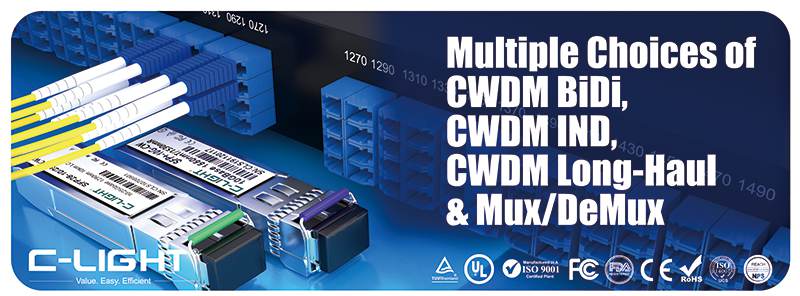
It is against this backdrop that the integration of BiDi (Bidirectional) technology with CWDM (Coarse Wavelength Division Multiplexing) technology—the CWDM BiDi optical transceiver—has emerged as a key solution. A BiDi optical transceiver incorporates a built-in WDM coupler (diplexer) on the optical port side, which multiplexes and demultiplexes optical signals of different center wavelengths. The local end transmits at wavelength λ₁ and receives at wavelength λ₂, while the remote end transmits at wavelength λ₂ and receives at wavelength λ₁. Only a single single-mode fiber is required to establish a full-duplex communication link. This means that carriers can effectively double the capacity of existing fiber networks without excavating new conduits or deploying new optical cables. CWDM further extends this concept by deploying up to 18 wavelength channels spaced at 20 nm intervals within the 1270 nm to 1610 nm range, enabling parallel transmission of multiple signals over a single fiber, thereby maximizing the information-carrying capacity of a single fiber strand.
C-LIGHT is a professional manufacturer with 15 years of experience in optical transceiver R&D and production, has established full-speed coverage capabilities across its CWDM BiDi product line, ranging from 100M to 25G. Leveraging robust manufacturing capabilities and a comprehensive product portfolio, C-LIGHT provides global customers with efficient optical interconnect solutions that enable "a single fiber to carry all services."
2. Technical Foundation: Operating Principles and Core Value of CWDM BiDi
2.1 Technical Principle of Single-Fiber Bidirectional Communication
Unlike traditional optical transceivers that utilize dual ports and dual fibers for separate transmission and reception, a BiDi optical transceiver is equipped with only a single optical port and integrates a WDM coupler internally. This coupler combines or separates optical signals based on different center wavelengths, enabling bidirectional communication over a single fiber. BiDi modules are typically used in pairs, with one end designated "U" (Upstream) and the other "D" (Downstream), each transmitting at different wavelengths. Taking the classic 1310 nm/1550 nm wavelength pair as an example: the local module transmits at 1310 nm and receives at 1550 nm; the remote module transmits at 1550 nm and receives at 1310 nm. Full-duplex data exchange is accomplished using only one single-mode fiber.
CWDM operates within the wavelength range of 1270 nm to 1610 nm, with a channel spacing of 20 nm, supporting the simultaneous transmission of up to 18 wavelength channels over a single fiber, compliant with the ITU-T G.694.2 standard. When CWDM is combined with BiDi technology, each bidirectional channel occupies two CWDM wavelengths (one for transmit, one for receive), forming a complete single-fiber multi-channel multiplexing solution.
2.2 Three Core Values: Fiber Savings, Efficiency Gains, and Enhanced Reliability
The core value of CWDM BiDi technology is manifested across three dimensions: Fiber Savings—Halving the required number of optical fibers, offering significant advantages in scenarios where fiber resources are scarce or leasing costs are high. Capacity Multiplication—Further overlaying multiple signals using CWDM multiplexing technology to achieve multiplicative expansion of network capacity without adding physical fiber. Enhanced Reliability—The single-fiber solution reduces the number of fiber connection points and patch cords, lowering the risk of service interruptions caused by connection failures. It also reduces the occupancy of distribution frame ports and patch cords.
3. Product Matrix: Full-Speed Coverage, Full-Scenario Adaptation
C-LIGHT's CWDM BiDi series optical transceivers cover five major data rate tiers: 100M, 1.25G, 2.5G, 10G, and 25G. They offer multiple transmission distance options ranging from 10 km to 120 km, and provide full support for both commercial (0°C to 70°C) and industrial (-40°C to +85°C) operating temperature grades.
3.1 100M CWDM BiDi Series
In industrial control scenarios such as power distribution automation, industrial fieldbuses, and railway signaling systems, 100 Mbps bandwidth is sufficient to carry critical services like real-time monitoring data, equipment status information, and control commands. C-LIGHT's 100M CWDM BiDi series utilizes standard SFP packaging and supports various transmission distances, from short-reach to long-haul. It enables bidirectional data communication over a single optical fiber, significantly simplifying the complexity of optical fiber cabling at industrial sites. This series adheres to rigorous industrial-grade component screening and temperature compensation design, ensuring long-term stable operation in extreme environments ranging from -40°C to +85°C, thereby providing a reliable optical transmission foundation for industrial automation networks.
| Form Factor | Part No. | Fiber Type | Data Rate | Wavelength | Distance | Connector | Temperature |
| SFP | CLSFP62BDXXXXB35 | SMF | 100M ~ 622Mbps | CWDM/CWDM | 35dB | LC/SC | Com./Ind. |
| SFP | CLSFP62BDXXXXB28 | SMF | 100M ~ 622Mbps | CWDM/CWDM | 28dB | LC/SC | Com./Ind. |
| SFP | CLSFP62BDXXXXB23 | SMF | 100M ~ 622Mbps | CWDM/CWDM | 23dB | LC/SC | Com./Ind. |
| SFP | CLSFP15BDXXXXB35 | SMF | 100M ~ 155Mbps | CWDM/CWDM | 35dB | LC/SC | Com./Ind. |
| SFP | CLSFP15BDXXXXB29 | SMF | 100M ~ 155Mbps | CWDM/CWDM | 29dB | LC/SC | Com./Ind. |
| SFP | CLSFP15BDCW80D-xx/xx | SMF | 100M-155Mbps | 18CH,1270/1290nm, 1310/1330nm, ect. | 80km | LC/SC | Com./Ind. |
3.2 1.25G CWDM BiDi Series
1.25G is the primary data rate for Gigabit Ethernet access and represents the most commercially mature rate node for BiDi technology applications. The global Gigabit BiDi optical transceiver market is projected to reach approximately $3.5 billion by 2033, growing at a compound annual growth rate (CAGR) of 8.2% from 2025 to 2033.
C-LIGHT's 1.25G CWDM BiDi series supports multiple transmission distances, including 10 km, 20 km, 40 km, 80 km, and up to 120 km. Wavelength schemes cover various CWDM wavelength combinations such as 1310 nm/1490 nm and 1310 nm/1550 nm. The communication protocol complies with the IEEE 802.3z Gigabit Ethernet 1000BASE-2BX10 standard. This series is widely applicable in scenarios including Gigabit Ethernet, fiber access networks, fiber switch interconnects, and FTTx (Fiber to the x). Notably, the industrial-grade versions maintain stable transmission performance with a Bit Error Rate (BER) below 1×10⁻¹² across the extended temperature range of -40°C to +85°C, meeting the stringent requirements of demanding deployment environments such as outdoor communication base stations, intelligent transportation systems, and industrial Ethernet.
| Form Factor | Part No. | Fiber Type | Data Rate | Wavelength | Distance | Connector | Temperature |
| SFP | CLSFPGECWBDxxH24 | SMF | 1.25G | 18CH, 1275nm, 1295nm, 1315nm,1335nm, ect. | 80km | LC/SC | Com./Ind. |
| SFP | CLSFPGECWBDxxL24 | SMF | 1.25G | 18CH, 1265nm, 1285nm, 1305nm,1325nm, ect. | 80km | LC/SC | Com./Ind. |
| SFP | CLSFPGEBDCW80D-xx/xx | SMF | 1.25G | 18CH, 1270/1290nm, 1310/1330nm, ect. | 80km | LC/SC | Com./Ind. |
| SFP | CLSFPGEBDXXXXB28 | SMF | 1.25G | CWDM/CWDM | 28dB | LC/SC | Com./Ind. |
| SFP | CLSFPGEBDXXXXB23 | SMF | 1.25G | CWDM/CWDM | 23dB | LC/SC | Com./Ind. |
3.3 2.5G CWDM BiDi Series
The 2.5G data rate serves as a critical transitional node bridging 1G access and 10G backbone networks. It has a broad application foundation in SDH/SONET transmission networks, CPRI wireless fronthaul, and enterprise multi-service access gateways. C-LIGHT's 2.5G CWDM BiDi series inherits the single-fiber bidirectional technical advantages of the company's BiDi platform, achieving bidirectional 2.5G full-duplex communication within the standard SFP form factor. It supports various transmission distance options ranging from 10 km to 80 km. This series provides a cost-effective alternative for port expansion in traditional transmission networks, particularly suitable for metro access layer upgrades where fiber resources are constrained and deploying new cables is infeasible.
| Form Factor | Part No. | Fiber Type | Data Rate | Wavelength | Distance | Connector | Temperature |
| CWDM BIDI SFP | CLSFP25CWBDxxH24 | SMF | 2.5G | 18CH, 1275nm, 1295nm, 1315nm,1335nm, ect. | 40km | LC/SC | Com./Ind. |
| CWDM BIDI SFP | CLSFP25CWBDxxL24 | SMF | 2.5G | 18CH, 1265nm, 1285nm, 1305nm, 1325nm, ect. | 40km | LC/SC | Com./Ind. |
| CWDM BIDI SFP | CLSFP25BDXXXXB30 | SMF | 2.5G | CWDM/CWDM | 30dB | LC/SC | Com./Ind. |
| CWDM BIDI SFP | CLSFP25BDXXXXB20 | SMF | 2.5G | CWDM/CWDM | 20dB | LC/SC | Com./Ind. |
| CWDM BIDI SFP | CLSFP25BDXXXXB15 | SMF | 2.5G | CWDM/CWDM | 15dB | LC/SC | Com./Ind. |
3.4 10G CWDM BiDi+ Series
The 10G CWDM BiDi+ represents the most widely deployed high-speed single-fiber solution for enterprise campus networks, data center access layers, and metro aggregation layers today. BiDi SFP+ modules enable operators to double the number of available ports without deploying new optical cables, supporting transmission distances ranging from several kilometers up to 40 km. C-LIGHT's 10G CWDM BiDi+ series complies with the IEEE 802.3ae 10GBASE-SR/LR/ER communication protocol and the SFF-8431 and SFF-8432 interface specifications, supporting transmission distances of 10 km, 20 km, and 40 km.
The value of the 10G CWDM BiDi+ solution is particularly prominent in the field of IP video surveillance. Taking a city-level "Safe City" project as an example, if tens of thousands of 4K high-definition cameras were to use a traditional dual-fiber scheme, 20,000 fiber cores would be required, overwhelming conduit capacity. When C-LIGHT 10G CWDM BiDi+ is deployed down to the access switch level, a single port can aggregate multiple 4K video streams, achieving uplink non-blocking transmission. A 20 km single-fiber link, combined with a hybrid fiber-power cable, can simultaneously address both "power supply and data" transmission requirements, saving 50% on optical cable procurement costs. In enterprise campus network scenarios, 10G CWDM BiDi+ can be used for inter-building backbone interconnects, enabling bandwidth upgrades without the need for additional fiber deployment.
| Form Factor | Part No. | Fiber Type | Data Rate | Wavelength | Distance | Connector | Temperature |
CWDM BIDI SFP+ | CLSFP10GBDCW40D-xx/xx | SMF | 1G/10.3G | 18CH, 1270/1470nm, 1290/1490nm, ect. | 40km | LC/SC | Com./Ind. |
CWDM BIDI SFP+ | CLSFP10GBDCW10D-xx/xx | SMF | 1G/10.3G | 18CH, 1270/1290nm, 1310/1330nm, ect. | 10km | LC/SC | Com./Ind. |
| CWDM BIDI XFP | CLXFP10GBDXXXXB23 | SMF | 9.95-11.1G | CWDM | 23dB | LC | Com./Ind. |
| CWDM BIDI XFP | CLXFP10GBDXXXXB16 | SMF | 9.95-11.1G | CWDM | 16dB | LC | Com./Ind. |
| CWDM BIDI XFP | CLXFP10GBDXXXXB10 | SMF | 9.95-11.1G | CWDM | 10dB | LC | Com./Ind. |
3.5 25G CWDM BiDi+ Series
The 25G CWDM BiDi+ is a core optical transceiver solution for 5G fronthaul networks. The number of optical modules required for 5G fronthaul increases from 6 in the 4G era to 12. With nationwide 5G base station deployments in China projected to reach 600,000 to 800,000 sites, the demand for 25G fronthaul optical transceivers is expected to reach 7.2 to 9.6 million units. In CRAN (Centralized Radio Access Network) fiber direct-drive scenarios, the 25G BiDi interface, with its working distance of 10 km to 15 km and the significant advantage of halving fiber core requirements, has become the mainstream solution for 5G fronthaul.
C-LIGHT's 25G CWDM BiDi+ series utilizes the SFP28 form factor, supporting transmission distances of 10 km, 20 km, and 40 km. Wavelength schemes cover CWDM combinations such as 1270 nm/1330 nm and 1310 nm/1270 nm, conforming to SFP28 MSA, 25G Ethernet, and CPRI/eCPRI standards. This series features power consumption below 1W, with specifications meeting the IEEE 802.3cc industry standard for 25GBASE-LR applications. It supports both commercial and industrial operating temperatures, meeting the full-scenario deployment requirements of 5G base stations, from indoor equipment rooms to outdoor tower tops.
The value of 25G CWDM BiDi has been validated through large-scale deployments. In 2025, China Telecom Shanghai branch commercially deployed 12,000 25G BiDi fronthaul links, covering all dense urban 5G areas within the outer ring road. Field measurements demonstrated a link budget of 27 dB, meeting the 20 km coverage requirement. Compared to a dual-fiber solution, this resulted in optical cable investment savings of approximately 110 million RMB. By pairing with passive CWDM multiplexers, 25G CWDM BiDi can further enable dense wavelength division multiplexing, carrying multiple 25G signals over a single fiber, thus further enhancing the fiber utilization efficiency of 5G fronthaul networks.
4. Four Core Application Scenarios
4.1 5G Fronthaul Networks
5G fronthaul networks represent the largest-scale current application scenario for CWDM BiDi technology. In CRAN centralized deployment models, a single DU (Distributed Unit) pool can aggregate signals from dozens of base stations, causing exponential growth in fiber requirements. The 25G CWDM BiDi, by employing single-fiber bidirectional transmission, halves the fiber core demand. Combined with CWDM passive wavelength division technology, it can achieve an aggregated bandwidth of up to 120 Gbps over a single fiber, emerging as a rapid solution to the 5G "fiber core crunch."
4.2 IP Video Surveillance
From city-wide "Safe City" projects to smart campus security, high-definition video surveillance networks are experiencing a sharp increase in demand for fiber optic resources. Taking a 2024 project at a port in Shenzhen involving 600 newly installed 4K surveillance cameras as an example: by adopting a 1G BiDi SFP (1310/1550 nm, 20 km) solution, a total of 300 fiber cores were used, saving 300 cores compared to the traditional dual-fiber approach. The overall project cost decreased by 18%, the construction timeline was shortened by two weeks, and the single-fiber links operated error-free for one year in a high-humidity, typhoon-prone environment. C-LIGHT's 1.25G to 10G CWDM BiDi series provides a complete optical interconnect solution for video surveillance networks, spanning from access to aggregation.
4.3 Industrial Ethernet and Automation Networks
Industrial scenarios such as power distribution automation, railway signaling systems, and oil pipeline monitoring impose stringent requirements on the environmental adaptability of optical transceivers. The entire C-LIGHT CWDM BiDi series offers industrial-grade extended temperature options, supporting extreme operating temperatures from -40°C to +85°C, alongside industrial-grade reliability features including dust resistance, salt spray resistance, and vibration resistance. In harsh environments such as offshore wind turbine ring networks, mine communications, and outdoor power substations, CWDM BiDi significantly simplifies cabling complexity with its single-fiber bidirectional approach while meeting industrial-grade communication requirements for millisecond-level ring network self-healing.
4.4 Enterprise Campus Networks and Data Center Access Layers
In enterprise campus networks and data center access layers, fiber conduit resources are often constrained by existing building structures, making expansion difficult. C-LIGHT's 10G CWDM BiDi+ series offers transmission distances from 10 km to 40 km, enabling bandwidth upgrades between buildings and across campuses using existing single-mode fiber infrastructure. In sectors like finance and government, where link security and reliability are paramount, the single-fiber solution reduces the number of connection points and patch cords, lowering the risk of service interruptions due to connection failures and providing more reliable transmission assurance for mission-critical services.
5. Conclusion
CWDM BiDi optical transceivers, utilizing the technical logic of "carrying bidirectional or even multiple signals over a single fiber," are redefining how optical networks are deployed under resource-constrained conditions. From 100M industrial control to 25G 5G fronthaul, and from urban video surveillance to enterprise campus networks, CWDM BiDi technology—with its three core values of "Fiber Savings, Efficiency Gains, and Enhanced Reliability"—is becoming an indispensable key solution within optical interconnect infrastructure.
Leveraging 15 years of technical expertise and a comprehensive CWDM BiDi product portfolio covering data rates of 100M, 1.25G, 2.5G, 10G, and 25G, C-LIGHT provides global customers with complete optical interconnect solutions spanning from the access layer to the aggregation layer, and from commercial-grade to industrial-grade applications. The company's 100% factory inspection coverage, automated smart manufacturing system, and global supply chain network provide a solid guarantee for the reliability of every CWDM BiDi optical transceiver. In an era where fiber optic resources are increasingly becoming a strategic asset for communication infrastructure, C-LIGHT's CWDM BiDi series products will continue to leverage robust manufacturing strength and professional engineering capabilities to help global customers achieve the network construction goal of "carrying greater bandwidth with fewer fibers."
 >
>

 >
>
 >
>
 >
>
 >
>
 >
>
 >
>
 >
>