TEL:+86 132 6656 7067





As AI clusters and high-performance data centers move toward increasingly higher network speeds, switch designers face a growing challenge: delivering more bandwidth without proportionally increasing equipment size, port count, power consumption, and cooling requirements. The transition from 800G to 1.6T Ethernet addresses this challenge by doubling the bandwidth available through an individual network port.
However, higher port bandwidth does not automatically mean more physical ports on a switch. Port density depends on the number of optical cages that fit within the front panel, the switching ASIC capacity, electrical interface design, module dimensions, and thermal limitations. The main advantage of 1.6T is its ability to deliver twice the bandwidth per port, potentially increasing bandwidth density while reducing the number of physical connections needed for a given switching capacity.
1. What Is Port Density in High-Speed Ethernet Switches?
Port density describes how many physical network interfaces can be installed within a defined equipment space, such as a 1U or 2U switch chassis. In data center networking, it is also important to evaluate the aggregate bandwidth delivered by those ports.
Two measurements should be considered separately:
Physical port density: The number of individual network ports available on the switch front panel or within a specified rack space.
Bandwidth density: The aggregate data capacity delivered by the installed ports, commonly expressed in Tbps per switch or per rack unit.
For example, a switch with 64 physical 800G ports provides the same nominal aggregate port bandwidth as a switch with 32 physical 1.6T ports.
| Measurement | 800G Port | 1.6T Port |
|---|---|---|
| Bandwidth per physical port | 800 Gbps | 1.6 Tbps |
| Relative port bandwidth | 1× | 2× |
| Physical port count for 51.2T | 64 ports | 32 ports |
| Physical port count for 102.4T | 128 ports | 64 ports |
| Bandwidth per physical port | Lower | Twice that of 800G |
These figures illustrate equivalent aggregate port bandwidth, not a guarantee that every switch supports these exact configurations. Actual port counts depend on the ASIC, chassis, supported port modes, and product design.
2. 800G vs 1.6T: Port Density and Bandwidth Comparison
The most direct way to evaluate the difference is to compare switch configurations with the same aggregate bandwidth. A 51.2T switching system can theoretically be configured with 64 ports operating at 800G or 32 ports operating at 1.6T. Both configurations provide 51.2 Tbps of nominal aggregate port bandwidth.
The same principle applies to a 102.4T system. It can use 128 × 800G ports or 64 × 1.6T ports, assuming the switching architecture and hardware support those configurations.
| Switch Capacity | 800G Configuration | 1.6T Configuration | Physical Port Reduction |
|---|---|---|---|
| 25.6T | 32 × 800G | 16 × 1.6T | 50% |
| 51.2T | 64 × 800G | 32 × 1.6T | 50% |
| 102.4T | 128 × 800G | 64 × 1.6T | 50% |
The reduction in physical port count can simplify front-panel connectivity and cabling. However, it does not necessarily mean that the 1.6T switch occupies half the rack space or has twice the physical port density. The chassis dimensions, cooling system, optical cage layout, and switching architecture still determine the actual equipment density.
For network designers, the important measurement is often aggregate bandwidth per rack unit rather than port count alone. A system that delivers more Tbps within the same rack space can improve overall infrastructure efficiency, provided that power and thermal requirements remain manageable.
3. Electrical Lane Architecture: 800G vs 1.6T
The increase from 800G to 1.6T is enabled primarily by doubling the electrical signaling rate per lane while maintaining an eight-lane architecture in common OSFP implementations.
800G OSFP architecture
Typical 800G OSFP implementations use eight electrical lanes operating at approximately 100 Gbps per lane, based on 112G-class PAM4 signaling. The aggregate host interface provides 800 Gbps of bandwidth.
1.6T OSFP architecture
OSFP1600 extends this architecture to eight electrical lanes operating at approximately 200 Gbps per lane, using 224G-class PAM4 signaling. The result is an aggregate host interface of 1.6 Tbps.
| Technical Parameter | 800G OSFP | 1.6T OSFP1600 |
|---|---|---|
| Aggregate bandwidth | 800 Gbps | 1.6 Tbps |
| Electrical lanes | 8 | 8 |
| Nominal data rate per lane | 100 Gbps | 200 Gbps |
| Electrical signaling class | 112G-class PAM4 | 224G-class PAM4 |
| Host interface | 800GAUI-8 | 1.6TAUI-8 |
| Optical generation | 800G optical applications | 1.6T optical applications |
| Signal integrity requirements | 112G-class electrical channel | Higher-speed 224G-class electrical channel |
The higher lane rate places greater demands on signal integrity across the switch ASIC, PCB traces, connectors, cages, and optical module electrical interface. Host channel design, equalization, DSP performance, and FEC implementation become increasingly important at 224G-class signaling rates.
It is also important to distinguish the host electrical interface from the optical interface. An 800G or 1.6T module can use different optical lane arrangements depending on its transmission application. The electrical lane count alone does not determine the number of optical fibers or wavelengths.
4. Front-Panel Design and Physical Port Density
The switch front panel is a major constraint in high-density networking. Optical modules, cages, heat sinks, connectors, management interfaces, and airflow paths all compete for limited space.
With 800G switches, OSFP and QSFP-DD800 interfaces provide established options for high-bandwidth data center connectivity. A 1.6T OSFP1600 interface increases the bandwidth available through a compatible port, allowing designers to deliver higher aggregate capacity without necessarily increasing the number of front-panel positions.
For example, consider two hypothetical 51.2T switch configurations:
800G design: 64 physical ports, each providing 800 Gbps.
1.6T design: 32 physical ports, each providing 1.6 Tbps.
The second design requires fewer physical ports to achieve the same nominal aggregate bandwidth. This can reduce the number of optical connections and simplify some cabling arrangements, but the actual front-panel space saved depends on cage dimensions and chassis engineering.
There are also different 1.6T form-factor approaches. OSFP1600 uses eight 200G-class lanes, while OSFP-XD is a separate extra-density form factor designed around a different mechanical and electrical architecture. The two should not be treated as interchangeable simply because both can support 1.6T applications.
| Design Factor | 800G OSFP | 1.6T OSFP1600 |
|---|---|---|
| Front-panel bandwidth per port | 800 Gbps | 1.6 Tbps |
| Electrical lane architecture | 8 × 100G-class | 8 × 200G-class |
| Host signal requirements | 112G-class | 224G-class |
| Mechanical implementation | OSFP800 or supported variants | OSFP1600 or supported RHS variants |
| System design challenge | Port density, cooling, and 800G signal integrity | Higher-speed signal integrity, power, and thermal management |
Physical compatibility must be checked carefully. OSFP and OSFP-RHS variants use different heat sink arrangements and mechanical keying. The OSFP MSA also defines separate mechanical variants and compatibility restrictions. A module should always match the host cage and cooling design specified by the equipment manufacturer.
5. Breakout Connectivity and Network Topology
Breakout connectivity is another important factor when evaluating 800G and 1.6T port density. A high-speed physical port can sometimes be divided into multiple lower-speed logical connections, allowing a switch to connect to different server or network interface speeds.
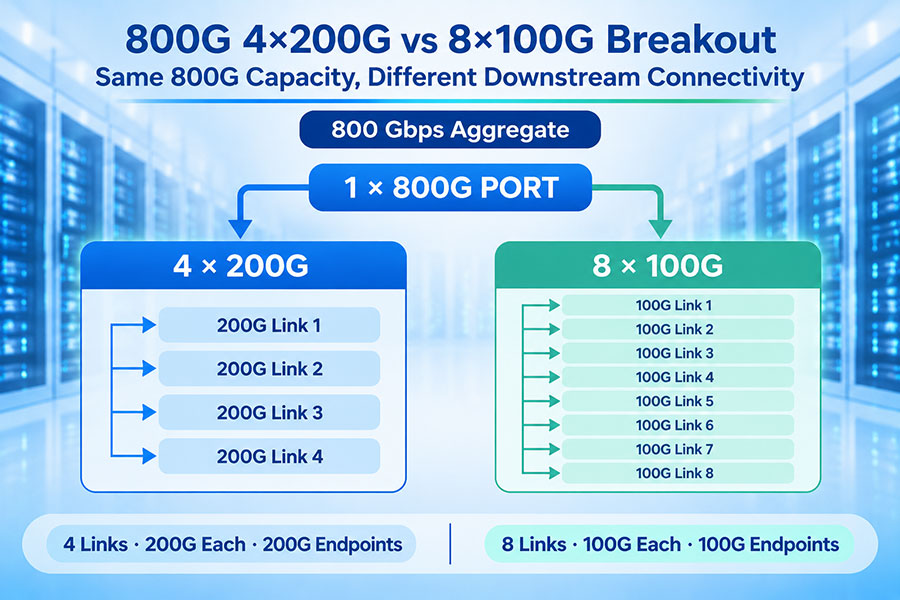
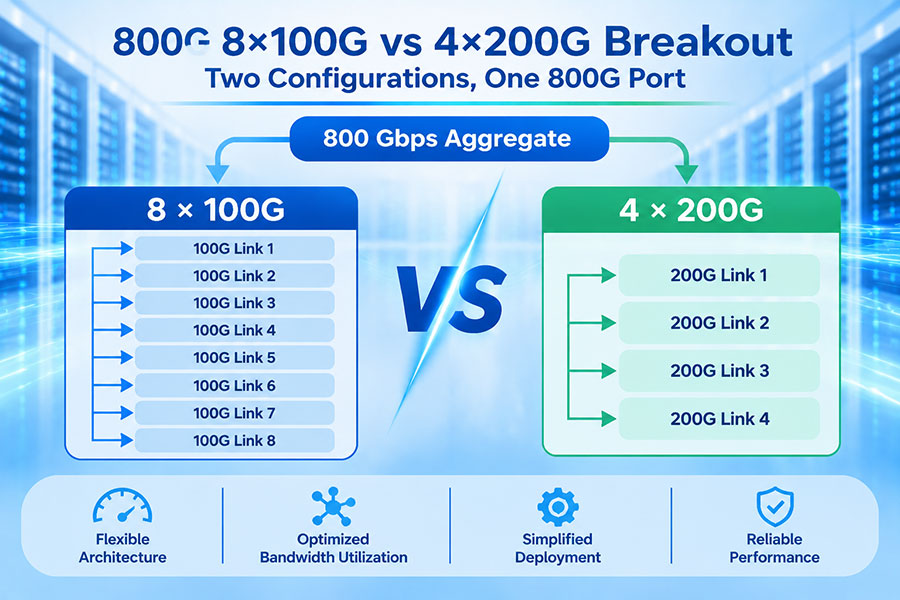
For example, an 800G port may support configurations such as 2 × 400G or 8 × 100G, depending on the switch and optical or cable implementation. A 1.6T port may support 2 × 800G or 4 × 400G configurations on platforms designed for those modes.
| Physical Port | Possible Breakout Configuration | Typical Application |
|---|---|---|
| 800G | 1 × 800G | Direct connection to an 800G endpoint |
| 800G | 2 × 400G | Two 400G network connections |
| 800G | 8 × 100G | Multiple lower-speed connections where supported |
| 1.6T | 1 × 1.6T | Direct connection to a 1.6T endpoint |
| 1.6T | 2 × 800G | Two 800G network connections |
| 1.6T | 4 × 400G | Multiple 400G connections |
These are possible port-mode examples, not universal breakout capabilities. Actual configurations depend on the switch ASIC, operating system, port electrical architecture, transceiver type, fiber assembly, and supported lane mapping.
Breakout can help network operators connect 1.6T-capable switches to existing 800G or 400G infrastructure. However, the physical optical interface must support the required channel arrangement. A simple configuration change cannot create unsupported optical lanes or alter the physical capabilities of a transceiver.
6. Power Consumption and Thermal Management
Increasing port bandwidth also increases the engineering demands on optical modules and switching systems. A 1.6T optical transceiver uses higher-speed electrical signaling and more advanced signal processing than an equivalent 800G generation module.
Power consumption is influenced by several components:
Optical DSP and signal processing architecture.
Electrical interface speed and signal conditioning.
Laser and photodetector technology.
Optical reach and transmission architecture.
Module cooling and heat sink design.
Higher module power can increase the thermal load across a densely populated switch. This makes heat dissipation, airflow, and cooling system capacity important considerations when moving toward 1.6T.
| Thermal Consideration | 800G Deployment | 1.6T Deployment |
|---|---|---|
| Module power | Depends on optical application and design | Can be higher due to faster signaling and processing |
| Heat dissipation | Requires suitable heat sink and airflow | Requires careful thermal design at higher bandwidth |
| Front-panel cooling | Depends on port density and module power | Requires validation for the selected OSFP1600 variant |
| System cooling | Air cooling or other supported system designs | May require more advanced cooling arrangements |
| Power budget | Must match switch port limits | Must match higher-speed host and module requirements |
It is not technically accurate to assume that every 1.6T module consumes exactly twice the power of an 800G module. Actual consumption varies by reach, optical architecture, DSP implementation, and power class. The host platform's supported power limits and the transceiver manufacturer's specifications should be checked before deployment.
7. 800G vs 1.6T in AI Data Center Networks
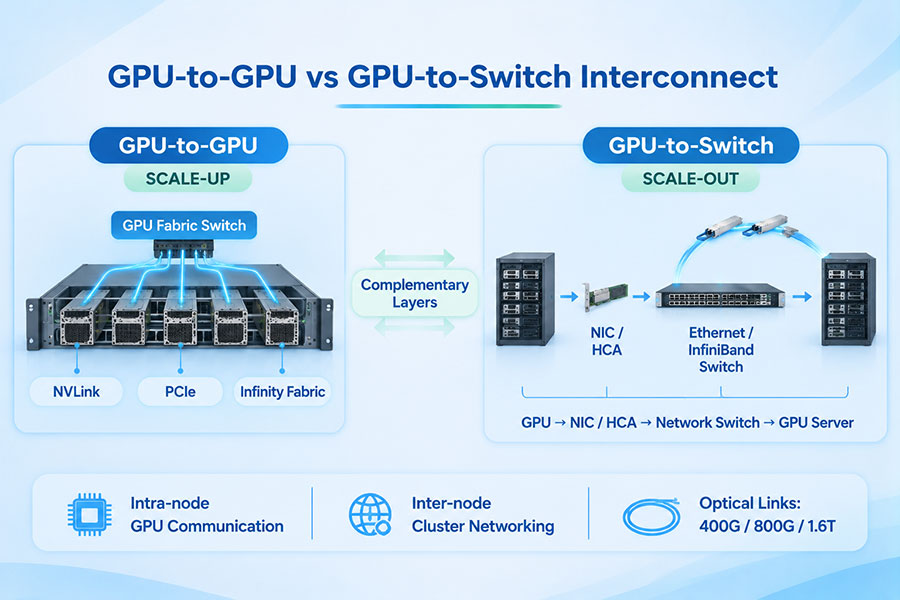
AI data centers require high-bandwidth connections between GPU servers, leaf switches, spine switches, and other networking infrastructure. As GPU cluster sizes increase, the number of high-speed network links and the aggregate switching capacity become major factors in data center design.
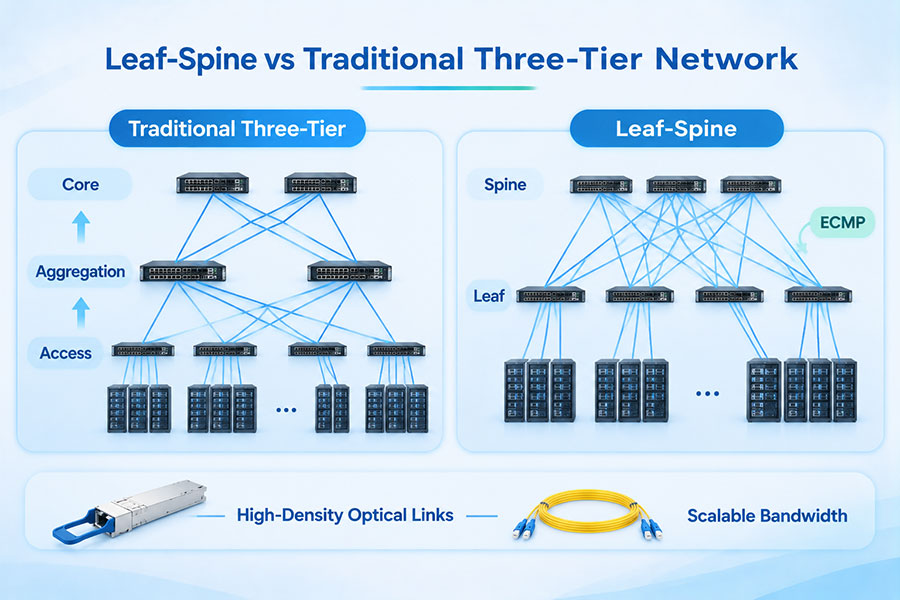
800G has become an important building block for high-performance AI networking. It supports high-bandwidth connections in leaf-spine architectures and can be deployed across server-to-switch and switch-to-switch links, depending on the network design.
1.6T extends the available bandwidth per physical connection. This can reduce the number of links needed to deliver a particular aggregate bandwidth and may simplify selected high-capacity spine or inter-switch connections.
The choice depends on the network's upgrade stage:
800G networks: Suitable for existing 800G-capable switching systems, established optical ecosystems, and deployments with large numbers of 800G endpoints.
1.6T networks: Suitable for systems designed around 200G-class electrical lanes and higher-capacity optical interfaces.
Mixed-speed networks: Useful during phased upgrades, provided that the switch supports the required breakout modes and the optical interfaces are interoperable.
For large AI clusters, a transition to 1.6T should be evaluated across the complete network fabric. Upgrading only the switch uplinks does not automatically double end-to-end throughput if server adapters, intermediate switches, or other network components remain at lower speeds.
8. Real-World Switch Capacity and Port Configuration Examples
Switch ASIC capacity provides a useful reference for understanding how 800G and 1.6T port configurations affect physical port density. For example, a 51.2T switching system can provide 64 × 800G ports or 32 × 1.6T ports. A 102.4T system can provide 128 × 800G or 64 × 1.6T ports in equivalent aggregate bandwidth configurations.
Commercial equipment demonstrates how these architectures are being implemented. For example, 102.4T switch designs have been introduced with 64 OSFP1600 ports, while 51.2T platforms have supported 64 × 800G configurations.
| Architecture | Example Port Configuration | Aggregate Port Bandwidth | Design Objective |
|---|---|---|---|
| 51.2T / 800G | 64 × 800G | 51.2 Tbps | High-density 800G connectivity |
| 51.2T / 1.6T | 32 × 1.6T | 51.2 Tbps | Higher bandwidth per physical port |
| 102.4T / 800G | 128 × 800G | 102.4 Tbps | High physical port count |
| 102.4T / 1.6T | 64 × 1.6T | 102.4 Tbps | Higher aggregate capacity per port |
These configurations illustrate the relationship between port speed and total switching capacity. They should not be interpreted as proof that all four configurations are available in the same chassis size or on the same switch ASIC. Actual products may use different rack-unit heights, port layouts, cooling systems, and breakout configurations.
9. C-LIGHT 800G and 1.6T Optical Transceiver Solutions
The transition to higher-speed Ethernet requires optical transceivers that match the host electrical interface, optical transmission standard, module form factor, and thermal requirements of the target switch.
C-LIGHT provides high-speed optical connectivity products for data center and AI networking applications, including:
800G OSFP Optical Transceivers for supported 800G switch and data center interfaces.
800G QSFP-DD Optical Transceivers for compatible 800G networking platforms.
1.6T OSFP-RHS Optical Transceivers for next-generation high-bandwidth switching architectures.
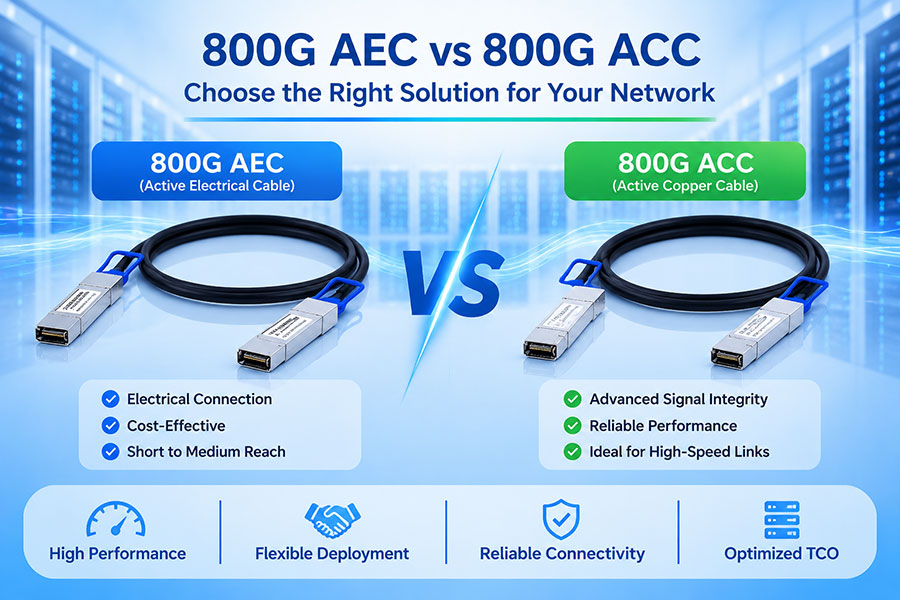
800G Active Electrical Cables for supported short-reach electrical interconnect applications.
When selecting an 800G or 1.6T module, customers should confirm the exact switch model, port configuration, optical reach, fiber type, connector, power limit, and cooling arrangement. A higher-speed module is not automatically compatible with an existing lower-speed port.
For projects involving mixed 800G and 1.6T environments, platform-specific compatibility and breakout requirements should be evaluated before procurement. For technical specifications and product support, Contact C-LIGHT.
10. Conclusion
The transition from 800G to 1.6T represents a significant increase in bandwidth per physical network port. By doubling the nominal bandwidth from 800 Gbps to 1.6 Tbps, 1.6T can deliver the same aggregate capacity with approximately half the physical port count in equivalent configurations.
However, higher port bandwidth should not be confused with higher physical port count. Actual port density depends on switch chassis design, front-panel layout, ASIC capacity, module dimensions, cooling, and supported electrical interfaces.
800G remains an important option for established AI and data center networks, while 1.6T provides a path toward higher bandwidth density and more efficient high-capacity connections. The right choice depends on endpoint speeds, network topology, switching capacity, optical compatibility, and the infrastructure's ability to support 224G-class electrical signaling and higher thermal requirements.
 >

 >
 >
 >
 >
 >
 >
 >