TEL:+86 132 6656 7067





As data center networks move toward 800GbE, the physical design of optical interfaces becomes a major factor in switch architecture. An 800G port must accommodate high-speed electrical signaling, optical transmission, module power, heat dissipation and front-panel connectivity within a limited chassis footprint. OSFP and QSFP-DD are two widely adopted form factors for this generation of networking equipment. Both support 800Gbps transmission, but their mechanical dimensions and thermal approaches create different design priorities.
The density question is not simply which transceiver is smaller. QSFP-DD has a narrower module profile and can give switch designers more flexibility when arranging ports. OSFP provides a larger mechanical envelope and is commonly designed with an integrated heatsink. Actual system density depends on how the switch manufacturer balances port spacing, power delivery, cooling, PCB layout and serviceability.
1. 800G OSFP and 800G QSFP-DD: Core Architecture
Both 800G OSFP and 800G QSFP-DD are eight-lane pluggable optical interfaces. In a common 800G implementation, eight electrical lanes operate at approximately 100Gbps per lane using PAM4 signaling, producing an aggregate host-side bandwidth of 800Gbps. The optical architecture may use eight parallel optical lanes or other configurations depending on the transceiver type.
The difference lies primarily in the module and host interface design. OSFP uses a larger octal small form-factor package, while QSFP-DD extends the established QSFP family with a second row of electrical contacts to support eight high-speed electrical lanes. Their mechanical interfaces are different, so an OSFP module cannot be inserted into a QSFP-DD cage, or vice versa.
| Parameter | 800G OSFP | 800G QSFP-DD |
|---|---|---|
| Aggregate data rate | 800Gbps | 800Gbps |
| Typical electrical lanes | 8 × 100Gbps | 8 × 100Gbps |
| Modulation | PAM4 | PAM4 |
| Module profile | Larger | Narrower and more compact |
| Thermal approach | Commonly uses an integrated heatsink; RHS variants use host-mounted cooling | Module heatsink and host airflow design |
| Mechanical compatibility | OSFP-specific cage | QSFP-DD-specific cage |
| Common applications | AI fabrics, HPC and high-speed data center switching | High-density Ethernet, cloud and data center networks |
2. Module Dimensions and Front-Panel Space
QSFP-DD has a smaller mechanical footprint than OSFP. This difference can be valuable when a switch designer wants to place more optical interfaces across a fixed front-panel width. A narrower module can also provide additional flexibility for connector placement, port grouping and front-panel organization.
OSFP uses a larger package. Its mechanical envelope accommodates a different heatsink and host-cage arrangement, which can be advantageous when thermal design is a major concern. The larger size does not automatically mean poor density: switch manufacturers can engineer compact OSFP layouts with carefully designed cages, airflow paths and front panels.
It is important to distinguish module dimensions from complete switch density. A transceiver's width is only one part of the design. The cage, connector, PCB routing, port spacing, cooling hardware and chassis structure determine how many usable ports can be deployed.
3. 800G Port Density per Rack Unit
At 800Gbps per port, even a small change in the number of front-panel interfaces has a substantial effect on aggregate bandwidth. A 1RU switch with 32 800G ports provides 25.6Tbps of nominal aggregate port bandwidth. A 36-port design provides 28.8Tbps.
The following figures illustrate the arithmetic behind two possible high-density layouts. They are not universal port-count specifications for either form factor. OSFP MSA material describes designs supporting up to 36 OSFP ports in a 1U front panel, while actual QSFP-DD and OSFP switch configurations vary by manufacturer and platform.
| Illustrative 1RU Layout | 800G Ports | Aggregate Port Bandwidth |
|---|---|---|
| 32-port configuration | 32 | 25.6Tbps |
| 36-port configuration | 36 | 28.8Tbps |
The 36-port example provides 12.5% more ports and nominal front-panel bandwidth than the 32-port example. However, this is a comparison of two chassis layouts, not proof that every QSFP-DD switch will outperform every OSFP switch. A high-density OSFP platform may achieve a similar port count, while a particular QSFP-DD platform may use fewer ports to meet its cooling or system-design requirements.
4. Thermal Design and Module Power
Thermal management is one of the most important considerations in an 800G switch. High-speed optical modules contain laser transmitters, photodetectors, driver circuits, TIAs and, in many designs, DSP functions. Their power consumption creates heat that must be removed without allowing module temperatures or neighboring components to exceed their operating limits.
The OSFP form factor provides a larger mechanical envelope and commonly uses an integrated heatsink. This gives module and system designers additional freedom to develop thermal structures around high-power optical modules. OSFP-RHS variants use a different arrangement in which a heatsink mounted in the host system contacts the module. These variants require the corresponding host cage and cooling structure.
QSFP-DD uses a narrower package. Its thermal performance depends on the specific module heatsink, cage design, airflow and host platform. The QSFP-DD800 specification includes mechanical and thermal requirements for the 800G interface, but the usable power and temperature limits of an actual deployment must be checked against the module datasheet and switch documentation.
Neither form factor should be selected based on package size alone. A smaller module does not guarantee lower power consumption, and a larger module does not guarantee better system cooling. The complete thermal solution must be evaluated at full port population and under the intended operating conditions.
5. Backward Compatibility and Network Migration
QSFP-DD builds on the established QSFP ecosystem. The QSFP-DD family is designed to maintain backward compatibility with earlier QSFP module generations when the host cage, module type and platform implementation support the relevant interfaces. This can simplify migration for operators with existing QSFP-based infrastructure.
OSFP follows a separate mechanical interface. It is not physically interchangeable with QSFP-DD, and a switch designed for one form factor cannot accept the other without a purpose-designed host interface. Network planners must therefore confirm the exact switch model, cage type, supported module generations and firmware requirements before selecting replacement optics.
Backward compatibility should not be confused with automatic support for every data rate or optical standard. A module may fit a compatible cage but still require platform support for its lane rate, power class, management interface, breakout mode and optical specification.
6. Breakout Options and Network Connectivity
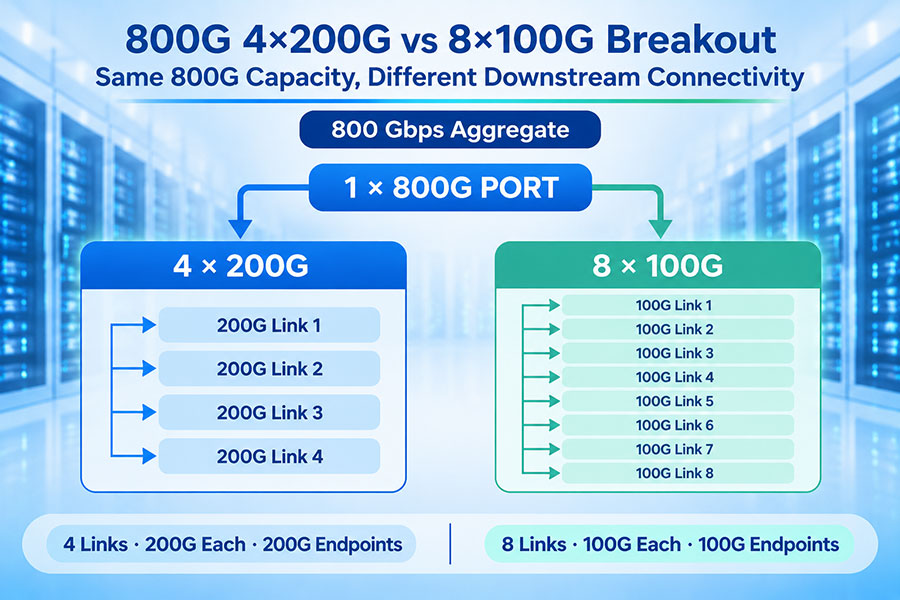
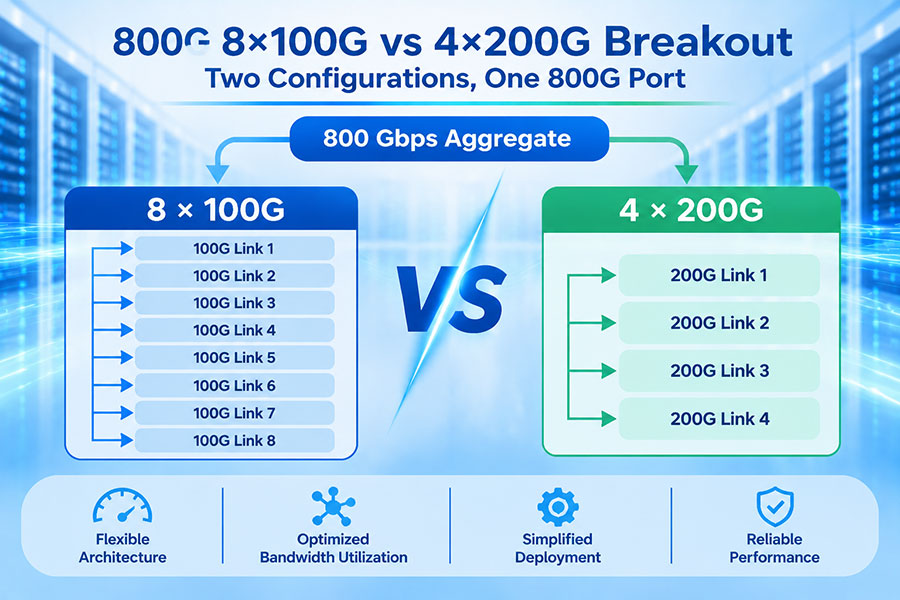
Both form factors can support flexible 800G connectivity options, depending on the transceiver design and switch capabilities. An 800G port may be configured for a single 800G connection or supported breakout modes such as 2 × 400G, 4 × 200G or 8 × 100G. The actual combinations depend on the optical module, host electrical interface, switch ASIC and software configuration.
For short-reach AI and HPC links, parallel optics such as SR8 and DR8 can provide high-bandwidth connectivity using multiple optical lanes. For links that need duplex fiber connectivity, 2 × FR4 designs can provide two independent 400G optical channels in one 800G module. These configurations affect fiber plant design, patch-panel planning and the number of remote ports that can be connected.
When selecting an 800G transceiver, engineers should verify both the optical interface and the host-side breakout support. The module's advertised breakout capability alone does not guarantee that every switch port can operate in every mode.
7. C-LIGHT 800G OSFP and QSFP-DD Optical Transceivers
C-LIGHT offers both OSFP and QSFP-DD 800G optical transceiver options for data center, AI cluster, cloud and high-performance computing networks. Having both form factors available allows network designers to select optics according to the host switch architecture rather than forcing the network design around a single module package.
The C-LIGHT 800G OSFP optical transceiver portfolio includes SR8, DR8, 2 × FR4 and longer-reach options. Listed configurations include 800G SR8 for up to 100m over multimode fiber, 800G DR8 for up to 500m over single-mode fiber, and 2 × FR4 for 2km links. Specific variants, connector types and host compatibility should be confirmed against the product datasheet.
The C-LIGHT 800G QSFP-DD optical transceiver portfolio supports 800G connectivity in the QSFP-DD800 form factor. Listed configurations include 2 × FR4, 2 × DR4 and 2 × SR4 options, with transmission distances covering short-reach data center links and 2km single-mode applications. The portfolio also includes longer-reach coherent options; deployment requirements should be checked against the exact model specification.
For a complete view of available optical modules, visit the C-LIGHT Optical Transceiver product category. When evaluating an 800G solution, provide the switch manufacturer and model, target transmission distance, fiber type, connector, operating temperature and required breakout mode so that the appropriate module can be identified.
8. Choosing the Right Form Factor for 800G Networks
QSFP-DD is a strong option for platforms that prioritize a compact module footprint, continuity with the QSFP ecosystem and flexible front-panel layouts. Its smaller mechanical profile can help manufacturers arrange ports efficiently, especially when designing switches for high-density Ethernet deployments.
OSFP is attractive for platforms built around its larger mechanical envelope and thermal architecture. Its integrated-heatsink variants and host-mounted RHS designs give equipment manufacturers different ways to manage heat in demanding high-speed systems. OSFP is also widely used in high-performance AI and HPC networking platforms.
The final decision should be based on the switch platform rather than a general assumption that one package always delivers higher density. Engineers should compare the published port count, total switching bandwidth, module power limits, cooling requirements, supported optical types and migration path for each candidate system.
9. Conclusion
800G OSFP and 800G QSFP-DD deliver the same nominal bandwidth per port, but they approach mechanical design, thermal management and host integration differently. QSFP-DD offers a narrower package that can support compact front-panel arrangements, while OSFP provides a larger form factor with an established integrated-heatsink approach and RHS cooling variants.
Neither form factor guarantees a higher port count in every switch. A 32-port 800G layout delivers 25.6Tbps of nominal aggregate port bandwidth, while a 36-port layout delivers 28.8Tbps. The actual density advantage depends on the complete chassis and cooling design. Selecting the right 800G platform requires checking the switch's documented port configuration, optical compatibility and thermal limits together.
For 800G OSFP or QSFP-DD optical transceiver requirements, visit C-LIGHT product solutions or Contact C-LIGHT for technical assistance.
 >

 >
 >
 >
 >
 >
 >
 >