TEL:+86 132 6656 7067




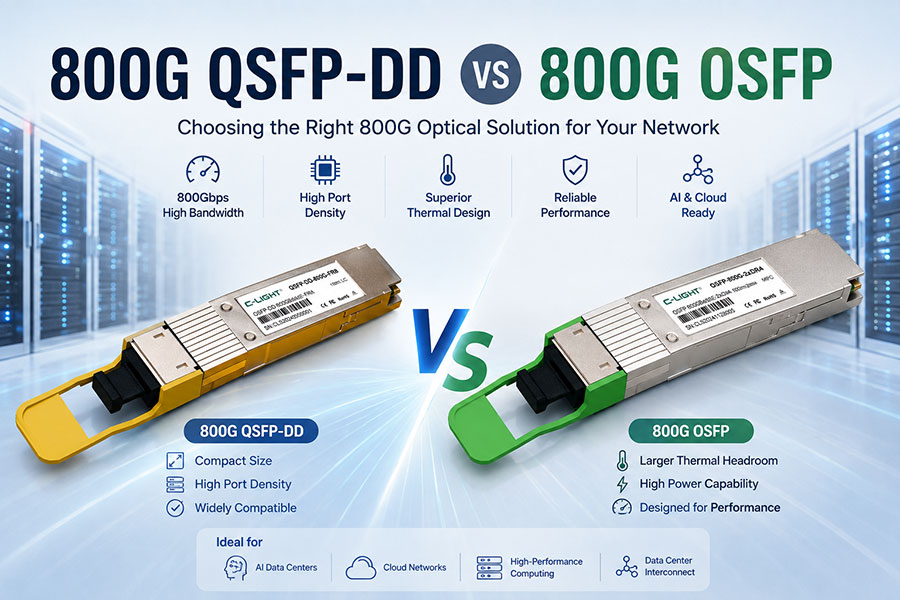
The rapid growth of AI and hyperscale data centers is accelerating the deployment of 800G optical transceivers. As network bandwidth increases, choosing the right optical module form factor becomes an important part of switch and data center network design.
Two important form factors for 800G optical connectivity are QSFP-DD and OSFP. Both can support 800Gbps-class optical connectivity, but they differ in mechanical design, thermal characteristics, host compatibility, port density, and deployment considerations.
This article compares 800G QSFP-DD vs 800G OSFP and examines their differences, advantages, limitations, and applications in AI data centers, hyperscale networks, cloud computing, and high-performance computing.
1. What Is 800G QSFP-DD?
800G QSFP DD SR8/DR8/FR4 optical transceiver丨C-LIGHT
800G QSFP-DD is an 800Gbps optical transceiver based on the QSFP-DD form factor. QSFP-DD, or Quad Small Form-factor Pluggable Double Density, was developed to provide higher bandwidth while maintaining a compact module footprint and compatibility with the broader QSFP ecosystem.
800G QSFP-DD solutions can use different electrical and optical lane architectures depending on the module design and host platform. A common approach uses eight 100G-class lanes to achieve an aggregate data rate of 800Gbps.
The compact form factor makes QSFP-DD attractive for high-density switching environments where physical port density and backward compatibility are important considerations.
Key Point: 800G QSFP-DD focuses on compact size, high port density, and compatibility with the established QSFP ecosystem.
2. What Is 800G OSFP?
800G OSFP MSA SR8/DR8/2FR4 Optical Transceiver丨C-LIGHT
800G OSFP is an 800Gbps optical transceiver based on the OSFP, or Octal Small Form-factor Pluggable, form factor.
OSFP was designed specifically for high-speed networking applications and provides a larger mechanical envelope than QSFP-DD. The additional space can provide advantages for thermal management and high-power optical module designs.
800G OSFP modules are widely associated with high-performance data center switching, AI networking, and other environments requiring high bandwidth and substantial thermal capacity.
An 800G OSFP module can also use multiple high-speed lanes. The exact electrical and optical architecture depends on the specific product, switch platform, DSP, and application.
Key Point: 800G OSFP emphasizes high-speed performance, thermal capability, and next-generation data center networking.
3. 800G QSFP-DD vs 800G OSFP: Key Differences
| Feature | 800G QSFP-DD | 800G OSFP |
|---|---|---|
| Aggregate Data Rate | 800Gbps | 800Gbps |
| Form Factor | QSFP-DD | OSFP |
| Module Size | More compact | Larger mechanical envelope |
| Thermal Capacity | High | Very high |
| Port Density | Very high | High |
| QSFP Ecosystem Compatibility | Strong | Different ecosystem |
| AI Data Center Applications | Yes | Yes |
| High-Power Module Design | More constrained by compact size | More mechanical and thermal headroom |
| Typical Deployment Focus | High-density networking | High-performance and high-density networking |
4. Physical Size and Form Factor
One of the most visible differences between 800G QSFP-DD and 800G OSFP is their physical form factor.
QSFP-DD was designed around a compact form factor. Its smaller mechanical footprint can allow switch manufacturers to implement a high number of ports within a limited front-panel area.
OSFP has a larger form factor. While this can reduce the maximum number of modules that can fit into a given front-panel area, the larger mechanical envelope provides additional space for thermal management and high-performance module designs.
Therefore, the choice is not simply about which module is smaller. Network designers must balance port density, power, cooling, module performance, and switch architecture.
5. Thermal Performance: QSFP-DD vs OSFP
Thermal management becomes increasingly important as optical module data rates increase.
An 800G optical transceiver contains high-speed electrical components, DSP or signal-conditioning functions, laser drivers, optical components, and receiver components. These components generate heat during operation.
The larger OSFP form factor can provide additional space for thermal solutions, making it attractive for high-power 800G and future higher-speed modules.
QSFP-DD uses a more compact mechanical design. This can be advantageous for port density but places greater importance on efficient module thermal design and host-system airflow.
| Thermal Factor | 800G QSFP-DD | 800G OSFP |
|---|---|---|
| Module Envelope | Compact | Larger |
| Cooling Space | More constrained | More available mechanical space |
| High-Power Applications | Supported with appropriate design | Well suited |
| Host Thermal Design | Important | Important |
Actual power consumption and thermal performance vary significantly between individual optical modules. Therefore, the form factor alone should not be used to determine the power consumption of a specific product.
6. Port Density and Switch Design
Port density is a major consideration in large-scale data center switches.
Because QSFP-DD has a compact footprint, it can be advantageous for platforms that prioritize a high number of ports within a limited front-panel area.
OSFP occupies more physical space, but its larger form factor can provide advantages for high-power optical applications and thermal management.
The actual port density depends on the complete switch design rather than the optical module alone.
QSFP-DD: Compact form factor → high port-density potential
OSFP: Larger form factor → greater mechanical and thermal headroom
7. Electrical and Optical Lane Architecture
800G does not represent a single electrical or optical architecture. Different 800G modules can use different lane configurations.
A simplified example is an eight-lane architecture:
8 × 100G = 800G
Newer systems can also use higher-rate lanes, depending on the host electrical interface and module architecture.
This is particularly important as data center networking moves toward 200G-per-lane technologies and eventually higher lane rates.
Therefore, when comparing QSFP-DD and OSFP, engineers should check the actual electrical lane rate, optical lane configuration, DSP architecture, modulation format, and host interface rather than comparing only the names of the form factors.
8. Compatibility Considerations
QSFP-DD and OSFP are different mechanical form factors. An optical module should therefore be selected according to the specifications of the target switch or networking platform.
A QSFP-DD 800G module should be used with a compatible QSFP-DD host interface, while an OSFP 800G module requires a compatible OSFP host interface.
Compatibility also involves more than the physical connector.
Form Factor: Confirm QSFP-DD or OSFP compatibility.
Electrical Interface: Verify supported host electrical lane rates.
Optical Interface: Check connector type, wavelength, fiber type, and optical lane configuration.
Transmission Distance: Confirm that the module supports the required reach.
Power: Verify the host platform's supported module power class.
Management: Confirm module management and monitoring compatibility.
Interoperability: Validate compatibility with the target switch and network architecture.
9. 800G QSFP-DD Applications
800G QSFP-DD is suitable for data center environments where compact form factor and high port density are important.
9.1 AI Data Centers
800G QSFP-DD can be used in high-bandwidth AI networking where the switch platform supports QSFP-DD interfaces.
9.2 Cloud Data Centers
Cloud infrastructure can benefit from the compact form factor and high bandwidth provided by 800G QSFP-DD solutions.
9.3 Hyperscale Networks
Large-scale networks often require a high number of switch ports. The compact QSFP-DD form factor can help support high-density switch designs.
9.4 Data Center Interconnect
Depending on the optical specification and transmission distance, 800G QSFP-DD modules can also be used for high-capacity interconnect applications.
10. 800G OSFP Applications
800G OSFP is particularly attractive for high-performance networking platforms designed around the OSFP ecosystem.
10.1 AI Training Networks
Large AI clusters require high-bandwidth connectivity between GPU servers and network switches. 800G OSFP can provide high-capacity optical interfaces for these environments.
10.2 High-Performance Computing
HPC systems can use high-speed OSFP optical connectivity to support high-bandwidth communication between computing and networking systems.
10.3 Hyperscale Data Centers
OSFP can be used in high-performance switch platforms where thermal management and high-speed connectivity are important design requirements.
10.4 Next-Generation Network Platforms
The larger OSFP form factor also provides a platform for continued bandwidth scaling toward higher-speed optical modules.
11. 800G QSFP-DD vs 800G OSFP for AI Data Centers
AI data centers place particularly strong demands on optical connectivity. GPU clusters require large numbers of high-speed connections, while increasing switch bandwidth also increases power and thermal requirements.
In this environment, both QSFP-DD and OSFP can play important roles.
| AI Data Center Requirement | QSFP-DD | OSFP |
|---|---|---|
| High bandwidth | Excellent | Excellent |
| Compact module size | Excellent | Good |
| High port-density potential | Excellent | Very Good |
| Thermal headroom | Very Good | Excellent |
| High-power optical designs | Good to Very Good | Excellent |
| Existing QSFP ecosystem | Strong advantage | Not applicable |
| AI networking | Suitable | Highly suitable |
12. 800G QSFP-DD vs 800G OSFP: Which Is Better?
Neither form factor is universally better. The appropriate choice depends on the target networking platform and system requirements.
800G QSFP-DD can be a strong choice when compact size, high port density, and integration with the QSFP ecosystem are priorities.
800G OSFP can be a strong choice when thermal capacity, high-power module support, and high-performance AI or data center networking are major considerations.
Choose 800G QSFP-DD When:
Compact module size is important
High front-panel port density is required
The switch platform uses QSFP-DD ports
QSFP ecosystem compatibility is valuable
The application has appropriate thermal capacity
Choose 800G OSFP When:
The switch platform uses OSFP ports
Higher thermal headroom is important
High-power optical modules are required
The application is designed around AI or HPC networking
Future high-speed networking is a major consideration
13. 800G QSFP-DD and OSFP in Network Migration
The transition from 400G to 800G is an important step in AI and hyperscale networking.
When planning an 800G upgrade, operators should first determine the host switch architecture. The optical module form factor should then be selected according to the available switch ports.
As networks progress toward 1.6T and higher speeds, the differences between module form factors become increasingly important because electrical lane rates, module power, cooling requirements, and switch architecture all continue to evolve.
14. C-LIGHT 800G Optical Transceiver Solutions
C-LIGHT provides high-speed optical transceiver solutions for data center, AI networking, cloud, hyperscale, and high-performance computing applications.
The C-LIGHT 800G portfolio includes optical solutions designed for different switch architectures, transmission distances, fiber configurations, and deployment requirements.
800G optical transceivers can be designed in different form factors and optical configurations according to the requirements of the target networking platform.
800G High-Speed Optical Connectivity
High-bandwidth optical connectivity for AI data centers, hyperscale networks, cloud computing, and high-performance computing.
When selecting an 800G optical transceiver, C-LIGHT recommends evaluating the complete system specification, including form factor, host switch compatibility, electrical lane rate, optical configuration, transmission distance, connector, power consumption, thermal requirements, and interoperability.
15. Future Development of 800G Optical Modules
The development of 800G optical modules is closely connected to the broader evolution of AI data center networking.
As switch bandwidth increases, optical modules must support higher data rates while maintaining acceptable power consumption, thermal performance, reliability, and cost.
At the same time, the industry is moving toward 1.6T and future 3.2T optical connectivity. Higher electrical lane rates, advanced DSPs, silicon photonics, improved laser technologies, and new optical architectures will contribute to this transition.
QSFP-DD and OSFP will therefore continue to serve different parts of the high-speed networking ecosystem, while future module architectures will be developed according to the requirements of increasingly high-density AI infrastructure.
16. FAQ: 800G QSFP-DD vs 800G OSFP
Q1: What is the difference between 800G QSFP-DD and 800G OSFP?
Answer: Both can provide 800Gbps-class optical connectivity, but they use different mechanical form factors. QSFP-DD is more compact and supports high port-density designs, while OSFP provides a larger mechanical envelope with greater thermal and high-power design headroom.
Q2: Is 800G QSFP-DD compatible with 800G OSFP ports?
Answer: No. QSFP-DD and OSFP are different physical form factors. The optical transceiver must match the host switch's supported form factor and interface specifications.
Q3: Which is better for AI data centers, QSFP-DD or OSFP?
Answer: Both can be used for AI data center networking. QSFP-DD is attractive for compact, high-density designs, while OSFP is particularly attractive for platforms requiring high thermal capacity and high-performance optical connectivity.
Q4: Does OSFP have better cooling than QSFP-DD?
Answer: The larger OSFP form factor provides more mechanical space for thermal solutions, but actual thermal performance depends on the module design, power consumption, host switch, heatsink, airflow, and system cooling architecture.
Q5: Does QSFP-DD provide higher port density than OSFP?
Answer: QSFP-DD's more compact form factor can provide higher port-density potential. However, actual switch port density depends on the complete system design, including connector spacing, cooling, PCB layout, and mechanical architecture.
Q6: Can both QSFP-DD and OSFP support 800G?
Answer: Yes. Both form factors can be used for 800G optical transceivers. The exact implementation, lane architecture, optical reach, and module specifications depend on the specific product.
Q7: What should be checked before selecting an 800G optical module?
Answer: Check the switch form factor, electrical interface, lane rate, optical configuration, fiber type, connector, transmission distance, power consumption, thermal requirements, management interface, FEC requirements, and interoperability.
17. Summary
800G QSFP-DD and 800G OSFP are two important form factors for high-speed optical networking. Both can provide 800Gbps-class connectivity, but they are optimized around different mechanical and system-level requirements.
QSFP-DD offers a compact form factor and strong potential for high port density, making it attractive for networking platforms where space efficiency and ecosystem compatibility are important.
OSFP uses a larger mechanical envelope that provides greater thermal and high-power design headroom, making it particularly suitable for high-performance AI, HPC, and data center networking platforms.
The best choice depends primarily on the host switch architecture. Network operators should not select an 800G module based solely on bandwidth. Form factor, electrical interface, optical configuration, power, thermal performance, transmission distance, and interoperability must all be evaluated together.
As AI data center networks continue to move from 400G to 800G and 1.6T, both QSFP-DD and OSFP will remain important technologies in the development of high-speed optical connectivity.
C-LIGHT provides 800G optical transceiver solutions for AI data centers, hyperscale networks, cloud computing, and high-performance networking applications.
 >
>

 >
>
 >
>
 >
>
 >
>
 >
>
 >
>
 >
>