TEL:+86 132 6656 7067




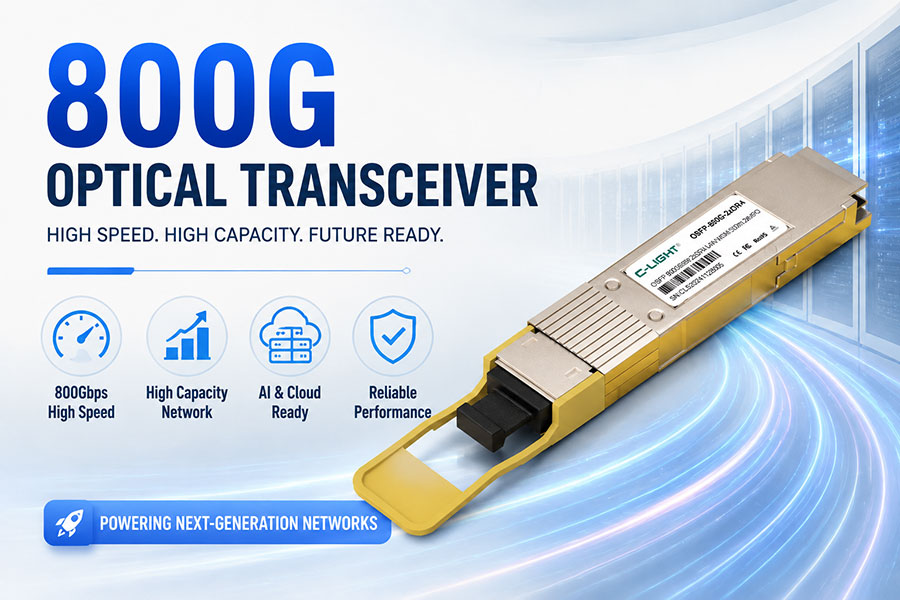
The rapid growth of artificial intelligence (AI), cloud computing, and hyperscale data centers is accelerating the demand for higher-speed optical connectivity. As data traffic continues to increase, traditional 400G optical networks are gradually moving toward 800G optical transceiver solutions to support next-generation data center architectures.
800G optical transceivers provide higher bandwidth, improved network efficiency, and scalable connectivity for AI clusters, high-performance computing (HPC), and large-scale cloud infrastructure. With the adoption of advanced technologies such as PAM4 modulation, silicon photonics, and high-speed optical engines, 800G has become a key technology milestone in the evolution of optical communication networks.
1. Introduction to 800G Optical Transceiver Technology
An 800G optical transceiver is a high-speed optical communication module designed to provide 800Gbps data transmission capacity. It integrates optical transmitters, receivers, DSP chips, and advanced signal processing technologies to achieve high-performance network connectivity.
Compared with previous generations, 800G optical modules significantly improve bandwidth density while reducing the number of optical connections required in large-scale data center networks.
Typical applications include:
AI data center networks
Cloud computing infrastructure
High-performance computing systems
Data center interconnect (DCI)
Next-generation Ethernet networks
2. Why 800G Optical Transceivers Are Needed
2.1 Increasing Bandwidth Requirements from AI Workloads
Artificial intelligence workloads are creating unprecedented network bandwidth requirements. Large AI models require thousands of GPUs to communicate continuously during training and inference processes.
The communication between GPU servers, switches, and storage systems generates massive east-west traffic, requiring optical networks with:
Higher bandwidth capacity
Lower latency
Higher port density
Improved power efficiency
800G optical transceivers provide the necessary bandwidth foundation for modern AI cluster networking.
2.2 Evolution from 400G to 800G Networking
The optical communication industry is moving through a continuous bandwidth upgrade cycle:
100G Optical Connectivity
400G Optical Connectivity
800G Optical Connectivity
1.6T Optical Connectivity
800G represents the current transition point between large-scale 400G deployments and future 1.6T optical networks.
3. Key Technologies Behind 800G Optical Transceivers
3.1 PAM4 Modulation Technology
PAM4 (Pulse Amplitude Modulation 4-Level) is one of the most important technologies enabling 800G optical communication.
Unlike NRZ signaling, which transmits one bit per symbol, PAM4 uses four signal levels and transmits two bits per symbol, improving transmission efficiency.
Advantages of PAM4 include:
Higher data transmission efficiency
Reduced signal bandwidth requirements
Support for high-speed Ethernet applications
Improved scalability for future networks
3.2 Advanced DSP Technology
Digital Signal Processing (DSP) plays an important role in 800G optical modules. DSP helps compensate for signal distortion, improve transmission quality, and maintain reliable communication performance.
High-performance DSP solutions enable:
Signal equalization
Error correction
Improved receiver sensitivity
Better link stability
3.3 High-Speed Optical Engines
800G optical transceivers require advanced optical components, including high-speed lasers, optical receivers, and integrated optical engines.
These components must provide:
High optical performance
Low power consumption
Thermal stability
Long-term reliability
4. 800G Optical Transceiver Form Factors
4.1 800G OSFP Optical Transceiver
800G OSFP MSA SR8/DR8/2FR4 Optical Transceiver丨C-LIGHT
OSFP (Octal Small Form Factor Pluggable) is one of the most widely adopted form factors for 800G optical modules.
Advantages include:
High thermal capability
Support for high-speed applications
Excellent scalability for AI networks
800G OSFP modules are widely used in AI data centers, Ethernet switches, and hyperscale networking environments.
4.2 800G QSFP-DD Optical Transceiver
800G QSFP DD SR8/DR8/FR4 optical transceiver丨C-LIGHT
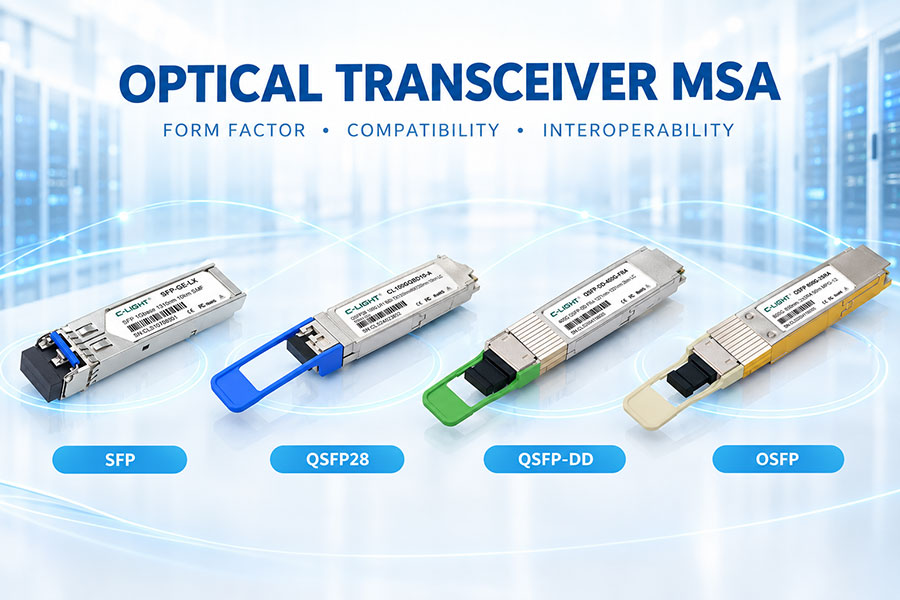
QSFP-DD provides another high-density solution for 800G applications. It maintains compatibility with existing QSFP-based network architectures while increasing bandwidth capacity.
4.3 800G Optical Module Types
Common 800G optical solutions include:
800G OSFP DR8
800G OSFP 2xDR4
800G OSFP 2xFR4
800G QSFP-DD DR8
5. Applications of 800G Optical Transceivers
5.1 AI Data Centers
AI data centers are becoming the largest growth market for 800G optical transceivers.
Applications include:
GPU cluster networking
AI training infrastructure
High-speed switch interconnects
AI fabric networks
5.2 Cloud Computing Networks
Cloud service providers require scalable optical networks to support increasing user traffic and distributed computing workloads.
800G optical modules help improve:
Network capacity
Data transmission efficiency
Infrastructure scalability
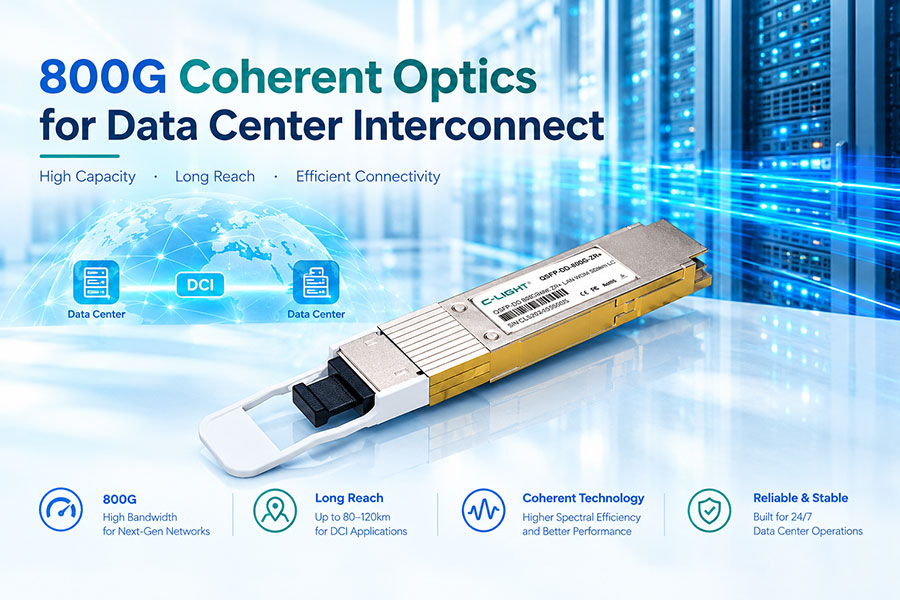
5.3 Data Center Interconnect (DCI)
800G optical technology enables high-capacity connections between different data centers, supporting cloud expansion and large-scale digital infrastructure.
6. Market Trends of 800G Optical Transceivers
6.1 AI Infrastructure Drives Market Growth
The rapid expansion of AI computing is the primary factor accelerating 800G optical transceiver adoption. Increasing GPU performance requires faster and more efficient network connections.
As AI clusters grow larger, demand for 800G optical connectivity will continue increasing.
6.2 Transition Toward 1.6T Optical Networks
800G optical technology is an important step toward future 1.6T and higher-speed optical communication systems.
The industry is developing:
Higher-speed optical engines
Lower-power optical modules
Advanced modulation technologies
Higher-density network architectures
6.3 Lower Power Consumption Requirements
Power efficiency has become a major challenge in AI data centers. Future 800G optical modules will focus on reducing power consumption while maintaining high transmission performance.
7. Challenges of 800G Optical Transceiver Deployment
7.1 Thermal Management
Higher-speed optical modules generate more heat due to advanced components and higher processing requirements. Effective thermal management is essential for reliable operation.
7.2 Signal Integrity
800G transmission requires strict control of:
Insertion loss
Return loss
Jitter
Crosstalk
Bit error rate (BER)
7.3 Cost Optimization
Although 800G technology provides significant performance advantages, reducing manufacturing costs and improving supply chain efficiency remain important industry goals.
8. C-LIGHT 800G Optical Transceiver Solutions
C-LIGHT provides advanced 800G optical transceiver solutions designed for AI data centers, cloud networks, and high-performance computing applications.
C-LIGHT 800G optical solutions support:
High-bandwidth AI networking
Low-latency optical interconnects
High-density data center deployment
Future-ready network upgrades
With advanced PAM4 technology and high-performance optical design, C-LIGHT helps customers build scalable optical infrastructure for next-generation data centers.
9. Conclusion: The Future of 800G Optical Transceivers
800G optical transceivers are becoming a critical technology for modern data center networks. Driven by AI, cloud computing, and increasing bandwidth requirements, 800G will continue expanding as a mainstream optical connectivity solution.
The evolution from 400G to 800G and eventually 1.6T will shape the future of optical communication. High-speed optical transceivers will remain essential for building efficient, scalable, and reliable AI-driven network infrastructure.
FAQ: 800G Optical Transceiver
Q1: What is an 800G optical transceiver?
Answer: An 800G optical transceiver is a high-speed optical module that supports 800Gbps data transmission for AI data centers, cloud networks, and high-performance computing systems.
Q2: Why are 800G optical modules important for AI data centers?
Answer: AI clusters require massive data exchange between GPUs and switches. 800G optical modules provide the bandwidth and scalability required for next-generation AI networks.
Q3: What technology enables 800G optical transmission?
Answer: PAM4 modulation, advanced DSP, and high-performance optical engines are key technologies enabling 800G optical communication.
Q4: What are the common 800G optical module form factors?
Answer: Common form factors include OSFP and QSFP-DD, with applications such as DR8, 2xDR4, and FR4 solutions.
Q5: What applications use 800G optical transceivers?
Answer: Applications include AI data centers, cloud computing networks, HPC systems, Ethernet networks, and data center interconnects.
Q6: What are the challenges of 800G optical modules?
Answer: The main challenges include thermal management, signal integrity, power consumption, and cost optimization.
Q7: Will 800G replace 400G optical modules?
Answer: 800G will gradually become the preferred solution for high-performance AI and cloud networks, while 400G will continue supporting many existing deployments.
Q8: How does C-LIGHT support 800G optical networking?
Answer: C-LIGHT provides high-performance 800G optical transceiver solutions designed for AI infrastructure, cloud data centers, and next-generation optical networks.
 >
>

 >
>
 >
>
 >
>
 >
>
 >
>
 >
>
 >
>