TEL:+86 132 6656 7067





As cloud infrastructure, AI computing and distributed data platforms expand, data centers increasingly need high-capacity connections between geographically separated facilities. 800G Data Center Interconnect combines high-speed Ethernet interfaces, coherent optical transmission and DWDM networking to move large volumes of data across metro, regional and long-distance fiber infrastructure.
1. What Is 800G DCI?
800G DCI refers to data center interconnect solutions designed to transport up to 800 gigabits per second of client traffic between separate data center locations. These connections support applications such as cloud data replication, AI cluster interconnection, distributed storage, disaster recovery and large-scale enterprise networking.
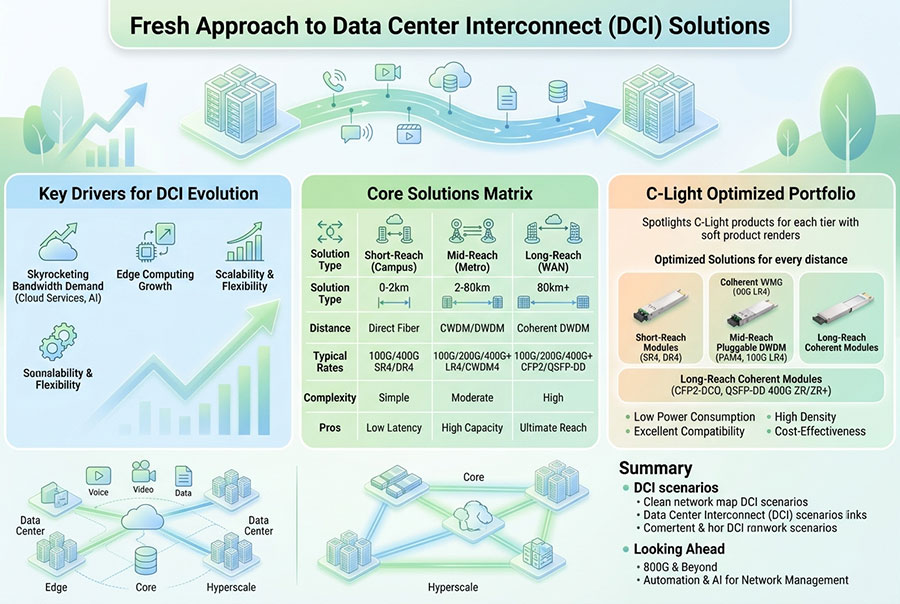
Unlike short-reach optical connections inside a single rack or data center building, DCI links may cross campus fiber routes, metropolitan networks or regional optical transport infrastructure. The required optical technology depends on distance, fiber quality, available amplification and network architecture.
Therefore, 800G DCI is not a single transceiver specification. It is a network application that can use different optical interfaces and transmission technologies according to the deployment environment.
2. Why Data Centers Are Moving Toward 800G Interconnects
Modern data center infrastructure increasingly operates across multiple facilities rather than relying on a single centralized location. AI training, cloud computing and distributed storage generate substantial traffic between compute sites, storage platforms and network aggregation points.
AI and Distributed Computing
Large AI environments may distribute computing resources across buildings or separate data center campuses. Data movement between training systems, storage and inference platforms creates demand for high-capacity inter-site links.
Cloud Storage and Data Replication
Cloud operators frequently replicate data between facilities to support availability, backup and workload distribution. Higher-capacity DCI links can help accommodate growing replication traffic while reducing the number of individual connections required for a given bandwidth target.
Data Center Consolidation and Expansion
Operators may connect new facilities to existing network infrastructure rather than building every service within one location. 800G links provide additional capacity for these distributed architectures.
3. 800G DCI Optical Technologies
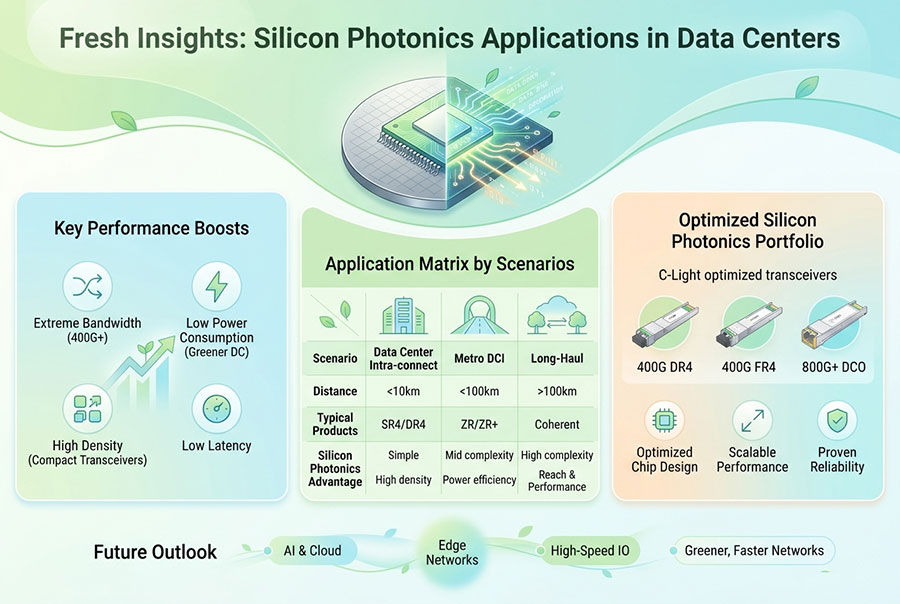
The optical technology selected for an 800G DCI link depends primarily on transmission distance and the available fiber infrastructure. PAM4 and coherent transmission address different parts of the DCI market.
| Technology | Transmission Approach | Typical Application | Key Consideration |
|---|---|---|---|
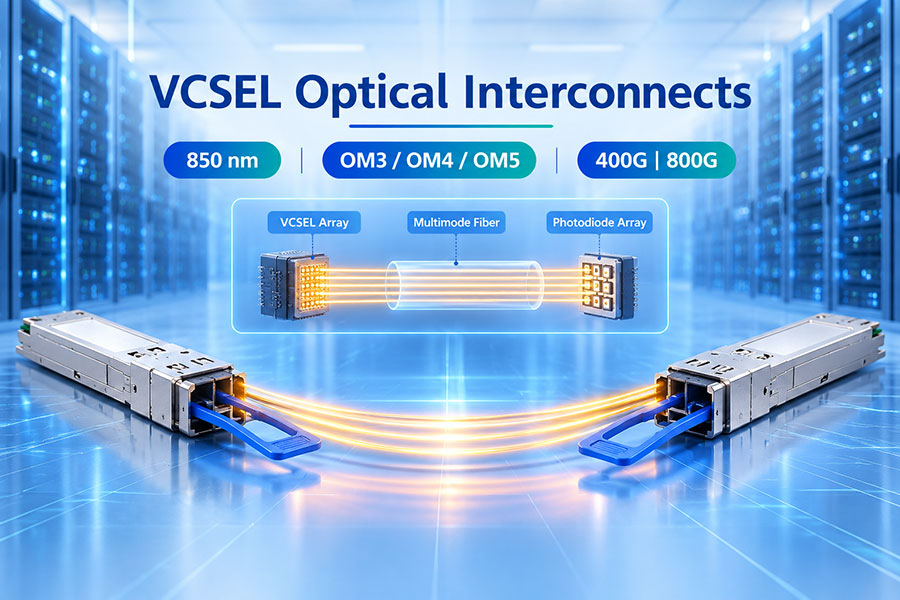
| 800G SR8 | 850nm PAM4 over multimode fiber | Short-reach data center links | Multimode fiber and parallel optics |
| 800G DR8 | Parallel single-mode optical lanes | Short-reach single-mode connections | Fiber count and MPO connectivity |
| 800G 2×FR4 | Two 400G optical channels using wavelength multiplexing | Campus and selected inter-building links | Optical reach and duplex fiber design |
| 800G 2×LR4 | Two 400G long-reach optical channels | Selected longer campus links | Optical budget and host compatibility |
| 800G ZR | Coherent DWDM transmission | Single-span amplified DCI | OSNR and line-system design |
| 800G ZR+ | Extended-reach coherent transmission | Metro and regional DCI | Modulation, FEC and optical route conditions |
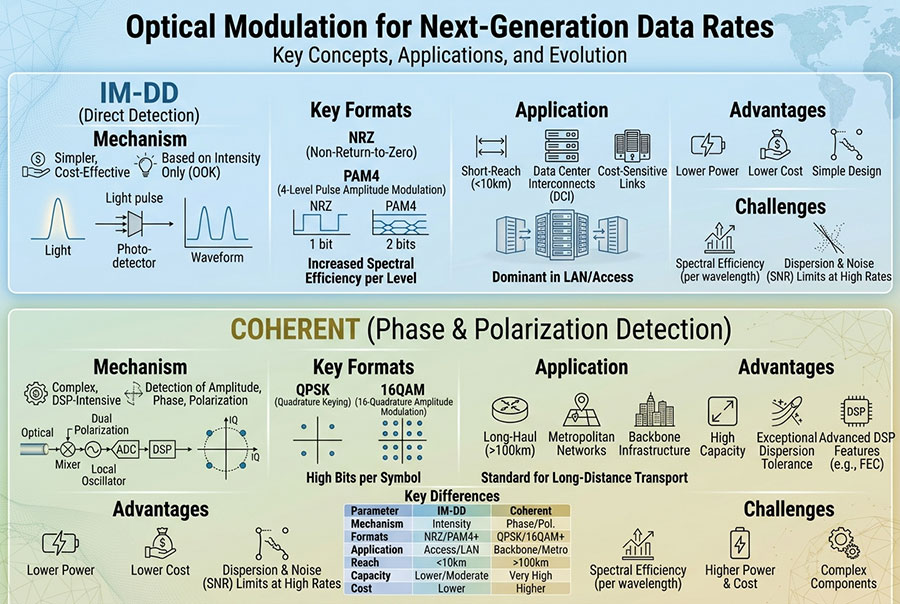
SR8, DR8, FR4 and LR4 are direct-detection PAM4 optical approaches. ZR and ZR+ are coherent optical transmission modes. Their optical interfaces, line-system requirements and deployment considerations are different.
4. 800G ZR and ZR+: Coherent Optics for DCI
Coherent optical technology is a central part of high-capacity DCI because it can transmit high-speed data over longer fiber routes while compensating for important optical impairments.
An 800G coherent transceiver integrates a coherent DSP, tunable laser, optical modulator and coherent receiver. The DSP processes amplitude and phase information from the received optical signal, helping compensate for chromatic dispersion and other transmission impairments.
800G ZR
800ZR is intended for high-capacity coherent transmission over relatively short amplified DWDM links. It is particularly relevant to single-span DCI applications where two data centers are connected through an optical line system.
Some 800ZR implementations target distances of approximately 120 km over amplified DWDM infrastructure. Actual reach depends on fiber attenuation, connector loss, optical amplification, OSNR and the complete link design.
800G ZR+
800ZR+ extends the application range through additional coherent operating modes and transmission flexibility. Depending on the implementation, it can support different modulation formats, stronger FEC configurations and reduced line rates to improve reach.
Higher-order modulation such as DP-16QAM can provide greater spectral efficiency, while lower-order formats such as DP-QPSK offer improved tolerance to optical noise at the expense of spectral efficiency. Probabilistic constellation shaping can further optimize the trade-off between reach and spectral efficiency.
| Feature | 800G ZR | 800G ZR+ |
|---|---|---|
| Primary Application | Single-span DCI | Metro and regional optical networks |
| Modulation | Typically DP-16QAM | May support DP-16QAM, PCS-16QAM and lower-order modes |
| FEC | Defined by the applicable implementation | Mode-dependent coherent FEC |
| Reach | Approximately 120 km in representative amplified designs | Can extend several hundred kilometers or farther in suitable configurations |
| Network Design | Shorter amplified DWDM route | More flexible optical line-system planning |
5. How 800G Coherent DCI Works
An 800G coherent DCI link converts high-speed client traffic into a coherent optical signal, transports that signal over single-mode fiber and reconstructs the original data at the receiving site.
A router, switch or transport platform provides the 800G client signal to the coherent optical module.
Digital processing prepares the signal for optical transmission and performs compensation and decoding functions at the receiver.
A tunable laser and optical modulator generate a wavelength that can operate within the supported DWDM band.
Multiplexers, amplifiers and other optical transport equipment support transmission over the fiber route.
The receiver detects the incoming optical signal and converts it into electrical information for DSP processing.
Recovered client traffic is delivered to the destination router, switch or transport platform.
In a direct-detect PAM4 link, the receiver primarily detects optical intensity. A coherent receiver instead uses a local oscillator and phase-sensitive detection to recover information encoded in the optical field. This enables more advanced compensation and longer-distance transmission.
6. DWDM and Optical Line-System Requirements
Many 800G DCI deployments use Dense Wavelength Division Multiplexing to transport multiple optical channels over a shared fiber pair. Each channel operates at an assigned wavelength, allowing network operators to increase aggregate fiber capacity without installing a separate fiber pair for every connection.
Wavelength Planning
Coherent DCO modules commonly support tunable wavelengths within the C-band, and some systems also support the L-band. The selected wavelength must match the available DWDM grid and the operating range of the optical line system.
Optical Amplification
EDFA-based amplification can compensate for fiber attenuation over longer routes. Amplifier gain, noise figure, output power and channel loading influence the available optical signal-to-noise ratio.
ROADM and Network Flexibility
Reconfigurable optical add-drop multiplexers allow wavelengths to be routed through optical transport networks. Their filtering characteristics, passband width and accumulated loss must be considered when planning high-baud-rate coherent channels.
Optical Power and OSNR
Sufficient received optical power alone does not guarantee a reliable coherent link. OSNR, nonlinear effects, filtering penalties and other transmission impairments must remain within the operating limits of the selected coherent mode.
7. Fiber Link Budget and Transmission Distance
Fiber distance is only one part of an 800G DCI design. The actual operating reach depends on the optical budget and the signal quality available at the receiver.
| Design Parameter | Engineering Impact | Evaluation Focus |
|---|---|---|
| Fiber Attenuation | Reduces received optical power | Fiber type, wavelength and route length |
| Connector and Splice Loss | Consumes optical power margin | Connector quality and route records |
| OSNR | Influences coherent signal quality | Amplifier noise and channel loading |
| Chromatic Dispersion | Broadens optical pulses and affects signal recovery | Fiber dispersion and DSP compensation |
| Polarization Effects | Can impair signal recovery | PMD and coherent receiver capability |
| Nonlinear Effects | Can degrade signal quality at higher optical power | Launch power and channel configuration |
For direct-detection links, engineers commonly evaluate transmitter output power, receiver sensitivity and total insertion loss. For coherent DWDM links, OSNR and optical line-system performance are also critical.
A link budget should include fiber attenuation, connectors, splices, patch panels, multiplexers, demultiplexers and any other passive components. Amplified systems require additional evaluation of amplifier placement, gain, noise and channel performance.
8. 800G DCI Deployment Architectures
The most suitable 800G architecture depends on the physical separation of the data centers, the number of required channels and whether an existing DWDM network is available.
Direct Fiber Connection
For shorter routes, two sites may connect through dedicated single-mode fiber using compatible direct-detect optical modules. This architecture can be straightforward when the fiber distance and optical budget fit the selected transceiver specification.
Point-to-Point DWDM
A point-to-point DWDM system carries multiple wavelengths over a shared fiber route. Coherent 800G modules can provide high-capacity channels while optical amplifiers support longer transmission distances.
ROADM-Based Metro Network
In metro networks with multiple data center locations, ROADMs allow optical channels to be added, dropped or routed between sites. This architecture supports flexible capacity allocation and network expansion.
IP over DWDM
Pluggable coherent modules can connect directly to compatible router or switch ports, allowing IP equipment to transmit coherent wavelengths into a DWDM line system. This approach can reduce the need for separate transponder equipment in suitable deployments.
9. 800G PAM4 DCI vs. 800G Coherent DCI
The distinction between PAM4 and coherent optics is important when selecting an 800G solution. Both can support 800G traffic, but they are designed for different optical channel conditions.
| Comparison | 800G PAM4 | 800G Coherent |
|---|---|---|
| Signal Detection | Direct detection | Coherent detection |
| Modulation | Four-level intensity modulation | Phase and amplitude modulation |
| Common Applications | Data center and campus connections | Metro and regional DCI |
| Optical Interface | Depends on SR, DR, FR or LR configuration | Typically tunable DWDM wavelengths |
| Transmission Infrastructure | Direct fiber or suitable optical links | Often amplified DWDM systems |
| Signal Processing | PAM4 DSP or linear electrical architecture | Coherent DSP |
| Distance | Model-dependent, generally shorter reach | Can extend from DCI spans to regional networks |
PAM4 is generally suitable when the optical route fits the reach and loss budget of the module. Coherent optics become more relevant when the network requires DWDM wavelength flexibility, optical amplification and compensation of long-distance transmission impairments.
10. Power Consumption and Thermal Design
High-capacity coherent modules integrate advanced DSPs, tunable lasers and coherent receiver components. Their power requirements can be higher than those of conventional short-reach direct-detect modules.
The actual power consumption depends on the form factor, modulation mode, optical output requirements, DSP architecture and operating temperature. QSFP-DD and OSFP platforms may also have different host power classes and cooling capabilities.
Module power: Confirm the typical and maximum power consumption of the exact transceiver model.
Host compatibility: Verify that the switch or router supports the module's power class.
Airflow: Check the chassis airflow direction and cooling capacity.
Port density: Consider the thermal impact of fully populated 800G ports.
Operating temperature: Confirm that the module remains within its specified case-temperature range.
Thermal planning is particularly important in high-density DCI routers and switches, where multiple coherent modules may operate simultaneously.
11. C-LIGHT 800G DCI Optical Solutions
C-LIGHT provides 800G optical connectivity options for data center infrastructure, AI networking and inter-site connectivity. Different product architectures address different distances and network requirements, from short-reach PAM4 connections to coherent DWDM transmission.
800G QSFP-DD Coherent DCO
C-LIGHT's 800G QSFP-DD DCO family includes coherent operating modes for DCI and extended-reach optical networks. The published product information includes 800ZR and 800ZR+ configurations with different modulation and reach options.
View 800G DCO Technical Information →800G OSFP Coherent DCO
The OSFP coherent product family supports high-capacity optical transmission using tunable coherent technology. It is intended for compatible high-speed platforms and DWDM-based network applications.
View 800G OSFP Products →800G QSFP-DD PAM4 Transceivers
The 800G QSFP-DD product family includes short-reach and campus-oriented optical configurations. Available product options include 100m, 500m and 2km categories, depending on the selected model.
View 800G QSFP-DD Products →800G OSFP PAM4 Transceivers
OSFP-based 800G modules support high-density data center and AI networking environments. Product configurations include SR8, DR8 and 2×FR4 options, depending on the model.
View 800G OSFP Product Family →When selecting an 800G DCI solution, customers should confirm the required optical reach, modulation mode, host interface, wavelength range, connector type, power consumption and line-system compatibility. Coherent modules also require careful evaluation of FEC mode, OSNR performance and DWDM interoperability.
12. Key Factors When Selecting an 800G DCI Solution
A reliable DCI deployment begins with the network requirements rather than the transceiver data rate alone. The following factors should be evaluated during system planning.
| Selection Factor | Questions to Verify |
|---|---|
| Transmission Distance | Is the connection within a building, across a campus, across a metro area or over a regional route? |
| Fiber Infrastructure | Is the available route single-mode fiber, and what are its attenuation and dispersion characteristics? |
| Optical Architecture | Is direct detection sufficient, or is coherent DWDM transmission required? |
| Host Compatibility | Does the switch or router support the module form factor, interface mode and power class? |
| DWDM Compatibility | Are wavelength tuning, channel spacing and optical power compatible with the line system? |
| Performance | Do OSNR, FEC, BER and optical budget meet the required link performance? |
| Scalability | Can the network support additional wavelengths, higher capacity and future site expansion? |
13. Conclusion
800G DCI is an important part of next-generation data center networking. It enables high-capacity connections between distributed facilities supporting AI computing, cloud platforms, storage replication and enterprise infrastructure.
Shorter connections can use 800G PAM4 optical modules, while metro and regional networks increasingly benefit from coherent DCO technology such as 800ZR and 800ZR+. DWDM, optical amplification, OSNR management and appropriate FEC configurations are central to reliable long-distance transmission.
The right 800G DCI architecture depends on the actual fiber route, transmission distance, optical line system, host platform and operating requirements. Matching these factors to the correct transceiver technology is essential for building scalable and efficient high-capacity networks.
Building an 800G DCI Network?
Contact C-LIGHT for 800G optical transceiver information and connectivity solutions for data center and AI networking applications.
Contact C-LIGHT >

 >
 >
 >
 >
 >
 >
 >