TEL:+86 132 6656 7067




The global high-speed copper cable market is undergoing explosive growth. Forecasts indicate that sales of high-speed cables (including DAC, AOC, and AEC) are projected to more than double over the next five years, reaching $2.8 billion by 2028. Within this segment, DAC sales are expected to grow at a compound annual growth rate (CAGR) of 25%.
More specific projections show the global DAC market will reach $1.7 billion by 2029, representing a CAGR of 12.3% from 2023 to 2029. The Chinese market is experiencing even faster growth, with a CAGR of 17.3%.
The global communication cable market reached RMB 17 billion in 2024, with an average annual growth of 7.1% over the past four years. However, the high-speed copper cable sub-segment achieved an average annual growth rate of 30.4%, significantly outperforming the industry average.
1. Core Growth Drivers
AI Computing Power Arms Race
The explosive growth of generative AI is the most powerful engine driving demand for 800G DAC. A single NVIDIA GB200 server utilizes approximately RMB 500,000 worth of DAC cables. With mass production projected to reach 40,000 units in 2025, this directly drives a market demand of RMB 20 billion. The Blackwell architecture GPU delivers 2.5 to 5 times the performance of its predecessor, further fueling the need for high-speed interconnects.
NVIDIA's strategy is to deploy DAC wherever possible, resorting to optical modules only when absolutely necessary. This strategic choice profoundly influences the trajectory of the entire industry chain.
Green Data Center Construction
Driven by global carbon neutrality goals, data center energy efficiency requirements are becoming increasingly stringent. DAC solutions are 60% more energy-efficient than optical modules, with a single cable saving up to 120,000 kWh annually. The EU's Code of Conduct on Data Centre Energy Efficiency mandates a Power Usage Effectiveness (PUE) below 1.3 by 2026, compelling data centers worldwide to adopt DAC technology.
Highlighted Cost Advantages
For short-distance transmission within 5 meters, DAC costs are only one-third that of Active Optical Cables (AOC), and they eliminate the need for optical transceiver modules, reducing deployment time by 80%. For hyperscale data centers with tens of thousands of ports, this cost differential translates into tens of millions of dollars in capital expenditure savings.
2. Regional Market Characteristics
North America: The U.S. Infrastructure Investment and Jobs Act mandates a PUE below 1.3 for data centers by 2026, driving DAC penetration rates up to 75%. Capital expenditures from the four major cloud providers—Microsoft, Amazon, Meta, and Google—totaled a combined $95 billion in Q2 2025, a year-over-year increase exceeding 60%.
China: Market demand is projected to reach $610 million in 2025, a year-over-year increase of 17.3%. Chinese cloud vendors like Tencent and Alibaba continue to increase capital expenditures. Domestic AI chips, such as Huawei's Ascend 910B and Cambricon's offerings, are driving demand for locally sourced DAC solutions.
Other Asia-Pacific Regions: Malaysia is attracting companies like Amphenol and TE Connectivity to establish assembly plants, leveraging its labor cost advantages. The "Electrical and Electronics Manufacturing Corridor" in Penang aims to achieve an annual DAC production capacity of 2 million units by 2027.
3. Application Scenarios & Selection Strategies
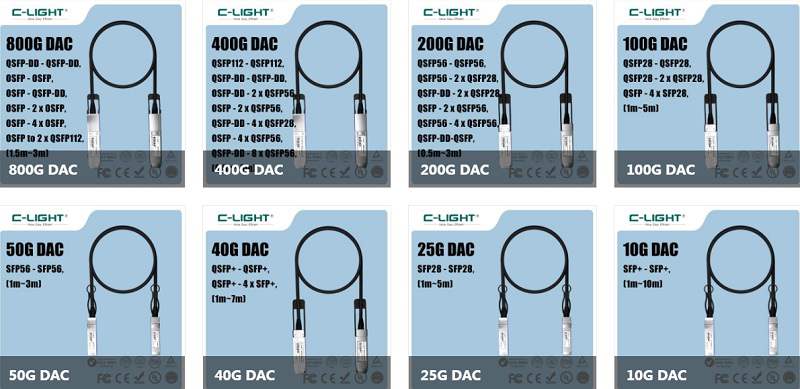
Based on technical characteristics, the application scenarios for 800G DAC in data centers are clearly defined:
AI Clusters: AI training demands extremely high bandwidth and low latency for GPU-to-GPU interconnects. DAC is an ideal choice for connecting GPU servers to switches within a rack.
Hyperscale Data Centers: In the data centers of Facebook, Google, AWS, and Alibaba Cloud, the sheer volume of connections between top-of-rack (ToR) switches and servers makes deploying DAC a significant means of reducing cabling costs, power consumption, and operational overhead.
High-Performance Computing (HPC): Computing nodes require high-speed interconnects to form clusters for large-scale scientific computing. DAC provides ultra-low latency performance in short-distance scenarios.
Storage Area Networks: Data access latency directly impacts service experience. DAC enables high-speed data exchange between storage nodes and compute nodes, accelerating response times for critical applications.
4. Challenges & Risks
Transmission Distance Limitation: The physical limit for 800G DAC is 5-7 meters, making it unsuitable for cross-rack or row-to-row interconnections. This represents its most significant technical bottleneck.
Cabling Management Complexity: Copper cables are thicker, have a larger bend radius, and are heavier than fiber optic cables, increasing the complexity of cabling management in high-density deployments.
Supply Chain Risks: China accounts for 90% of global neodymium production. Geopolitical tensions could lead to quarterly cost fluctuations exceeding 25% for DAC magnetic materials. Surging demand for copper from the new energy vehicle industry could also create raw material supply constraints.
Intensifying Market Competition: High-speed copper cable manufacturing capacity is expanding at an astonishing pace, with current order backlogs showing clear signs of oversupply, intensifying price competition pressure. AEC technology is also capturing a portion of the DAC market, offering approximately 30% cost advantages and a smaller cable form factor.
5. Development Path for 2026-2030
Technology Evolution Path
Migration to 1.6T: With the shipment of 200G SerDes beginning in late 2024, DAC will extend to 200G per lane designs, supporting 1.6T transmission rates and securing its market position for the next decade.
Material Substitution: Magnesium alloy DAC is projected to capture an 18% market share by 2026, serving as a strategy to mitigate copper shortage risks.
Smart Integration: Siemens' "Digital Twin DAC Platform" can control installation errors within 0.1mm, reducing design cycles by 60%.
Market Outlook
LightCounting forecasts that DAC sales will grow at a 25% CAGR between 2024 and 2028, with market share expected to increase by 2028. High-speed copper cable shipments are projected to surpass 20 million units by 2027.
While AEC technology is growing faster (45% CAGR), DAC will maintain a significant market position due to its irreplaceable cost and power advantages in ultra-short-reach scenarios. The market positioning of the three technologies is becoming increasingly distinct: DAC dominates intra-rack connections (< 3 meters, >7 meters).
800G DAC is transitioning from a "supporting role" to a "leading role" in data center interconnects. Driven by the dual engines of surging AI computing power demand and the transition to green computing, this copper cabling solution—once considered transitional—has become a critical component supporting next-generation data center infrastructure, leveraging its exceptional cost-effectiveness, ultra-low latency, and near-zero power consumption.
 >
>

 >
>
 >
>
 >
>
 >
>
 >
>
 >
>
 >
>