TEL:+86 132 6656 7067





As AI models grow and GPU clusters expand, the network connecting compute nodes is becoming a major infrastructure consideration. Distributed training, model parallelism, and large-scale GPU communication generate substantial east-west traffic between servers. The interconnect must deliver sufficient bandwidth while maintaining efficient use of switch ports, optical links, and data center resources.
400G and 800G Ethernet interconnects represent two important stages in this evolution. A 400G link provides 400 Gbps of nominal bandwidth, while an 800G link doubles that capacity to 800 Gbps. However, choosing between them involves more than comparing port speeds. GPU network interfaces, switch capacity, traffic patterns, optical reach, cabling density, power consumption, and upgrade costs all influence the appropriate design.
For many AI data centers, 400G remains a practical option for existing GPU clusters and infrastructure with moderate bandwidth requirements. 800G becomes increasingly attractive when network traffic grows, higher-speed switches and adapters are available, and reducing the number of physical links becomes an important design objective.
1. Why AI Data Centers Need Higher-Speed Interconnects
AI computing workloads generate communication patterns that differ from conventional enterprise applications. In distributed training, GPUs located in different servers repeatedly exchange gradients, parameters, activations, and other intermediate data.
These transfers take place across the data center network, often involving multiple switches and links. When network communication cannot keep pace with GPU processing, compute resources may spend more time waiting for data exchange and synchronization.
Several factors are increasing AI network bandwidth requirements:
Larger GPU clusters: More compute nodes create additional communication paths and aggregate traffic.
Larger AI models: Model parameters and intermediate tensors increase the amount of data exchanged during training and inference.
Distributed training: Collective operations such as All-Reduce generate intensive traffic between GPU servers.
Higher GPU performance: Faster accelerators can increase the rate at which data must move through the network.
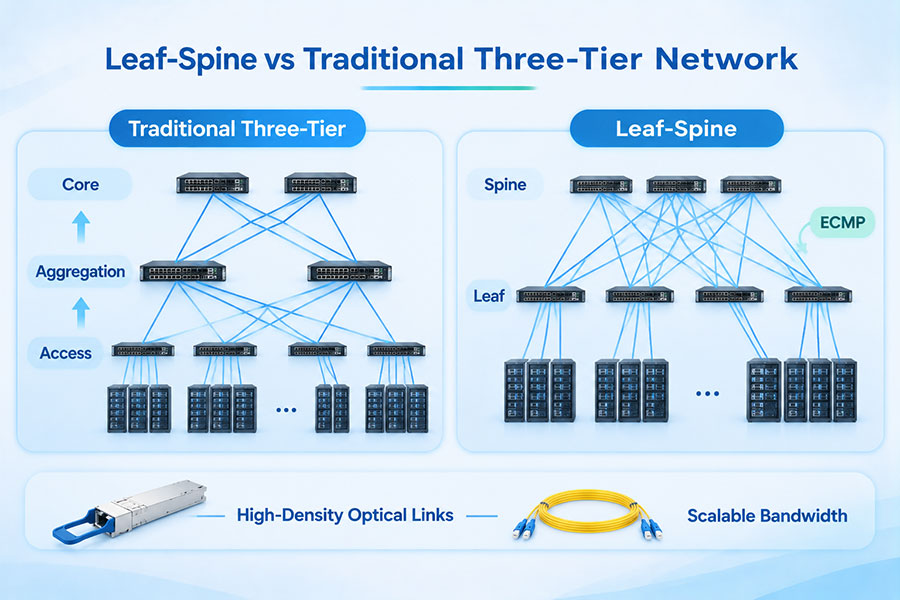
Scale-out architectures: Expanding clusters require sufficient bandwidth across leaf, spine, and other switching layers.
Moving from 400G to 800G is one way to address these requirements. The upgrade, however, must be considered across the entire network rather than at the optical port level alone.
2. What Is a 400G AI Interconnect?
A 400G AI interconnect is a network connection with a nominal aggregate data rate of 400 gigabits per second. It can be implemented using 400GbE optical transceivers, direct-attach copper cables, active optical cables, and compatible network adapters and switches.
400G connectivity is used in AI data center networks for server-to-switch connections, switch-to-switch links, and other high-bandwidth connections, depending on the architecture and equipment capabilities.
2.1 400G Optical Transceiver Architecture
Common 400G optical transceivers use QSFP-DD or OSFP form factors. The exact electrical and optical lane arrangement depends on the module specification.
For example, a typical 400G QSFP-DD implementation may use eight 50Gb/s PAM4 electrical lanes, while optical interfaces such as DR4 and FR4 commonly use four 100Gb/s optical lanes.
Typical 400G optical configurations include:
| 400G Type | Fiber Type | Typical Reach | Typical Connector | Application |
|---|---|---|---|---|
| 400G SR8 | Multimode fiber | Up to 100m | MPO | Short-reach data center links |
| 400G DR4 | Single-mode fiber | 500m | MPO | Data center switching links |
| 400G FR4 | Single-mode fiber | 2km | LC | Longer-reach data center connections |
| 400G LR4 | Single-mode fiber | 10km | LC | Extended-reach data center links |
Actual reach and connector specifications depend on the selected standard and product variant.
2.2 Where 400G Fits in AI Networks
400G is suitable for AI environments where server network interfaces, switch ports, and aggregate traffic requirements align with 400GbE connectivity.
It can also be deployed in larger networks using multiple parallel links. For example, several 400G connections can provide substantial aggregate bandwidth between network layers, although the resulting port count and cabling requirements must be considered.
3. What Is an 800G AI Interconnect?
An 800G AI interconnect provides a nominal aggregate bandwidth of 800 gigabits per second per link. It is designed for higher-capacity Ethernet networks used in hyperscale data centers, large GPU clusters, and high-performance computing environments.
Compared with 400G, an 800G connection can carry twice the nominal bandwidth over a single link. This makes it attractive for high-capacity switch uplinks, spine connections, and GPU network architectures designed around 800GbE interfaces.
3.1 800G Optical Transceiver Architecture
800G optical transceivers are available in form factors such as QSFP-DD800 and OSFP. Their lane arrangements vary by interface type and generation.
A common 800G architecture uses eight 100Gb/s electrical lanes. Optical implementations may use eight 100Gb/s optical lanes, while some designs use different lane arrangements or support multiple 400G optical interfaces within one module.
Examples of 800G optical configurations include:
| 800G Type | Fiber Type | Typical Reach | Typical Connector | Application |
|---|---|---|---|---|
| 800G SR8 | Multimode fiber | Up to 100m | MPO | Short-reach data center connections |
| 800G DR8 | Single-mode fiber | 500m | MPO | High-density data center links |
| 800G 2xDR4 | Single-mode fiber | 500m | 2x MPO | Dual 400G optical interfaces |
| 800G 2xFR4 | Single-mode fiber | 2km | LC or CS, depending on variant | Extended-reach data center links |
The optical architecture is important when planning an 800G deployment. Two modules with the same aggregate data rate may have different optical lane counts, connectors, breakout capabilities, and host interface requirements.
3.2 Why 800G Matters for AI Infrastructure
800G helps increase network capacity without requiring every connection to be implemented as two separate 400G links. In a compatible switching architecture, a single 800G port can provide twice the nominal bandwidth of a 400G port.
This can reduce the number of physical connections required for a given aggregate bandwidth target. It may also simplify high-capacity switch interconnections and support denser network architectures.
4. 400G vs 800G AI Interconnect: Key Differences
The most direct difference is the bandwidth per link. Other differences become important when evaluating port density, cabling, optical interfaces, power, and network expansion.
| Comparison Point | 400G AI Interconnect | 800G AI Interconnect |
|---|---|---|
| Nominal link bandwidth | 400 Gbps | 800 Gbps |
| Bandwidth per port | 400 Gbps | 800 Gbps |
| Relative capacity | Baseline | 2x 400G capacity |
| Common form factors | QSFP-DD, OSFP | QSFP-DD800, OSFP |
| Electrical lane architecture | Varies by implementation; commonly 8x50G or 4x100G | Varies by implementation; commonly 8x100G |
| Typical AI applications | 400G GPU fabrics and switch connections | Higher-capacity GPU fabrics and switch connections |
| Port count for the same aggregate bandwidth | More ports required | Fewer ports required |
| Optical infrastructure | 400G-compatible transceivers and cabling | 800G-compatible transceivers and cabling |
| Switch requirements | 400G-capable ports and switching capacity | 800G-capable ports and switching capacity |
| Deployment considerations | Established 400G infrastructure and device compatibility | Higher-speed host interfaces, switch capacity, thermal and power planning |
| Upgrade strategy | Suitable for incremental expansion | Suitable for higher-density capacity expansion |
Neither speed automatically delivers better application performance in every environment. The benefit depends on whether the servers, switches, network topology, and workload can make effective use of the available bandwidth.
5. Bandwidth Comparison: How Much Capacity Does 800G Add?
At the individual link level, 800G provides twice the nominal bandwidth of 400G.
For example:
One 400G link provides 400 Gbps of nominal bandwidth.
One 800G link provides 800 Gbps of nominal bandwidth.
Two 400G links provide 800 Gbps of combined nominal bandwidth.
Four 400G links provide 1.6 Tbps of combined nominal bandwidth.
Two 800G links provide 1.6 Tbps of combined nominal bandwidth.
This comparison illustrates why 800G can reduce the number of physical links needed to achieve a particular aggregate bandwidth target.
5.1 Port Density and Switch Capacity
Assuming a switch has the same total available switching bandwidth, higher-speed ports can support greater bandwidth per connection. This can reduce the number of ports needed for high-capacity uplinks.
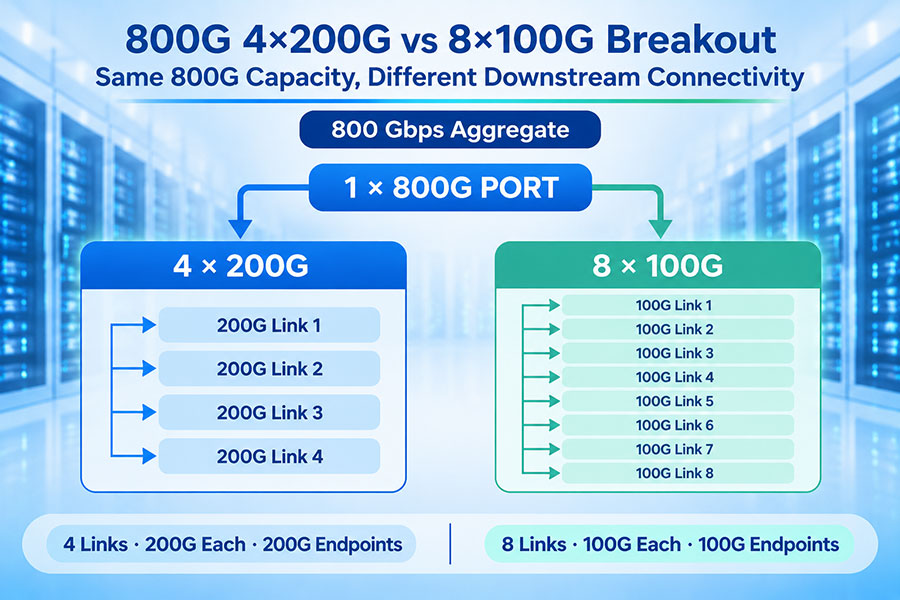
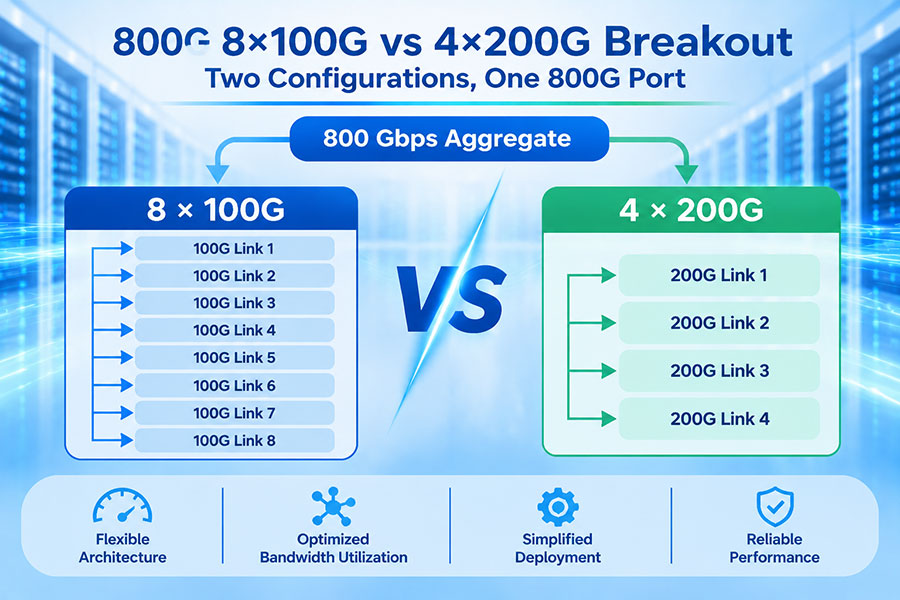
For example, an 800G connection can carry the same nominal bandwidth as two 400G connections. Whether it also saves switch ports depends on the switch architecture, port configuration, and available breakout options.
5.2 Does 800G Double AI Training Performance?
No. Doubling network link bandwidth does not automatically double AI training performance.
Actual training throughput depends on several factors:
GPU processing capability and memory bandwidth.
Server network interface speed.
Switch capacity and network oversubscription.
Communication patterns generated by the training framework.
Collective communication efficiency.
Congestion and traffic distribution.
Storage and data-loading performance.
If the GPU server is connected through a 400G network adapter, upgrading only the switch uplink to 800G does not turn that server connection into an 800G link. The end-to-end architecture must support the intended data rate.
6. Network Topology: 400G and 800G in GPU Clusters
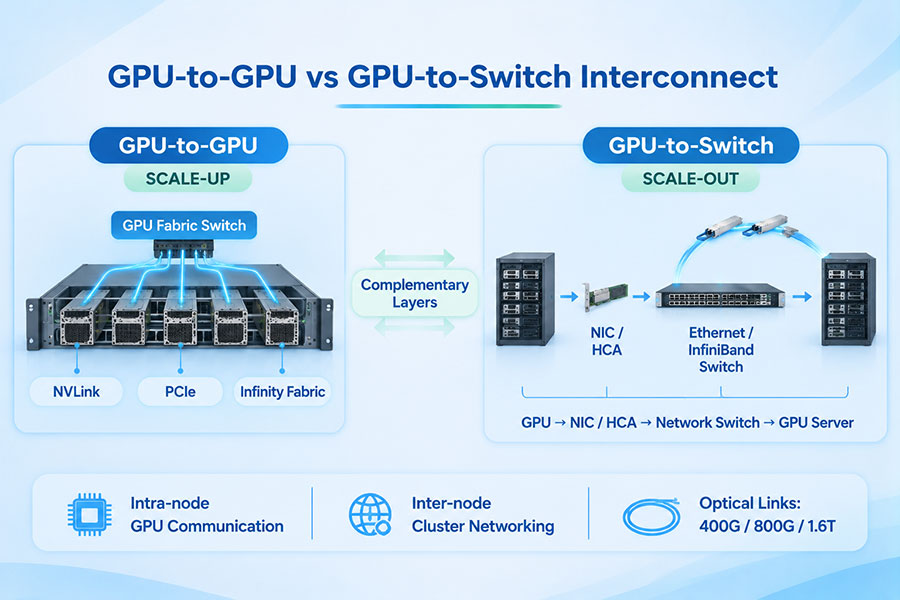
AI networks are commonly designed using multi-tier switching architectures. The exact topology depends on the cluster size, required bandwidth, oversubscription target, and equipment platform.
6.1 400G Network Architecture
A 400G AI fabric can connect GPU servers to leaf switches using 400G links, with 400G uplinks connecting the leaf layer to spine switches.
This design is suitable when server interfaces and switch ports operate at 400G and the aggregate network capacity meets the workload requirements.
For larger clusters, multiple 400G links can be used between network layers. This increases aggregate bandwidth but also consumes more ports, cables, and optical interfaces.
6.2 800G Network Architecture
An 800G fabric can use higher-speed links between switches or between compatible GPU servers and switches. It provides more capacity per physical connection and can support higher-bandwidth network layers.
In some deployments, the server-facing connections may remain at 400G while the switch uplinks operate at 800G. This allows the network to aggregate traffic from multiple 400G server connections.
For example, two 400G server-facing links can generate up to 800 Gbps of combined nominal traffic. An 800G uplink can carry that aggregate bandwidth under suitable traffic conditions, subject to the rest of the topology and contention.
6.3 Mixed 400G and 800G Networks
A mixed-speed architecture is often a practical migration approach. A data center does not necessarily need to upgrade every port to 800G at the same time.
Possible deployment patterns include:
400G server connections with 800G leaf-to-spine uplinks.
400G access switches connected to 800G-capable aggregation switches.
800G spine infrastructure serving multiple 400G network segments.
Separate 400G and 800G fabrics for different generations of GPU servers.
When using mixed-speed links, engineers should validate port breakout modes, supported transceiver combinations, switch operating modes, and the intended traffic distribution.
7. Optical Transceivers and Cabling: 400G vs 800G
Optical connectivity is a central part of high-speed AI network design. As data rates increase, transceiver selection and fiber infrastructure must match the required interface, reach, connector, and switch configuration.
7.1 400G Optical Connectivity
400G optical transceivers are widely used for data center connections at different distances. Depending on the selected module, 400G links can use multimode or single-mode fiber.
Common choices include:
400G SR8: Short-reach multimode connectivity, commonly used within data center environments.
400G DR4: Single-mode connectivity for links around 500m.
400G FR4: Single-mode connectivity for links around 2km.
400G LR4: Single-mode connectivity for links around 10km.
C-LIGHT's 400G QSFP-DD optical transceiver portfolio covers multiple optical configurations, including SR8, DR4, FR4, LR4, ER4, and coherent variants. Available reach depends on the exact product model.
7.2 800G Optical Connectivity
800G optical modules provide higher aggregate bandwidth per transceiver and support high-capacity data center links.
Common 800G configurations include:
800G SR8: Short-reach multimode connectivity.
800G DR8: Single-mode connectivity for links around 500m.
800G 2xDR4: Two 400G optical interfaces within an 800G aggregate configuration.
800G 2xFR4: Dual 400G optical interfaces for longer-reach data center connections.
C-LIGHT's 800G QSFP-DD optical transceiver portfolio includes 100m, 500m, and 2km configurations, depending on the selected variant. The portfolio also includes different host and optical interface arrangements.
7.3 DAC and AOC Connections
Not every AI interconnect requires a pluggable optical transceiver at both ends.
For short connections, passive DAC and active optical cable solutions may be appropriate depending on reach, power, flexibility, and equipment support.
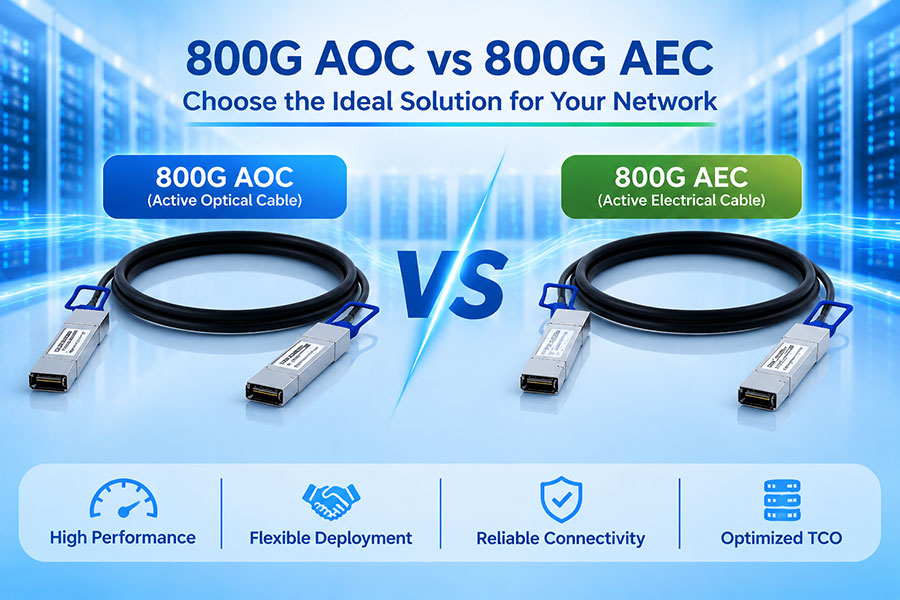
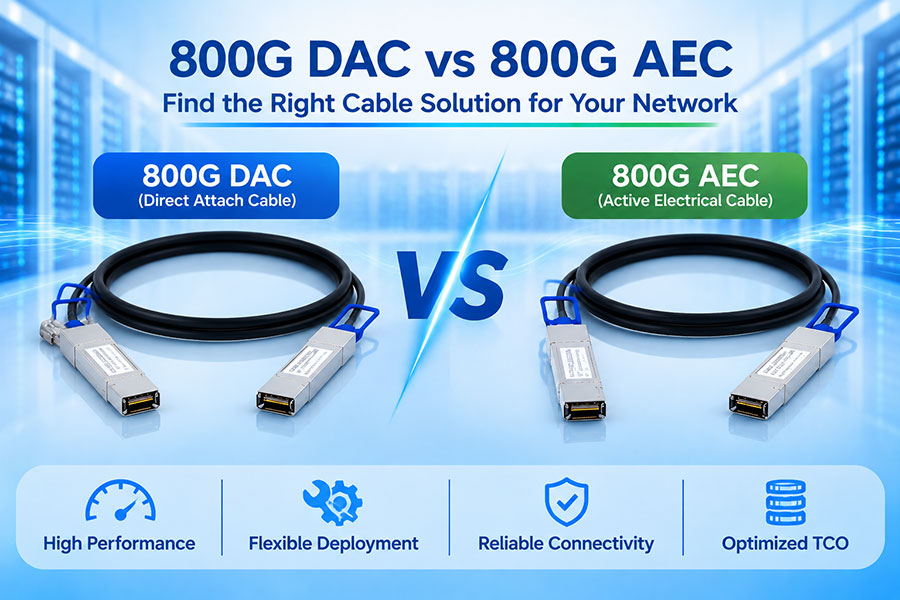
DAC cables provide a direct electrical connection and are commonly considered for short-reach server-to-switch or switch-to-switch links. AOCs use optical transmission within an integrated cable assembly and can support longer short-reach connections.
For 800G environments, C-LIGHT's 800G AOC product family provides high-speed optical cable configurations for compatible QSFP-DD and OSFP interfaces.
7.4 Fiber and Connector Planning
Moving from 400G to 800G may change the number of optical lanes, fiber strands, and connectors required by a link.
For example, an 800G implementation using two optical groups may require a different cabling arrangement from a single-interface 400G module. Engineers should check the exact transceiver specification instead of assuming that all 800G modules use the same MPO or LC connection.
Before deployment, verify:
Fiber type: multimode or single-mode.
Optical reach and link budget.
Connector type and fiber polarity.
Optical lane count and breakout configuration.
Switch and network adapter compatibility.
Transceiver power consumption and thermal requirements.
8. Power Consumption, Cooling and Port Density
Higher-speed optical interfaces can increase power and thermal design requirements. The exact difference depends on the transceiver technology, DSP implementation, optical architecture, and form factor.
In a large AI data center, even a small increase in power per module can become significant when multiplied across hundreds or thousands of network ports.
8.1 Power Considerations
800G modules may require more power than comparable 400G modules, although actual values vary by product type and reach. A higher-speed link can still improve overall infrastructure efficiency if it replaces multiple lower-speed connections and reduces associated switch-port requirements.
Power comparisons should therefore consider the complete connection, including the transceiver, switch port, cabling, and any additional equipment required.
8.2 Cooling and Thermal Design
High-density 800G switches and optical modules require appropriate airflow and thermal management. OSFP and QSFP-DD800 implementations may use different thermal designs depending on the platform.
Before selecting an 800G module, verify the switch vendor's supported module types, temperature specifications, airflow direction, and power budget.
8.3 Port Density
800G can provide more bandwidth per port, helping operators build high-capacity network layers with fewer physical connections.
However, port density is not determined by data rate alone. Switch ASIC capacity, electrical interface design, thermal limits, and chassis configuration also influence the number of usable ports.
9. Cost Considerations: 400G vs 800G
The economic comparison between 400G and 800G should include the entire network deployment rather than the purchase price of an individual transceiver.
Relevant cost factors include:
Optical transceiver or cable price.
Switch port and chassis costs.
Network adapter upgrade requirements.
Fiber cabling and installation.
Power consumption and cooling.
Network management and maintenance.
Future expansion and migration costs.
9.1 When 400G Can Be More Cost-Effective
400G may offer a better cost balance when the existing GPU servers, switches, and network adapters already support 400GbE. It can also be appropriate when the cluster does not yet require 800G bandwidth per connection.
Using existing 400G infrastructure can avoid premature equipment replacement and allow capacity to expand incrementally.
9.2 When 800G Can Improve Infrastructure Efficiency
800G may be attractive when a network needs higher aggregate capacity but wants to avoid adding large numbers of 400G links.
For a target of 1.6 Tbps of nominal link capacity, for example, two 800G connections provide the same aggregate rate as four 400G connections. Depending on switch design and cabling, this may reduce port consumption and simplify the network layout.
Whether this results in a lower total cost depends on module pricing, switch hardware, power requirements, and the cost of upgrading connected equipment.
10. When Should AI Data Centers Choose 400G?
400G remains a strong option for many AI network deployments. It is not automatically obsolete when 800G becomes available.
Consider 400G when:
The GPU servers and network adapters are designed around 400GbE.
Existing switches provide sufficient 400G port capacity.
The current network fabric meets application throughput requirements.
The cluster is being expanded incrementally.
Budget and infrastructure reuse are important priorities.
The required bandwidth can be achieved without excessive network oversubscription.
For many deployments, maintaining a well-designed 400G fabric can be more beneficial than upgrading to 800G before the endpoints and workloads are ready.
11. When Should AI Data Centers Choose 800G?
800G becomes attractive when the network needs more capacity per connection and the supporting hardware can use that capacity effectively.
Consider 800G when:
GPU clusters generate high east-west traffic volumes.
Switch platforms support native 800GbE ports.
Server or network adapter interfaces can operate at compatible speeds.
Leaf-to-spine or spine-to-spine links require higher capacity.
Reducing physical port count is an important design objective.
The data center is planning a new high-density AI network.
For new AI infrastructure, 800G can provide additional bandwidth headroom and a more scalable foundation. The decision should still be based on the actual compute platform, switch architecture, and workload requirements.
12. A Practical 400G-to-800G Migration Strategy
Upgrading an AI data center from 400G to 800G does not have to be an all-at-once replacement. A phased migration can help preserve existing infrastructure while increasing capacity where it is most needed.
12.1 Evaluate Current Network Utilization
Start by measuring link utilization, congestion, oversubscription, packet drops, and application communication performance. Identify whether the actual bottleneck is at the server-facing layer, leaf-to-spine uplinks, or higher network tiers.
12.2 Upgrade the Most Constrained Links First
If the main bottleneck is between leaf and spine switches, upgrading those connections may provide more value than replacing every server-facing 400G link.
For example, a network can retain 400G server connections while introducing 800G uplinks to increase aggregate capacity between switching layers.
12.3 Confirm Endpoint Compatibility
An 800G switch port cannot independently upgrade a 400G network adapter to 800G. Verify that the server NIC, switch port, transceiver, firmware, and supported link modes are compatible.
12.4 Validate Optical and Cable Infrastructure
Check optical reach, fiber type, connector arrangement, polarity, and cable routing. New 800G links may require different optical modules and cabling from existing 400G connections.
12.5 Benchmark the Complete AI Workload
After upgrading, test network throughput, latency, congestion behavior, and collective communication performance. Use representative AI workloads to determine whether the additional bandwidth improves training efficiency or reduces communication bottlenecks.
13. Conclusion
400G and 800G AI interconnects serve different stages of data center network scaling. 400G provides a mature high-bandwidth option for existing GPU clusters and infrastructure where 400GbE connectivity meets the workload requirements. 800G doubles the nominal bandwidth per link and can help build higher-capacity, higher-density network fabrics.
The best choice depends on more than the speed printed on an optical module. Server NIC capabilities, switch architecture, network topology, optical reach, cabling, power, cooling, and total deployment cost must all be considered.
For an established AI cluster, a targeted 400G-to-800G upgrade may be the most practical approach. For a new high-density GPU infrastructure, 800G can provide additional bandwidth headroom and simplify high-capacity connections.
Ultimately, the right AI interconnect is the one that matches the bandwidth needs of the compute platform while maintaining efficient end-to-end network performance.
Frequently Asked Questions
Q1: What is the main difference between 400G and 800G AI interconnects?
400G provides 400 Gbps of nominal bandwidth per link, while 800G provides 800 Gbps. The higher-speed option doubles the nominal capacity of an individual connection.
Q2: Is 800G twice as fast as 400G for AI training?
It provides twice the nominal link bandwidth, but AI training performance does not necessarily double. GPU capability, network topology, congestion, and application communication patterns also matter.
Q3: Can 400G and 800G links coexist in one AI network?
Yes. A mixed-speed fabric can use 400G server connections and 800G switch uplinks, provided that the switches and optical interfaces support the required configurations.
Q4: Does 800G require different optical transceivers from 400G?
Yes. 800G connections require compatible 800G optical interfaces or supported breakout configurations. The module, port mode, connector, and fiber arrangement must match the equipment.
Q5: What optical modules are commonly used for 400G AI interconnects?
Common options include 400G SR8, DR4, FR4, and LR4. Selection depends on fiber type, transmission distance, connector, and equipment compatibility.
Q6: What optical modules are commonly used for 800G AI interconnects?
Common options include 800G SR8, DR8, 2xDR4, and 2xFR4. Their reach and connector configurations vary by product and optical standard.
Q7: Is 800G always more cost-effective than 400G?
No. 800G can reduce the number of connections needed for a target bandwidth, but equipment, optics, power, cooling, and upgrade costs determine the total economics.
Q8: Can a 400G server connect to an 800G switch?
It may be possible when the switch supports the required 400G port mode or breakout configuration. Physical form factor alone does not guarantee compatibility.
Q9: Should a new AI data center deploy 800G instead of 400G?
800G is worth evaluating for new high-density AI fabrics, but the choice should match server NIC speeds, switch capacity, workload demands, and the total deployment budget.
Q10: What should be checked before upgrading from 400G to 800G?
Evaluate network utilization, switch and NIC compatibility, optical reach, cabling, power, cooling, breakout modes, and application-level performance before migration.
 >

 >
 >
 >
 >
 >
 >
 >