TEL:+86 132 6656 7067




I. Introduction
In the digital era marked by the deep integration of artificial intelligence, cloud computing, and 5G networks, global data traffic is growing at an unprecedented rate. From hyperscale data center interconnects to carrier backbone network upgrades, and from high-density connections in AI computing clusters to the transmission of high-capacity video streams, optical communication infrastructure bears the exponentially expanding demand for bandwidth. The 400G optical module, as a core product in the current high-speed optical communication landscape, is entering a phase of large-scale global deployment, serving as a critical hub connecting computing power and networks.
II. Overview of 400G Optical Module Technology
2.1 Standardization and Form Factors
The standardization of 400G optical modules is primarily driven by the IEEE 802.3 Working Group. Since the release of IEEE 802.3bs in 2017, a series of 400G Ethernet physical interface specifications have been established: IEEE 802.3bs-2017 defined standards for 200GE and 400GE over distances up to 10km; IEEE 802.3cn-2019 extended the reach to 40km; and IEEE 802.3cw specified transmission standards for 400Gb/s over DWDM systems. Additionally, the Optical Internetworking Forum (OIF) has played a key role in standardizing coherent optical modules, with the 400ZR standard becoming the industry benchmark for Data Center Interconnect (DCI).
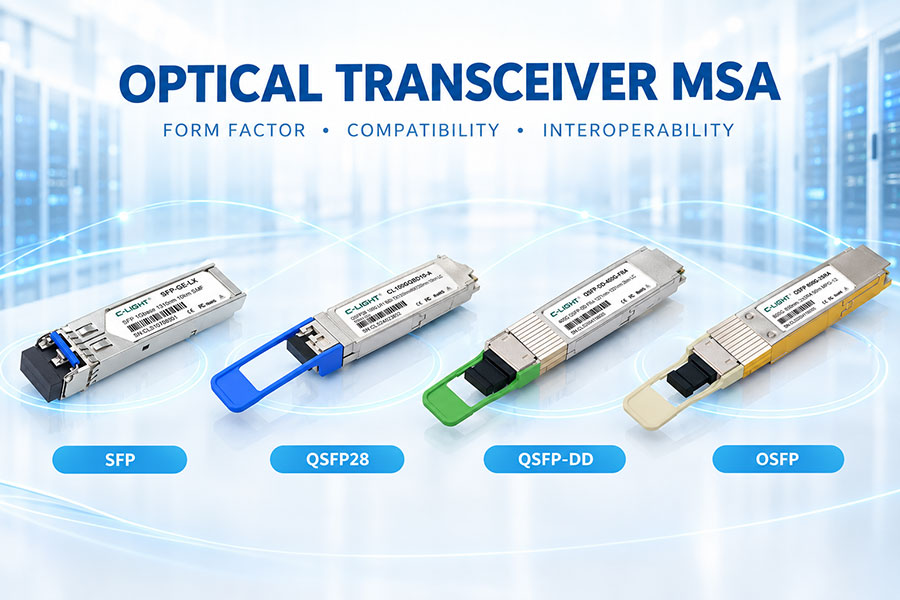
In terms of form factors, QSFP-DD (Quad Small Form Factor Pluggable Double Density) has become the mainstream form factor for 400G modules. QSFP-DD achieves a total bandwidth of 400G via an 8-channel electrical interface (8×53.125Gb/s PAM4), effectively doubling port density while maintaining compatibility with QSFP28/QSFP56. OSFP (Octal Small Form Factor Pluggable) represents another significant form factor option, featuring a larger heat dissipation surface area suitable for higher power consumption scenarios.
2.2 Core Technology Roadmaps
The technological competition surrounding 400G modules centers on three key dimensions: modulation technology, photonic integration platforms, and transmission architectures.
Regarding modulation, PAM4 (4-Level Pulse Amplitude Modulation) has become the standard for 400G modules. Compared to traditional NRZ (Non-Return-to-Zero) modulation, PAM4 transmits 2 bits of information per symbol period, effectively doubling the data rate at a given baud rate. At the 2026 OFC conference, 400G per-lane PAM4 optical technology was demonstrated using Broadcom's Taurus DSP, with initial module vendors showcasing excellent performance.
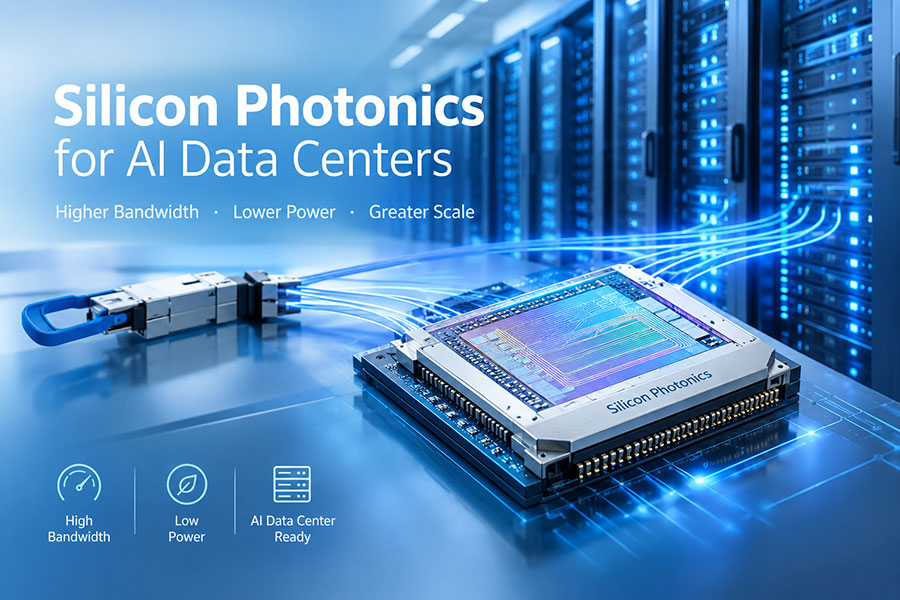
In terms of photonic platforms, three major approaches exist: Silicon Photonics (SiPh), Electro-absorption Modulated Lasers (EML), and Thin-Film Lithium Niobate (TFLN). Silicon Photonics dominates 400G IM/DD (Intensity Modulation/Direct Detection) applications due to its high integration and cost efficiency. EML technology excels in bandwidth and linearity, making it the mainstream choice for longer-reach 400G LR/ER solutions. TFLN is viewed as a promising platform for single-lane 400G and beyond due to its ultra-low RF loss characteristics.
Regarding transmission architecture, 400G modules are primarily divided into IM/DD and Coherent schemes. IM/DD is suitable for intra-data center interconnects up to several kilometers, offering low power and cost. Coherent solutions, employing high-order modulation formats like PM-16QAM combined with OFEC/SFEC forward error correction algorithms, enable transmission over hundreds or even thousands of kilometers, making them the preferred choice for DCI and metro/long-haul networks.
III. Market Drivers and Application Scenarios
The explosive growth of AI computing power is the primary driver for 400G optical module demand. According to Cignal AI statistics, total shipments of 400G and higher-speed datacom optical modules reached 42 million units in 2025, with 800G module shipments exceeding 20 million units. The global optical module market achieved sales of nearly $18 billion in 2025, a year-on-year increase of approximately 70%, and is projected to maintain a growth rate of around 60% in 2026. A specific report by QY Research indicates the global 400G optical module market was valued at approximately $1.13 billion in 2025 and is expected to reach about $2.07 billion by 2032, with a CAGR of 8.5%.
Current key application scenarios for 400G modules span four major areas:
Intra-Data Center High-Density Interconnects: Utilizing short-reach IM/DD modules like 400G SR8/DR4/FR4 for high-speed data exchange between servers and switches or switch-to-switch links.
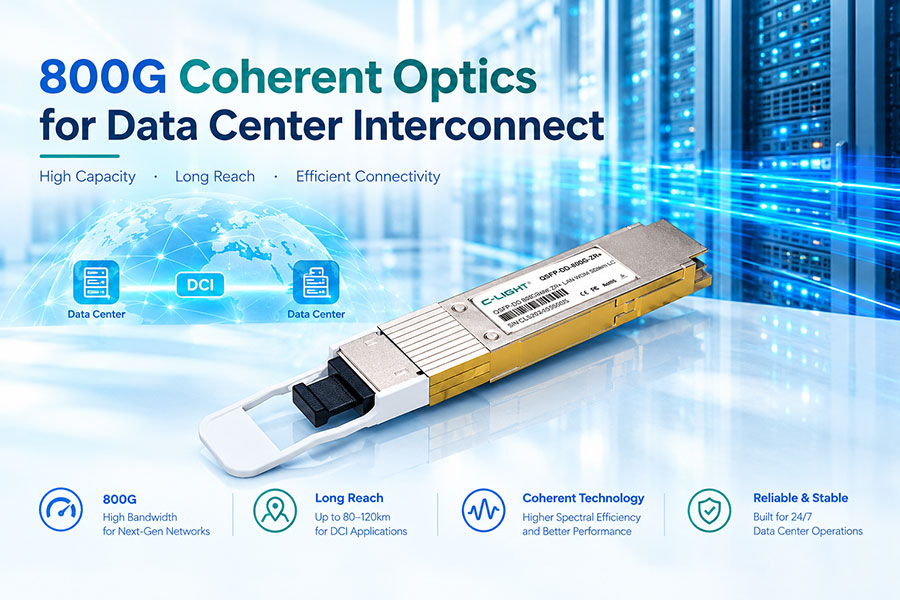
Data Center Interconnect (DCI): Employing 400G ZR/ZR+ coherent modules for long-distance optical transmission between data center campuses.
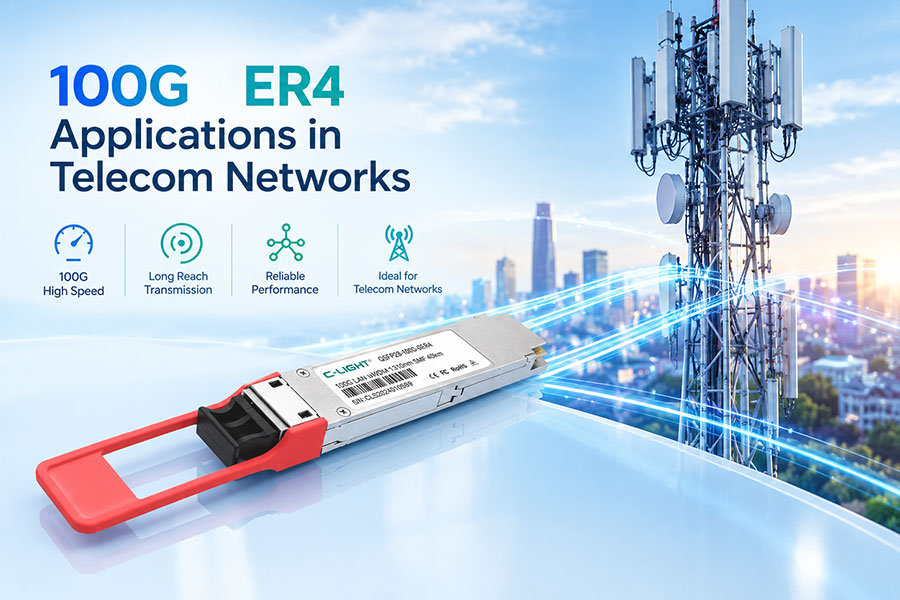
5G Backhaul Networks: Leveraging 400G LR4/ER4 modules to provide high-bandwidth bearer services for base stations.
Carrier Backbone Networks: Building ultra-long-haul, high-capacity all-optical foundations based on 400G DWDM systems. 400G DWDM technology adopts C+L band expansion, increasing usable spectrum from 4 THz to 8 THz, thereby doubling system capacity.
IV. C-LIGHT 400G Optical Module Product Portfolio
Shenzhen C-LIGHT Network Communications, established in 2011, possesses over 15 years of industry experience in fiber optic network products. The company's product line spans a full range of optical modules including 800G, 2x400G, 400G, 4x100G, 200G, 100G, 50G, 40G, 25G, and 10G. In the 400G segment, C-LIGHT has built a comprehensive product matrix covering scenarios from short-reach data center links to ultra-long-haul metro and backbone networks.
4.1 Data Center Short-Reach Series: SR8 and FR4
The 400G QSFP-DD SR8 100m module is designed for ultra-short-reach, high-density interconnects within data centers. It utilizes an 8-channel 850nm VCSEL array with PAM4 modulation, supporting transmission up to 100 meters over OM4 multimode fiber and featuring an MPO-16/APC connector to minimize return loss. With power consumption under 9W and compliance with IEEE 802.3cm and QSFP-DD MSA, it seamlessly integrates with 200G/100G infrastructure, suitable for low-cost, low-latency connections in leaf-spine architectures, HPC clusters, and cloud networks.
The 400G QSFP-DD FR4 module is a hot-pluggable coherent module designed for 400GbE Ethernet applications, supporting transmission distances up to 2km over single-mode fiber. This module provides reliable transmission performance while maintaining low power consumption, ideal for cross-building data center links and campus networks.
4.2 Medium and Long-Reach Series: LR4 and ZR
The 400G QSFP-DD LR4 10km module employs CWDM4 technology, achieving 10km transmission over single-mode fiber via 4×100G lanes. Power consumption is kept under 9W, equipped with a duplex LC connector and compliant with IEEE 802.3bs and QSFP-DD CMIS Rev 5.0 management interface specifications. The product is suitable for data center interconnects, enterprise networks, and 5G fronthaul/backhaul applications, providing reliable optical transmission support for cloud computing and AI-driven infrastructure.
The 400G ZR QSFP-DD Coherent 120km module is a key product in C-LIGHT's portfolio for advancing high-speed, long-distance optical networks. Based on coherent detection technology, it supports unrepeatered transmission up to 120km and is compatible with ZR+ mode for extension to hundreds of kilometers using optical amplifiers, making it particularly suitable for metro networks and DCI.
4.3 Ultra-Long-Haul Coherent Series: DWDM ZR+ Series
C-LIGHT's DWDM 400G ZR+ coherent module series represents the flagship line within its 400G product offering, covering ultra-long-haul transmission requirements from 120km up to 500km and even 1000km. This series utilizes a full-spectrum 60GBaud DP-16QAM coherent design, supporting multiple client-side rate modes including 4x100GbE, 400GbE, 2x100GbE, and 1x100GbE, meeting various international standards such as Open ZR+ MSA R1.0, OIF 400ZR, and IEEE 802.3cw.
This series features three core technical advantages:
Advanced FEC: Employs Soft-Decision FEC algorithms to improve the Bit Error Rate (BER) from 10^-3 to 10^-15, ensuring stable and reliable signal transmission even after 2000km.
Integrated Functionality: Features integrated EDFA and tunable optical filters, supporting full C-band 96-channel tunable single-carrier operation.
Enhanced Performance: Improves Optical Signal-to-Noise Ratio (OSNR) tolerance through distributed Raman amplification and DSP-based nonlinear compensation algorithms.
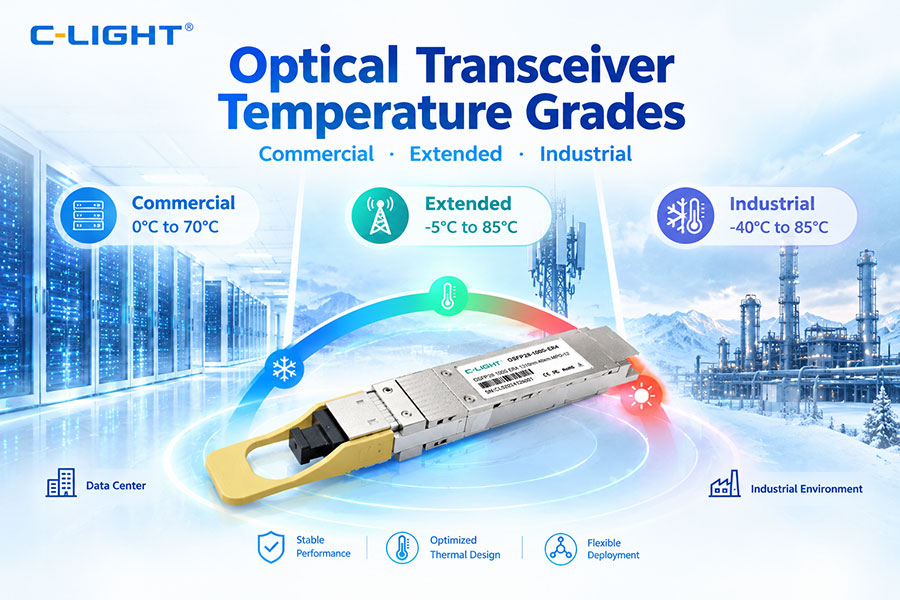
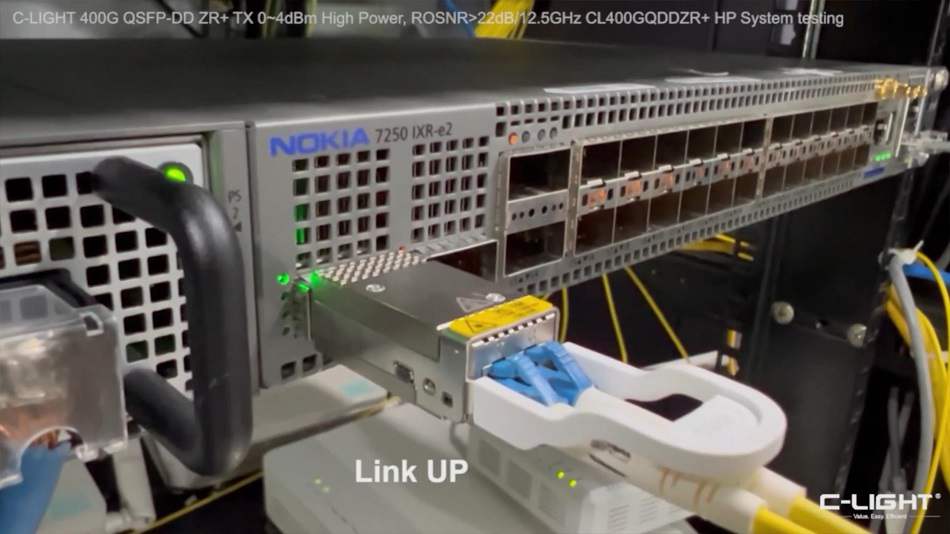
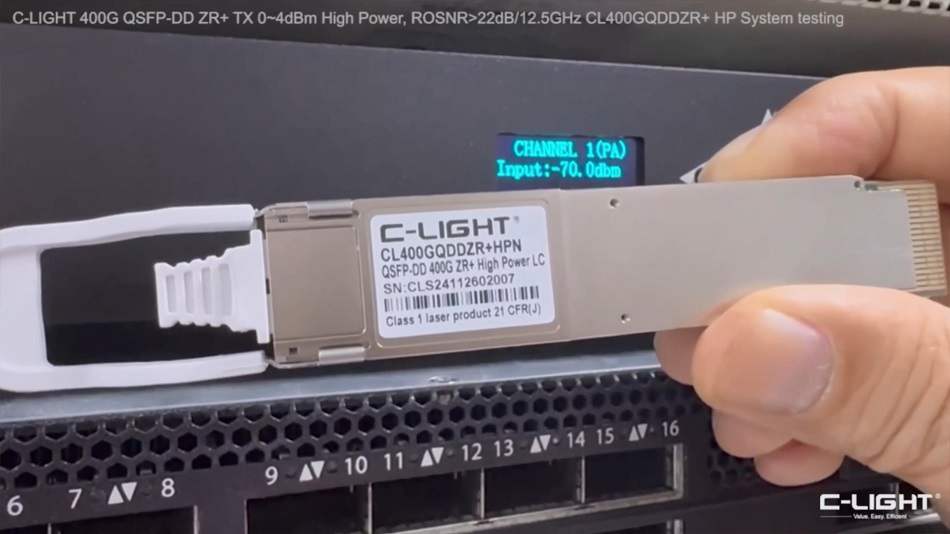
Among these, the QSFP-DD DWDM ZR+ High Power model offers a high transmit power of 0dBm, supporting 80km transmission over unamplified links and up to 500km with amplifiers. This model maintains power consumption within 22W and supports an extended operating temperature range from -20°C to 80°C, adapting to diverse deployment environments. C-LIGHT provides a 3-year warranty, long-term maintenance, and professional free technical guidance services for all products, with 100% factory testing conducted on all modules.
4.4 System-Level Solutions
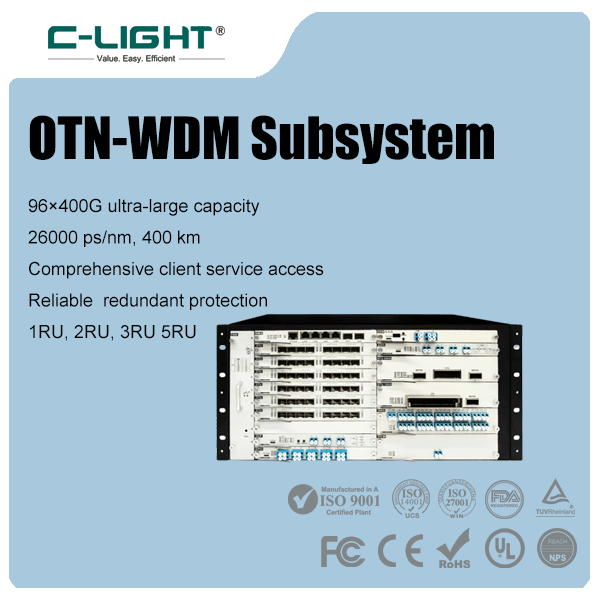
Beyond discrete optical modules, C-LIGHT offers OTN-WDM subsystems. This 400G system utilizes 16QAM coherent coding technology, supports OFEC soft-decision FEC, exhibits excellent B2B OSNR tolerance, features a dispersion tolerance of 26,000 ps/nm, and supports unrepeatered transmission exceeding 400km. The subsystem is optimized for multiple scenarios including 5G fronthaul, cloud-network convergence, and mission-critical networks, providing carriers and enterprise users with comprehensive end-to-end optical transmission solutions.
V. Technology Evolution and Future Outlook
From an industry evolution perspective, 400G optical modules stand at a critical juncture of technological iteration. On one hand, the maturity of 400G per-lane PAM4 technology lays the core foundation for next-generation 3.2T (8×400G) optical modules, with commercialization expected to begin around 2027-2028. On the other hand, Co-Packaged Optics (CPO) technology is gaining increasing industry attention, with major players like Nvidia explicitly betting on CPO for AI scale-up and scale-out architectures.
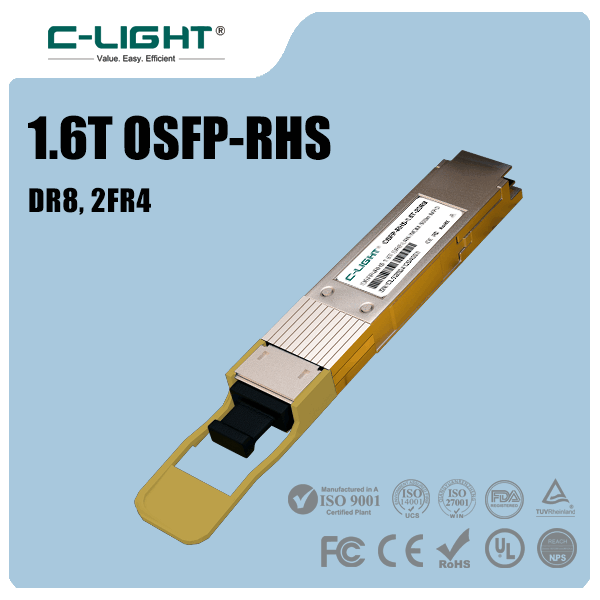
Simultaneously, Silicon Photonics platforms are undergoing a dual evolution from cost optimization to performance enhancement. Solutions replacing eight lasers with just two lasers have been validated in 1600G-DR8 modules. In the pluggable module sector, new form factor standards like the XPO MSA are exploring next-generation solutions that quadruple density and incorporate liquid cooling, potentially supporting over 400 watts per pluggable module.
For 400G modules themselves, their lifecycle is expected to persist for several more years. DWDM 400G technology is steadily expanding from DCI applications into metro, long-haul, and even submarine cable scenarios. With the integration of C+L band technologies, the continued proliferation of coherent solutions, and increasing DSP capabilities, 400G optical modules will continue to play a central role in optical communication networks for years to come. Domestic optical module manufacturers like C-LIGHT, with their complete product portfolio spanning from SR to ZR+ and flexible customization capabilities, are securing an increasingly significant position in the global 400G competitive landscape.
 >
>

 >
>
 >
>
 >
>
 >
>
 >
>
 >
>
 >
>