TEL:+86 132 6656 7067





As AI clusters and hyperscale data centers expand, switch bandwidth is becoming a major factor in network architecture. Increasing the capacity of each optical port allows equipment manufacturers to deliver more aggregate bandwidth without proportionally increasing the number of front-panel connections. This is one of the main reasons the industry is moving from 800G to 1.6T optical connectivity.
Both 800G OSFP and 1.6T OSFP use the eight-lane OSFP architecture, but they operate at different electrical lane rates. The 800G generation provides approximately 100Gb/s per lane, while 1.6T raises the lane bandwidth to approximately 200Gb/s. As a result, 1.6T can double the bandwidth available through an individual port while maintaining a similar overall port-count architecture.
However, higher bandwidth per port does not automatically mean twice the usable rack density. Power delivery, cooling capacity, host SerDes performance, module compatibility, and optical cabling all influence the actual system-level result.
1. What Is 800G OSFP Density?
800G OSFP is a high-speed pluggable optical interface designed to provide an aggregate bandwidth of 800Gb/s. It commonly uses eight electrical lanes, each carrying approximately 100Gb/s of data through 112G-class PAM4 electrical signaling.
The OSFP form factor supports high-density front-panel connectivity in data-center switches, routers, and high-performance computing equipment. Multiple OSFP ports can be installed across a switch front panel, allowing a large number of high-speed optical links to operate within a compact chassis.
For example, a switch with 32 active 800G OSFP ports provides:
32 ports × 800Gb/s = 25.6Tb/s
This represents the theoretical aggregate bandwidth across the 32 ports, assuming every port operates at its full 800Gb/s capacity.
800G OSFP density is therefore determined by both the number of available ports and the bandwidth supported by each port. The OSFP module itself does not determine the complete switch capacity; the host ASIC, electrical interface, internal switching fabric, and system design must also support the required throughput.
2. What Is 1.6T OSFP Density?
1.6T OSFP, also known as OSFP1600, extends the OSFP platform to an aggregate data rate of 1.6Tb/s per module. It uses eight high-speed electrical lanes, each supporting approximately 200Gb/s through 224G-class PAM4 signaling.
The main architectural improvement is the increase in bandwidth per lane rather than a doubling of the lane count. This allows a 1.6T module to deliver twice the aggregate bandwidth of an 800G module through an eight-lane host interface.
For a switch equipped with 32 active 1.6T OSFP ports:
32 ports × 1.6Tb/s = 51.2Tb/s
The same number of ports can provide twice the theoretical aggregate bandwidth of a 32-port 800G configuration.
This increase is particularly relevant to AI infrastructure, where large numbers of GPUs and accelerators exchange data across high-capacity network fabrics. Higher per-port bandwidth can reduce the number of physical connections required to achieve a given aggregate network capacity.
3. 1.6T OSFP vs 800G OSFP: Density Specifications
The following table highlights the main differences affecting bandwidth density and switch design.
| Technical Parameter | 800G OSFP | 1.6T OSFP |
|---|---|---|
| Aggregate Port Bandwidth | 800Gb/s | 1.6Tb/s |
| Electrical Lane Count | 8 lanes | 8 lanes |
| Approximate Data Rate per Lane | 100Gb/s | 200Gb/s |
| Electrical Signaling Class | 112G-class PAM4 | 224G-class PAM4 |
| Host Interface | 800GAUI-8 class | 1.6TAUI-8 class |
| OSFP Family | OSFP800 | OSFP1600 |
| Bandwidth per Port | 800Gb/s | 1,600Gb/s |
| Bandwidth Increase | Baseline | 100% higher per port |
| Port Count Potential | Up to 36 OSFP ports per 1U front panel under the MSA reference capability | Up to 36 OSFP ports per 1U front panel under the MSA reference capability, subject to implementation |
| Thermal Requirements | High, depending on module design | More demanding, with higher-power cooling provisions |
The OSFP MSA identifies the eight-lane electrical architecture and defines support for 800G and 1.6T performance grades. The physical implementation also includes specific mechanical requirements for OSFP1600 modules. Therefore, the shared OSFP family name should not be interpreted as meaning that every 800G and 1.6T module is mechanically or electrically interchangeable.
4. Bandwidth Density per Switch Port
The most direct density benefit of 1.6T OSFP appears when comparing switches with the same number of optical ports. Because each 1.6T port carries twice the bandwidth of an 800G port, the aggregate front-panel capacity doubles without requiring twice as many module positions.
| OSFP Port Count | 800G Switch Capacity | 1.6T Switch Capacity |
|---|---|---|
| 16 ports | 12.8Tb/s | 25.6Tb/s |
| 24 ports | 19.2Tb/s | 38.4Tb/s |
| 32 ports | 25.6Tb/s | 51.2Tb/s |
| 36 ports | 28.8Tb/s | 57.6Tb/s |
These figures represent theoretical aggregate port bandwidth, not guaranteed switch throughput or a specification for every commercial chassis. Actual port availability depends on the switch ASIC, PCB design, power budget, cooling architecture, and front-panel layout.
For a fixed target bandwidth, 1.6T can also reduce the number of required ports. For example, a theoretical 25.6Tb/s aggregate connection capacity requires 32 ports at 800G but only 16 ports at 1.6T.
This can reduce the number of module positions, optical connectors, and associated cabling interfaces needed for a given capacity. The actual reduction in total system cost or physical footprint depends on the network topology and equipment design.
5. Rack-Level Bandwidth Density
Front-panel bandwidth density is only one part of rack-level network capacity. A data center may contain several switching layers, network interface cards, optical distribution panels, and fiber management systems. Increasing the capacity of each switch port can influence the entire network layout.
Consider a simplified example in which a rack-level network design requires 51.2Tb/s of aggregate switch-facing port bandwidth:
800G architecture: 64 ports are needed to provide 51.2Tb/s of nominal aggregate capacity.
1.6T architecture: 32 ports provide the same nominal aggregate capacity.
The 1.6T arrangement uses half as many ports for this specific bandwidth target. It may reduce the number of optical module positions and simplify some cable-management requirements.
However, fewer ports do not always translate into fewer fibers or smaller optical distribution systems. Fiber count depends on the optical interface used by each transceiver. Parallel optics, wavelength multiplexing, duplex-fiber designs, and breakout configurations have different cabling requirements.
Network engineers should therefore evaluate bandwidth density together with the complete optical connectivity plan, rather than using port count as the only measure of rack efficiency.
6. Electrical Lane Rate and Signal Integrity
The transition from 800G to 1.6T places significantly greater demands on the electrical interface between the switch ASIC and the optical module.
800G OSFP commonly uses eight electrical lanes operating at approximately 100Gb/s per lane. 1.6T OSFP increases this to approximately 200Gb/s per lane, requiring a substantially faster electrical signaling environment.
At these speeds, system designers need to consider:
Host SerDes capability: The switch ASIC must support the required 200G-class electrical lanes for native 1.6T operation.
PCB insertion loss: High-frequency signal attenuation becomes more challenging as electrical data rates increase.
Signal integrity: Crosstalk, reflections, impedance discontinuities, and channel loss require careful control.
Connector performance: The module connector and host PCB layout must support the relevant electrical signaling requirements.
Equalization and DSP: Electrical and optical signal-conditioning architectures must be designed for the target lane rate.
These requirements mean that replacing an 800G module with a 1.6T module is not simply a matter of changing the optical transceiver. The host platform must also support the higher electrical interface speed.
7. Power Consumption and Cooling Density
Higher bandwidth density creates a more demanding thermal environment. Although 1.6T doubles the nominal bandwidth per port, the module's power consumption does not necessarily remain the same as that of an 800G module.
Higher-speed electrical and optical components, laser sources, DSP functions, and signal-conditioning circuits can increase module power requirements. The actual value depends on the product architecture, optical reach, modulation implementation, and operating conditions.
The OSFP MSA Rev. 5.21 specifies a maximum power capability of up to 42.9W for OSFP1600. This is a standards-level maximum capability, not a claim that every 1.6T module consumes 42.9W in normal operation. Individual product datasheets should be used for actual power specifications.
For a switch with 32 populated ports, the total module power can become a major system-design consideration. Higher module power increases the requirements for:
Airflow through the module heatsinks and chassis.
Heat dissipation around densely populated cages.
Power-supply capacity and distribution.
Thermal monitoring and fan-control strategies.
Liquid-cooling or advanced cooling options in high-density platforms.
The result is an important distinction between theoretical bandwidth density and deployable bandwidth density. A switch may have enough physical port positions for 1.6T modules, but its power and cooling architecture must also support the intended population and workload.
8. OSFP and OSFP1600 Mechanical Compatibility
Although 800G OSFP and 1.6T OSFP belong to the same form-factor family, the OSFP MSA defines specific mechanical details for OSFP1600. These include changes to the module card edge and latch specifications.
The MSA describes the following compatibility behavior:
| Host Port / Cage | Installed Module | MSA Compatibility Guidance |
|---|---|---|
| OSFP / OSFP800 port | OSFP / OSFP800 module | Supported use case. |
| OSFP1600 port | OSFP1600 module | Supported use case. |
| OSFP1600 port | OSFP / OSFP800 module | Supported backward compatibility; module operates according to its own capabilities. |
| OSFP / OSFP800 port | OSFP1600 module | Not advisable. The module may be inserted and powered, but operation at its designed maximum speed and mechanical reliability are not guaranteed. |
This distinction matters when planning an upgrade path. A switch designed for OSFP1600 may support backward operation with an 800G OSFP module, but an existing 800G port should not be assumed to support a 1.6T module at its full performance.
OSFP and OSFP-RHS also have different cooling arrangements. Integrated-heatsink modules and riding-heatsink modules require the corresponding host cage and cooling design. Their mechanical variants should not be treated as interchangeable simply because they belong to the same OSFP family.
9. Optical Architecture and Breakout Options
Bandwidth density also depends on how the optical lanes are distributed between modules and network devices. Both 800G and 1.6T systems can use different optical architectures, including parallel single-mode optics, multimode optics, and wavelength-multiplexed designs where supported.
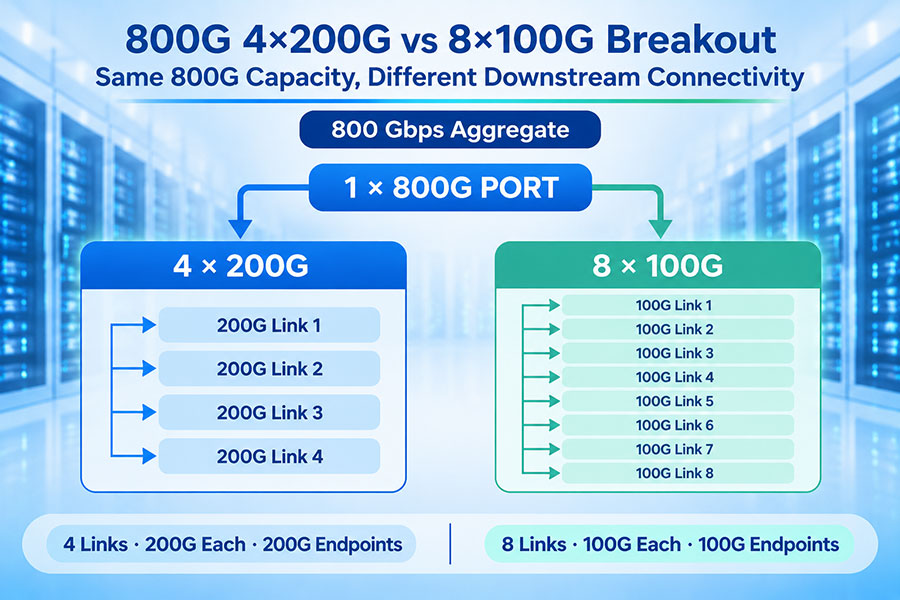
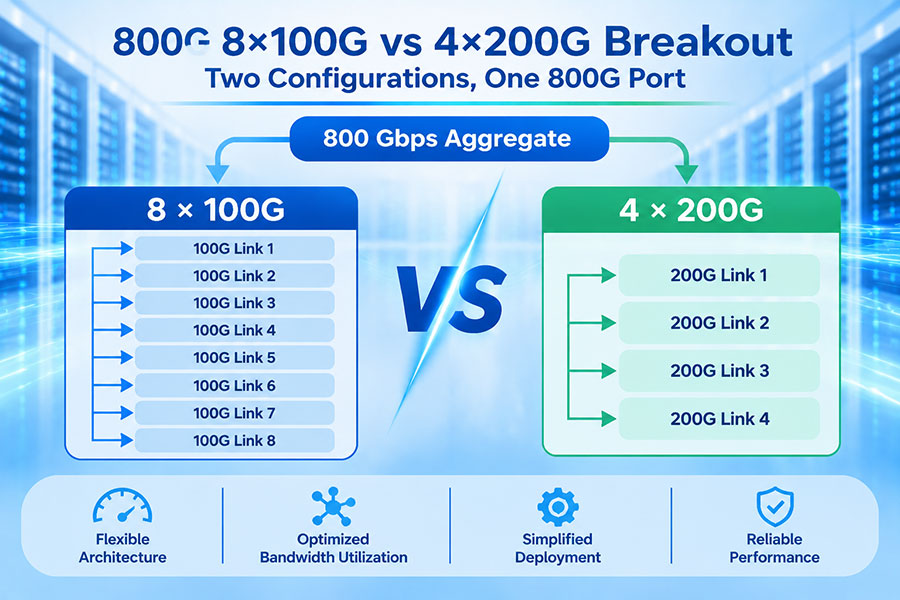
Some 1.6T implementations support two independent 800G connections through a single module. For example, Arista's 1.6T transceiver portfolio includes dual-800G optical configurations. This allows a 1.6T module to support either a single aggregate 1.6T connection or two independent 800G links when the host and module configuration support that mode.
Breakout capabilities can provide useful migration options, but they are not universal across all modules. Engineers should verify:
Supported electrical lane mapping.
Optical lane count and wavelength configuration.
Connector type and fiber polarity.
Host switch breakout modes and software support.
Compatibility with the remote transceiver or network interface.
In particular, 200G PAM4 optical channels are not automatically interoperable with older 100G PAM4 optical channels. A module may require a suitable gearbox architecture or a specific host configuration to connect with existing 400G or 800G equipment.
10. 1.6T OSFP vs 800G OSFP for AI Data Centers
AI training and inference clusters generate large volumes of traffic between accelerators, switches, and storage systems. As GPU counts increase, the network must provide sufficient bandwidth while keeping latency, congestion, and infrastructure complexity under control.
Moving from 800G to 1.6T OSFP can provide several architectural advantages:
Higher switch bandwidth: Each optical port can provide twice the nominal capacity.
Fewer ports for a fixed bandwidth target: Network designers can reduce the number of required physical connections in suitable configurations.
Higher front-panel capacity: More aggregate bandwidth can be delivered through a similar number of module positions.
Potentially simpler cabling layouts: Fewer ports may reduce some connector and cable-management requirements.
Support for larger network fabrics: Higher per-port bandwidth can help scale high-capacity switch architectures.
However, 1.6T adoption also requires compatible switches, 200G-class SerDes, suitable optical infrastructure, higher-capacity power delivery, and adequate cooling. In many deployments, 800G remains attractive because of its established ecosystem and broad equipment availability.
The choice depends on the timing of infrastructure upgrades, target network capacity, equipment qualification, and total cost of ownership.
11. How to Choose Between 800G and 1.6T OSFP
The correct choice depends on whether the network prioritizes immediate deployment, equipment maturity, or maximum bandwidth density for the next generation of infrastructure.
| Selection Factor | 800G OSFP | 1.6T OSFP |
|---|---|---|
| Bandwidth per Port | 800Gb/s | 1.6Tb/s |
| Port Density | High-density OSFP connectivity. | Twice the bandwidth per port within the OSFP family. |
| Host Platform | Requires 100G-class electrical lanes. | Requires 200G-class electrical lanes for native operation. |
| Thermal Design | High-power module cooling requirements. | More demanding power and cooling provisions. |
| Deployment Considerations | Suitable for existing 800G-capable infrastructure. | Requires compatible 1.6T host ports and system design. |
| Migration Strategy | Established option for current high-speed networks. | Supports higher-capacity network upgrades and selected 800G breakout configurations. |
| Typical Priority | Deployment maturity and broad ecosystem support. | Higher bandwidth density and future network scaling. |
For an existing 800G network, retaining 800G OSFP may be more practical when the current switch platform cannot support 200G-class electrical lanes. For new infrastructure designed around 1.6T switching, the higher per-port capacity can provide a more scalable path, provided the power and cooling requirements are addressed.
12. C-LIGHT 800G and 1.6T Optical Connectivity
High-speed optical connectivity is an important part of modern data-center and AI network infrastructure. C-LIGHT's optical transceiver portfolio covers multiple data rates and application categories, including high-speed optical modules for data-center connectivity.
Relevant product categories include:
800G OSFP optical transceivers: For high-bandwidth switch-to-switch and data-center links.
800G OSFP DAC and AEC: Short-reach copper interconnect options for suitable equipment configurations.
1.6T OSFP optical transceivers: For next-generation high-capacity optical connectivity.
1.6T OSFP DAC and AEC: High-speed electrical interconnect options for supported short-reach applications.
Product selection should be based on the exact module specification, host interface, lane rate, optical reach, connector, power consumption, and cooling requirements. The 800G and 1.6T categories should not be assumed to share universal host compatibility.
Visit the C-LIGHT optical transceiver portfolio for available optical connectivity categories and the complete C-LIGHT product range for additional interconnect solutions.
Planning an 800G or 1.6T network upgrade?
Contact C-LIGHT for assistance with optical module selection, interface requirements, transmission distance, and equipment compatibility.
13. Conclusion
1.6T OSFP provides twice the nominal bandwidth per port compared with 800G OSFP, using eight approximately 200Gb/s electrical lanes instead of eight approximately 100Gb/s lanes. With the same number of ports, a switch can theoretically double its aggregate front-panel bandwidth.
For example, a 32-port configuration increases from 25.6Tb/s at 800G per port to 51.2Tb/s at 1.6T per port. This creates a significant opportunity to improve bandwidth density in AI data centers and high-capacity network fabrics.
Nevertheless, practical density depends on more than port bandwidth. Host SerDes capability, module power, thermal management, mechanical compatibility, and optical cabling all influence the final system design. 800G remains suitable for established platforms, while 1.6T provides a higher-capacity option for next-generation infrastructure designed to support 200G-class lanes.
 >

 >
 >
 >
 >
 >
 >
 >