TEL:+86 132 6656 7067




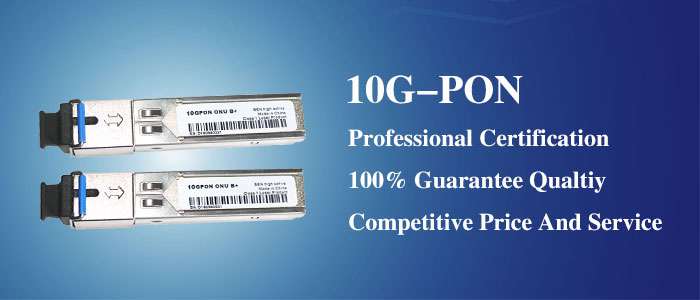
10 Gbps passive optical network (10G-PON) is a next-generation solution following the current-generation gigabit passive optical network (GPON) (ITU-T G.984) and Ethernet passive optical network (EPON) (IEEE 802.3ah) solutions, basically offering higher bandwidth and additional features. Like its predecessors, 10G-PON will allow multiple users to share the capacity over a passive fiber-optic “tree” infrastructure, where the fibers to individual users branch out from a single fiber running to a network node.
In September 2009, the Institute of Electrical and Electronics Engineers (IEEE) approved 802.3av as a 10G-EPON standard, including both 10/1 Gbps and symmetrical 10 Gbps implementations. In October 2010, the International Telecommunication Union (ITU) approved the ITU-T G.987.1 and G.987.2 10G-PON standards with asymmetrical and symmetrical implementations.Asymmetrical 10G-PON (specified by the Full Service Access Network [FSAN] as XG-PON1) provides 10 Gbps downstream and 2.5 Gbps upstream. Symmetrical 10G-PON (specified by FSAN as XG-PON2) provides 10 Gbps both ways.
10G-PON uses different downstream and upstream wavelengths (1,577 nanometers [nm] and 1,270nm respectively) to those used by GPON, so that both systems can coexist on the same fiber architecture. This allows communications service providers (CSPs) to supply GPON services to the majority of their subscribers, while providing higher-bandwidth 10G-PON to premium subscribers, such as enterprises, or for the deployment of broadband to high-density multidwelling units.
This article is edited by C-light Network. Please contact us if any future opportunities arise where we can be of service to you.
10G PON Optical Network FAQ
Q1: What is 10G PON technology?
Answer: 10G PON (10 Gigabit Passive Optical Network) is a next-generation fiber access technology designed to provide higher bandwidth than traditional GPON networks.
10G PON enables high-speed optical communication between:
OLT (Optical Line Terminal)
ONU/ONT (Optical Network Unit / Optical Network Terminal)
End-user devices
Compared with traditional GPON, 10G PON provides significantly higher bandwidth capacity to support applications such as:
Gigabit broadband access
Enterprise networking
Cloud services
5G backhaul
High-bandwidth residential services
10G PON has become an important upgrade path for modern fiber access networks.
Q2: Why is 10G PON important for fiber access networks?
Answer: The rapid growth of cloud computing, video services, smart homes, and enterprise applications is increasing demand for higher bandwidth.
Traditional GPON networks may face limitations when supporting:
Multi-gigabit broadband services
High-density user access
Enterprise connectivity
Future digital applications
10G PON helps operators achieve:
Higher access bandwidth
Better network scalability
Improved fiber utilization
Smooth migration from existing PON infrastructure
It provides a foundation for future high-speed broadband networks.
Q3: What are the main types of 10G PON technologies?
Answer: The main 10G PON technologies include:
XG-PON
Based on ITU-T standards
Supports 10Gbps downstream transmission
Designed as an upgrade from GPON
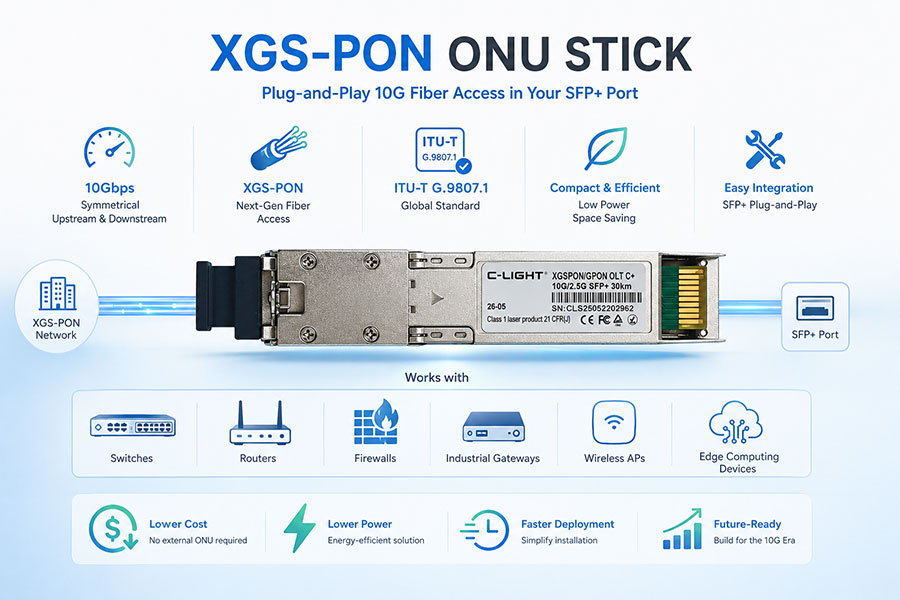
XGS-PON
Supports symmetrical 10Gbps upstream and downstream
Suitable for higher-bandwidth applications
10G EPON
Based on IEEE Ethernet PON standards
Supports 10Gbps optical access
Different technologies are selected based on operator requirements, existing network infrastructure, and service applications.
Q4: What is the difference between GPON and 10G PON?
Answer: The main difference between GPON and 10G PON is bandwidth capacity and future scalability.
| Feature | GPON | 10G PON |
|---|---|---|
| Downstream Speed | Lower bandwidth | Up to 10Gbps |
| Network Capacity | Standard broadband | High-speed broadband |
| Application | Traditional FTTH | Next-generation access |
| Scalability | Limited | Higher |
10G PON allows operators to upgrade network capacity while continuing to use much of the existing fiber infrastructure.
This makes it an efficient solution for long-term fiber network evolution.
Q5: How does a 10G PON network work?
Answer: A 10G PON network uses a point-to-multipoint fiber architecture to connect multiple users through a shared optical distribution network.
The main components include:
OLT (Optical Line Terminal)
Located at the service provider side and manages optical communication.
ODN (Optical Distribution Network)
Includes passive optical splitters and fiber distribution components.
ONU/ONT
Located at customer premises and converts optical signals into electrical data.
This architecture provides efficient fiber utilization and simplifies network expansion.
Q6: What are 10G PON optical modules used for?
Answer: 10G PON optical modules are key components used in OLT and ONU/ONT equipment to enable high-speed fiber communication.
Typical applications include:
Residential Broadband
FTTH deployment
Multi-gigabit internet access
Enterprise Networks
Business broadband
Campus connectivity
Telecom Networks
Access network upgrades
5G transport infrastructure
C-LIGHT 10G EPON OLT/ONU optical modules support different transmission distances and are designed for broadband access, enterprise networking, and FTTx applications.
Q7: How do you choose the right 10G PON solution?
Answer: Choosing a suitable 10G PON solution depends on several factors:
1. Network Standard
Select according to:
XG-PON
XGS-PON
10G EPON
2. Equipment Compatibility
Ensure compatibility with:
OLT systems
ONU/ONT devices
Network management platforms
3. Transmission Distance
Consider:
Fiber length
Optical power budget
Network environment
4. Application Requirements
Different solutions may be selected for:
Residential FTTH
Enterprise access
Telecom infrastructure
Proper selection ensures reliable and scalable fiber network deployment.
Q8: What is the future of 10G PON technology?
Answer: 10G PON will continue playing an important role in next-generation broadband infrastructure.
Future trends include:
Higher-speed access networks
Expansion of XGS-PON deployment
Integration with 5G networks
Smart city connectivity
Enterprise cloud access
As bandwidth requirements continue increasing, operators will gradually move from traditional GPON toward higher-capacity PON technologies.
10G PON provides a scalable foundation for future fiber communication networks.
 >
>

 >
>
 >
>
 >
>
 >
>
 >
>
 >
>
 >
>