TEL:+86 132 6656 7067




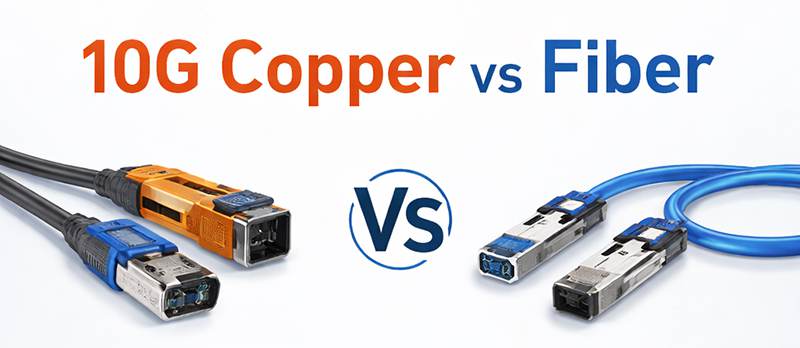
When deploying 10G Ethernet in real-world scenarios, engineers and procurement professionals often face a dilemma between copper and fiber transmission media. Copper cables are inexpensive but limited in reach; fiber spans long distances but comes at a higher cost. The choice between the two frequently determines the overall project cost, performance, and maintainability. This article provides a technical comparison of 10G copper and fiber solutions across key parameters and application scenarios, incorporating relevant product examples from C-LIGHT (Chengwang Network) to offer practical guidance for data center and enterprise network deployments.
Part I: Copper Solutions — The Workhorse for Low-Cost Short-Reach Interconnects
1.1 10G SFP+ DAC (Direct Attach Copper)
DAC (Direct Attach Copper) is the most economical option for short-distance 10G interconnects currently available. It is essentially a pre-terminated Twinax copper cable with SFP+ connectors fixed at both ends, ready for plug-and-play use straight out of the factory.
DAC cables are available in passive and active variants. Passive DACs contain no electronic components, transmitting electrical signals directly over copper with a typical reach of no more than 7 meters and virtually zero additional power consumption. Active DACs incorporate signal amplification chips, extending the reach up to 10 meters at the cost of increased power draw. Notably, DAC solutions are 30% to 50% less expensive than fiber-based alternatives — a cost advantage that becomes particularly significant in high-density intra-rack connections.
The three core strengths of DAC are low cost, low power consumption, and extremely low latency. Since no optical-to-electrical conversion is required, signals travel directly through the copper medium as electrical impulses, yielding latency typically in the sub-microsecond range — far lower than 10GBASE-T solutions. Moreover, DAC deployment is remarkably simple: no optical transceiver configuration, no fiber end-face cleaning; simply plug into an SFP+ port and it works, substantially reducing operational complexity.
The limitations of DAC are equally clear. Signal attenuation becomes severe beyond 7 meters due to the physical properties of copper, and copper cabling is susceptible to noise in environments with strong electromagnetic interference (EMI). Additionally, DAC cables cannot be repaired in the field — a damaged cable requires complete replacement.
1.2 10GBASE-T Copper SFP+ Modules
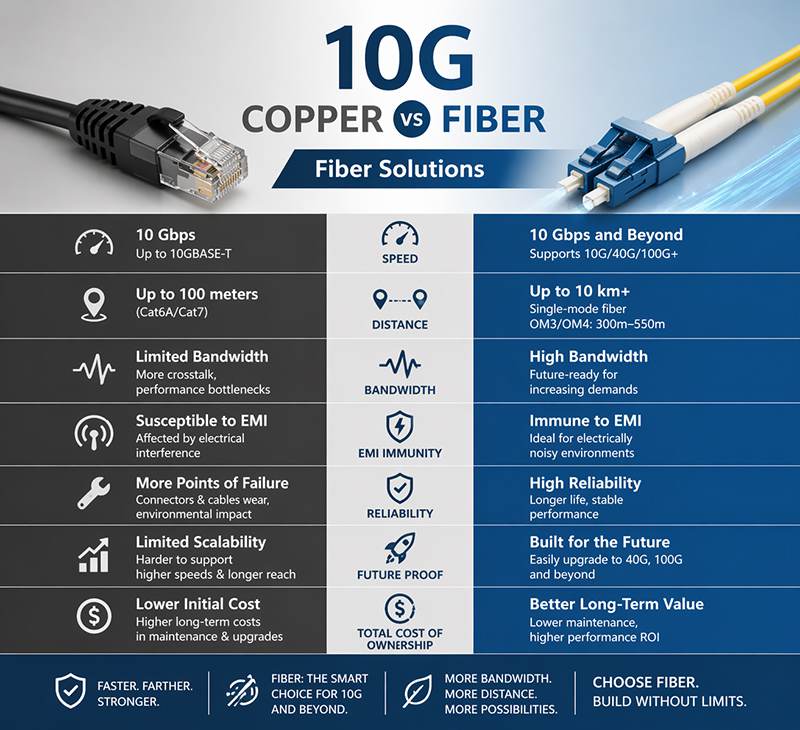
Beyond DAC, another copper-based alternative is the 10GBASE-T SFP+ module. These modules feature an RJ45 interface and operate with Cat6a or Cat7 twisted-pair cabling, supporting distances up to 100 meters. Their key advantage lies in compatibility with existing copper cabling infrastructure, enabling 10G upgrades without the need to replace cabling with fiber.
However, the trade-offs of 10GBASE-T are substantial. The complex encoding and decoding performed by the PHY chip results in significantly higher power consumption compared to both DAC and fiber solutions — typically 2 to 5 watts per port, whereas 10G fiber SFP+ modules generally consume less than 1 watt. In terms of latency, 10GBASE-T adds approximately 1.5 to 3 microseconds of additional delay, which is unacceptable for latency-sensitive applications such as high-frequency trading.
C-LIGHT Related Product: The C-LIGHT 10G Copper SFP+ 80m module exemplifies the 10GBASE-T copper approach. This module utilizes twisted-pair copper cabling as the transmission medium, offering a high-speed alternative to fiber transceivers and is designed for scenarios requiring 10G upgrades over existing copper infrastructure.
Part II: Fiber Solutions — Guaranteeing Long Reach and Immunity
2.1 SFP+ AOC (Active Optical Cable)
AOC (Active Optical Cable) is the fiber-based solution closest in form factor to DAC. It is also a pre-terminated cable assembly with SFP+ connectors fixed at both ends, but the transmission medium is optical fiber rather than copper, with built-in electro-optical conversion chips. The reach of AOC falls between pure DAC and the "optical transceiver plus patch cord" combination, typically supporting distances from 0.5 to 30 meters, with some multimode versions reaching up to 100 meters.
The most significant advantage of AOC is its immunity to electromagnetic interference. Fiber transmits signals as light, rendering it completely unaffected by EMI — a critical benefit in high-interference industrial environments and densely populated equipment racks. Furthermore, AOC is lighter and more flexible than DAC, facilitating easier cable management. In terms of cost, AOC is more expensive than DAC but more economical than the combination of separate optical transceivers and fiber patch cords.
C-LIGHT Related Product: C-LIGHT's self-developed 10G AOC active optical cable complies with the IEEE 802.3ae communication protocol, adheres to the SFF-8431 interface specification, and follows the SFP+ MSA packaging standard. Transmission distances range from 0.5 to 30 meters using 850nm multimode fiber. Compatible with over 100 switch brands, this AOC is primarily deployed in high-end server connectivity, data center networking, and various device interconnection scenarios.
2.2 SFP+ Optical Transceiver + Fiber Patch Cord
This is the most traditional and flexible fiber solution: a pluggable optical transceiver is inserted into the SFP+ port of the equipment, and a separate fiber patch cord connects the two ends. Depending on wavelength and fiber type, transmission distances can range from several hundred meters (multimode SR) to over 80 kilometers (single-mode LR/ER).
The primary value of this approach lies in its flexibility and serviceability. Since the transceiver and fiber are separate components, either can be replaced individually in the event of failure, avoiding the need to discard an entire cable assembly as with DAC or AOC. Additionally, fiber links can be seamlessly upgraded to 25G, 100G, and higher speeds simply by replacing the transceivers, without requiring recabling.
2.3 Industrial-Grade DWDM Solutions
For specialized scenarios requiring long-distance, high-capacity transmission, DWDM (Dense Wavelength Division Multiplexing) technology offers an advanced solution. By multiplexing multiple wavelengths over a single fiber, DWDM dramatically increases fiber utilization efficiency.
C-LIGHT Related Product: C-LIGHT's Multi-Rate DWDM industrial-grade module series covers SFP, SFP+, XFP, and other form factors, supporting data rates from 1G to 12G (actual support from 1.25Gbps to 10.7Gbps), compatible with Gigabit Ethernet, 10GE LAN/WAN, Fibre Channel, and other protocols. This series supports C-band 50GHz or 100GHz channel spacing, with wavelengths configurable as fixed or software-tunable across up to 96 channels. Transmission distances span 40km to 120km, and the operating temperature range extends from -40°C to +85°C, making these modules suitable for demanding environments such as 5G fronthaul, metro aggregation, and data center interconnect.
Part III: Side-by-Side Comparison Across Key Dimensions
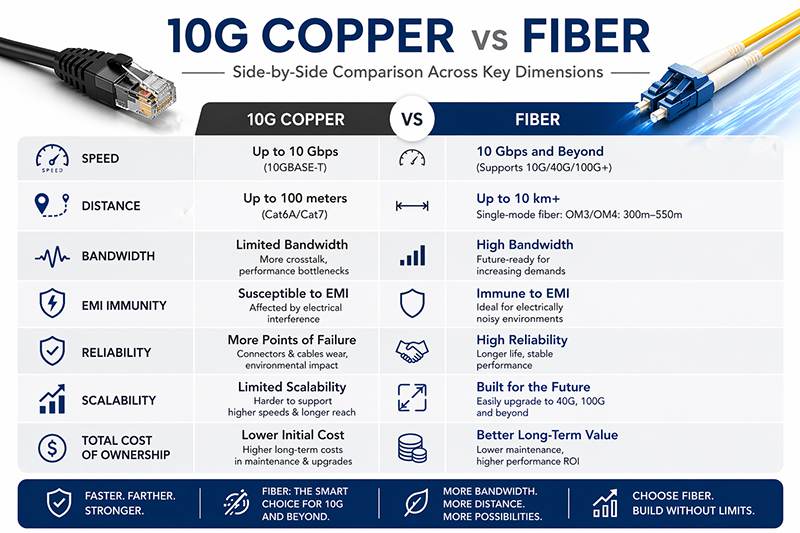
3.1 Transmission Distance
| Solution | Typical Distance | Maximum Distance |
| Passive DAC | 1-7 m | 10 m |
| Active DAC | 7-10 m | 10 m |
| AOC | 0.5-30 m | ~100 m |
| 10GBASE-T | ≤100 m | 100 m |
| Multimode Optics (SR) | ≤300-400 m | 400 m |
| Single-mode Optics (LR/ER) | 10-40 km | 80+ km |
DAC and AOC each occupy distinct niches in terms of reach: DAC excels at ultra-short connections within 7 meters, AOC covers the short-to-medium span of 10 to 30 meters, while "transceiver plus fiber" provides a universal solution for any distance. For copper cabling at a given power budget, transmission distance decreases markedly as bandwidth increases — at 10Gbps, copper reach is typically less than 10 meters.
3.2 Cost
From a per-port cost perspective, DAC is the least expensive option. Its simple construction, minimal internal components, and use of low-cost copper cabling result in significantly lower cost compared to AOC and "transceiver plus fiber" combinations. AOC comes next; while incorporating active electro-optical chips, it remains more economical than discrete transceiver solutions. The "transceiver plus patch cord" approach carries the highest initial cost but offers the greatest reach and flexibility.
3.3 Power Consumption
Power consumption ranking from lowest to highest: Passive DAC (near 0 W) < AOC (<1 w="">
3.4 Latency
Latency ranking from lowest to highest: Passive DAC (sub-microsecond) ≈ Fiber Transceiver (~300 ns) < AOC < 10GBASE-T (adds ~1.5-3 µs). For the vast majority of applications, the latency difference between DAC and fiber transceivers is negligible. However, the additional latency introduced by 10GBASE-T requires special consideration in latency-sensitive environments.
3.5 Immunity to Interference
Fiber, transmitting signals as light, is entirely immune to electromagnetic interference and offers the strongest immunity. Copper cabling in high-EMI environments is prone to noise pickup, which can cause signal degradation and data errors. In high-density equipment racks, industrial settings, or areas near high-power equipment, the reliability advantage of fiber solutions is particularly pronounced.
Part IV: Scenario-Based Selection Recommendations
Scenario 1: Server-to-Switch Connections Within the Same Rack (≤5 meters)
Recommended Solution: Passive DAC
Rationale: Distance is fully satisfied; lowest cost; near-zero power consumption; plug-and-play simplicity. C-LIGHT 10G DAC high-speed cables are available in 1m, 2m, 3m, and 5m lengths, comply with SFP+ MSA standards, and are compatible with over 100 switch brands — an ideal choice for this scenario.
Scenario 2: ToR Switch Interconnects Between Adjacent Racks (5-15 meters)
Recommended Solution: AOC or Fiber Transceiver
Rationale: Signal degradation in DAC becomes significant beyond 7 meters, while AOC reliably supports 10-30 meter reaches with superior EMI immunity. C-LIGHT 10G AOC active optical cables support 0.5 to 30 meter transmission distances using 850nm multimode fiber, providing a cost-effective and reliable connection for such deployments.
Scenario 3: Upgrading to 10G Over Existing Cat6a Cabling (≤100 meters)
Recommended Solution: 10GBASE-T Copper SFP+ Module
Rationale: Leverages existing cabling investment without the need for infrastructure replacement. Note the trade-offs in power consumption and latency. The C-LIGHT 10G Copper SFP+ 80m module is specifically designed for this requirement, using twisted-pair copper as the transmission medium to provide a high-speed alternative solution.
Scenario 4: Long-Distance Connections Between Buildings or Across Floors (>100 meters)
Recommended Solution: Single-mode Fiber Transceiver + Fiber Patch Cord
Rationale: Copper is incapable of supporting such distances; single-mode fiber is the only viable option. For specialized scenarios requiring higher capacity and extended reach, C-LIGHT Multi-Rate DWDM industrial-grade modules can multiplex multiple wavelengths over a single fiber, achieving transmission distances of 40 to 120 kilometers while supporting multi-rate adaptation from 1G to 12G.
Part V: Conclusion
The copper versus fiber debate is not fundamentally about one replacing the other, but rather about each fulfilling distinct roles and coexisting in complementary fashion. DAC dominates ultra-short intra-rack connections with unparalleled economy; AOC strikes a balance between immunity and flexibility; and optical transceivers underpin the backbone networks and long-haul links of data centers. As AI data centers and high-speed network construction accelerate, the global optical transceiver market is projected to reach $23.7 billion in 2026, with 800G and 1.6T products ramping significantly. Nevertheless, 10G-level foundational connectivity continues to account for a substantial volume of connections, and both copper and fiber solutions will maintain their respective positions for the foreseeable future. For engineers and procurement professionals, the goal should not be the pursuit of a single "optimal solution," but rather selecting the most appropriate medium for each individual connection based on actual distance, budget, power constraints, and future scalability.
Frequently Asked Questions (FAQ)
Q1. What is the difference between 10G copper and fiber solutions?
Answer: The main difference between 10G copper and fiber solutions is the transmission medium, distance capability, and application scenarios. Copper solutions such as 10G SFP+ DAC and 10GBASE-T provide cost-effective connectivity for short-distance links, while fiber solutions offer longer transmission distances, lower signal loss, and better immunity to electromagnetic interference for enterprise networks and data centers.
Q2. Which is better for 10G networks, copper or fiber?
Answer: The choice between 10G copper and fiber depends on network distance, cost, power consumption, and future scalability. Copper solutions are ideal for short-reach connections such as server-to-switch links, while fiber solutions are better suited for longer distances, high-density deployments, and networks requiring higher flexibility and reliability.
Q3. What is a 10G SFP+ DAC cable used for?
Answer: A 10G SFP+ DAC (Direct Attach Copper) cable is designed for short-distance 10GbE connections, mainly between servers, storage devices, and ToR switches inside data centers. It provides low latency, near-zero power consumption for passive versions, and a cost-effective solution for high-density rack connections.
Q4. What is the difference between 10G DAC and 10G optical transceivers?
Answer: The main difference between 10G DAC and optical transceivers is the transmission medium and deployment flexibility. DAC uses copper cables with fixed connectors and is optimized for short distances, while optical transceivers use fiber cables and support a wider range of applications from short-range data center links to long-distance network connections.
Q5. When should I choose a 10G fiber optical transceiver instead of copper?
Answer: A 10G fiber optical transceiver is recommended when longer transmission distance, lower power consumption, or stronger resistance to electromagnetic interference is required. Fiber solutions are commonly used for connections between racks, buildings, enterprise networks, telecom infrastructure, and data center interconnect (DCI) applications.
Q6. What is the difference between 10GBASE-T and 10G SFP+ fiber modules?
Answer: 10GBASE-T SFP+ modules use copper twisted-pair cables such as Cat6a or Cat7 with RJ45 interfaces, providing compatibility with existing Ethernet cabling. In comparison, 10G SFP+ fiber modules use optical fiber, offering lower power consumption, longer transmission distances, and better performance for high-density networking environments.
Q7. Should I choose 10G DAC or 10G AOC for data center connections?
Answer: The choice between 10G DAC and 10G AOC depends on connection distance and deployment requirements. DAC is suitable for very short connections due to its low cost and low power consumption, while AOC provides longer reach, lighter cabling, and better electromagnetic interference immunity for connections between adjacent racks or equipment rows.
Q8. What are the advantages of 10G fiber solutions over copper?
Answer: The advantages of 10G fiber solutions include longer transmission distance, lower signal attenuation, higher resistance to electromagnetic interference, and better scalability for future network upgrades. Fiber-based solutions are widely used in enterprise networks, data centers, and high-performance communication systems requiring reliable 10GbE connectivity.
 >
>

 >
>
 >
>
 >
>
 >
>
 >
>
 >
>
 >
>