TEL:+86 132 6656 7067




1. Introduction
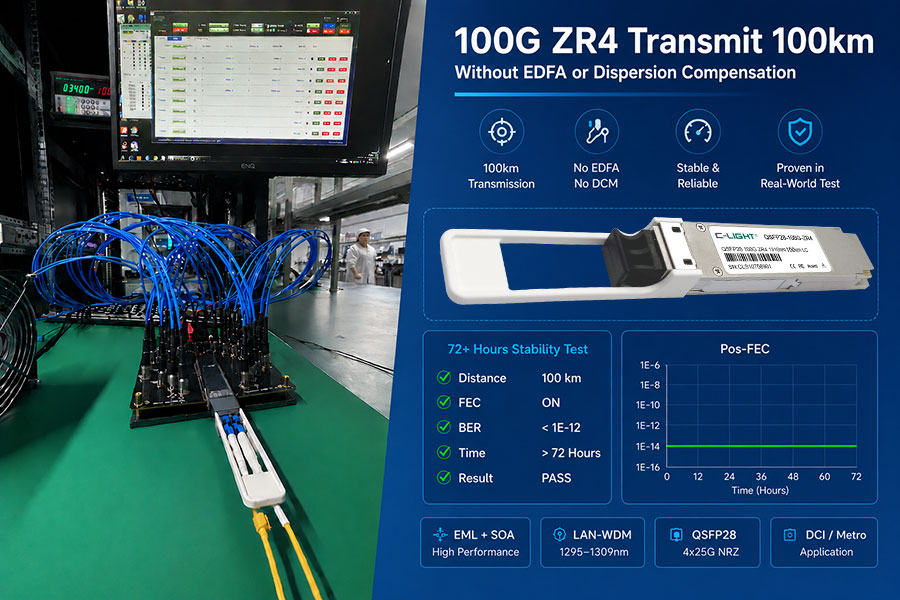
For many operators, enterprises, and data center providers, extending an existing dark fiber network from 40 km or 80 km to nearly 100 km without deploying expensive optical line systems has become an attractive objective.
The common question is:
Can a standard 100G QSFP28 ZR4 optical module reliably transmit over 100 km without using an EDFA or a Dispersion Compensation Module (DCM)?
The answer is:
It depends on the optical link budget rather than the transmission distance itself.
In this article, we explain why some 100G ZR4 links can successfully operate close to 100 km while others cannot, and present practical engineering considerations based on real deployment experience.
2. Why Is 80km the Official Specification?
Most 100G QSFP28 ZR4 modules are specified for 80 km over standard G.652 single-mode fiber.
This specification includes sufficient engineering margin for:
· Fiber attenuation
· Connector loss
· Splice loss
· Color Dispersion
· Aging margin
· Temperature variation
In reality, the optical hardware is often capable of transmitting beyond 80 km if the total insertion loss remains within the receiver sensitivity and optical budget. C-LIGHT notes that while ZR4 products are specified for about 80 km, actual reach depends on fiber quality and total insertion loss rather than distance alone.
3. The Real Limitation Is Optical Loss, Not Distance
Many engineers assume chromatic dispersion is the primary challenge.
For 100G ZR4 operating around 1310 nm, this is generally not the case.
Compared with C-band DWDM systems, O-band transmission exhibits much lower chromatic dispersion, making dispersion far less significant over the intended operating range. As a result, the dominant limitation becomes optical attenuation and receiver OSNR rather than accumulated chromatic dispersion.
Typical contributors to link loss include:
Item | Typical Loss |
Fiber attenuation | Max 0.32 dB/km (1310 nm) |
Connector pair | 0.3–0.5 dB |
Fusion splice | 0.05–0.1 dB |
Patch panel | 0.2–0.5 dB |
A nominal 100 km link may therefore experience total losses approaching or exceeding the optical budget of a direct-detection ZR4 module unless the fiber plant is exceptionally clean.
4. Can 100km Work Without EDFA?
The answer is:
Yes—but only under favorable conditions.
A successful 100 km deployment typically requires:
✓ Low-loss G.652.D fiber
✓ Minimal connector count
✓ High-quality fusion splicing
✓ Clean optical interfaces
✓ No excessive patch panels
✓ Total insertion loss within the module's optical budget
P/N | TX Power (Each Lane) | RX Sensitivity (Each Lane) | Power Budget | Reach depends on 2dB CD off and power loss @ 0.32dB/km |
> 4dBm / Lane | <-30dbm> | 34dBm | 100km |
100G QSFP28 XZR4 100km Transceiver Commercial Level 0℃~70℃
If total end-to-end attenuation exceeds the available optical budget, communication becomes unstable regardless of the physical distance.
Industry discussions also note that some 100GBASE-ZR4 deployments can exceed 80 km on exceptionally low-loss dark fiber, but such operation is considered outside the standard guaranteed specification.
5. Recommended Test Method
A meaningful verification should include:
Test Environment
· Two 100G Ethernet switches
· Two CL100GQSFPXZR4
· Duplex G.652.D single-mode fiber
· No EDFA
· No DCM
· No ROADM
· Direct dark fiber
Measurements
· TX Optical Power
· RX Optical Power
· CRC Status
· FEC Status
· Module Temperature
· DOM Monitoring
· Traffic Stability
· 72-hour Continuous Traffic Test
Only long-duration testing under full traffic load can demonstrate whether the link has sufficient engineering margin
6. Expected Test Results
Fiber Distance | Expected Result |
80 km | Stable (FEC Disable) |
85 km | Stable (FEC Enable) |
90 km | Stable (FEC Enable); RX power > -25dBm |
95 km | Stable (FEC Enable); RX power > -26.5dBm |
100 km | Stable (FEC Enable); RX power > -28dBm |
Distance alone should never be used as the acceptance criterion.
Instead, engineers should evaluate:
· Optical budget
· BER
· Long-term stability
· DOM statistics
· Receiver margin
7. When Should EDFA Be Used?
An EDFA becomes advisable when:
· Link loss exceeds module specifications
· Multiple patch panels are present
· DWDM MUX/DEMUX insertion loss is introduced
· Aging margin is required
· Carrier-grade availability is mandatory
For many metro and enterprise DCI deployments below approximately 80 km, direct ZR4 connections without amplification can significantly reduce CAPEX and operational complexity. Beyond that range, careful optical budget analysis becomes essential.
8. Recommended C-LIGHT Products
Based on different deployment scenarios, the following C-LIGHT products are recommended.
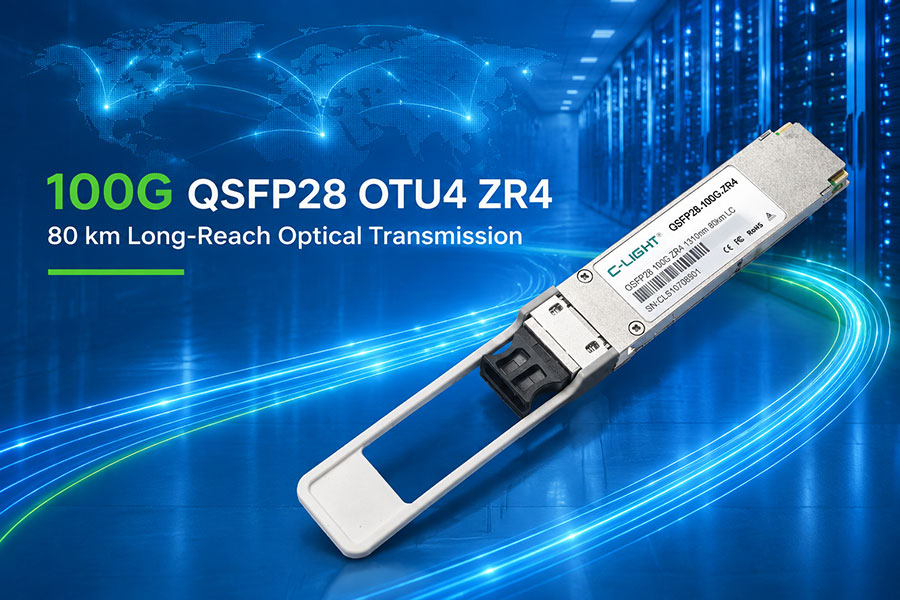
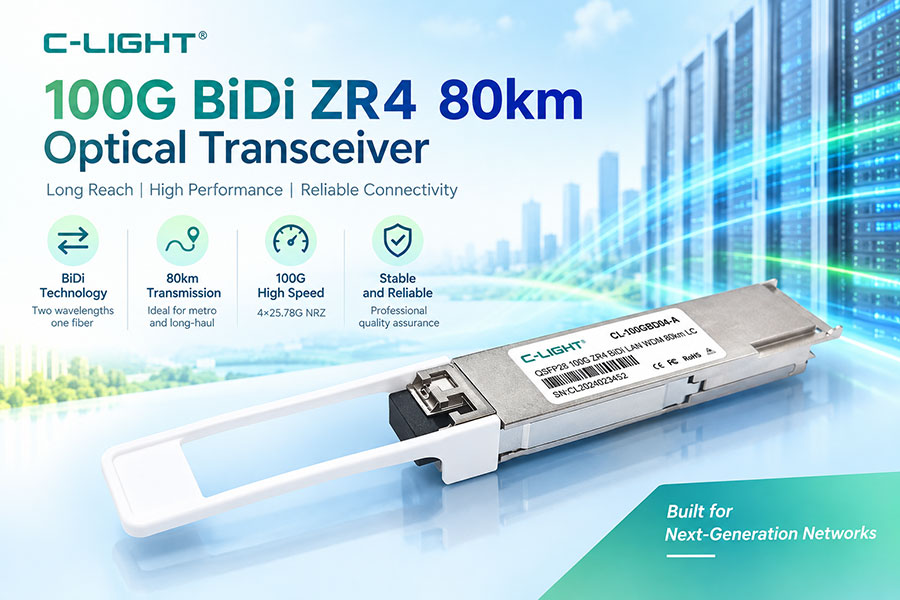
Option 1 — 100G QSFP28 ZR4 (80 km)
100G QSFP28 ZR4 80km Transceiver Commercial Level 0℃~70℃
Recommended for:
· Metro DCI
· Enterprise backbone
· Campus interconnection
· ISP aggregation
· Dark fiber links up to approximately 80 km
Advantages:
· Plug-and-play deployment
· No external transponder
· Low power consumption
· Low latency
· High compatibility
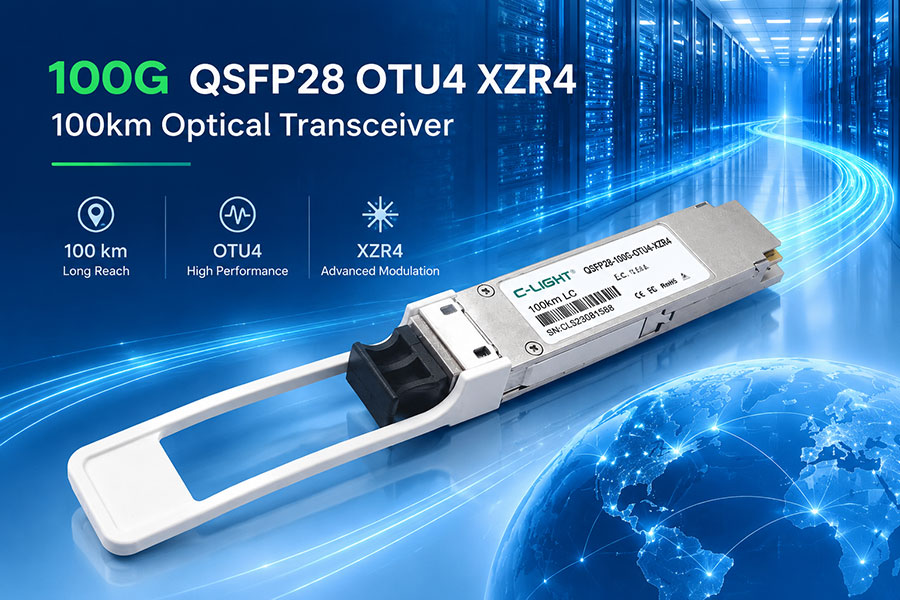
Option 2 — C-LIGHT 100G QSFP28 XZR4
100G QSFP28 XZR4 100km Transceiver Commercial Level 0℃~70℃
Recommended for:
· High-quality dark fiber
· Long-span enterprise networks
· Carrier access networks
· Links approaching 100 km after engineering validation
Typical features include:
· Enhanced transmit optical power
· Improved receiver sensitivity
· Optimized optical budget
· Stable operation without external EDFA on qualified fiber links
Option 3 — 100G QSFP28 DCO (Coherent)
400G QSFP-DD ZR+ High Power(+1dBm) Coherent Transceiver丨C-LIGHT
Recommended for:
· 100 km+
· DWDM transport
· ROADM networks
· Carrier backbone
· Long-haul transmission
Unlike direct-detection ZR4 modules, coherent DCO optics incorporate DSP and are designed for significantly longer transmission distances with much higher chromatic-dispersion tolerance.
9. Conclusion
Although the official specification for most 100G QSFP28 ZR4 modules is 80 km, successful transmission approaching 100 km is achievable in carefully engineered networks with exceptionally low-loss fiber and sufficient optical margin.
Rather than focusing solely on transmission distance, network designers should prioritize:
· Total optical loss
· Link budget
· Fiber quality
· Long-term BER performance
· Environmental margin
For metro DCI and enterprise backbone applications, C-LIGHT's 100G QSFP28 ZR4 and 100G QSFP28 XZR4 solutions provide a practical and cost-effective approach to extending 100G connectivity without relying on external optical amplification or dispersion compensation, provided that the link is validated through comprehensive testing.
10. Frequently Asked Questions (FAQ)
Q1. Can a standard 100G ZR4 reach 100 km?
Answer: Possibly, but only if the total insertion loss remains within the module's optical budget (<32 db="">). Transmission distance alone does not determine success. Fiber attenuation, connector loss, splice loss, and overall link margin must all be considered during network design.
Q2. Is chromatic dispersion the main limitation for 100G ZR4?
Answer: No. Because 100G ZR4 operates in the O-band (around 1310 nm), chromatic dispersion is relatively low. In most long-distance deployments, optical attenuation and available link budget are the primary factors limiting transmission reach.
Q3. When is an EDFA required?
Answer: An EDFA (Erbium-Doped Fiber Amplifier) should be considered when total span loss exceeds the optical budget of the transceiver or when additional engineering margin is required to improve transmission stability and reliability.
Q4. Which C-LIGHT product is best for long-distance 100G transmission?
Answer: C-LIGHT provides multiple 100G long-distance optical solutions for different application scenarios:
100G QSFP28 XZR4 — ideal for standard metro links up to approximately 100 km.
100G QSFP28 ZR4 FEC-Free — suitable for low-loss, high-quality dark fiber where extended reach is required after engineering validation.
100G QSFP28 DCO — recommended for 100 km+ DWDM and carrier-grade long-haul optical transmission applications.
 >
>

 >
>
 >
>
 >
>
 >
>
 >
>
 >
>
 >
>