TEL:+86 132 6656 7067




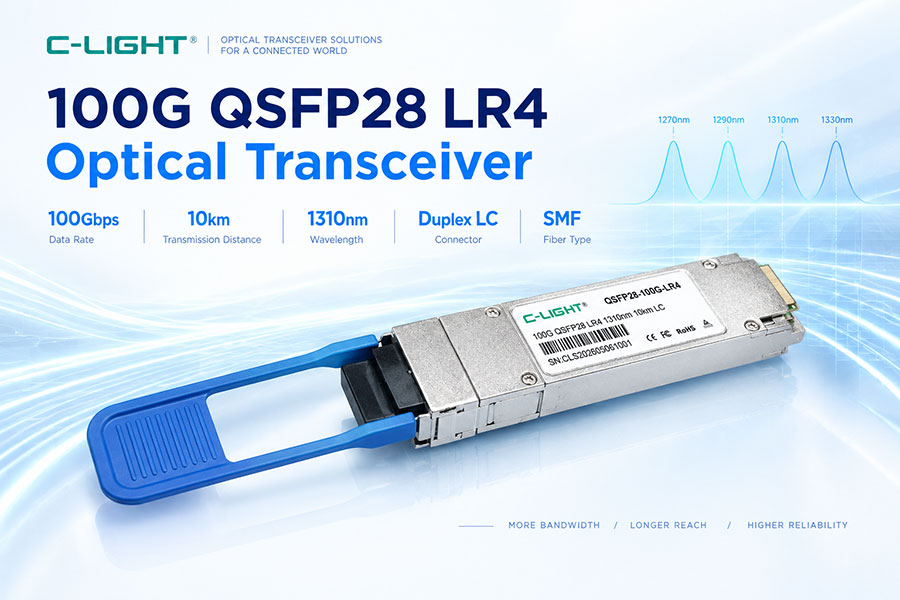
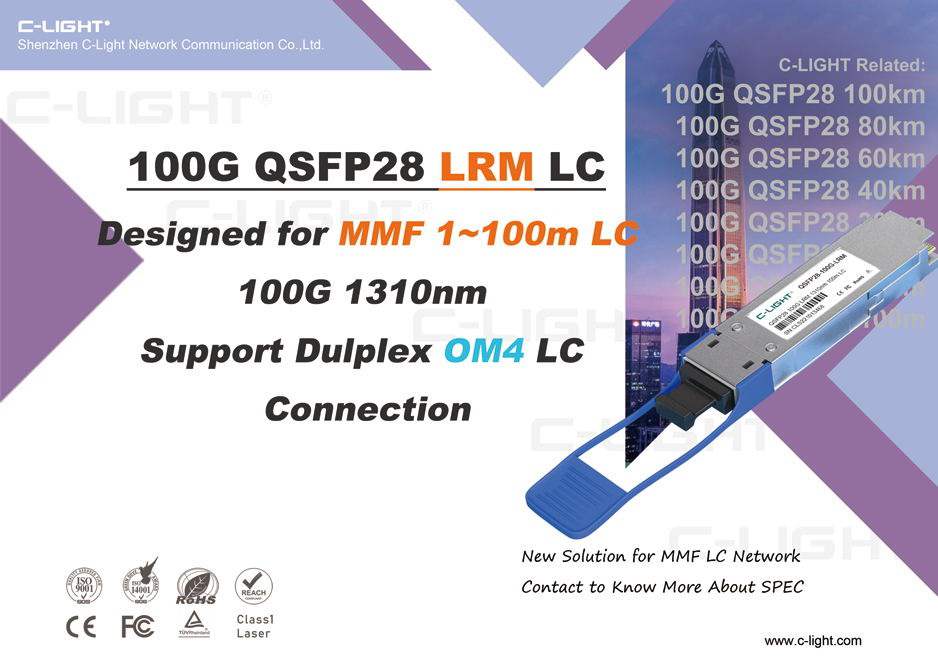
100G QSFP28 LRM LC is an optical transceiver module designed for high-speed data communication. It utilizes the QSFP28 form factor and supports a data rate of 100Gbps. LRM stands for "Long Reach Multimode," offering transmission distances of up to 300 meters over OM3/OM4 multimode fiber. With an LC fiber connector, it is suitable for high-bandwidth, short-to-medium distance applications such as data centers and enterprise networks. Key features include low power consumption, high port density, and compatibility with existing network infrastructure.
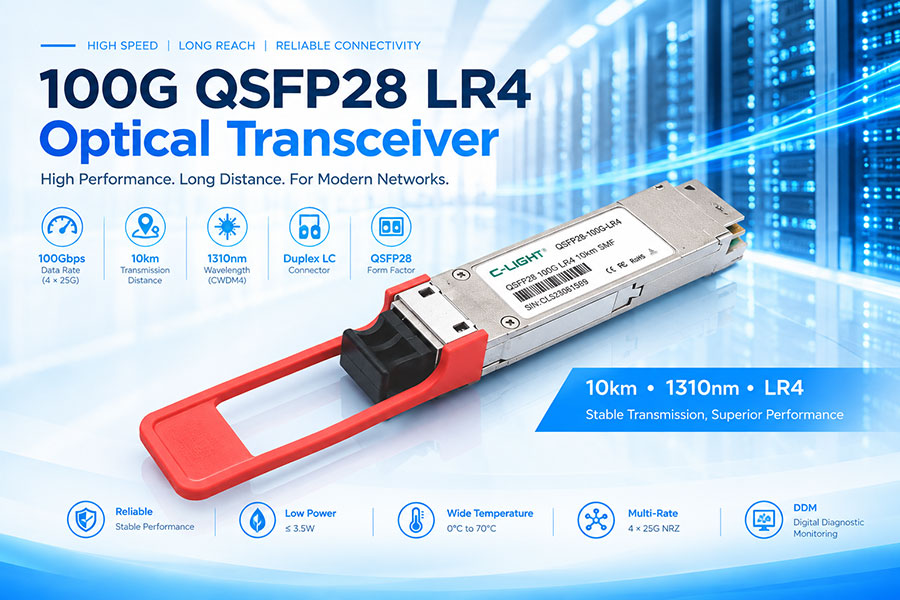
Designed for MMF 1~100m LC100G 1310nm Support Dulplex OM4 LC Connection
100G QSFP28 LRM Optical Transceiver FAQ
Q1: What is a 100G QSFP28 LRM optical transceiver?
Answer: A 100G QSFP28 LRM optical transceiver is a high-speed 100Gbps optical module designed for short-distance data center and enterprise network connections.
LRM stands for Long Reach Multimode, which is designed to provide longer transmission capability over multimode fiber compared with traditional short-range solutions.
The module typically features:
QSFP28 form factor
100Gbps transmission rate
Four-channel optical transmission
Duplex LC optical connector
Multimode fiber support
100G QSFP28 LRM modules are commonly used for:
Data center networks
Enterprise backbone connections
High-density switching environments
Q2: How does a 100G QSFP28 LRM optical module work?
Answer: A 100G QSFP28 LRM optical module converts electrical signals from network equipment into optical signals and transmits them through multimode fiber.
The working process includes:
The switch sends 100G electrical signals to the QSFP28 module.
The optical transmitter converts electrical signals into optical signals.
Optical signals travel through multimode fiber.
The receiver converts optical signals back into electrical data.
The QSFP28 architecture uses multiple optical channels to achieve high-bandwidth transmission while maintaining a compact form factor.
Q3: What are the advantages of 100G QSFP28 LRM optical transceivers?
Answer: 100G QSFP28 LRM optical modules provide several advantages for short-distance high-speed networks.
Key benefits include:
Compatibility with Existing Fiber Infrastructure
Supports multimode fiber deployments
Helps upgrade existing data center cabling
High Bandwidth
Provides 100Gbps Ethernet connectivity
Compact Design
QSFP28 form factor enables high-density switch deployment
LC Connector Design
Simplifies fiber connection and maintenance
Cost Efficiency
Provides an economical option for short-distance 100G links
These features make LRM suitable for organizations upgrading from lower-speed networks to 100G Ethernet.
Q4: What is the difference between 100G QSFP28 LRM and 100G QSFP28 SR4?
Answer: The main difference between LRM and SR4 is transmission distance and fiber compatibility.
| Feature | 100G QSFP28 LRM | 100G QSFP28 SR4 |
|---|---|---|
| Fiber Type | Multimode Fiber | Multimode Fiber |
| Connector | Duplex LC | MPO/MTP |
| Transmission Distance | Longer MMF reach | Short-range |
| Application | Existing MMF infrastructure | New high-density cabling |
LRM is often selected when customers need longer reach over installed multimode fiber networks, while SR4 is commonly used for short-distance rack-level connections.
Q5: What is the difference between 100G QSFP28 LRM and 100G QSFP28 LR4?
Answer: The main difference between LRM and LR4 is fiber type and application environment.
| Feature | 100G QSFP28 LRM | 100G QSFP28 LR4 |
|---|---|---|
| Fiber Type | Multimode Fiber | Single-mode Fiber |
| Connector | LC Duplex | LC Duplex |
| Typical Application | Data center MMF upgrade | Long-distance SMF links |
| Deployment | Existing multimode cabling | New single-mode infrastructure |
LRM is optimized for multimode fiber environments, while LR4 is designed for longer-distance single-mode fiber transmission.
Q6: What are the applications of 100G QSFP28 LRM optical modules?
Answer: 100G QSFP28 LRM modules are widely used in environments requiring reliable 100G short-distance connectivity.
Typical applications include:
Data Centers
Switch-to-switch connections
Server aggregation networks
Leaf-spine architectures
Enterprise Networks
Campus backbone networks
High-speed uplinks
Cloud Infrastructure
High-density Ethernet switching
Network expansion
LRM provides a flexible solution for upgrading existing fiber networks to 100G connectivity.
Q7: How do you choose between 100G QSFP28 LRM and other 100G optical modules?
Answer: The correct 100G optical module depends on transmission distance, fiber type, and network architecture.
Choose 100G QSFP28 LRM when:
Existing fiber infrastructure uses multimode fiber
LC connectors are preferred
Medium short-distance 100G connectivity is required
Choose 100G QSFP28 SR4 when:
Very short links are needed
MPO/MTP cabling is available
Choose 100G QSFP28 LR4 when:
Single-mode fiber is used
Longer transmission distance is required
Selecting the correct module helps optimize network cost and performance.
Q8: Why is 100G QSFP28 LRM still important in modern networks?
Answer: Although 400G and 800G optical technologies are expanding rapidly, 100G QSFP28 LRM remains valuable for many existing network environments.
Reasons include:
Large installed base of 100G networks
Compatibility with existing multimode fiber
Lower upgrade cost
Simple deployment
100G LRM provides a practical migration path for enterprises and data centers upgrading network bandwidth while maximizing existing fiber resources.
 >
>

 >
>
 >
>
 >
>
 >
>
 >
>
 >
>
 >
>