TEL:+86 132 6656 7067





The expansion of AI infrastructure, distributed computing and hyperscale cloud networks is driving demand for higher-capacity connections between data centers. 1.6T Data Center Interconnect brings greater bandwidth to inter-site networks through advanced optical transceivers, coherent transmission, high-speed PAM4 interfaces and scalable DWDM architectures.
1. What Is 1.6T DCI?
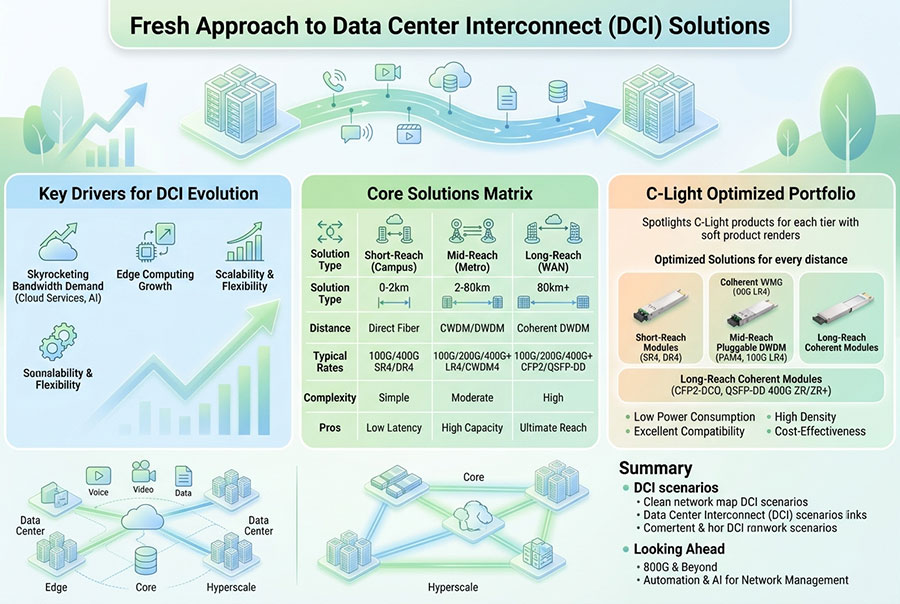
1.6T DCI refers to optical networking solutions designed to transport up to 1.6 terabits per second of data between separate data center locations. These connections support AI training infrastructure, distributed storage, cloud service replication, large-scale Ethernet networks and geographically distributed computing environments.
Compared with earlier 400G and 800G DCI deployments, 1.6T architectures provide greater capacity per interface. This can help network operators increase aggregate bandwidth while managing rack space, fiber utilization, equipment density and network expansion.
The most suitable architecture depends on the physical distance between sites, the available fiber infrastructure, optical line-system capabilities and the required interoperability with routers, switches and transport equipment.
2. Why 1.6T DCI Is Becoming Important
AI workloads are increasing the amount of data exchanged between computing facilities. Training clusters, inference platforms and distributed storage systems may operate across multiple buildings or separate data center campuses. Their traffic creates growing demand for high-capacity inter-site connectivity.
AI Scale-Across Networks
Large AI systems increasingly distribute computing resources across multiple facilities. Moving model data, checkpoints and training information between locations requires high-throughput network connections. Higher-capacity DCI links help accommodate this traffic without relying exclusively on large numbers of lower-rate interfaces.
Cloud and Storage Replication
Cloud platforms use inter-site networks for data replication, backup, workload migration and service continuity. A 1.6T interface can provide additional capacity for these operations as storage systems and distributed applications expand.
Fiber and Port Density
Increasing bandwidth per port can help reduce the number of physical interfaces needed for a given aggregate capacity. This is valuable in high-density router and switch platforms where front-panel space, fiber routing and cooling capacity are limited.
3. Main 1.6T Optical Transmission Technologies
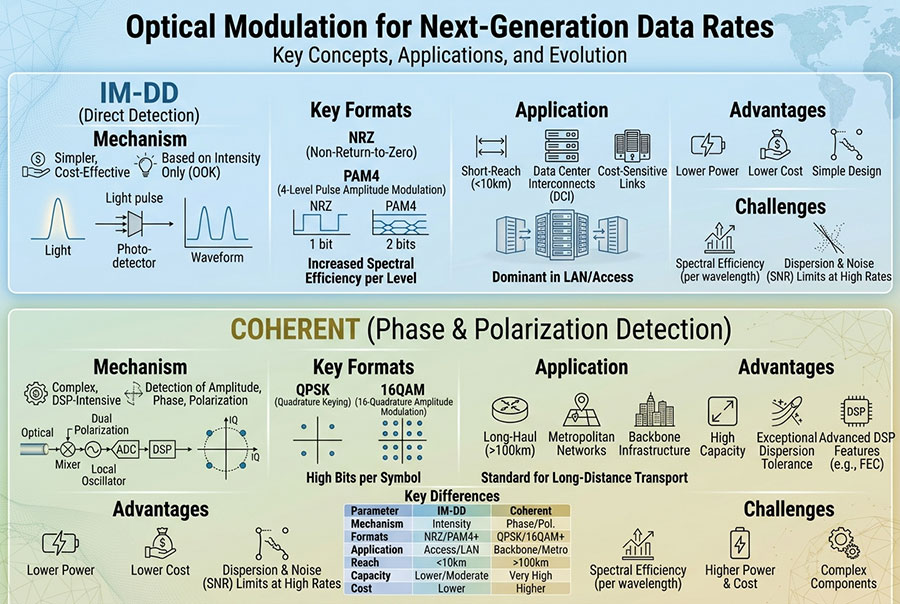
Several optical architectures can support 1.6T connectivity, but they serve different distances and network environments. Direct-detection PAM4 and coherent transmission should be evaluated separately.
| Technology | Optical Architecture | Typical Application | Primary Consideration |
|---|---|---|---|
| 1.6T DR8 | Eight parallel 200G PAM4 optical lanes | Short-reach single-mode connections | Fiber count and parallel optical connectivity |
| 1.6T 2×FR4 | Two 800G FR4 optical groups | Campus and selected inter-building links | Wavelength multiplexing and duplex fiber |
| 1.6T FR8 | Eight optical wavelengths or channels in a single interface | Selected single-mode data center links | Optical channel and wavelength implementation |
| 1600ZR | 1.6T coherent transmission over one wavelength | Amplified point-to-point DCI | OSNR and DWDM line-system performance |
| Extended-Reach Coherent | Coherent transmission with application-specific modes | Metro and regional transport | Modulation, FEC and optical route conditions |
DR8, 2×FR4 and FR8 are direct-detection PAM4 approaches. 1600ZR is a coherent optical interface designed for a different transmission environment. The choice between them depends on the required reach, fiber topology and network equipment.
4. 1.6T PAM4 Transceivers for Data Center Connectivity
1.6T PAM4 optical modules use high-speed electrical and optical lanes to achieve an aggregate data rate of 1.6 terabits per second. A common architecture uses eight lanes operating at 200 Gbps per lane.
PAM4 encodes two bits per symbol using four signal levels. Compared with NRZ, it carries more information per symbol and supports higher data rates within a given signaling bandwidth. However, the smaller separation between signal levels increases sensitivity to noise, distortion and channel impairments.
1.6T DR8
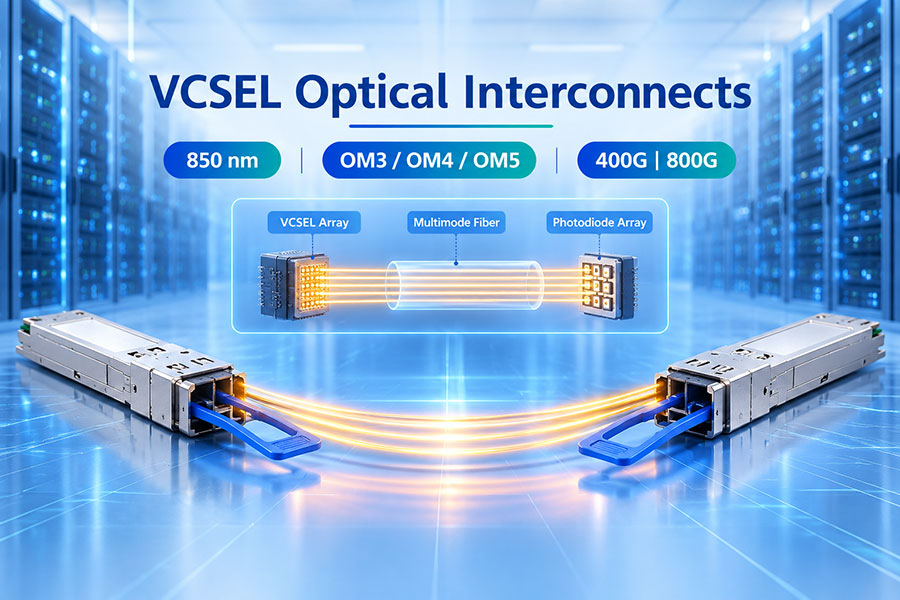
A 1.6T DR8 module typically uses eight parallel optical lanes over single-mode fiber. It is suitable for short-reach connections where the required optical distance and fiber infrastructure match the module specification.
1.6T 2×FR4
A 1.6T 2×FR4 architecture combines two 800G FR4 optical groups within one module. It can provide two 800G optical connections or a single aggregate 1.6T connection, depending on the host interface and supported operating mode.
1.6T FR8
FR8 implementations use wavelength-multiplexed optical channels to deliver high aggregate bandwidth over single-mode fiber. The exact wavelength grid, lane rate and optical reach depend on the implementation.
5. 1600ZR: Single-Wavelength Coherent 1.6T DCI
Coherent optics are central to the development of high-capacity DCI because they support advanced optical signal processing and transmission over amplified fiber routes. The 1600ZR interface represents an important step toward carrying a complete 1.6T Ethernet client over one coherent optical wavelength.
In September 2026, the Optical Internetworking Forum published its 1600ZR Coherent Interface Implementation Agreement. The specification defines an interoperable coherent line interface and frame format for single-span, amplified, point-to-point DWDM links up to 120 km.
This development extends the ZR technology progression from 400ZR and 800ZR to 1.6T. It provides a common technical framework for client mapping, framing, FEC, modulation and optical characteristics.
Single-Span DCI
1600ZR is intended for point-to-point amplified optical routes. Its target application is a connection between two sites using a DWDM line system, with the optical performance designed around the specified reach and operating conditions.
Interoperability
An implementation agreement establishes common interface requirements so equipment from different vendors can work toward interoperable operation. Actual deployment still requires validation of module support, host electrical interfaces, optical line-system characteristics and system-level performance.
Reach and Optical Conditions
The 120 km target is associated with the specified amplified single-span application. It should not be interpreted as a guaranteed distance over every fiber route. Fiber attenuation, amplifier noise, OSNR, connector loss and optical power conditions remain important.
6. 1.6T Coherent Transmission Beyond Single-Span DCI
Not every 1.6T inter-site network uses the same coherent operating mode. Some deployments require longer metro or regional routes, multiple optical spans or more demanding optical performance than a single-span DCI connection.
Extended-reach coherent solutions may use different modulation formats, baud rates, FEC configurations and optical power levels to balance spectral efficiency and transmission distance.
| Coherent Approach | Primary Objective | Network Application |
|---|---|---|
| 1600ZR | 1.6T over a single coherent wavelength | Amplified point-to-point DCI |
| Extended-Reach Coherent | Improve reach under different optical conditions | Metro and regional networks |
| Multi-Wavelength Transport | Aggregate capacity across multiple optical channels | Large-scale DWDM systems |
| External Coherent Transponder | Use transport-oriented optical processing | Longer and more complex optical routes |
The term ZR+ is often used for vendor-specific or extended-reach coherent operating options. It should not be treated as a single universal 1.6T specification with one fixed reach. The supported modes and distances must be confirmed from the relevant equipment documentation.
7. How a 1.6T Coherent DCI Link Works
A coherent DCI system converts client traffic into a modulated optical signal, transports it through a fiber and DWDM line system, and reconstructs the original data at the destination.
The router or switch provides a 1.6T Ethernet client signal to a compatible coherent optical interface.
Digital processing performs signal mapping, compensation, timing recovery and decoding functions.
A laser and optical modulator generate the coherent signal at the selected optical wavelength.
Multiplexers, optical amplifiers and fiber infrastructure transport the signal between data center sites.
The receiving optical system detects the signal using coherent detection and converts it for digital processing.
Recovered 1.6T client traffic is delivered to the destination network device.
Coherent detection uses a local oscillator and phase-sensitive signal recovery. This allows the receiver to recover information encoded in both the amplitude and phase of the optical field, supporting advanced compensation of transmission impairments.
8. DWDM and Fiber Infrastructure for 1.6T DCI
DWDM is an important part of high-capacity DCI because it allows multiple optical wavelengths to share the same fiber infrastructure. Each wavelength carries a separate optical channel, increasing the total capacity available over a fiber pair.
Wavelength Allocation
Coherent channels must operate within the supported wavelength range and channel plan of the optical line system. The selected channel spacing must accommodate the signal's spectral characteristics and the system's filtering requirements.
Optical Amplifiers
EDFAs compensate for fiber attenuation in amplified DCI links. Their gain, noise figure, output power and channel loading influence the OSNR available to the receiving transceiver.
ROADM-Based Networks
ROADMs allow optical wavelengths to be routed through multi-site transport networks. Their insertion loss, filtering characteristics and passband must be considered when deploying high-baud-rate coherent channels.
Fiber Quality
Fiber attenuation, chromatic dispersion, polarization-mode dispersion and nonlinear effects influence the achievable transmission performance. Existing fiber routes should be characterized before selecting a coherent operating mode.
9. Optical Link Budget and OSNR Requirements
A 1.6T DCI design requires a complete evaluation of optical power and signal quality. The distance between sites alone is not enough to determine whether a particular transceiver can operate reliably.
| Parameter | Effect on Transmission | Design Consideration |
|---|---|---|
| Fiber Attenuation | Reduces received optical power | Route length and fiber characteristics |
| Connector Loss | Consumes optical power margin | Connector quality and connection count |
| OSNR | Influences coherent signal quality | Amplifier noise and channel loading |
| Chromatic Dispersion | Distorts the received signal | Fiber dispersion and DSP compensation |
| Polarization Effects | Can affect coherent signal recovery | PMD and receiver capability |
| Nonlinear Effects | Can degrade signal quality at higher launch power | Launch power and channel configuration |
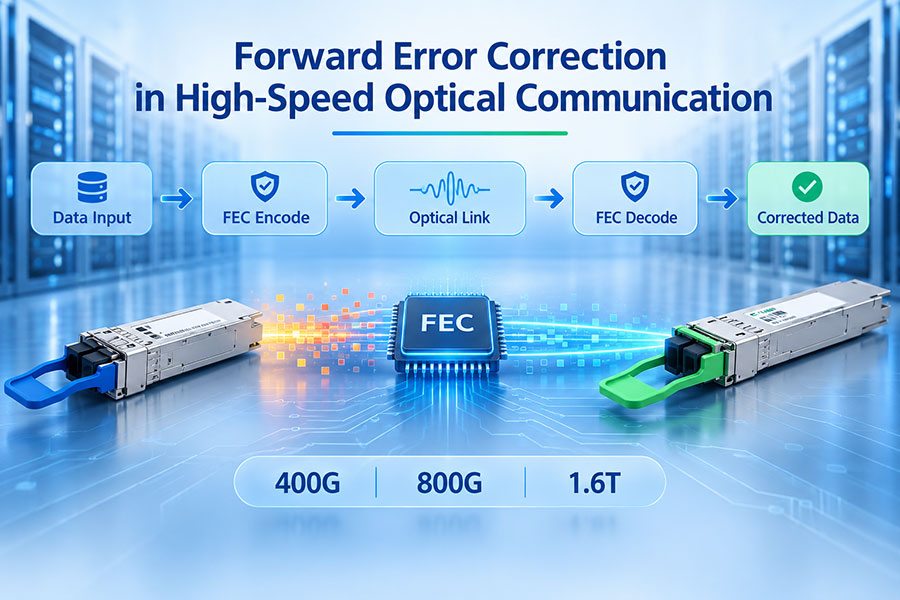
| FEC Performance | Helps correct transmission errors | FEC mode and pre-FEC error performance |
For direct-detection PAM4 links, engineers typically evaluate transmitter output power, receiver sensitivity, insertion loss and the supported optical budget. For coherent DWDM links, OSNR and the performance of the complete optical line system are equally important.
10. 1.6T DCI Power Consumption and Thermal Design
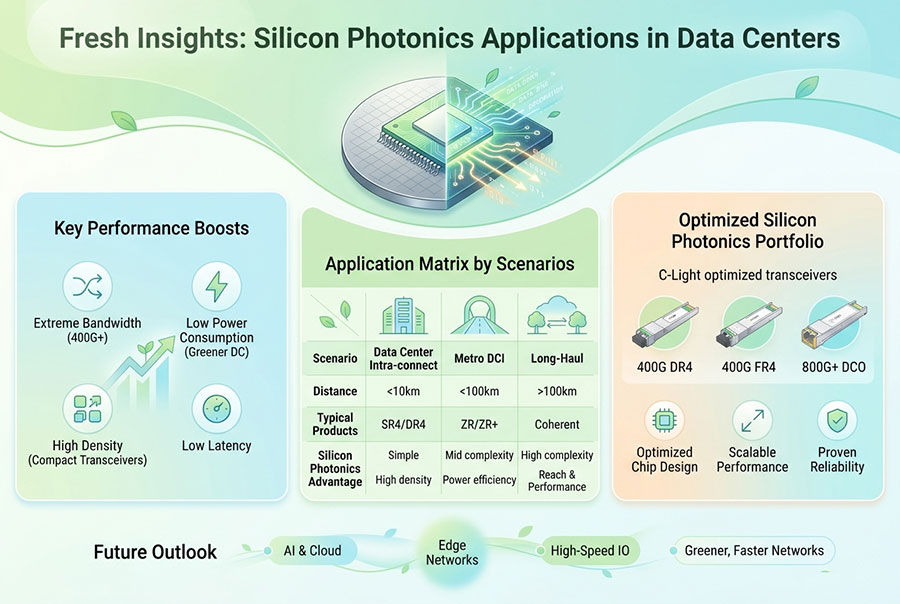
Higher data rates increase the demands placed on transceiver electronics, optical components and host platforms. A 1.6T module may integrate high-speed DSP functions, multiple optical lanes, laser sources and advanced thermal-management structures.
The actual power consumption depends on the module architecture. A parallel PAM4 module and a coherent DCI transceiver may have different processing requirements, optical components and cooling characteristics. Their power ratings should not be treated as interchangeable.
DSP architecture: Higher processing throughput and advanced signal recovery affect electrical power consumption.
Optical components: Laser sources, drivers and receiver circuits contribute to the total module power.
Host power support: The switch or router must support the module's specified power class.
Cooling capability: Airflow, heat sinks and chassis thermal design must accommodate high-power modules.
Port density: Fully populated 1.6T interfaces can create concentrated thermal loads.
OSFP and OSFP-RHS mechanical designs are relevant to high-density optical platforms, but the form factor alone does not establish a module's power consumption or cooling capability. The exact product datasheet and host platform requirements must be checked.
11. 800G DCI vs. 1.6T DCI
Moving from 800G to 1.6T increases the capacity available per client interface. However, the transition involves more than doubling the nominal data rate. Electrical lane speed, optical modulation, DSP architecture and line-system performance all influence the deployment.
| Comparison | 800G DCI | 1.6T DCI |
|---|---|---|
| Client Capacity | 800 Gbps | 1.6 Tbps |
| Common PAM4 Lane Rate | 100G per lane in common architectures | 200G per lane in next-generation architectures |
| Direct-Detect Options | SR8, DR8, 2×FR4 and other configurations | DR8, 2×FR4, FR8 and other configurations |
| Coherent Interface | 800ZR | 1600ZR |
| DCI Application | High-capacity metro and campus connections | Higher-capacity inter-site connectivity |
| Key Design Challenge | 100G lane signal integrity and thermal density | 200G lane performance, power and thermal density |
| Network Planning | Fiber and port capacity scaling | Higher-capacity interfaces and optical line compatibility |
The 1600ZR interface is particularly significant because it enables a 1.6T Ethernet client to be transported over one coherent wavelength in the specified single-span amplified application. This differs from simply combining two independent 800G client links.
12. C-LIGHT 1.6T Optical Connectivity Solutions
C-LIGHT offers high-speed optical connectivity solutions for next-generation data center and AI networking environments. Its 1.6T OSFP-RHS product family is relevant to high-density 1.6T optical connectivity, while the appropriate application depends on the exact optical configuration and supported interface.
1.6T OSFP-RHS Optical Transceiver
Designed for high-speed optical connectivity in next-generation network platforms. OSFP-RHS is a relevant form factor for high-density 1.6T system designs. Confirm the specific optical interface, reach, lane configuration and power specifications before using it in a DCI deployment.
View 1.6T OSFP-RHS Products →800G OSFP Optical Transceivers
800G OSFP modules provide an established high-speed connectivity option for data center networks. They can be used in architectures where 800G links are aggregated or deployed alongside higher-capacity interfaces.
View 800G OSFP Products →800G QSFP-DD Optical Transceivers
The 800G QSFP-DD family supports high-bandwidth data center connectivity. Available optical configurations can address different reach and fiber requirements, depending on the selected model.
View 800G QSFP-DD Products →400G Optical Connectivity
400G QSFP-DD and OSFP solutions remain useful for network aggregation, existing data center infrastructure and staged bandwidth upgrades toward 800G and 1.6T architectures.
View 400G QSFP-DD Products →For DCI projects, the product selection process should include a review of optical reach, wavelength configuration, host electrical interface, module power, connector type, FEC behavior and DWDM compatibility. A 1.6T PAM4 client module should not be assumed to support 1600ZR coherent line transmission unless its specifications explicitly state that capability.
13. Key Considerations When Selecting a 1.6T DCI Solution
A successful 1.6T DCI deployment requires matching the optical technology to the actual network environment. The following factors should be evaluated before selecting transceivers and transport equipment.
| Selection Factor | What to Verify |
|---|---|
| Transmission Distance | Is the route within a data center, across a campus, through a metro network or over a regional route? |
| Optical Architecture | Is direct-detection PAM4 sufficient, or is coherent DWDM transmission required? |
| Fiber Infrastructure | What fiber type, attenuation, dispersion and connector configuration are available? |
| Host Compatibility | Does the router or switch support the required form factor, electrical interface and power class? |
| DWDM Compatibility | Are wavelength range, channel spacing and optical power compatible with the line system? |
| Signal Performance | Do OSNR, FEC, BER and optical link budget meet the required operating conditions? |
| Thermal Design | Can the host platform support the module's power consumption and cooling requirements? |
| Scalability | Can the network accommodate additional wavelengths, ports and future capacity upgrades? |
14. Conclusion
1.6T DCI represents an important step in the evolution of high-capacity optical networking. It addresses the growing bandwidth requirements of AI infrastructure, hyperscale cloud platforms and distributed data center environments.
PAM4-based 1.6T transceivers provide high-speed connectivity for suitable short-reach and campus applications. Coherent 1600ZR introduces a single-wavelength 1.6T transmission approach for amplified point-to-point DWDM links, creating a new option for high-capacity DCI.
The right architecture depends on transmission distance, fiber quality, optical line-system capabilities, host compatibility, power consumption and thermal requirements. Careful selection of the client interface and optical transport technology is essential for building scalable 1.6T networks.
Planning a 1.6T Optical Network?
Contact C-LIGHT for information about high-speed optical transceivers and connectivity solutions for data center and AI networking applications.
Contact C-LIGHT >

 >
 >
 >
 >
 >
 >
 >