C-LIGHT telephone TEL:+86 132 6656 7067    

Language
C-LIGHT search
How AI Data Centers Choose Between DAC, AOC, Optical Transceivers>
By C-LIGHT Marketing 丨
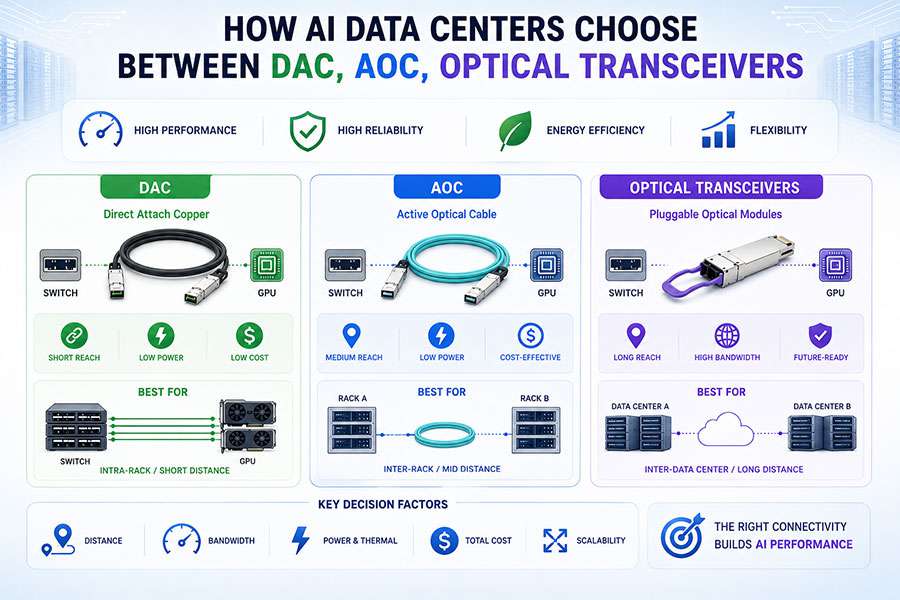
Learn how AI data centers select DAC, AOC, and optical transceivers for GPU clusters and high-performance networks. Discover the advantages, deployment scenarios, and C-LIGHT high-speed connectivity solutions for AI infrastructure.
What is the difference between a DAC cable and an SFP cable?>
By C-LIGHT Marketing 丨
DAC cable vs SFP cable, DAC cable, SFP cable, SFP transceiver, direct attach copper, AOC cable, optical transceiver
GPU-to-GPU Interconnect Explained>
By C-LIGHT Marketing 丨
GPU-to-GPU interconnects enable high-bandwidth communication for AI workloads through technologies such as NVLink, PCIe, and scale-out networks.
How Does CWDM Work?>
By C-LIGHT Marketing 丨
CWDM combines multiple optical wavelengths over one fiber pair, helping increase fiber capacity for metro networks, access networks, and data center links.
Why Silicon Photonics Is Revolutionizing AI Networking>
By C-LIGHT Marketing 丨
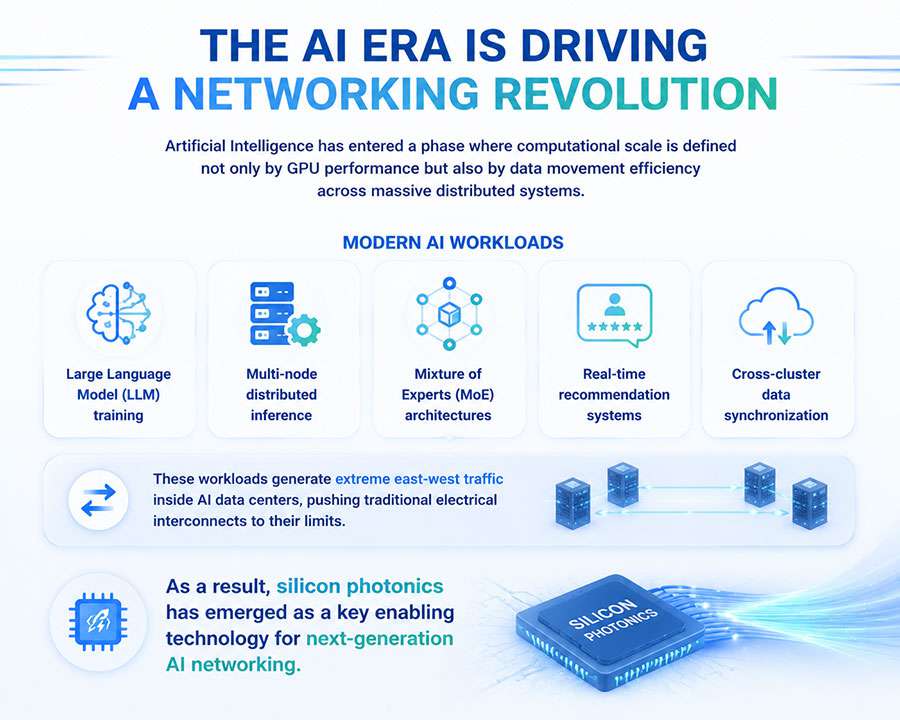
Explore how silicon photonics is transforming AI networking by enabling ultra-high bandwidth, low power consumption, and scalable 400G/800G/1.6T interconnects. Learn how C-LIGHT optical solutions support next-generation AI data center architectures.
What Is TOSA in Optical Communication?>
By C-LIGHT Marketing 丨
TOSA converts electrical signals into optical signals in fiber optic transceivers, supporting high-speed data transmission across data centers and telecom networks.
What Is ROSA in Optical Communication?>
By C-LIGHT Marketing 丨
ROSA converts optical signals into electrical signals in fiber optic transceivers, with receiver sensitivity and signal quality critical to reliable data transmission.
What Is BOSA in Optical Communication? >
By C-LIGHT Marketing 丨
BOSA integrates optical transmitting and receiving functions in one assembly, enabling bidirectional communication in PON, FTTH, and fiber access networks.

Call
Top