TEL:+86 132 6656 7067




1. Why Connectivity Matters in AI Data Centers
Artificial Intelligence is transforming modern data center architecture. As AI clusters grow from hundreds to thousands of GPUs, network infrastructure has become just as critical as computing power itself.
Large-scale AI training workloads generate massive east-west traffic between GPUs, servers, and switches. Applications such as Large Language Model (LLM) training, MoE (Mixture of Experts), distributed inference, parameter synchronization, and storage access require ultra-low latency, high bandwidth, and highly reliable network connectivity.
A single unstable link can negatively impact overall cluster performance, causing training delays, packet retransmissions, and underutilized GPU resources.
As a result, selecting the right interconnect technology has become a key decision for AI infrastructure architects.
2. The Three Main Connectivity Options
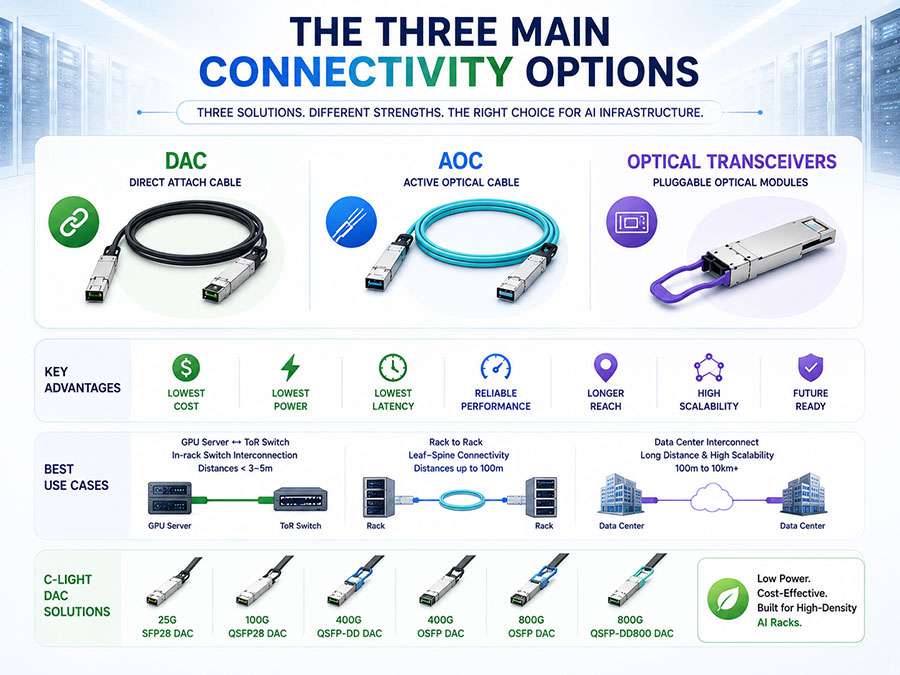
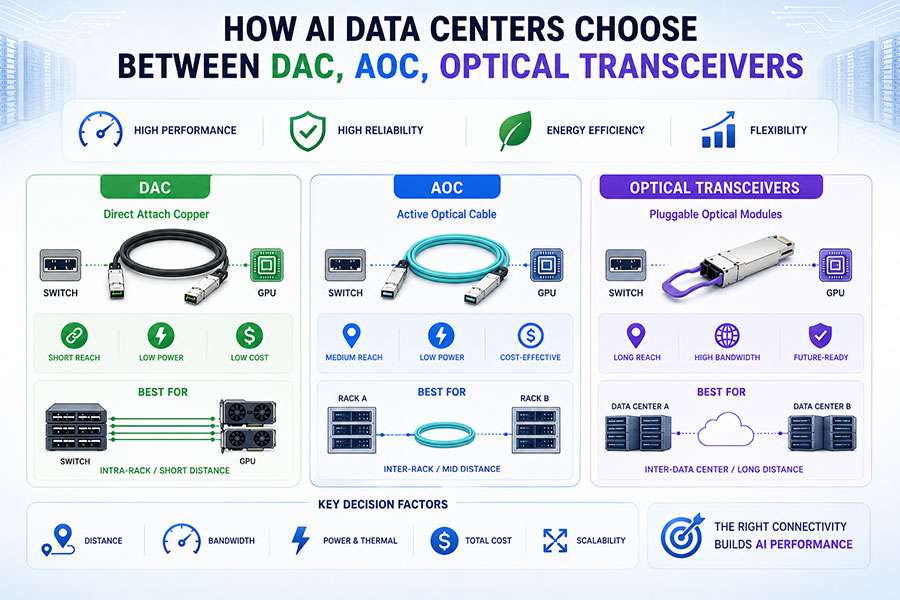
AI data centers typically deploy three primary connectivity solutions:
DAC (Direct Attach Cable)
DAC cables use passive or active copper technology to connect devices directly.
Advantages:
Lowest acquisition cost
Lowest power consumption
Extremely low latency
Plug-and-play deployment
No optical components required
Limitations:
Limited transmission distance
Thicker and heavier cable management
Less flexible for large-scale structured cabling
Best Use Cases:
GPU server to Top-of-Rack (ToR) switch
In-rack switch interconnection
Distances under 3-5 meters
For these scenarios, C-LIGHT offers:
These solutions provide low power consumption and cost-effective connectivity for high-density AI racks.
3. When AI Data Centers Choose AOC
As cluster sizes increase, cable management becomes more challenging. Copper cables become heavier and less practical, especially when connecting equipment across multiple racks.
Active Optical Cables (AOCs) integrate optical engines and fiber within a single assembly, offering a lightweight alternative.
Advantages of AOC
Longer transmission distance
Lightweight and flexible
Reduced cable congestion
Better EMI resistance
Simplified deployment
Limitations
Entire cable must be replaced if damaged
Higher cost than DAC
Best Use Cases
Cross-rack GPU networking
High-density switch deployments
Distances between 5m and 100m
Typical C-LIGHT solutions include:
These products are widely deployed in AI training clusters where cable weight and airflow optimization are critical considerations.
4. Why Optical Transceivers Remain Essential
While DAC and AOC dominate short-distance deployments, optical transceivers remain indispensable for scalable AI infrastructure.
Unlike AOCs, optical modules are independent components that connect through standard fiber cabling, providing greater flexibility and maintainability.
Advantages
Supports structured cabling architectures
Easy maintenance and replacement
Long transmission distances
Scalable network design
Higher operational flexibility
Ideal Applications
Leaf-Spine fabrics
Data center interconnect (DCI)
Multi-building AI campuses
Storage networking
Long-distance backbone connections
Common deployment options include:
| Distance | Recommended Technology |
| 100m | 400G SR8 |
| 500m | 400G DR4 |
| 2km | 400G FR4 |
| 10km | 400G LR4 |
| 500m | 800G DR8 |
| 2km | 800G 2×FR4 |
| 10km+ | DWDM Solutions |
C-LIGHT offers a comprehensive portfolio including:
CWDM/DWDM MUX DEMUX Platforms
These solutions support modern Ethernet and InfiniBand AI fabrics.
5. How AI Architects Actually Make the Decision
The selection process is rarely based on bandwidth alone. AI data center architects typically evaluate three primary factors:
Distance
Under 3m → DAC preferred
5m–100m → AOC preferred
Beyond 100m → Optical transceiver preferred
Cost
DAC remains the lowest-cost option for short-range connectivity.
Operational Flexibility
Optical transceivers provide superior maintainability and scalability for long-term infrastructure planning.
A practical rule used by many hyperscale operators is:
Use DAC whenever possible, AOC when cabling complexity increases, and optical transceivers when scalability and maintainability become priorities.
6. The Rise of 400G and 800G AI Fabrics
The latest AI clusters powered by NVIDIA H100, H200, and Blackwell GPUs are rapidly accelerating the adoption of 400G and 800G networking.
Modern AI fabrics require:
Higher bisection bandwidth
Lower latency
Better congestion management
Improved energy efficiency
As a result, 400G and 800G connectivity solutions are becoming the standard foundation of next-generation AI infrastructure.
C-LIGHT's AI networking portfolio includes:
400G Solutions
800G Solutions
These products are designed to support high-density GPU clusters, AI training networks, cloud infrastructure, and hyperscale data center deployments.
7. Conclusion
Choosing between DAC, AOC, and optical transceivers is not simply a matter of speed. The decision depends on transmission distance, cabling architecture, power consumption, maintenance requirements, and long-term scalability.
For most AI data centers:
DAC is the preferred solution for short-distance in-rack connections.
AOC provides an efficient balance for medium-distance, high-density deployments.
Optical transceivers remain the best choice for scalable, long-distance, and structured networking environments.
As AI infrastructure continues evolving toward 800G and eventually 1.6T networking, selecting the right connectivity strategy will be critical to maximizing GPU utilization and ensuring long-term network performance.
With a comprehensive portfolio of DAC, AOC, optical transceivers, and WDM solutions, C-LIGHT helps AI data centers build reliable, high-performance, and future-ready networking infrastructure.
How AI Data Centers Choose DAC, AOC and Optical Transceivers FAQ
Large AI clusters generate massive east-west traffic between GPUs, servers, and switches. Different connections require different solutions:
DAC for short-distance, low-cost connections
AOC for medium-distance, flexible high-speed links
Optical transceivers for scalable long-distance networking
Low latency
Lowest power consumption
Cost-effective deployment
Plug-and-play installation
GPU server to ToR switch connections
In-rack connections
Short-distance switch interconnects
Compared with DAC, AOC provides:
Longer transmission distance
Lighter cable design
Better EMI resistance
Higher flexibility for complex cabling environments
Rack-to-rack connections
Leaf-spine network links
Medium-distance GPU cluster communication
They are mainly used for:
Long-distance data center connections
Spine-leaf network architectures
Data Center Interconnect (DCI)
Large-scale AI network fabrics
100G
200G
400G
800G
| Feature | DAC | AOC | Optical Transceiver |
| Medium | Copper | Optical Fiber | Optical Fiber |
| Distance | Short | Medium | Medium to Long |
| Power Consumption | Lowest | Low | Higher |
| Cost | Lowest | Medium | Higher |
| Latency | Extremely Low | Very Low | Very Low |
| Scalability | Limited | Moderate | Excellent |
1. Transmission Distance
Short distance (within rack): DAC
Medium distance (between racks): AOC
Long distance or structured networking: Optical transceiver
DAC provides the lowest power consumption, making it suitable for high-density GPU racks.
3. Future ScalabilityOptical transceivers provide better flexibility for large-scale AI network expansion.A hybrid deployment using DAC, AOC, and optical modules is usually the most practical approach.
Modern AI clusters require:
Higher GPU-to-GPU communication speed
Lower network congestion
Higher bandwidth density
Improved energy efficiency
A typical architecture uses:
GPU Server Layer
DAC cables for short-distance connections
AOC cables for flexible high-speed connections
Optical transceivers for scalable optical networking
How AI Data Centers Choose DAC, AOC and Optical Transceivers FAQ
DAC for short-distance, low-cost connections
AOC for medium-distance, flexible high-speed links
Optical transceivers for scalable long-distance networking
Answer: DAC (Direct Attach Copper) is a high-speed copper cable solution designed for short-distance data center connections.
DAC provides:
Low latency
Lowest power consumption
Cost-effective deployment
Plug-and-play installation
GPU server to ToR switch connections
In-rack connections
Short-distance switch interconnects
Compared with DAC, AOC provides:
Longer transmission distance
Lighter cable design
Better EMI resistance
Higher flexibility for complex cabling environments
Rack-to-rack connections
Leaf-spine network links
Medium-distance GPU cluster communication
Answer: Optical transceivers provide the highest flexibility and scalability among the three connectivity solutions.
They are mainly used for:
Long-distance data center connections
Spine-leaf network architectures
Data Center Interconnect (DCI)
Large-scale AI network fabrics
100G
200G
400G
800G
| Feature | DAC | AOC | Optical Transceiver |
| Medium | Copper | Optical Fiber | Optical Fiber |
| Distance | Short | Medium | Medium to Long |
| Power Consumption | Lowest | Low | Higher |
| Cost | Lowest | Medium | Higher |
| Latency | Extremely Low | Very Low | Very Low |
| Scalability | Limited | Moderate | Excellent |
Answer: AI data centers typically make decisions based on three key factors:
1. Transmission Distance
Short distance (within rack): DAC
Medium distance (between racks): AOC
Long distance or structured networking: Optical transceiver
2. Power Efficiency
DAC provides the lowest power consumption, making it suitable for high-density GPU racks.
3. Future Scalability
Optical transceivers provide better flexibility for large-scale AI network expansion.
A hybrid deployment using DAC, AOC, and optical modules is usually the most practical approach.
Answer: AI workloads are driving rapid growth in network bandwidth requirements.
Modern AI clusters require:
Higher GPU-to-GPU communication speed
Lower network congestion
Higher bandwidth density
Improved energy efficiency
Answer: There is no single best solution because AI data centers contain different network layers.
A typical architecture uses:
GPU Server Layer
DAC cables for short-distance connections
AOC cables for flexible high-speed connections
Optical transceivers for scalable optical networking
 >
>

 >
>
 >
>
 >
>
 >
>
 >
>
 >
>
 >
>