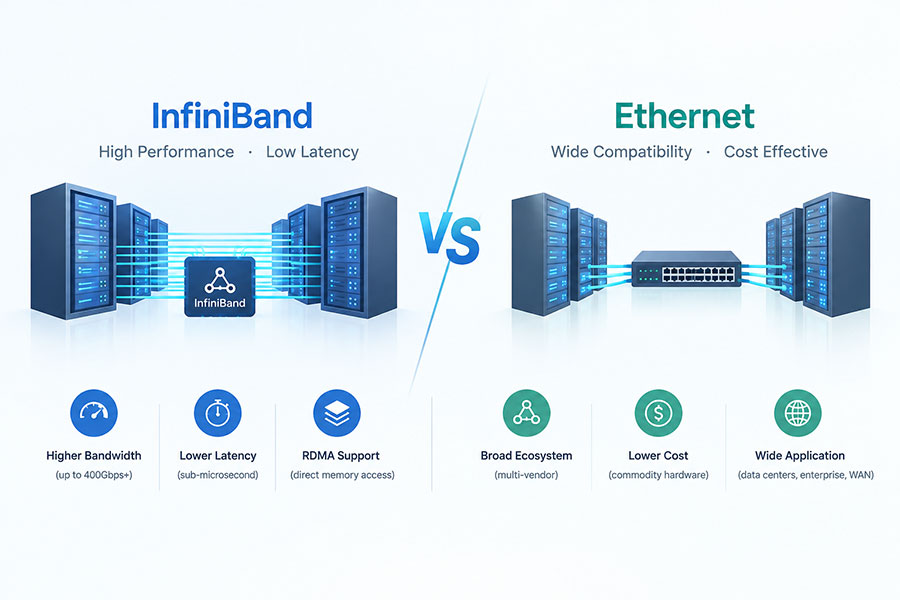
InfiniBand and Ethernet use different fabric architectures and traffic-management methods, with important differences in RDMA, routing, congestion control, interoperability, management, scalability and AI cluster deployment.
Structured and point-to-point cabling use different physical architectures for connecting network equipment, with differences in patching, scalability, cable management, deployment complexity, maintenance, and data center applications.
High-density and standard-density fiber cabling differ in fiber capacity, connector density, rack space, cable management, installation, scalability, and support for high-speed data center networks.
Pre-terminated and field-terminated data center cabling differ in installation, testing, cable length flexibility, labor requirements, deployment speed, scalability, maintenance, and project cost.
Fiber patch panels and MTP cassettes serve different roles in data center cabling, with differences in structure, fiber density, connectivity, installation, patching, scalability, polarity, and high-speed network applications.
MTP cassettes and breakout modules provide different approaches to high-density fiber connectivity, with differences in structure, breakout function, port mapping, fiber density, installation, polarity, and data center applications.