TEL:+86 132 6656 7067





Large-scale AI training is constrained not only by processor performance but also by how efficiently accelerators exchange data. Modern training jobs distribute model computation across many GPUs or other accelerators, requiring frequent transfers of parameters, gradients, activations, and intermediate results. When communication cannot keep pace with computation, accelerators spend more time waiting for data and less time performing useful work. Optical interconnects help address this challenge by providing high bandwidth over practical distances, supporting dense network fabrics, and enabling larger computing systems to operate as coordinated clusters.
1. Distributed AI Training Makes Network Performance a Computing Requirement
Training a large AI model on a single accelerator is often impractical because of memory capacity, processing time, and computational requirements. Distributed training divides the workload across multiple accelerators, allowing them to process different data batches, model components, or pipeline stages in parallel.
This arrangement creates continuous communication between computing devices. Depending on the parallelization strategy, accelerators exchange gradients, synchronize model parameters, transfer activations, and coordinate intermediate computation results. The network is therefore part of the training system itself rather than simply a connection between independent servers.
As the accelerator count increases, communication traffic can become a major source of overhead. If a network link is congested or has insufficient bandwidth, the affected devices may have to wait before continuing their next computation stage. In synchronized training operations, the performance of the entire group can be influenced by the slowest participating communication path.
Optical interconnects help provide the physical bandwidth and reach needed to connect these distributed resources. Their importance becomes greater as clusters expand beyond the practical distance and density limits of conventional electrical connections.
2. Collective Communication Creates Heavy Traffic Between Accelerators
Many AI training frameworks use collective communication operations to coordinate work across multiple GPUs. These operations move data among groups of devices and can generate substantial network traffic, particularly during large-scale model training.
AllReduce
AllReduce combines values from multiple devices and distributes the resulting aggregate back to the participating devices. It is widely used for gradient synchronization in data-parallel training. When a training job involves many accelerators, repeated AllReduce operations can consume significant network bandwidth.
AllGather and ReduceScatter
AllGather collects data distributed across devices and makes the combined result available to the group. ReduceScatter performs reduction operations while distributing different portions of the result among participants. These operations are important in model-parallel and distributed optimizer designs.
All-to-All communication
All-to-All exchanges data between multiple devices, often with each participant sending different data to many other participants. Mixture-of-Experts (MoE) models can generate this type of traffic when tokens are routed to different expert networks distributed across accelerators.
| Communication Operation | Primary Function | Network Implication |
|---|---|---|
| AllReduce | Aggregate values and distribute the result | High aggregate bandwidth and efficient group communication |
| AllGather | Collect distributed data across devices | Large data transfers between participating accelerators |
| ReduceScatter | Reduce values and distribute result segments | Efficient bandwidth for distributed model and optimizer operations |
| All-to-All | Exchange different data among multiple devices | High connection concurrency and traffic-pattern flexibility |
These operations do not all produce the same traffic pattern. Some involve structured communication among a group of devices, while others create many simultaneous transfers. The network must support the relevant patterns without allowing congestion, link imbalance, or excessive latency to undermine accelerator utilization.
3. Bandwidth Determines How Efficiently Compute Resources Can Be Used
Accelerator performance is often measured by computational throughput, but that figure alone does not describe the performance of a distributed training system. The network must deliver data at a rate that keeps the processors supplied with the information required for each stage of computation.
When communication bandwidth is insufficient, several problems can occur:
Longer synchronization periods: Devices spend more time exchanging gradients or waiting for collective operations to finish.
Lower accelerator utilization: Computing resources remain idle while communication tasks are incomplete.
Reduced scaling efficiency: Adding more accelerators produces less improvement in total training throughput than expected.
Network congestion: Multiple simultaneous transfers compete for shared links and switch capacity.
Uneven completion times: Different communication paths may complete at different speeds, delaying synchronized operations.
Optical links support higher data rates and longer reach than many conventional copper connections at comparable high-speed deployment scales. They are particularly useful for switch-to-switch and rack-to-rack connections where electrical channel loss, cable bulk, and signal integrity become increasingly difficult to manage.
However, bandwidth must be evaluated across the complete network. A high-speed optical module cannot compensate for an oversubscribed switch fabric, insufficient uplink capacity, poor traffic distribution, or an unsuitable network topology.
4. Latency and Tail Performance Affect Training Synchronization
Bandwidth describes how much data a link can carry over time, while latency describes how long communication takes. Both influence distributed training performance, but their relative importance depends on the operation, message size, topology, and parallelization strategy.
For large transfers, throughput and sustained bandwidth are often central considerations. For smaller or more frequent exchanges, communication latency and protocol overhead can have a greater influence. Collective operations also depend on coordination among multiple participants, making completion time sensitive to the performance of the slowest paths.
Tail latency is particularly relevant. Even when average communication time is acceptable, occasional slow transfers can delay synchronization points and affect the progress of an entire training iteration. Congestion, queueing, retransmissions, link errors, and network reconfiguration can all contribute to unpredictable completion times.
Optical fiber itself does not eliminate every source of latency. The total delay also includes propagation through the fiber, transceiver processing, switch forwarding, serialization, queuing, and software communication overhead. Optical architectures that reduce electrical conversion stages or switching hops may improve selected parts of this path, but their actual benefit must be measured at system level.
5. Scale-Up and Scale-Out Networks Have Different Optical Requirements
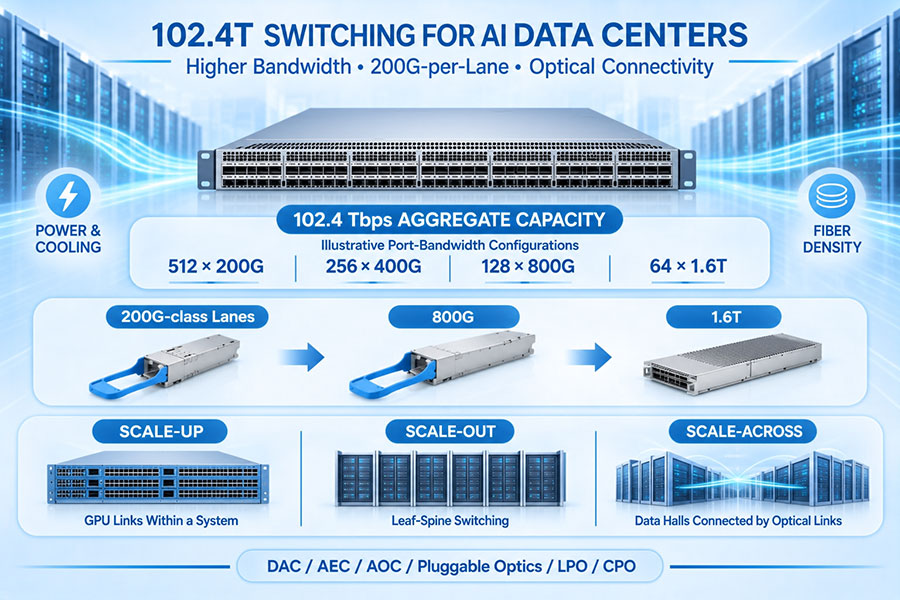
Large AI systems use multiple levels of connectivity. Scale-up networks connect accelerators within a tightly coupled computing domain, while scale-out networks connect servers and racks across a larger cluster. Some deployments also require scale-across connectivity between separate facilities.
| Network Layer | Connection Scope | Main Requirements | Relevant Technologies |
|---|---|---|---|
| Scale-up | Accelerators within a closely coupled system | Very high bandwidth density, low latency, and short electrical or optical paths | High-speed electrical links, emerging optical I/O, NPO, and CPO |
| Scale-out | Servers, racks, and switch fabrics | Aggregate bandwidth, reach, port density, and predictable network performance | 400G/800G/1.6T transceivers, DAC, AEC, and AOC |
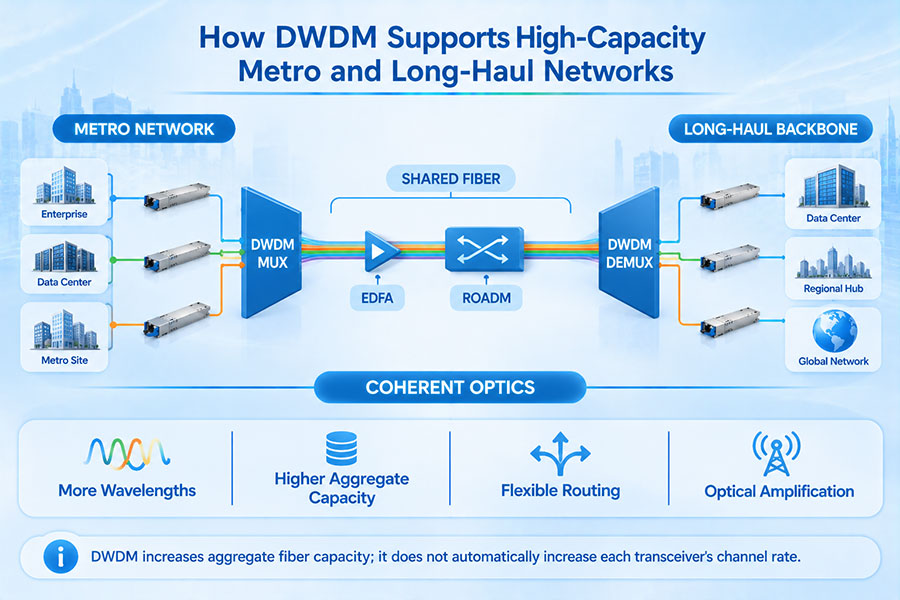
| Scale-across | Separate buildings, campuses, or data center sites | Longer reach, high capacity, and optical transport reliability | WDM, coherent optics, and DCI systems |
Optical technology is not equally mature or necessary at every layer. Short electrical connections remain attractive within servers and tightly integrated systems because they avoid optical-electrical conversion at the endpoints. As reach and bandwidth requirements increase, optical solutions become more relevant.
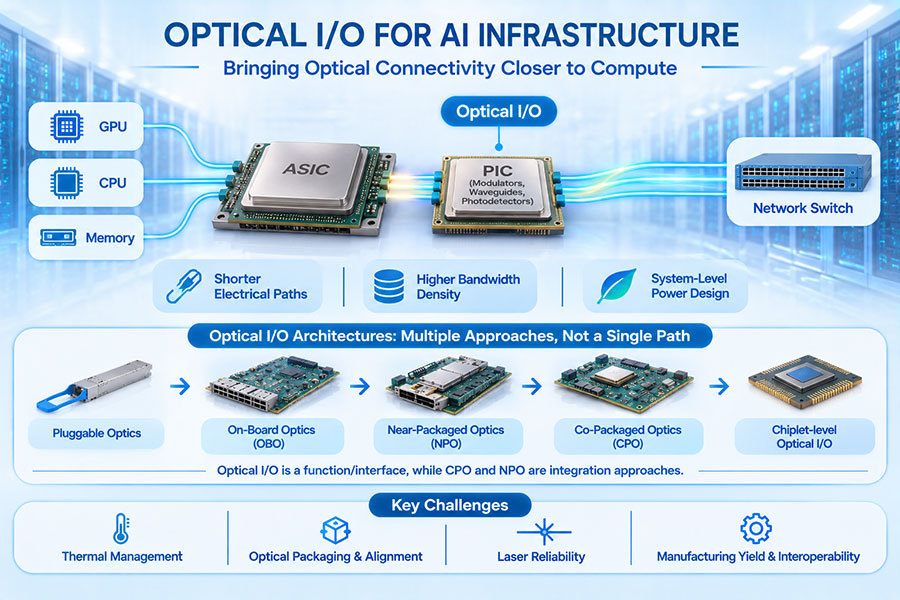
At the scale-out layer, pluggable optical transceivers are widely used to connect switches and racks. At the scale-up layer, optical I/O and more integrated optical architectures are being developed to extend high-bandwidth connectivity beyond the practical reach of conventional electrical links.
6. Copper and Optical Interconnects Serve Different Distance and Bandwidth Requirements
Optical interconnects are important for large-scale AI training, but they do not make copper connections obsolete. The two technologies have different electrical, optical, mechanical, and operational characteristics. Network designers select between them according to link distance, data rate, power, cost, density, and service requirements.
| Interconnect Type | Transmission Medium | Typical Application | Important Considerations |
|---|---|---|---|
| DAC | Passive copper twinax | Short connections within racks | Low cost and power, but limited reach at high data rates |
| AEC | Active electrical copper cable | Selected short-reach server and switch connections | Signal conditioning, cable power, reach, and host compatibility |
| AOC | Optical fiber with integrated electrical-to-optical conversion | Short-to-medium equipment and rack connections | Fixed cable assembly, optical reach, and endpoint compatibility |
| Pluggable optical transceiver | Optical fiber with removable modules | Switch-to-switch and rack-to-rack links | Flexible replacement, optical specifications, and module power |
| Integrated optical I/O | Optical engines near or within compute packages | Emerging high-density accelerator interconnects | Packaging, fiber attachment, thermal management, and serviceability |
For short connections, DAC can provide a cost-effective solution with low power consumption. AEC can extend selected electrical connections through active signal conditioning. AOC combines optical transmission with integrated cable-end conversion, while pluggable transceivers provide replaceable optical interfaces for a wider range of network distances and architectures.
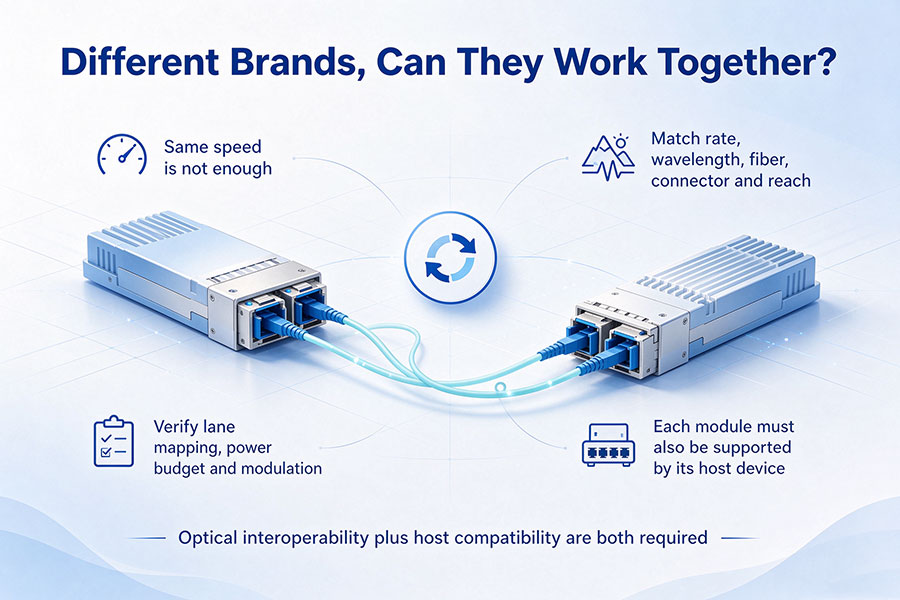
The correct choice depends on the actual host platform and link requirements. A cable or module should not be selected based on data rate alone; electrical lane configuration, optical reach, connector, power, and interoperability must also be verified.
7. 800G and 1.6T Optics Support Increasing Network Capacity
As AI clusters grow, network switches need to support higher aggregate bandwidth and more demanding port configurations. This is driving adoption of 800G optical interfaces and development of 1.6T solutions for newer switching platforms.
800G modules can support high-capacity connections in scale-out networks, including switch uplinks and rack interconnections. Depending on the optical application, products may use parallel-fiber transmission or multiple wavelengths over duplex single-mode fiber. These approaches have different reach, connector, and fiber requirements.
1.6T modules increase aggregate interface capacity further. Many designs target eight high-speed electrical lanes using approximately 200G-class signaling per lane, although the exact implementation depends on the module standard and host platform. Higher lane rates increase the importance of electrical signal integrity, optical transmitter performance, receiver sensitivity, thermal design, and production testing.
| Optical Generation | Typical Network Role | Engineering Priorities |
|---|---|---|
| 400G | Established high-capacity data center connections | Reach, power budget, lane configuration, and host interoperability |
| 800G | High-bandwidth AI cluster and switch interconnections | Port density, PAM4 signal quality, thermal performance, and power efficiency |
| 1.6T | Newer high-capacity switch platforms and next-generation network fabrics | 200G-class lane performance, advanced packaging, and system-level validation |
These generations will coexist during network transitions. Operators may retain 400G links in parts of the fabric while deploying 800G and 1.6T at higher-capacity switching layers. Network planning must therefore account for mixed-speed connections and the compatibility of the complete link.
8. Silicon Photonics and Optical Switching Offer New Network Architectures
Conventional optical networks commonly use pluggable transceivers connected to electronic packet switches. This architecture is mature and provides flexible replacement and maintenance. However, increasing electrical I/O bandwidth and power consumption are encouraging research and development into more integrated optical systems.
Silicon photonics
Silicon photonics integrates selected optical functions onto a photonic integrated circuit. It can support compact optical engines, high integration density, and optical I/O designs positioned close to computing or switching silicon. It is a photonic integration platform rather than a specific network architecture, and it can be used in different module and packaging designs.
Near-packaged and co-packaged optics
Near-packaged optics places optical engines close to the host ASIC, while co-packaged optics integrates optical engines within the same package assembly as the electronic switching or computing chip. Both approaches aim to shorten high-speed electrical paths and improve bandwidth density. Their practical deployment depends on thermal design, optical packaging, laser arrangements, reliability, and serviceability.
Optical circuit switching
Optical circuit switches establish optical paths between selected endpoints without forwarding every data packet through conventional electronic packet-switching stages. They can be useful when traffic patterns are sufficiently predictable or can be scheduled. Reconfigurable optical fabrics may help allocate bandwidth between groups of accelerators, but they require coordination between network control, workload scheduling, and physical topology.
These technologies do not automatically replace conventional Ethernet or InfiniBand switching. They provide additional architectural options for particular communication patterns and system requirements. Hybrid electrical and optical fabrics are likely to remain important because AI clusters combine traffic with different bandwidth, latency, and flexibility needs.
9. Optical Link Reliability Directly Affects Long-Running Training Jobs
Large-scale training jobs may run for extended periods and involve many interconnected devices. A single unstable link can introduce packet errors, retransmissions, congestion, or link recovery events. When communication is synchronized across a large accelerator group, a local network problem can affect overall job progress.
Optical link reliability depends on more than the transceiver itself. Fiber quality, connector end-face condition, insertion loss, return loss, bend radius, cable routing, module temperature, and host compatibility all contribute to link stability.
Important validation areas include:
Transmitter performance: Verify output power, wavelength, extinction ratio, and applicable optical signal-quality parameters.
Receiver performance: Check sensitivity, overload, and error performance under specified operating conditions.
Fiber and connector condition: Inspect end faces and measure insertion loss and return loss where required.
BER and FEC: Evaluate pre-FEC and post-FEC performance using the correct settings at both ends of the link.
Thermal stability: Confirm that the module operates within its specified temperature range under representative airflow conditions.
Host interoperability: Validate module recognition, management functions, link initialization, and sustained traffic on the target equipment.
At cluster scale, repeatable manufacturing tests and consistent field maintenance procedures are essential. A transceiver that passes an isolated optical power test may still require additional signal-quality, compatibility, and long-duration testing before it is suitable for a production training fabric.
10. Optical Network Design Must Be Coordinated With AI Workloads
The most effective interconnect architecture depends on how the model is distributed and how accelerators communicate. Data parallelism, tensor parallelism, pipeline parallelism, and expert parallelism create different traffic patterns. A network designed for one communication pattern may not deliver the same efficiency for another.
Network and compute design should therefore be coordinated across several areas:
Workload analysis: Identify communication operations, message sizes, synchronization frequency, and traffic concentration.
Topology selection: Evaluate leaf-spine, multi-plane, hierarchical, and hybrid optical-electrical designs against the workload.
Bandwidth planning: Calculate per-node and aggregate requirements, including oversubscription and redundancy.
Latency assessment: Measure end-to-end communication time and tail behavior rather than relying only on individual link specifications.
Congestion management: Consider traffic engineering, load balancing, flow control, and network scheduling.
Operational validation: Test failure recovery, link replacement, firmware changes, and sustained training traffic.
Optical connectivity delivers the greatest system benefit when physical link design, switching architecture, and training software are considered together. Increasing optical bandwidth without addressing topology or communication scheduling may simply move the bottleneck to another part of the system.
11. Conclusion
Optical interconnects are critical to large-scale AI training because distributed accelerators must exchange substantial volumes of data while maintaining high utilization and predictable synchronization. As clusters expand, the limitations of electrical reach, signal integrity, cable density, and power consumption become more significant. Optical fiber and advanced photonic technologies provide a scalable foundation for high-bandwidth connections across switches, racks, and data center facilities.
The transition involves more than adopting faster transceivers. 800G and 1.6T modules, silicon photonics, LPO, NPO, CPO, and optical circuit switching each address different aspects of network capacity and integration. Copper remains useful for short-reach links, while optical technologies support the broader connectivity requirements of large AI fabrics. Ultimately, training performance depends on the complete system: compute architecture, network topology, optical link quality, switching behavior, and workload communication patterns.
Planning high-speed optical connectivity for AI infrastructure?
Review optical transceiver and fiber connectivity solutions for different data rates and network distances, or Contact C-LIGHT to discuss your application requirements.
 >

 >
 >
 >
 >
 >
 >
 >