TEL:+86 132 6656 7067





AI data center networking is evolving alongside the computing systems it connects. As accelerator clusters expand, switches must handle increasing volumes of traffic between servers, racks, and network domains. Higher-capacity optical interfaces are becoming important in this environment because they provide the bandwidth and reach needed to connect increasingly dense network fabrics. A 1.6T optical transceiver doubles the nominal aggregate data rate of an 800G module, creating another step in the evolution of high-speed data center connectivity.
1. AI Networking Is Creating Higher Bandwidth Requirements
AI training and inference systems rely on communication between large numbers of accelerators, servers, and storage resources. During distributed training, GPUs exchange intermediate results and synchronize model updates through collective communication operations such as AllReduce, AllGather, and ReduceScatter. These operations can generate substantial east-west traffic across the data center network.
As the number of accelerators increases, the network must support more concurrent connections and higher aggregate throughput. A link that performs adequately in a smaller cluster may become a bottleneck when traffic volumes, cluster size, and synchronization requirements increase.
Several characteristics of AI workloads contribute to this demand:
Distributed training: Multiple accelerators exchange gradients, parameters, and intermediate results throughout training iterations.
Large model communication: Model size and parallel execution strategies can increase the volume of data exchanged between compute nodes.
High-radix network fabrics: Large clusters require switches with substantial aggregate capacity and sufficient port bandwidth.
Concurrent workloads: Training, inference, storage, and data ingestion may compete for network resources.
Cluster expansion: Adding accelerator servers increases the number of network endpoints and the capacity required to connect them.
Optical connectivity is particularly important when these connections extend beyond the practical reach or deployment limits of direct electrical cabling.
2. How 1.6T Transceivers Increase Network Capacity
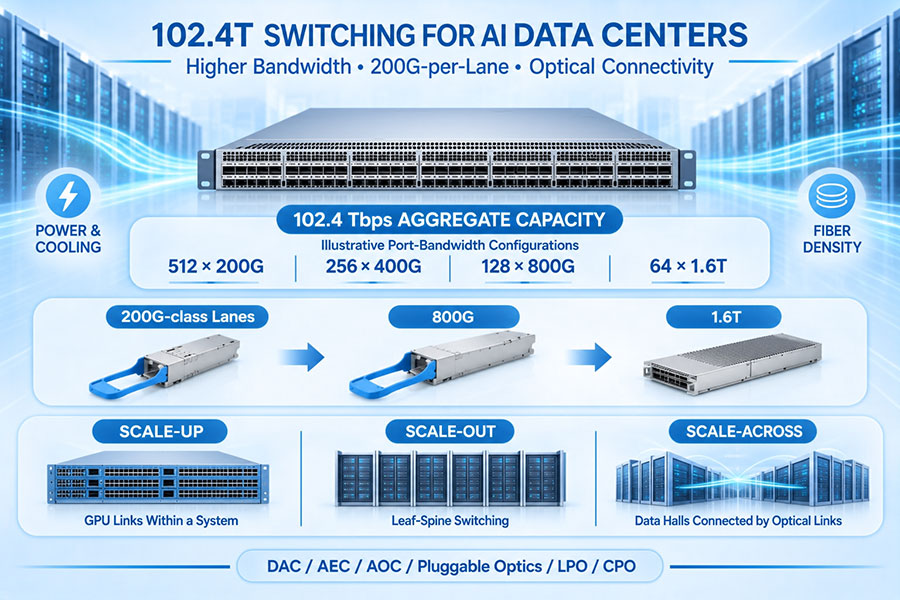
A 1.6T optical transceiver provides a nominal aggregate data rate of 1.6 Tb/s, twice the capacity of an 800G interface. This increase allows a supported switch port to carry more traffic without requiring the same proportional increase in port count.
Many 1.6T client optical designs use eight lanes operating at approximately 200 Gb/s per lane, with PAM4 modulation. The electrical interface commonly relies on the 224G-class SerDes generation, while the optical implementation converts the electrical lanes into corresponding optical channels.
| Interface generation | Typical lane architecture | Aggregate bandwidth | Networking significance |
|---|---|---|---|
| 400G | 4 × 100G or 8 × 50G | 400 Gb/s | Established high-speed data center connectivity |
| 800G | 8 × 100G or 4 × 200G | 800 Gb/s | Higher-capacity links for large-scale switching fabrics |
| 1.6T | 8 × 200G | 1,600 Gb/s | Higher bandwidth per port for next-generation network platforms |
These are representative lane-rate arrangements, not a universal description of every product. The actual electrical mapping, optical channel count, modulation, FEC architecture, and breakout support depend on the applicable interface and transceiver design.
Higher port capacity can reduce the number of physical ports needed to provide a given aggregate bandwidth. However, it does not automatically reduce total network complexity. Switch radix, traffic distribution, oversubscription, topology, and endpoint requirements still determine the number and arrangement of links.
3. Why Optical Connectivity Matters in AI Cluster Networks
AI data center networks contain multiple connectivity domains. Some links connect accelerators within a tightly coupled compute system, while others connect servers and racks across the wider network fabric. The appropriate transmission medium depends on distance, bandwidth, system architecture, and the electrical interface available at each endpoint.
Scale-up connectivity
Scale-up networks connect accelerators within a closely coupled computing domain. These connections may use high-speed electrical interconnects, proprietary accelerator fabrics, or emerging optical technologies. Copper remains important for many short-reach scale-up connections, particularly where low latency and direct electrical connectivity are required.
Scale-out connectivity
Scale-out networks connect servers, racks, and switching layers across an AI cluster. Ethernet and InfiniBand are common networking approaches, with optical transceivers used where bandwidth and reach requirements justify fiber connectivity. High-capacity 800G and 1.6T interfaces are relevant to these switching fabrics as supported platforms become available.
Scale-across connectivity
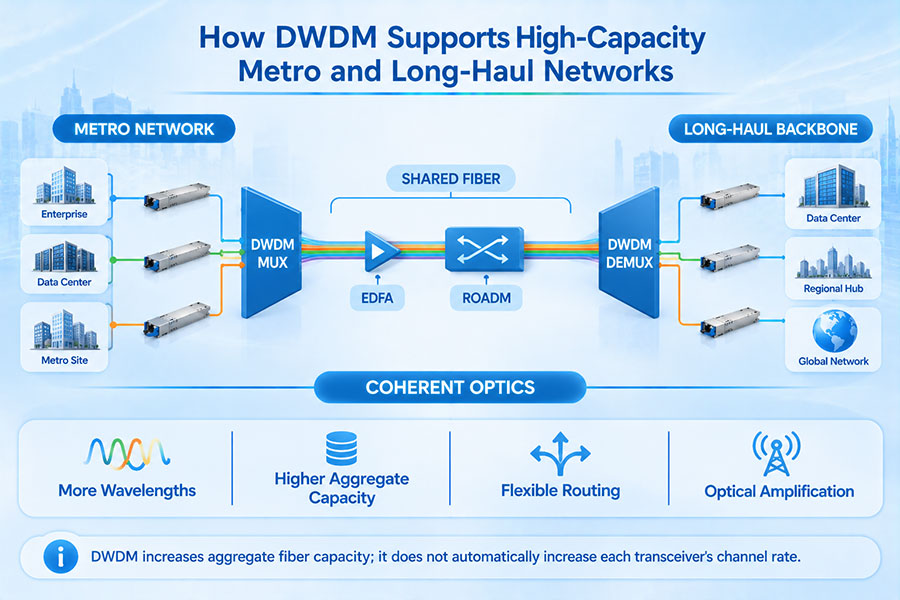
Scale-across networking connects separate data center buildings, campuses, or geographically distributed facilities. These links may use coherent optical technology, DWDM systems, and data center interconnect architectures to provide high capacity over longer distances.
4. Higher Port Bandwidth Supports Larger Switching Fabrics
Switching capacity is a major consideration when building large AI clusters. As network traffic increases, operators need sufficient bandwidth between leaf and spine switches, as well as adequate capacity at each network layer.
Moving from 800G to 1.6T interfaces can increase the bandwidth available per port on compatible switch platforms. This can help network designers build higher-capacity connections between switching layers and support larger aggregate traffic volumes.
The benefit is particularly relevant to leaf-spine and Clos-based architectures. In these designs, multiple paths connect network layers, and the available bandwidth depends on port speed, switch radix, link allocation, and oversubscription.
| Network design factor | Potential contribution of 1.6T interfaces | What still needs evaluation |
|---|---|---|
| Leaf-to-spine bandwidth | Higher capacity per supported uplink | Number of uplinks, oversubscription, and traffic distribution |
| Switch port density | More aggregate bandwidth from each high-speed port | ASIC radix, module form factor, and chassis limitations |
| Network expansion | Additional capacity without proportionally increasing port count | Topology changes, endpoint compatibility, and cabling availability |
| Fabric aggregation | Higher-capacity connections between network tiers | Congestion control, routing, and path utilization |
A faster optical interface does not independently eliminate network congestion. Effective AI networking still requires appropriate routing, load balancing, congestion management, and sufficient end-to-end capacity.
5. 1.6T Optical Transceivers and Fiber Infrastructure
Higher-speed optical links must be supported by a suitable physical fiber infrastructure. The selected 1.6T optical architecture determines the number of optical channels, fiber strands, connector arrangement, and required transmission distance.
Parallel single-mode designs distribute data across multiple optical lanes and fiber paths. Wavelength-multiplexed designs combine multiple optical channels using different wavelengths, potentially reducing the number of fibers required for a given connection. These approaches have different component, connector, and link-budget requirements.
| Infrastructure element | Role in high-speed AI networking | Deployment consideration |
|---|---|---|
| Single-mode fiber | Supports optical links across rack rows, data halls, and other defined distances | Fiber quality, insertion loss, connector condition, and reach specification |
| MPO/MTP connectivity | Provides multi-fiber connectivity for supported parallel-optics designs | Polarity, fiber mapping, connector gender, and insertion loss |
| Duplex LC connectivity | Used by optical interfaces designed around duplex fiber arrangements | Correct fiber type, Tx/Rx mapping, and connector cleanliness |
| Fiber trunk cables | Organize high-density connections between distribution points and equipment areas | Cable capacity, bend radius, pathway fill, and labeling |
| Patch panels | Provide structured fiber distribution and cross-connect management | Port identification, accessibility, and documentation |
Existing fiber infrastructure may be reusable, but this must be verified against the selected transceiver's optical specification. Fiber type, connector configuration, polarity, channel loss, and distance all affect compatibility.
6. Power Efficiency and Thermal Management
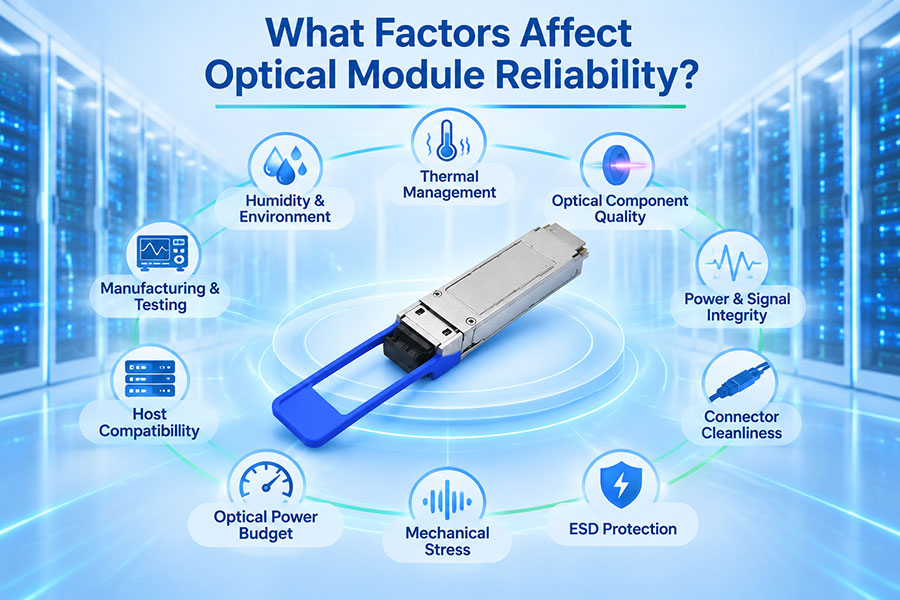
Higher bandwidth per port can improve network capacity density, but the electrical and optical components required to achieve 1.6T introduce demanding power and thermal requirements. High-speed SerDes, DSPs, laser drivers, modulators, photodetectors, and receiver circuits all contribute to module power consumption.
In a densely populated switch, the thermal impact of individual transceivers accumulates across the front panel. Cooling performance therefore becomes an important consideration when evaluating a complete 1.6T switch configuration.
System designers need to consider:
Module power consumption: Evaluate the specified maximum power and operating conditions rather than relying only on typical values.
Airflow and heatsinking: Confirm that the chassis cooling design supports the intended module population.
Operating temperature: Validate module performance across the specified case-temperature range.
Signal processing: Consider the power and latency implications of DSP, retiming, and FEC implementation.
Power per bit: Evaluate total system energy relative to delivered network capacity, not just the transceiver's standalone power.
Removing or changing signal-processing functions may reduce power in some architectures, but it can also change the electrical channel requirements and link-performance margin. Power optimization must be evaluated at the complete system level.
7. 1.6T Optical Technology and Signal Integrity
Most 1.6T client optical architectures use eight 200G-class lanes with PAM4 signaling. PAM4 carries two bits per symbol through four amplitude levels, increasing the amount of information transmitted at a given symbol rate compared with NRZ. The trade-off is a smaller voltage separation between adjacent signal levels, making the interface more sensitive to noise and distortion.
On the host side, 224G-class electrical interfaces must maintain signal quality through the switch ASIC package, PCB traces, connectors, and module contacts. On the optical side, the transmitter and receiver must meet the required modulation, optical power, sensitivity, and error-performance specifications.
FEC is an important part of high-speed link reliability. It adds redundancy to transmitted data so that the receiver can correct certain errors. The exact FEC arrangement and performance requirements depend on the Ethernet PHY and module architecture.
Successful operation therefore depends on more than the nominal data rate. Electrical channel quality, transmitter performance, receiver sensitivity, optical loss, FEC compatibility, and host implementation all need to be considered together.
8. Interoperability and Platform Compatibility
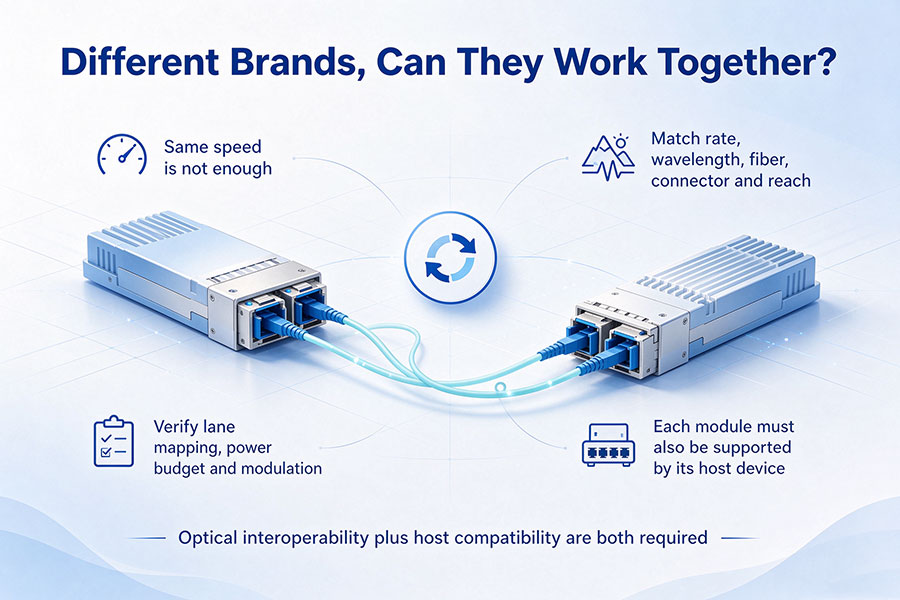
A 1.6T optical transceiver must match the capabilities of the switch or network device in which it is installed. The physical form factor alone does not establish compatibility. OSFP1600 and OSFP-RHS implementations, for example, may have different mechanical and thermal requirements, and support varies by platform.
Before selecting a module, network operators should verify the following:
Host port capability: The switch ASIC and platform must support the intended 1.6T operating mode.
Electrical interface: Confirm lane count, signaling rate, host electrical specifications, and supported FEC behavior.
Optical interface: Match the wavelength arrangement, fiber type, reach, and connector configuration.
Mechanical compatibility: Check module dimensions, heatsink design, cage type, and airflow requirements.
Management support: Verify module identification, monitoring functions, firmware behavior, and platform software support.
Breakout capability: Confirm whether the switch supports the required 2 × 800G, 4 × 400G, or 8 × 200G operating modes.
Compatibility should be validated using the equipment manufacturer's documentation and, where possible, tested in the target platform before large-scale deployment.
9. Where 1.6T Transceivers Fit in the AI Networking Roadmap
The progression from 400G to 800G and then 1.6T reflects the increasing bandwidth requirements of data center switching and AI infrastructure. Each generation brings changes in electrical signaling, optical components, packaging, power consumption, and network architecture.
1.6T is not a universal replacement for 800G. Different network segments have different capacity and reach requirements, and existing 800G platforms will remain relevant wherever they provide sufficient bandwidth. The transition depends on switch availability, module maturity, cost, power efficiency, and the economics of upgrading the complete network.
Meanwhile, research and standards work on higher per-lane rates continues. Future architectures may combine pluggable optics with near-package and co-packaged optical technologies, depending on the requirements for bandwidth density, power, thermal management, and serviceability.
For network planners, the most practical approach is to design a migration path that allows different generations of optical connectivity to coexist while maintaining consistent fiber management, compatibility validation, and network monitoring.
10. Conclusion
1.6T optical transceivers matter for AI networking because they increase the bandwidth available per supported network port and provide another capacity step for large-scale switching fabrics. Their value extends beyond faster optical transmission: they influence switch architecture, port density, fiber infrastructure, power efficiency, signal integrity, and network scalability.
However, higher link speed alone does not guarantee better AI application performance. The complete network must provide sufficient end-to-end bandwidth, appropriate topology, effective congestion management, compatible host platforms, and reliable optical links. As AI clusters continue to evolve, 1.6T connectivity will be an important option for network designs that need higher capacity and density.
For optical connectivity requirements and product-related technical discussions, view the optical transceiver product range or Contact C-LIGHT.
 >

 >
 >
 >
 >
 >
 >
 >